Integrated rate equations
NCERT Class 12 Chemistry Chapter 3 Section 3.3
Quick answer
Integrated rate equations connect reactant concentration with time under a stated kinetic model. At constant volume and rate constant, a zero-order disappearance law gives a linear concentration fall, while a first-order law gives exponential decay with a concentration-independent half-life. Suitable linear plots support these models over the measured range, provided reverse and side reactions are negligible.
With your textbook
NCERT Chemistry Part I (Class 12), Chapter 3 “Chemical Kinetics”, Section 3.3 “Integrated Rate Equations”, pages 71–78.
Open the official NCERT chapter (PDF, 4.0 MB, ncert.nic.in) (opens in a new tab)
Checked against the 2026-27 reprint on .
What are integrated rate equations?
Integrated rate equation
A rate law such as rate = k[R] gives the rate at one instant, and an instantaneous rate is hard to measure: it is the slope of a tangent to the concentration–time curve (NCERT page 71). In NCERT’s words:
In order to avoid this difficulty, we can integrate the differential rate equation to give a relation between directly measured experimental data, i.e., concentrations at different times and rate constant.
NCERT Chemistry Part I (Class 12), Section 3.3, page 71
- Zero order: [R] = [R]0 − kt, and the half-life is [R]0/2k (NCERT pages 71 and 76).
- First order: k = (2.303/t) log([R]0/[R]), and the half-life is 0.693/k whatever the starting concentration (NCERT pages 73 and 76–77).
In plain words: the rate law says how fast a reaction is going right now. The integrated equation says how much reactant is left after any time, which is what you actually measure. For the one-reactant laws below, assume constant volume and temperature, constant k, and negligible reverse/side reactions. A linear plot over a useful conversion range supports the chosen model and yields k; a short nearly straight segment alone does not prove the order. Here k is defined using reactant disappearance, −d[R]/dt, so a stoichiometrically normalised reaction-rate constant may differ.
Differential and integrated rate equations
- The way the rate depends on concentration, such as −d[R]/dt = k[R], is the differential rate equation (NCERT pages 67 and 71). The rate law is written this way.
- To use it directly you need instantaneous rates, read from tangents to the concentration–time curve. That makes the rate law, and so the order, hard to find (NCERT page 71).
- Integrating the differential equation gives the integrated rate equation: a relation between the concentrations measured at different times and the rate constant (NCERT page 71).
- The integrated equations differ from one order to another. NCERT derives them only for zero and first order reactions (NCERT page 71), and the JEE Main and NEET syllabuses ask only for these two.
Zero order reactions
-
In a zero order reaction the rate is proportional to the zeroth power of the reactant concentration, and a nonzero concentration raised to power zero is 1 (NCERT page 71). For R → P:
Rate = −d[R]/dt = k[R]0 = k
-
So d[R] = −k dt. Integrating, [R] = −kt + I, where I is a constant (NCERT Eq. (3.5), page 71). At t = 0, [R] = [R]0, the initial concentration, so I = [R]0, which gives NCERT Eq. (3.6):
Zero order (NCERT Eq. 3.6)
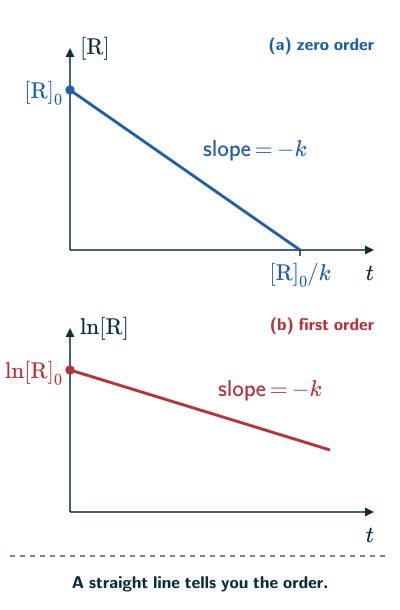
- The graph. Compare it with the slope-intercept form y = mx + c: a plot of [R] against t is a straight line with slope −k and intercept [R]0 (NCERT Fig. 3.3, page 72). The concentration falls by the same amount every second.
- The rate constant. Rearranging, k = ([R]0 − [R])/t (NCERT Eq. (3.7), page 72), in mol L−1 s−1.
- It cannot run for ever. The ideal line reaches [R] = 0 at t = [R]0/k and cannot continue beyond it. Real saturated-surface or enzyme systems usually leave the zero-order regime before exhaustion (reasoned).
In NCERT’s words:
Zero order reactions are relatively uncommon but they occur under special conditions.
NCERT Chemistry Part I (Class 12), Section 3.3.1, page 72
- Examples. Some enzyme-catalysed reactions and some reactions on metal surfaces are zero order (NCERT page 72).
- Ammonia on hot platinum. At high pressure the decomposition 2NH3(g) → N2(g) + 3H2(g), on a platinum catalyst at 1130 K, is zero order: rate = k[NH3]0 = k (NCERT page 72). The metal surface is saturated with gas molecules, so more ammonia in the gas cannot put more on the surface, and the rate does not depend on its concentration (NCERT page 72). The independence applies to ammonia pressure within the saturated regime, not to every reaction condition: temperature, catalyst area and surface condition can still change the rate (reasoned).
- The thermal decomposition of HI on a gold surface is another zero order reaction (NCERT page 72).
First order reactions
-
In a first order reaction the rate is proportional to the first power of the reactant concentration (NCERT page 72). For R → P:
Rate = −d[R]/dt = k[R]
-
So d[R]/[R] = −k dt. Integrating, ln[R] = −kt + I (NCERT Eq. (3.8), page 72). At t = 0, I = ln[R]0, so ln[R] = −kt + ln[R]0 (NCERT Eq. (3.9), page 72), which rearranges to NCERT Eq. (3.10), page 73:
First order (NCERT Eq. 3.10)
- As an exponential. Taking antilogs, [R] = [R]0e−kt (NCERT Eq. (3.14), page 73). The concentration falls by the same fraction in each equal interval of time (reasoned).
- The graph. A plot of ln[R] against t is a straight line with slope −k and intercept ln[R]0 (NCERT page 73, with its Fig. 3.4 on page 74).
- With base-10 logarithms, since ln x = 2.303 log x, NCERT Eq. (3.15), page 73, is:
First order, base 10 (NCERT Eq. 3.15)
- A plot of log([R]0/[R]) against t is then a straight line through the origin with slope k/2.303 (NCERT page 73, with its Fig. 3.5 on page 74).
- Two readings, neither at the start. For concentrations [R]1 and [R]2 at times t1 and t2, k = ln([R]1/[R]2)/(t2 − t1) (NCERT Eqs. (3.11)–(3.13), page 73).
- NCERT slip (page 73): NCERT says Eq. (3.11), ln[R]1 = −kt1 + ln[R]0, comes “from equation (3.8)”; strictly it is Eq. (3.9), which is Eq. (3.8) with I = ln[R]0 put in. The working is unaffected.
- Examples. NCERT gives the hydrogenation of ethene, C2H4(g) + H2(g) → C2H6(g), with rate = k[C2H4] (NCERT page 73). For an isolated unstable nuclear species, radioactive decay is described by first-order kinetics, for example 226Ra → 4He + 222Rn, with rate = k[Ra] (NCERT pages 73–74). The decompositions of N2O5 and N2O can also show first-order kinetics under suitable conditions (NCERT page 74).
- The unit of a first order rate constant is time−1, such as s−1 or min−1, so k does not depend on the concentration unit (NCERT Table 3.4, page 77).
First order gas phase reactions
For a gas, the pressure is followed instead of the concentration: for ideal gases at fixed volume and temperature, a gas’s partial pressure is proportional to its concentration (reasoned). Take A(g) → B(g) + C(g), starting with pure A, with initial pressure pi and total pressure pt at time t (NCERT pages 74–75):
| Time | A(g) | B(g) | C(g) |
|---|---|---|---|
| At t = 0 | pi | 0 | 0 |
| At time t | pi − x | x | x |
- So pt = (pi − x) + x + x = pi + x, which gives x = pt − pi (NCERT page 75).
- The pressure of A left is pA = pi − x = 2pi − pt (NCERT page 75). Put pi and pA in place of [R]0 and [R] in NCERT Eq. (3.15):
Gas phase, A → B + C (NCERT Eq. 3.16, page 75)
- Only for this stoichiometry. The 2pi − pt comes from one gas molecule giving two. For any other reaction, write the pressures at time t from the equation and find pA afresh, as NCERT does for 2N2O5 → 2N2O4 + O2 in Example 2 below (NCERT page 75).
- NCERT slip (pages 75–76): NCERT numbers two different equations (3.16): the gas phase equation on page 75 and [R] = [R]0/2 on page 76. Here (3.16) means the gas phase equation.
Half-life of a reaction
In NCERT’s words:
The half-life of a reaction is the time in which the concentration of a reactant is reduced to one half of its initial concentration.
NCERT Chemistry Part I (Class 12), Section 3.3.3, page 76
It is written t1/2 (NCERT page 76).
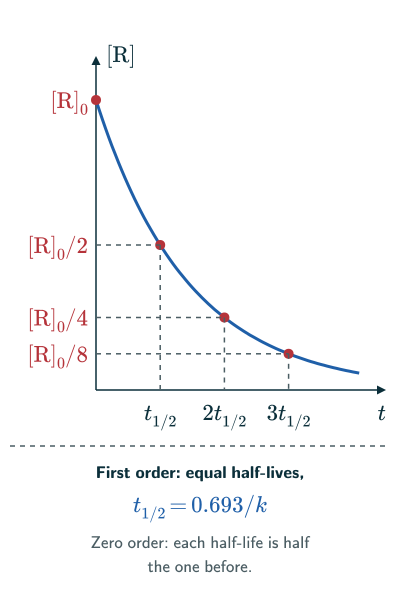
- Zero order. Put [R] = [R]0/2 in NCERT Eq. (3.7): k = ([R]0 − ½[R]0)/t1/2, so t1/2 = [R]0/2k (NCERT page 76). The half-life is directly proportional to the initial concentration and inversely proportional to k (NCERT page 76). Each half-life is half the one before, since it starts from half the concentration (reasoned).
- First order. Put [R] = [R]0/2 in NCERT Eq. (3.15): t1/2 = (2.303/k) log 2 = (2.303 × 0.301)/k (NCERT page 76), which gives NCERT Eq. (3.17):
First order half-life (NCERT Eq. 3.17)
- So the half-life of a first order reaction is constant: it does not depend on the initial concentration, and it can be found from k and vice versa (NCERT page 77). After n half-lives, [R] = [R]0/2n (reasoned).
- Two more graphs that show the order (reasoned from NCERT Table 3.4): t1/2 against [R]0 is a straight line through the origin for zero order and a flat line for first order; rate against [R] is a flat line at height k for zero order and a straight line through the origin, slope k, for first order.
- NCERT slip (page 76): in the step before t1/2 = (2.303/k) log 2, NCERT prints the ratio as [R]0/([R]/2). It should be [R]0/([R]0/2), which equals 2.
- NCERT Table 3.4 (page 77) puts the two orders side by side:
| Feature | Zero order | First order |
|---|---|---|
| Differential rate law | d[R]/dt = −k | d[R]/dt = −k[R] |
| Integrated rate law | kt = [R]0 − [R] | [R] = [R]0e−kt |
| Straight-line plot | [R] against t | ln[R] against t |
| Half-life | [R]0/2k | ln 2/k = 0.693/k |
| Units of k | mol L−1 s−1 | s−1 |
Pseudo first order reactions
The order a reaction shows can change with conditions (NCERT page 78): within a fixed mechanism and medium, a nearly constant reactant concentration can be absorbed into an observed rate constant (reasoned). In NCERT’s words:
There are many reactions which obey first order rate law although they are higher order reactions.
NCERT Chemistry Part I (Class 12), Section 3.3, page 78
- Hydrolysis of ethyl acetate. CH3COOC2H5 + H2O → CH3COOH + C2H5OH, with acid (H+) as catalyst, is treated in NCERT’s simplified model as involving ester and water in the rate law. But water is taken in large excess, so its concentration hardly changes, and the rate depends on the ester alone (NCERT page 78). Its order is then one.
- NCERT’s numbers (page 78). With 0.01 mol of ester and 10 mol of water at the start, complete conversion would leave 0 mol of ester and 9.99 mol of water (a stoichiometric limiting calculation; hydrolysis is reversible), with 0.01 mol each of acetic acid and ethanol. The water changes by only 0.1% (reasoned).
- So rate = k′[CH3COOC2H5][H2O] behaves as rate = k[CH3COOC2H5]: the nearly constant [H2O] is taken into k (reasoned). Such reactions are called pseudo first order reactions (NCERT page 78).
- Inversion of cane sugar is another (NCERT page 78): C12H22O11 + H2O → C6H12O6 (glucose) + C6H12O6 (fructose), in acid, with rate = k[C12H22O11].
Solved examples
Example 1: First order rate constant (NCERT Example 3.5)
The initial concentration of N2O5 in the first order reaction N2O5(g) → 2NO2(g) + ½O2(g) was 1.24 × 10⁻² mol L−1 at 318 K. After 60 minutes it was 0.20 × 10⁻² mol L−1. Find the rate constant at 318 K.
Answer: k = (2.303/60 min) × log(1.24/0.20) = (2.303/60) × log 6.2 = (2.303/60) × 0.7924 = 0.0304 min−1 (NCERT Example 3.5, page 74).
Example 2: From total pressure (NCERT Example 3.6)
For the first order decomposition 2N2O5(g) → 2N2O4(g) + O2(g) at constant volume and temperature, starting with pure N2O5, the total pressure is 0.5 atm at t = 0 and 0.512 atm at 100 s. Find k.
Answer: If N2O5 falls by 2x atm, N2O4 rises by 2x and O2 by x, so pt = 0.5 + x and p(N2O5) = 0.5 − 2x = 1.5 − 2pt (NCERT page 75). At 100 s, p(N2O5) = 1.5 − 1.024 = 0.476 atm. Then k = (2.303/100 s) × log(0.5/0.476) = (2.303/100) × 0.0214 = 4.92 × 10⁻⁴ s−1.
NCERT slip (page 76): NCERT takes log(0.5/0.476) as 0.0216 and prints k = 4.98 × 10⁻⁴ s−1. The logarithm is 0.0214, so k is 4.92 × 10⁻⁴ s−1.
Example 3: Half-life from k (NCERT Example 3.7)
A first order reaction has k = 5.5 × 10⁻¹⁴ s−1. Find its half-life.
Answer: t1/2 = 0.693/(5.5 × 10−14 s−1) = 1.26 × 10¹³ s (NCERT Example 3.7, page 77), about 4 × 10⁵ years (reasoned).
Example 4: 99.9% in ten half-lives (NCERT Example 3.8)
Show that a first order reaction takes about 10 half-lives to go 99.9% to completion.
Answer: At 99.9%, [R] = [R]0 − 0.999[R]0 = 0.001[R]0, so t = (2.303/k) log 103 = 6.909/k. With t1/2 = 0.693/k, t/t1/2 = 6.909/0.693 ≈ 10 (NCERT Example 3.8, page 77; NCERT writes the first [R] as [R]n). More exactly the ratio is 9.97, because 210 = 1024 is a little more than 1000 (reasoned).
Example 5: Time and rate constant (NCERT Intext Questions 3.5–3.6)
(a) A first order reaction has k = 1.15 × 10⁻³ s−1. How long will 5 g of reactant take to fall to 3 g? (b) SO2Cl2 decomposes by first order kinetics to half its initial amount in 60 minutes. Find k.
Answer: (a) With t = (2.303/k) log([R]0/[R]): 2.303/k = 2003 s and log(5/3) = 0.2218, so t = 2003 × 0.2218 = 444 s. (b) k = 0.693/60 min = 0.01155 min−1 = 1.925 × 10⁻⁴ s−1 (NCERT page 78; answers on page 88). The masses of the same species can replace concentrations when the volume is unchanged, because the ratios then agree (reasoned).
Example 6: A zero order half-life
A zero order reaction has k = 0.0050 mol L−1 s−1 and [R]0 = 0.20 mol L−1. Find its half-life, the time to completion, and the half-life if [R]0 is doubled.
Answer: t1/2 = [R]0/2k = 0.20/0.010 = 20 s. If the ideal zero-order law remains valid up to exhaustion, its predicted completion time is [R]0/k = 40 s, twice the first half-life, since the later half-lives shrink (10 s, 5 s, …). Doubling [R]0 doubles the half-life to 40 s (reasoned from NCERT page 76).
Common mistakes to avoid
Common mistake
Mixing ln and log
k = (1/t) ln([R]0/[R]) uses natural logarithms; with log to base 10 the factor 2.303 must go in (NCERT Eqs. (3.10) and (3.15), page 73).
Common mistake
Treating every half-life as constant
Only a first order half-life is independent of the starting concentration. A zero order half-life is proportional to [R]0 (NCERT pages 76–77).
Common mistake
Putting the total pressure in place of the reactant’s pressure
In the gas phase equation the reactant’s pressure is 2pi − pt for A → B + C, not pt (NCERT page 75).
Common mistake
Using the zero order equation after the reactant is gone
[R] = [R]0 − kt goes negative after t = [R]0/k; the model has reached its endpoint; real zero-order regimes may end even earlier (reasoned).
Quick revision summary
- Integrated rate equations relate concentration to time, so k and the order come from measured concentrations (NCERT Section 3.3).
- Zero order: [R] = [R] − kt; [R] against t is a straight line, slope −k; t½ = [R]/2k.
- First order: k = (2.303/t) log([R]/[R]), or [R] = [R] exp(−kt); ln[R] against t is a straight line, slope −k.
- First order half-life: t½ = 0.693/k, independent of [R]; after n half-lives [R]/2 is left.
- Gas phase A → B + C: k = (2.303/t) log[p/(2p − p)].
- Pseudo first order: one reactant in large excess, as in the hydrolysis of ethyl acetate and the inversion of cane sugar.
Formula sheet
- Zero order: [R] = [R] − kt
- Zero order: t½ = [R]/2k
- First order: k = (2.303/t) log([R]/[R])
- First order: [R] = [R] exp(−kt)
- First order: t½ = 0.693/k
- Gas phase: k = (2.303/t) log[p/(2p − p)]
Questions students ask
Why can a zero order reaction never be elementary?
A zero order reaction cannot be elementary because in an elementary reaction the order equals the molecularity, which is at least 1 (NCERT pages 70 and 84): the rate of a single step is proportional to the concentration of each species taking part in it (reasoned). Zero order is the apparent order of a multistep process limited by something already saturated, such as the metal surface in NCERT’s examples (NCERT page 72). Beyond the NCERT text, plentiful ethanol saturates the liver enzyme alcohol dehydrogenase and is oxidised at a constant, zero order rate, and like other enzyme reactions it turns first order when too dilute to keep the enzyme full (Wikipedia, “Rate equation”).
Why does a first order reaction never go to completion?
In theory a first order reaction never reaches completion, because [R] = [R]0e−kt (NCERT Eq. (3.14), page 73) only approaches zero: each half-life removes half of what is left, so after seven half-lives (1/2) = 1/128 of the reactant, under 1%, still remains (reasoned). In practice it counts as complete after about ten half-lives, 99.9%, and the smooth equation stops describing it once only a few molecules are left, since each of them then reacts at a random moment (reasoned).
What is the integrated rate equation for a second order reaction?
Beyond the NCERT text, the integrated rate equation for a second order reaction with −d[R]/dt = k[R]2 is 1/[R] = 1/[R]0 + kt, so a plot of 1/[R] against t is a straight line of slope k, with k in L mol s (Wikipedia, “Rate equation”). Putting [R] = [R]0/2 gives t1/2 = 1/(k[R]0), so each half-life is twice as long as the one before, unlike the constant first order half-life (reasoned). NCERT derives only the zero and first order equations (NCERT page 71), and Unit 8 of the JEE Main and NEET (UG) 2026 syllabuses lists only “differential and integral forms of zero and first-order reactions”.
What is the unit of the rate constant of a pseudo first order reaction?
The observed pseudo-first-order rate constant has units of time, such as s. In the specified model rate = k′[A][B], holding [B] constant gives kobs = k′[B]; then k′ = kobs/[B]. For example, 2.6 × 10 s divided by 55.5 mol L gives 4.7 × 10 L mol s. This division is valid only if that underlying law has been established. Acid-catalysed ester hydrolysis also depends on acid activity and medium, so observing first-order ester decay alone does not establish a universal second-order constant (NCERT page 78; model algebra).
Are pseudo first order and parallel reactions in the JEE Main and NEET syllabus?
Pseudo first order and parallel reactions are not named in the JEE Main syllabus or the NEET (UG) 2026 syllabus: Unit 8, Chemical Kinetics, of each lists “differential and integral forms of zero and first-order reactions, their characteristics and half-lives”. NCERT Class 12 Chemistry Part I still teaches pseudo first order reactions (page 78), which are solved with the first order equations, and names side reactions, such as the nitration of phenol to o-nitrophenol and p-nitrophenol, only as one kind of complex reaction (page 69); side reactions of this kind are parallel reactions (reasoned).
Practice questions
Try each question first, then open the answer to check your working.
-
Q1. Show that the half-life of a first order reaction does not depend on the initial concentration.
Show answerHide answer
Put [R] = [R]0/2 in k = (2.303/t) log([R]0/[R]): t1/2 = (2.303/k) log 2 = 0.693/k. [R]0 has cancelled out (NCERT pages 76–77).
-
Q2. Which plot gives a straight line for (a) a zero order and (b) a first order reaction, and what is the slope?
Show answerHide answer
(a) [R] against t, slope −k. (b) ln[R] against t, slope −k; or log([R]0/[R]) against t, slope k/2.303 (NCERT Figs. 3.3–3.5 and Table 3.4, pages 72–77).
-
Q3. What is a pseudo first order reaction? Give an example.
Show answerHide answer
A reaction of higher order that behaves as first order because one reactant is in such large excess that its concentration hardly changes, such as the acid hydrolysis of ethyl acetate in excess water, or the inversion of cane sugar (NCERT page 78).