Factors influencing the rate of a reaction
NCERT Class 12 Chemistry Chapter 3 Section 3.2
Quick answer
Rate depends on concentration, temperature, catalyst and other reaction conditions. For a power-law rate expression, the overall order is the sum of its concentration exponents and must be established from evidence rather than the overall equation alone. Molecularity counts reacting species in one elementary step; a dominant slow step can explain a simple mechanism’s rate, but overall order need not equal its molecularity.
With your textbook
NCERT Chemistry Part I (Class 12), Chapter 3 “Chemical Kinetics”, Section 3.2 “Factors Influencing Rate of a Reaction”, pages 66–71.
Open the official NCERT chapter (PDF, 4.0 MB, ncert.nic.in) (opens in a new tab)
Checked against the 2026-27 reprint on .
What controls the rate of a reaction?
Rate law, order and molecularity
The rate of a reaction depends on the experimental conditions: the concentrations of the reactants (pressure, for gases), the temperature and any catalyst (NCERT Section 3.2, page 66). How it depends on concentration is written as a rate law. In NCERT’s words:
The representation of rate of reaction in terms of concentration of the reactants is known as rate law.
NCERT Chemistry Part I (Class 12), Section 3.2.1, page 66
- Order: the sum of the powers of the concentrations in the rate law, found by experiment (NCERT page 68).
- Molecularity: the number of reacting species that must collide simultaneously in one elementary reaction; a unimolecular reaction involves one species (NCERT page 69).
In plain words: double the concentration of a reactant and the reaction may go twice as fast, four times as fast, or no faster at all. The rate law records which, and the order counts it up. That cannot be read off the balanced equation, because most reactions happen in several steps, and in a simple mechanism one slow step may set the pace. More complicated mechanisms can share rate control between steps.
Dependence of rate on concentration
- NCERT Table 3.1 (page 64) shows the rate of a reaction falling as time passes and its reactant is used up. Conversely, rates generally rise when reactant concentrations rise (NCERT page 66).
- So the rate at a given temperature depends on the concentration of one or more reactants, and sometimes products (NCERT page 66).
Rate expression and rate constant
- For aA + bB → cC + dD, the rate is found to be proportional to [A]x[B]y, where x and y may or may not equal a and b (NCERT Eqs. (3.4)–(3.4a), page 67):
Rate law (NCERT Eq. 3.4a)
- k is the rate constant. Written as −d[R]/dt = k[A]x[B]y, it is the differential rate equation (NCERT Eq. (3.4b), page 67). Here [R] is a reactant; with coefficients the rate is −(1/a) d[A]/dt, and k goes with whichever rate is used (reasoned).
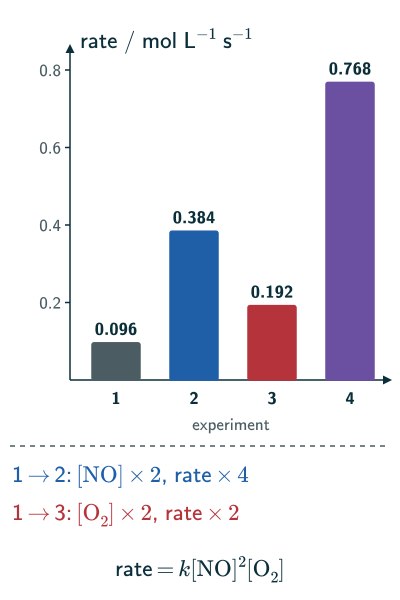
- Finding the rate law from initial rates. For 2NO(g) + O2(g) → 2NO2(g), NCERT Table 3.2 (page 67) gives initial rates for four mixtures. Doubling [NO] with [O2] fixed multiplies the rate by four, from 0.096 to 0.384 mol L−1 s−1; doubling [O2] with [NO] fixed doubles it. So rate = k[NO]2[O2] (NCERT page 67).
- Here the exponents happen to equal the coefficients, but often they do not: CHCl3 + Cl2 → CCl4 + HCl has rate = k[CHCl3][Cl2]1/2 (NCERT page 68). In NCERT’s words:
Rate law for any reaction cannot be predicted by merely looking at the balanced chemical equation, i.e., theoretically but must be determined experimentally.
NCERT Chemistry Part I (Class 12), Section 3.2.2, page 68
Strictly, the restriction is on using the overall equation alone: a rate law can be predicted from an independently supported mechanism, and experiment tests whether that model applies; not every rate law is a simple product of powers (reasoned). In an exam, give NCERT’s statement: the rate law must be determined experimentally.
-
Apparent order in excess water. NCERT page 68 writes the ester hydrolysis as rate = k[CH3COOC2H5]1[H2O]0; page 78 explains the pseudo-first-order treatment: the reaction is really second order but behaves as first order because water is in large excess. In an exam, call it a pseudo first order reaction (NCERT page 78). In the textbook model, rate = k′[ester][water] reduces to kobs[ester]; strictly, the observed law alone does not prove the order in water (reasoned).
-
This is where a rate law differs from an equilibrium constant, whose powers are the coefficients of the balanced equation (reasoned).
Order of a reaction
- In rate = k[A]x[B]y, x and y show how sensitive the rate is to [A] and [B]. They are the orders with respect to A and B, and x + y is the overall order (NCERT page 68).
- The order can be 0, 1, 2, 3 and even a fraction (NCERT page 68); a negative exponent can also occur, as in NCERT Example 3.3. A zero order reaction has a rate independent of the concentration of the reactants (NCERT page 68). Strictly, the zero order law holds only over a limited range, and an overall order of zero is not enough: rate = k[A]/[B] has powers summing to zero but depends on both concentrations (reasoned).
- Order is an experimental quantity (NCERT page 70).
Elementary and complex reactions
- A balanced equation rarely shows how a reaction really takes place, since few reactions happen in one step (NCERT page 68).
- NCERT slip (page 68): NCERT says a balanced equation “never” gives a true picture of how a reaction occurs. For an elementary reaction, which takes place in one step (NCERT page 68), the equation is the mechanism. In an exam, say the mechanism cannot be found from the overall equation alone.
- Reactions that take place in one step are elementary reactions. When a sequence of elementary reactions, the mechanism, gives the products, the reaction is complex (NCERT page 68).
- Complex reactions may be consecutive (the oxidation of ethane to CO2 and H2O passes through a series of intermediate steps in which alcohol, aldehyde and acid are formed), reverse reactions, or side reactions (nitration of phenol gives both o-nitrophenol and p-nitrophenol) (NCERT page 69). The ethane sequence is schematic, not a complete combustion mechanism (reasoned).
Units of rate constant
From rate = k[A]x[B]y with x + y = n, k = rate/(concentration)n, so its units are (mol L−1)1−n s−1 (NCERT page 69, NCERT Table 3.3):
| Order n | Units of k |
|---|---|
| 0 | mol L−1 s−1 |
| 1 | s−1 |
| 2 | L mol−1 s−1 |
| 3 | L2 mol−2 s−1 |
The first three rows are NCERT Table 3.3; the third-order row follows from the same rule (reasoned). So the units of k reveal the order, as in NCERT Example 3.4.
Molecularity of a reaction
The number of reacting species (atoms, ions or molecules) taking part in an elementary reaction, which must collide simultaneously in order to bring about a chemical reaction is called molecularity of a reaction.
NCERT Chemistry Part I (Class 12), Section 3.2.4, page 69
- Unimolecular: one reacting species undergoes an elementary change, symbolically A → products. NCERT lists NH4NO2 → N2 + 2H2O as an illustration (pages 69–70), but counting one formula unit in that overall equation does not establish an elementary unimolecular mechanism (reasoned).
- Bimolecular: two reacting species participate in an elementary step, A + B → products. NCERT illustrates this with 2HI → H2 + I2 (page 70); a real mechanism must be established under specified conditions, rather than assumed from its equation (reasoned).
- Termolecular: three reacting species participate in one elementary event. NCERT labels 2NO + O2 → 2NO2 this way (page 70), but its third-order law does not prove a three-body elementary mechanism: a fast dimerisation equilibrium followed by a bimolecular step can give the same law (reasoned). In an exam, give NCERT’s examples: NH4NO2 decomposition (unimolecular), dissociation of HI (bimolecular), 2NO + O2 (termolecular) (NCERT pages 69–70).
- Three molecules rarely collide at the same moment, and more than three almost never, so reactions of molecularity three “are very rare and slow to proceed” (NCERT page 70). So “complex reactions involving more than three molecules in the stoichiometric equation must take place in more than one step” (NCERT page 70). Strictly, how fast a termolecular step goes still depends on conditions, and large coefficients alone do not fix a molecularity: even multiplying an elementary equation by two changes its written coefficients (reasoned).
Rate determining step
- KClO3 + 6FeSO4 + 3H2SO4 → KCl + 3Fe2(SO4)3 + 3H2O “apparently seems to be of tenth order” but “is actually a second order reaction”, so it takes place in several steps (NCERT page 70). Strictly, in solution the salts are present as ions, so neither ten molecules nor tenth order can be read from the molecular equation (reasoned).
- In NCERT’s words, the “overall rate of the reaction is controlled by the slowest step in a reaction called the rate determining step” (page 70); give that in an exam. Strictly, this bottleneck approximation needs justification, and no single step necessarily controls every complex mechanism (reasoned).
- Example. Iodide ions catalyse the decomposition of hydrogen peroxide in alkaline solution, 2H2O2 → 2H2O + O2. The rate is −d[H2O2]/dt = k[H2O2][I−], first order in each, and the evidence suggests two bimolecular steps (NCERT page 70):
- (1) H2O2 + I− → H2O + IO− (slow, rate determining)
- (2) H2O2 + IO− → H2O + I− + O2
- IO− is an intermediate: it forms during the reaction but is not in the overall equation. The rate of its formation, in the slow step, sets the rate of the reaction (NCERT page 70). If the elementary slow-step constant is k1 and the intermediate does not accumulate, O2 forms at k1[H2O2][I−] while peroxide disappears twice as fast. Thus the disappearance constant k above equals 2k1. I− is used in step 1 and given back in step 2, so it is a catalyst (reasoned). A catalyst can appear in the rate law, as I− does (reasoned).
Order and molecularity compared
NCERT’s conclusions (pages 70–71):
| Order | Molecularity |
|---|---|
| found by experiment | from the mechanism |
| can be 0 or a fraction | a positive integer, usually 1 or 2 and rarely 3 |
| for elementary and complex reactions | for elementary steps only |
- NCERT slip (page 71): NCERT’s conclusion (iii) says the molecularity of the slowest step equals the overall order. This holds when the slow step comes first, as for H2O2 and I−, and no reactant is in large excess (reasoned from NCERT page 78). If a fast equilibrium comes first, the rate law can contain species outside the slow step, even a product with a negative power (Wikipedia, “Rate-determining step”). In an exam, write the rate law from the slow step, then replace any intermediate using the equilibrium constant (extras Q11).
Solved examples
Example 1: Overall order (NCERT Example 3.3)
Find the overall order of reactions with (a) rate = k[A]1/2[B]3/2 and (b) rate = k[A]3/2[B]−1.
Answer: (a) 1/2 + 3/2 = 2, second order. (b) 3/2 + (−1) = 1/2, half order (NCERT Example 3.3, page 68).
Example 2: Order from the units of k (NCERT Example 3.4)
Identify the order from (i) k = 2.3 × 10⁻⁵ L mol−1 s−1 and (ii) k = 3 × 10⁻⁴ s−1.
Answer: (i) L mol−1 s−1 is the unit of a second order rate constant. (ii) s−1 is the unit of a first order rate constant (NCERT Example 3.4, page 69).
Example 3: Rate constant from initial rates
Use NCERT Table 3.2, which gives the rate of formation of NO2, to find k for 2NO + O2 → 2NO2, and check it on all four experiments.
Answer: From experiment 1, k = 0.096/(0.302 × 0.30) = 0.096/0.027 = 3.56 L2 mol−2 s−1. Experiments 2, 3 and 4 give 0.384/0.108, 0.192/0.054 and 0.768/0.216, each 3.56 (data from NCERT Table 3.2, page 67). This k goes with the rate of formation of NO2. The rate of the reaction is half that, so its k is 1.78 L2 mol−2 s−1 (reasoned).
Example 4: Fractional and tripled (NCERT Intext Questions 3.3–3.4)
(a) For A + B → product, rate = k[A]1/2[B]2. What is the order? (b) X → Y is second order. How does the rate change if [X] is tripled?
Answer: (a) 1/2 + 2 = 5/2. (b) Rate ∝ [X]2, so it becomes 32 = 9 times as fast (NCERT page 68).
Example 5: Order and stoichiometry
Beyond the NCERT text: in the regime where NO2 + CO → NO + CO2 has the measured law rate = k[NO2]2 (Wikipedia, “Rate-determining step”). What is the order with respect to each reactant, and what does this show?
Answer: Second order in NO2 and zero order in CO, though each has coefficient 1. The rate law cannot be read from the equation (NCERT page 68); a multistep mechanism can explain this law. It fits a slow step, 2NO2 → NO3 + NO, then a fast one, NO3 + CO → NO2 + CO2 (Wikipedia, “Rate-determining step”).
Common mistakes to avoid
Common mistake
Taking the order from the balanced equation
The exponents in a rate law are found by experiment and often differ from the coefficients (NCERT page 68).
Common mistake
Calling order and molecularity the same thing
Order can be zero or a fraction and applies to any reaction; molecularity is a whole number for an elementary step (NCERT page 70).
Common mistake
Writing the units of k as mol L s for every order
Those are the units of rate, and of k only for a zero order reaction; first order k is in s−1 (NCERT Table 3.3, page 69).
Quick revision summary
- Rate depends on concentration (pressure for gases), temperature and catalyst.
- Rate law: rate = k[A]x[B]y, found by experiment; order n = x + y, which can be 0 or a fraction, and an exponent can even be negative (NCERT Example 3.3).
- Units of k: (mol L−1)1−n s−1; zero order mol L−1 s−1, first s−1, second L mol−1 s−1, third L2 mol−2 s−1.
- Molecularity: number of reacting species in one elementary step, usually 1, 2 or (rarely) 3.
- The slowest step is the rate determining step (NCERT page 70); intermediates form and are used up within the mechanism.
Formula sheet
- Rate = k[A][B]; order = x + y
- Units of k: (mol L) s
- Zero order: mol L s; first: s; second: L mol s; third: L mol s
- 2NO + O → 2NO: rate = k[NO][O]
Questions students ask
What is the difference between the rate of a reaction and the rate constant?
The rate of a reaction is how fast concentrations change, in mol L s, and it usually falls as the reactants are used up, while the rate constant k is the proportionality constant in the rate law, constant within the stated rate law at fixed temperature, medium and catalyst conditions (NCERT pages 63 and 67). Putting every concentration equal to 1 mol L in rate = k[A]x[B]y shows that k is numerically the rate at unit concentrations, but its units depend on the order (reasoned). Heating usually raises k for positive activation energy; a catalyst changes the mechanism and its effective rate constant.
Is a rate law the same as a rate equation or a rate expression?
Yes, a rate law, a rate equation and a rate expression are three names for the same thing in NCERT: the rate written in terms of the molar concentrations of the reactants, each raised to a power found by experiment, which may differ from its coefficient (NCERT pages 66–67). It is not the same as an integrated rate equation, the rate law integrated over time to give the concentration left at any time (NCERT page 71). How a rate law differs from the law of mass action is answered on the equilibrium constant page.
Why can the order of a reaction be zero, fractional or negative?
Order describes measured concentration dependence, not a fractional number of colliding molecules. Radical steady-state or pre-equilibrium models can give half powers; saturation can give apparent zero order, and inhibition can give negative powers. For rate = k[O3]2/[O2], the overall order is indeed one, while the order in ozone is two. With oxygen held constant, ozone therefore follows a pseudo-second-order decay, not a first-order decay (NCERT page 68; Wikipedia, “Rate equation”; algebra).
How do you find the order of a reaction from experimental data?
The order of a reaction is found only from experiment (NCERT page 68): in the initial rate method one concentration is changed at a time, and if doubling it multiplies the rate by 2n, the order in it is n (NCERT Table 3.2, page 67). In the integral method, measured concentrations are put into each integrated rate equation, and the one giving a constant k shows the order (reasoned). Beyond the NCERT text, Ostwald’s isolation method floods the mixture with every other reactant, so that the order in the one left is found alone, as in a pseudo first order reaction (Wikipedia, “Rate equation”).
Does surface area affect the rate of a reaction?
Beyond the NCERT text, the surface area of a solid reactant or catalyst does affect the rate of a reaction, though NCERT’s list of factors (page 62) and Unit 8 of the JEE Main and NEET (UG) 2026 syllabuses name only concentration, temperature, pressure and catalyst. A solid reacts only where its surface meets the other reactant, so the same mass ground to a fine powder, with far more surface, reacts faster (Wikipedia, “Chemical kinetics”). A fine combustible dust spread through air can even explode: three such explosions in US industrial plants in 2003 killed 14 people (US Chemical Safety Board, “Combustible Dust Hazard Investigation”).
Practice questions
Try each question first, then open the answer to check your working.
-
Q1. Define the order of a reaction and the molecularity of a reaction.
Show answerHide answer
Order: the sum of the powers of the concentrations of the reactants in the rate law. Molecularity: the number of reacting species (atoms, ions or molecules) taking part in an elementary reaction, which must collide simultaneously to bring it about (NCERT pages 68–69).
-
Q2. Why does the reaction of KClO3 with FeSO4 and H2SO4 not take place in one step?
Show answerHide answer
Ten molecules would have to collide at once, and even three colliding together is rare, so a reaction with more than three molecules in its equation must take place in several steps; its kinetics are second order, not tenth (NCERT page 70). Strictly, the dissolved salts are present as ions (reasoned).
-
Q3. In the iodide-catalysed decomposition of H2O2, what is the intermediate, and which step is rate determining?
Show answerHide answer
IO− is the intermediate, and the first, slow step, H2O2 + I− → H2O + IO−, is rate determining (NCERT page 70).