Collision theory of chemical reactions
NCERT Class 12 Chemistry Chapter 3 Section 3.5
Quick answer
Simple collision theory models bimolecular gas reactions as encounters requiring suitable energy and orientation. Multiplying the collision count by a steric factor and an energy factor estimates successful events; divide by Avogadro’s constant for a molar rate. The rate constant instead uses a collision coefficient normalised by reactant concentrations, so collision count, reaction rate and rate constant have different units.
With your textbook
NCERT Chemistry Part I (Class 12), Chapter 3 “Chemical Kinetics”, Section 3.5 “Collision Theory of Chemical Reactions”, pages 82–84.
Open the official NCERT chapter (PDF, 4.0 MB, ncert.nic.in) (opens in a new tab)
Checked against the 2026-27 reprint on .
What is collision theory?
Collision theory
Collision theory explains reaction rates with the kinetic theory of gases. It was developed by Max Trautz and William Lewis in 1916–18. It treats reactant molecules as hard spheres and supposes that a reaction occurs when they collide (NCERT pages 82–83). In NCERT’s words:
The number of collisions per second per unit volume of the reaction mixture is known as collision frequency (Z).
NCERT Chemistry Part I (Class 12), Section 3.5, page 83
- An effective collision is one in which the molecules collide with enough kinetic energy, the threshold energy, and with the proper orientation, so that old bonds can break and new bonds form (NCERT page 83).
- For a bimolecular elementary reaction A + B → products, Rate = PZABe−Ea/RT: the collision frequency, times the fraction of molecules with enough energy, times the steric factor P for orientation (NCERT page 83).
In plain words: molecules must meet before they can react, but most meetings are glancing blows. Some are too gentle; in others the wrong ends touch. Only a collision that is hard enough and lined up correctly breaks the old bonds and makes new ones. Collision theory counts all the collisions, then keeps only the effective ones.
Collision frequency
- The model. Collision theory is based on the kinetic theory of gases: the reactant molecules are taken as hard spheres, and a reaction is supposed to occur when they collide. NCERT says it gives a greater insight into the energetic and mechanistic aspects of reactions than the Arrhenius equation (NCERT pages 82–83).
- The number of collisions per second per unit volume is the collision frequency, Z. For collisions between molecules of A and B it is written ZAB (NCERT page 83).
- Energy. Activation energy also affects the rate. For a bimolecular elementary reaction, A + B → products, NCERT writes the rate as (NCERT Eq. (3.23), page 83):
Rate from collisions (NCERT Eq. 3.23)
- Here e−Ea/RT “represents the fraction of molecules with energies equal to or greater than Ea” (NCERT page 83); give that in an exam. Strictly, it is the simplified collision-model energy factor, not the exact fraction of individual molecules above a total translational-energy threshold (reasoned).
- Link to Arrhenius. Comparing NCERT Eq. (3.23) with k = Ae−Ea/RT shows that A, the pre-exponential factor, is related to the collision frequency (NCERT page 83).
- How large is Z? In air at ordinary conditions, each molecule collides a few billion times every second (NCERT Class 11 Physics, Chapter 12; see the mean free path estimate). With about 2.7 × 1025 molecules in a cubic metre, and two molecules in every collision, Z is about 3 × 1034 collisions m−3 s−1, the size used in Example 1 (reasoned). If every collision between reactant molecules gave products, a gas reaction would be over in about a billionth of a second. Many ordinary reactions take seconds to days, implying a small effective share in those cases; some barrierless reactions occur on essentially every suitable encounter (reasoned).
- Concentration. A molecule of A meets molecules of B at a rate proportional to the number of B molecules per unit volume, and the more A molecules there are, the more such meetings. So ZAB is proportional to [A][B], and so is the rate: a bimolecular elementary reaction is second order (reasoned; NCERT page 84: molecularity and order of an elementary reaction are the same).
- Temperature. At fixed concentrations, Z rises only as √T, with the molecular speed, but the fraction e−Ea/RT rises steeply. So nearly all of the effect of heating comes from the larger share of molecules beyond Ea on the Maxwell–Boltzmann curve (reasoned from NCERT Class 11 Physics, Chapter 12).
Effective collisions and threshold energy
- NCERT Eq. (3.23) predicts rate constants fairly accurately for reactions of atoms or simple molecules, but for complex molecules there are significant deviations. The reason could be that not all collisions lead to products (NCERT page 83).
- Effective collisions are those in which the molecules collide with sufficient kinetic energy, called the threshold energy, and proper orientation, so that the bonds of the reacting species break and new bonds form to give products (NCERT page 83). Other encounters may redistribute energy or orientation without giving the specified products (reasoned).
- Threshold energy. NCERT defines it in a footnote: threshold energy = activation energy + energy possessed by the reacting species (NCERT page 83).
- On the energy profile, the threshold energy is the level at the top of the barrier, where the activated complex sits, and Ea is the height of the barrier above the reactants. So Ea = threshold energy − energy of the reactants (reasoned from NCERT Fig. 3.7, page 79, and the footnote on page 83). The absolute level depends on the chosen energy zero; it is not a claim that this level equals the incoming relative kinetic energy (reasoned).
- A catalyst lowers the top of the barrier, so it lowers both the threshold energy and Ea; the energy of the reactants does not change (reasoned from NCERT Fig. 3.11, page 82). Within this fixed elementary barrier model, heating changes neither level: it raises the share of collisions that reach the threshold (reasoned).
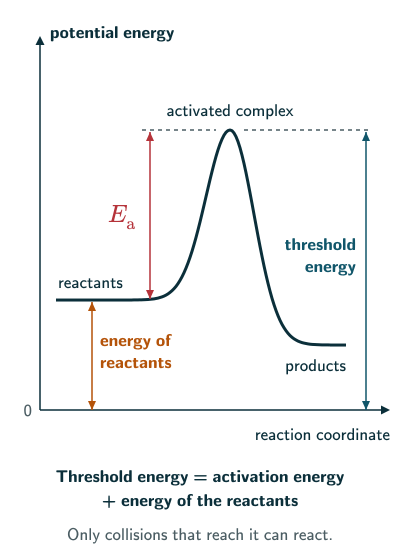
In NCERT’s words:
Thus, in collision theory activation energy and proper orientation of the molecules together determine the criteria for an effective collision and hence the rate of a chemical reaction.
NCERT Chemistry Part I (Class 12), Section 3.5, page 83
Orientation of colliding molecules
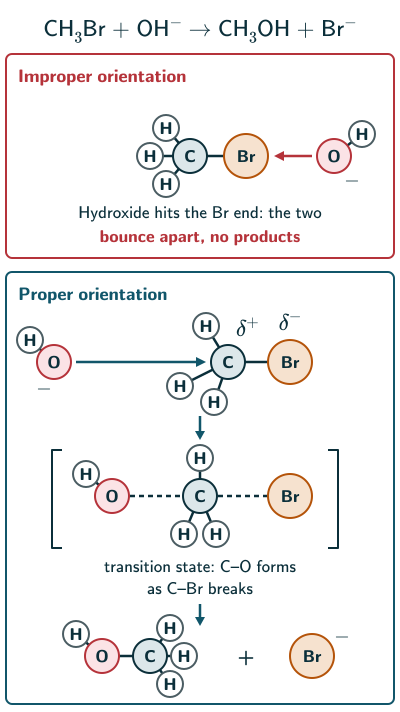
- NCERT’s example is the formation of methanol from bromomethane and hydroxide ion: CH3Br + OH− → CH3OH + Br− (NCERT Fig. 3.12, page 83). Whether a collision gives products depends on how the molecules meet. In NCERT’s words:
The proper orientation of reactant molecules lead to bond formation whereas improper orientation makes them simply bounce back and no products are formed.
NCERT Chemistry Part I (Class 12), Section 3.5, page 83
- Improper orientation. The OH− ion strikes the bromine end of CH3Br. No bond forms, and the two bounce apart (NCERT Fig. 3.12).
- Proper orientation. The OH− ion strikes the carbon atom, which carries a small positive charge (δ+), from the side away from bromine. The C–O bond forms as the C–Br bond breaks, through a short-lived species in which carbon is partly bonded to both O and Br. Then CH3OH and Br− separate (NCERT Fig. 3.12). The OH− ion acts here as a nucleophile, an electron-pair donor (NCERT Class 11 Chemistry, Unit 8).
- NCERT slip (page 83): the text says “formation of methanol from bromoethane”, but the equation in NCERT Figure 3.12 starts from CH3Br, which is bromomethane (methyl bromide). Bromoethane is C2H5Br and would give ethanol. In an exam, write bromomethane.
- NCERT slip (page 83): NCERT Figure 3.12 labels the bracketed species an intermediate. NCERT’s own chapter on this reaction type says that it happens in a single step and no intermediate is formed: the species is the transition state, which is unstable and cannot be isolated (NCERT Chemistry Part II (Class 12), Unit 6, pages 171–172). It is the activated complex of NCERT page 79, which this chapter also loosely calls an unstable intermediate. In a question on mechanisms, call it the transition state.
- Steric factor. To account for effective collisions, NCERT introduces another factor, P, called the probability or steric factor. It takes into account the fact that in a collision the molecules must be properly oriented (NCERT page 83):
With the steric factor (NCERT page 83)
- P is close to 1 when orientation hardly matters, as for atoms and simple molecules. It is much smaller than 1 for complex molecules, where only a small part of each molecule can react (reasoned from NCERT page 83).
- Rate or k? Keep the units explicit. If ZAB counts collisions per volume per second, the displayed formula gives successful events per volume per second. Divide by Avogadro’s constant to obtain a molar rate, and convert the volume unit if needed. Define a separate collision coefficient zAB = ZAB/(NA[A][B]), with consistent volume units. Then k = PzABe−Ea/RT and A ≈ PzAB, in L mol−1 s−1 for molar concentrations. NCERT uses Z for both conventions (pages 83–84); inspect units rather than equating a count rate with a rate constant. The √T dependence of z also makes constant A an approximation (reasoned). In an exam, write NCERT’s k = PZABe−Ea/RT (page 84) unless the question defines a molar collision coefficient.
Limits of collision theory
- Collision theory has drawbacks: it treats atoms and molecules as hard spheres and ignores their structure (NCERT page 83). Other theories are studied in higher classes (NCERT page 83).
- It cannot predict P. The steric factor is found by comparing the measured A with the collision frequency (reasoned; see Example 2).
Solved examples
Example 1: How many collisions react?
For a bimolecular gas reaction at 600 K, ZAB = 4.0 × 1034 collisions m−3 s−1, Ea = 120 kJ mol−1 and P = 0.02. Find the fraction of collisions with enough energy, and the rate in mol L−1 s−1.
Answer: Ea/RT = 120 000/(8.314 × 600) = 24.056, so the fraction is e−24.056 = 3.57 × 10⁻¹¹. With P = 1 the rate would be 4.0 × 1034 × 3.57 × 10−11 = 1.43 × 1024 m−3 s−1. With P = 0.02 it is 2.856 × 10²² m−3 s−1. Dividing by 6.022 × 10²³ mol−1 gives 0.0474 mol m−3 s−1, and 1 m3 = 1000 L, so the rate is 4.74 × 10⁻⁵ mol L−1 s−1 (reasoned from NCERT page 83). Only about 7 collisions in every 1013 give products.
Example 2: Finding the steric factor
For a gas reaction, collision theory with P = 1 gives a pre-exponential factor of 3.0 × 10¹¹ L mol−1 s−1. The measured Arrhenius A is 1.5 × 10⁸ L mol−1 s−1. Find P.
Answer: Using the molar collision coefficient, A ≈ PzAB, so P = 1.5 × 10⁸/(3.0 × 1011) = 5.0 × 10⁻⁴. Only about 1 in 2000 collisions with enough energy is lined up well enough to react, a small reactive-orientation fraction within this simplified model, not a proof of molecular complexity (reasoned from NCERT pages 83–84).
Example 3: Threshold energy and activation energy
On an energy profile the reactants lie at 35 kJ mol−1 and the threshold energy is 110 kJ mol−1. Find Ea. A catalyst lowers the threshold energy to 80 kJ mol−1; find the new Ea.
Answer: Ea = threshold energy − energy of the reactants = 110 − 35 = 75 kJ mol−1. The catalyst does not change the reactants’ energy, so the new Ea = 80 − 35 = 45 kJ mol−1 (reasoned from the NCERT footnote, page 83).
Example 4: Changing the concentrations
For the elementary reaction A + B → products in the gas phase, [A] is doubled and [B] is tripled at constant temperature. By what factor does the rate change?
Answer: ZAB is proportional to [A][B], so it rises 2 × 3 = 6 times. At the same temperature the energy factor e−Ea/RT and the steric factor P do not change, so the rate rises 6 times (reasoned from NCERT page 83).
Common mistakes to avoid
Common mistake
Taking the threshold energy as the activation energy
The threshold energy is the activation energy plus the energy the reactants already have (NCERT footnote, page 83). Ea is only the extra energy needed to reach the threshold.
Common mistake
Counting every energetic collision as effective
Enough energy is not enough: the molecules must also be properly oriented. That is why the steric factor P appears in the rate (NCERT page 83).
Common mistake
Saying heating works mainly through more collisions
At fixed concentrations the collision frequency grows only as √T (reasoned from NCERT Class 11 Physics, Chapter 12). Within the fixed-barrier model, heating leaves those levels unchanged; it speeds up a reaction mainly because a larger fraction of collisions reaches the threshold. A catalyst, by contrast, lowers the threshold (reasoned from NCERT Eq. (3.23) and Fig. 3.11).
Quick revision summary
- Collision theory: molecules are hard spheres that react only when they collide; Z is the number of collisions per second per unit volume.
- Without the orientation condition: Rate = ZAB exp(−Ea/RT), where exp(−Ea/RT) is the fraction of molecules with energy of at least Ea (NCERT; strictly a model energy factor).
- Effective collisions need at least the threshold energy and the proper orientation; the steric factor gives Rate = P ZAB exp(−Ea/RT).
- Use ZAB for collision events per volume per second and zAB for the molar collision coefficient. Then k = PzAB exp(−Ea/RT) and A ≈ PzAB.
- Threshold energy = Ea + energy of the reactants. Collision theory ignores molecular structure.
Formula sheet
- Rate = ZAB exp(−Ea/RT)
- Rate = P ZAB exp(−Ea/RT)
- k = P zAB exp(−Ea/RT), so A ≈ P zAB (NCERT writes P ZAB)
- Threshold energy = Ea + energy of the reactants
- Fraction with E ≥ Ea (NCERT) = exp(−Ea/RT)
Questions students ask
Is collision theory in the JEE Main and NEET syllabus?
Collision theory is in both syllabuses: Unit 8, Chemical Kinetics, of the JEE Main syllabus ends with “collision theory of bi-molecular gaseous reactions (no derivation)”, and the NEET (UG) 2026 syllabus has the same words, spelling it “bimolecular”. “No derivation” leaves out the working that gives the collision frequency from the sizes and speeds of the molecules; what remains is NCERT Section 3.5 (pages 82–84): rate = PZABe−Ea/RT, threshold energy, orientation and effective collisions (reasoned). Neither syllabus names the steric factor P, which NCERT introduces on page 83.
What is the difference between collision theory and transition state theory?
Collision theory counts reactive encounters between simplified hard spheres (NCERT page 83). Beyond the NCERT text, transition-state theory instead treats reactants and activated-complex configurations as being in a quasi-equilibrium and estimates passage across a dividing surface (Wikipedia, “Transition state theory”). Its activation free energy includes energetic and entropic effects (same article), including orientational restrictions (reasoned). Both are models with assumptions; the transition state is not an isolable intermediate (NCERT Class 12 Chemistry Part II, page 172: such structures “are unstable and cannot be isolated”).
Does the steric factor have a unit, and can it be greater than 1?
The steric factor P has no unit: it is the ratio of the measured Arrhenius factor A to the molar collision coefficient zAB, which have the same unit (reasoned from NCERT pages 83–84). Beyond the NCERT text, measured values are usually below 1, such as 1.7 × 10 for H2 + C2H4 → C2H6, where H2 must approach the C=C bond (Wikipedia, “Collision theory”). Though NCERT calls P a probability, it can exceed 1: for K + Br2 → KBr + Br, a harpoon reaction, in which the K atom hands Br2 an electron, the measured A is nearly five times the hard-sphere collision coefficient (Wikipedia, “Collision theory” and “Steric factor”).
Is the steric factor the same as steric hindrance or the steric number?
The steric factor P of collision theory is not the same as steric hindrance or the steric number: P allows for the orientation that colliding molecules need (NCERT page 83), steric hindrance is crowding by bulky groups that blocks an approach, and the steric number, the sigma-bonded neighbours plus lone pairs round a central atom, gives its hybridisation. The first two meet in NCERT’s example: OH− must reach the carbon of CH3Br from the side away from bromine, and bulky groups round that carbon hinder it, so SN2 reactivity falls from primary to tertiary halides (NCERT Class 12 Chemistry Part II, pages 172–173).
Practice questions
Try each question first, then open the answer to check your working.
-
Q1. What is collision frequency? Does every collision between reactant molecules give products?
Show answerHide answer
Collision frequency, Z, is the number of collisions per second per unit volume of the reaction mixture. Not every collision gives products: only effective collisions do, those with at least the threshold energy and the proper orientation (NCERT page 83).
-
Q2. Which two conditions make a collision effective, and which factor in Rate = PZABe−Ea/RT accounts for each?
Show answerHide answer
Enough energy, accounted for by e−Ea/RT, the fraction of molecules with energy of at least Ea in NCERT’s model; and proper orientation, accounted for by the steric factor P (NCERT page 83).
-
Q3. For a reaction the threshold energy is 150 kJ mol−1 and the activation energy is 110 kJ mol−1. The products lie at 20 kJ mol−1. Find the energy of the reactants, ΔH and the activation energy of the backward reaction.
Show answerHide answer
Energy of the reactants = 150 − 110 = 40 kJ mol−1. ΔH = 20 − 40 = −20 kJ mol−1 (exothermic). The backward reaction climbs from the products to the same top: Ea(b) = 150 − 20 = 130 kJ mol−1, which equals Ea(f) − ΔH (reasoned from the NCERT footnote, page 83).