Temperature dependence of the rate of a reaction
NCERT Class 12 Chemistry Chapter 3 Section 3.4
Quick answer
For positive activation energy, heating usually increases the rate constant, described over a suitable range by k = A exp(−Ea/RT). The familiar doubling per 10 K is an approximation, and the exponential is an energy factor rather than the exact Maxwell–Boltzmann tail of individual molecular energies. A catalyst provides a faster pathway without changing the equilibrium constant or the reaction Gibbs energy at a specified composition.
With your textbook
NCERT Chemistry Part I (Class 12), Chapter 3 “Chemical Kinetics”, Section 3.4 “Temperature Dependence of the Rate of a Reaction”, pages 78–82.
Open the official NCERT chapter (PDF, 4.0 MB, ncert.nic.in) (opens in a new tab)
Checked against the 2026-27 reprint on .
Why do reactions go faster when hot?
Arrhenius equation and activation energy
Most chemical reactions are accelerated by a rise in temperature (NCERT page 78). In NCERT’s words:
It has been found that for a chemical reaction with rise in temperature by 10°, the rate constant is nearly doubled.
NCERT Chemistry Part I (Class 12), Section 3.4, page 78
- The Arrhenius equation, k = Ae−Ea/RT, describes how the rate constant depends on temperature (NCERT page 78; Eq. (3.18), page 79). Strictly, it holds over a range in which A and Ea stay nearly constant (reasoned).
- Ea, the activation energy, is the energy needed to form the activated complex, the short-lived arrangement between reactants and products (NCERT page 79).
- A catalyst gives the reaction another path with a lower activation energy (NCERT page 82).
In plain words: molecules must hit each other hard enough to climb an energy hill before they can turn into products. For a substantial barrier, only a small fraction of encounters have sufficient energy in the relevant reaction motion; speed alone is not the whole criterion. Warm the gas a little and the number of molecules fast enough to climb the hill grows a lot, so the reaction speeds up far more than the temperature does. A catalyst digs a lower pass through the hill.
Arrhenius equation
- Examples. N2O5 takes 12 min to half-decompose at 50 °C, 5 h at 25 °C and 10 days at 0 °C. Potassium permanganate is decolourised by oxalic acid faster when the mixture is warmer (NCERT page 78).
- The equation was first proposed by J. H. van ’t Hoff; Arrhenius gave its physical justification and interpretation (NCERT page 78).
Arrhenius equation (NCERT Eq. 3.18)
- A is the Arrhenius factor, also called the frequency factor or pre-exponential factor, “a constant specific to a particular reaction”; R is the gas constant, and Ea is in J mol−1 (NCERT page 79). Strictly, A is constant only over the fitted temperature range; it has the same units as k (reasoned).
- In NCERT’s words, “the factor e−Ea/RT corresponds to the fraction of molecules that have kinetic energy greater than Ea” (page 80); give that in an exam. Strictly, it is not exactly the fraction of individual gas molecules whose total translational kinetic energy exceeds Ea: that requires integrating the Maxwell–Boltzmann energy density, and collision-weighted relative energies and reaction cross sections enter an actual rate calculation (reasoned).
- A straight-line test. Taking natural logarithms gives NCERT Eq. (3.19), page 80: ln k = −Ea/RT + ln A. A plot of ln k against 1/T is a straight line with slope −Ea/R and intercept ln A, so both can be found from it (NCERT Fig. 3.10, page 80).
- A plot of log k against 1/T has slope −Ea/(2.303R) and intercept log A (reasoned from NCERT Eq. (3.19); NCERT Exercise 3.27 uses this form). If constant A and Ea are extrapolated mathematically to infinite T, k approaches A; real mechanisms and parameters may change long before that limit.
- So increasing the temperature or decreasing the activation energy increases the rate, and the rate constant rises exponentially (NCERT page 80). Strictly, this assumes a positive, constant Ea and an unchanged A; a different mechanism can change A too (reasoned).
- Two temperatures. Writing NCERT Eq. (3.19) at T1 and T2 and subtracting, since A is the same, gives NCERT Eq. (3.22), page 81:
Two temperatures (NCERT Eq. 3.22)
- When does “nearly doubled” hold? Between 298 K and 308 K, k doubles if Ea = R ln 2/(1/298 − 1/308) ≈ 53 kJ mol−1. A reaction with a larger Ea speeds up more for the same 10° rise, and one with a smaller Ea less (reasoned from NCERT Eq. (3.22)).
Activation energy
- NCERT illustrates the idea with H2(g) + I2(g) → 2HI(g): a hydrogen molecule and an iodine molecule collide and then break up into two molecules of HI (NCERT Fig. 3.6, page 79).
- Beyond the NCERT text: for many years this reaction was thought to be a simple collision of H2 and I2 molecules. But light that splits I2 speeds it up greatly, which supports a path in which I2 first breaks into iodine atoms (Wikipedia, “Hydrogen iodide”). The idea of an activated complex does not depend on the example; in an exam, use NCERT’s picture.
- In NCERT’s picture the colliding molecules form an unstable intermediate, the activated complex, which exists for a very short time, and the energy required to form it is the activation energy (NCERT page 79). Strictly, the activated complex is not an intermediate at an energy minimum but the transition state at the top of the barrier, unstable and impossible to isolate, as NCERT says of the SN2 transition state (NCERT Chemistry Part II (Class 12), Unit 6, page 172; reasoned). In an exam, call it the activated complex; in a question on mechanisms, the transition state. Strictly, too, the Ea found from the slope of ln k against 1/T (NCERT Fig. 3.10, page 80) is an experimental quantity; for a reaction of several steps it need not equal the height of any single barrier (reasoned).
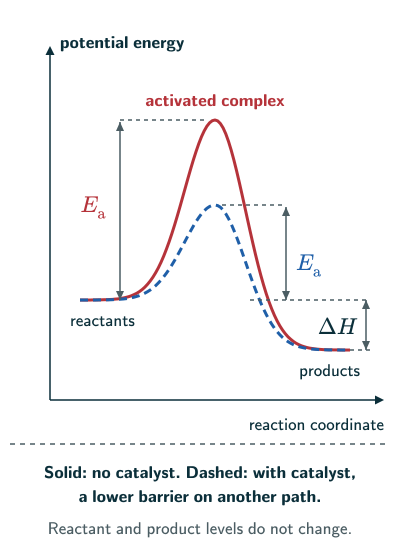
- The energy profile. A plot of potential energy against the reaction coordinate, a measure of progress along a path from reactants to products, not elapsed time, shows a hill: Ea is its height above the reactants, and the activated complex sits at the top (NCERT Fig. 3.7, page 79).
- For a common one-barrier enthalpy profile, the backward reaction climbs from the product side, so Ea(b) = Ea(f) − ΔH; for an exothermic reaction the backward barrier is higher (reasoned from NCERT Fig. 3.7, page 79).
- In this one-barrier schematic the energy falls from the transition state to products, so the overall enthalpy change depends only on the reactants and products (NCERT page 79), not on the height of the hill (reasoned).
Maxwell–Boltzmann distribution of kinetic energies
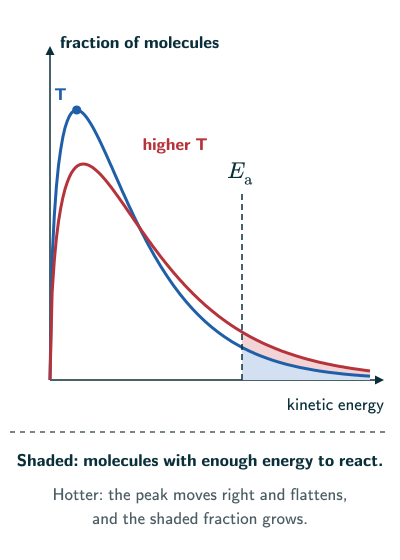
- The molecules of a gas do not all have the same kinetic energy. Boltzmann and Maxwell used statistics to describe a large number of molecules: NCERT plots the fraction of molecules, NE/NT, with a given kinetic energy against E (Fig. 3.8, page 79); strictly, it is a probability density, the fraction in a small energy interval (reasoned).
- NCERT slip (page 79): NCERT spells the physicist’s name “James Clark Maxwell”. It is James Clerk Maxwell, as NCERT’s own Physics book writes it (NCERT Physics Part I (Class 12), Chapter 8).
- The peak of the curve is the most probable kinetic energy; fewer molecules have energies above or below it (NCERT page 79).
- On heating, the peak moves to a higher energy and becomes lower, and the curve broadens, spreading to the right, so a greater proportion of molecules has much higher energies. The area under the curve stays the same, since the total probability is always one (NCERT Fig. 3.9, page 80).
- Mark Ea on the Maxwell–Boltzmann curve: increasing the temperature increases the fraction of molecules which collide with energies greater than Ea, as the enlarged high-energy tail shows (NCERT page 80). Strictly, successful reaction also requires suitable orientation and reaction dynamics, and the individual-molecule tail is not exactly the Arrhenius exponential (reasoned).
- NCERT slip (page 80): NCERT says that for a 10° rise the area beyond Ea “gets doubled”, as if for every reaction. That holds only for Ea near 53 kJ mol−1 near room temperature (reasoned from NCERT Eq. (3.22)): a larger Ea gives more than doubling, a smaller one less. Strictly, that is the doubling of the Arrhenius factor; the exact area under the three-dimensional kinetic-energy distribution is a slightly different function (reasoned). In an exam, give NCERT’s rule of thumb, that the rate constant is nearly doubled (page 78), when asked; in a calculation, use doubling only when the question gives it.
Effect of catalyst
In NCERT’s words:
A catalyst is a substance which increases the rate of a reaction without itself undergoing any permanent chemical change.
NCERT Chemistry Part I (Class 12), Section 3.4.1, page 82
- Example. MnO2 greatly increases the rate of 2KClO3 → 2KCl + 3O2 (NCERT page 82).
- A substance that reduces the rate is not called a catalyst but an inhibitor (NCERT page 82).
- Intermediate complex theory. The catalyst forms temporary bonds with the reactants, giving an intermediate complex that soon breaks up into the products and the catalyst (NCERT page 82).
- Lower barrier. The catalyst provides an alternative pathway, or mechanism, with a lower activation energy; by the Arrhenius equation, the lower Ea, the faster the reaction (NCERT page 82, Fig. 3.11).
- A catalyst regenerated in its cycle can process much more reactant than its own amount: “A small amount of the catalyst can catalyse a large amount of reactants” (NCERT page 82). Deactivation and competing reactions can limit its lifetime (reasoned).
- A catalyst does not alter the Gibbs energy change of a reaction; “It catalyses the spontaneous reactions but does not catalyse non-spontaneous reactions” (NCERT page 82). In an exam, use NCERT’s sentence. Strictly, a catalyst cannot make an otherwise unfavourable net direction thermodynamically favoured under the same conditions, although microscopic forward and reverse events still occur; external work or coupling can drive an unfavourable process, and the catalyst supplies neither (reasoned).
- It does not change the equilibrium constant: it speeds up the forward and backward reactions to the same extent, so the same equilibrium is reached sooner (NCERT page 82). Strictly, this is detailed balance (reasoned).
Solved examples
Example 1: Ea and A from two rate constants (NCERT Example 3.9)
The rate constants of a reaction are 0.02 s−1 at 500 K and 0.07 s−1 at 700 K. Find Ea and A.
Answer: log(0.07/0.02) = log 3.5 = 0.544, and (700 − 500)/(700 × 500) = 5.714 × 10⁻⁴ K−1. So Ea = 0.544 × 2.303 × 8.314/(5.714 × 10−4) = 18 230 J mol−1, about 18.2 kJ mol−1. Then e−18 230/(8.314 × 500) = 0.01246, so A = 0.02/0.01246 = 1.61 s−1 (NCERT Example 3.9, page 81).
NCERT slip (page 81): NCERT gives Ea in J, not J mol−1, and A with no unit; it is s−1, like k. It also rounds the exponential to 0.012 but writes 0.02/0.012 = 1.61; that division gives 1.67, and 1.61 comes from 0.01246.
Example 2: k at a new temperature (NCERT Example 3.10)
For C2H5I(g) → C2H4(g) + HI(g), k = 1.60 × 10⁻⁵ s−1 at 600 K and Ea = 209 kJ mol−1. Find k at 700 K.
Answer: log(k2/k1) = (209 000/(2.303 × 8.314)) × (1/600 − 1/700) = 2.599. With log k1 = −4.796, log k2 = −2.197, so k2 = 6.36 × 10⁻³ s−1 (NCERT Example 3.10, pages 81–82). A 100 K rise makes the reaction about 400 times faster.
NCERT slip (page 82): NCERT writes the units of Ea and R with a stray L, as J mol L−1 and J mol L−1 K−1. They are J mol−1 and J K−1 mol−1; the numbers are right.
Example 3: Ea from “doubles in 10 K” (NCERT Intext Question 3.8)
The rate of a reaction doubles when the temperature rises from 298 K to 308 K. Find Ea.
Answer: log 2 = (Ea/(2.303 × 8.314)) × (10/(298 × 308)), so Ea = 0.301 × 19.15 × 9178 = 52 900 J mol−1 = 52.9 kJ mol−1 (NCERT page 84; answer 52.897 kJ mol−1 on page 88).
Example 4: Fraction with enough energy (NCERT Intext Question 3.9)
For 2HI(g) → H2(g) + I2(g), Ea = 209.5 kJ mol−1 at 581 K. What fraction of the molecules has energy equal to or greater than Ea?
Answer: Fraction = e−Ea/RT = e−209 500/(8.314 × 581) = e−43.37 = 1.46 × 10⁻¹⁹ (NCERT page 84). NCERT’s answer on page 88, 1.471 × 10⁻¹⁹, comes from working in base 10 with 2.303; the difference is only rounding. This is NCERT’s Arrhenius-factor approximation, not the exact three-dimensional fraction of molecules above a translational-energy threshold.
Example 5: What a catalyst does to k
At 298 K a catalyst lowers Ea by 10 kJ mol−1 and leaves A unchanged. By what factor does k rise?
Answer: kcat/k = e10 000/(8.314 × 298) = e4.04 ≈ 57 (reasoned from NCERT Eq. (3.18)). A small cut in the barrier gives a large rise in rate.
Common mistakes to avoid
Common mistake
Using °C in the Arrhenius equation
T must be in kelvin: 1/T with T in °C gives nonsense (reasoned from NCERT Eq. (3.18)).
Common mistake
Mixing kJ and J
With R = 8.314 J K−1 mol−1, Ea must be in J mol−1: 209 kJ mol−1 is 209 000 J mol−1 (NCERT Example 3.10, pages 81–82).
Common mistake
Saying a catalyst shifts the equilibrium
A catalyst speeds up the forward and backward reactions to the same extent, so K and ΔG do not change; equilibrium is only reached sooner (NCERT page 82).
Quick revision summary
- For positive activation energy, rate constants rise with temperature; NCERT’s rule of thumb: a 10° rise nearly doubles k (it holds for Ea near 53 kJ mol).
- Arrhenius equation: k = A exp(−Ea/RT); ln k = −Ea/RT + ln A, so ln k against 1/T is a straight line of slope −Ea/R.
- Two temperatures: log(k/k) = (Ea/2.303R)(T − T)/(TT).
- Activation energy: the energy needed to form the activated complex; the high-energy tail helps explain the temperature effect, but energy alone does not guarantee reaction.
- A catalyst lowers Ea by another path; it changes neither ΔG nor K.
Formula sheet
- k = A exp(−Ea/RT)
- ln k = −Ea/RT + ln A
- log(k/k) = (Ea/2.303R)(T − T)/(TT)
- log k = log A − Ea/(2.303RT)
- Fraction with E > Ea (NCERT) = exp(−Ea/RT)
Questions students ask
What does the graph of the Arrhenius equation look like?
With constant A and activation energy, ln k against 1/T is a straight line of slope −Ea/R and intercept ln A. Using base-10 logarithms gives slope −Ea/(2.303R): a slope of −5.2 × 10 K corresponds to about 99.6 kJ mol. For positive activation energy, k increases with T, but it does not increase ever more steeply at every conceivable temperature. Extrapolating constant parameters gives the mathematical limit k → A; real high-temperature behaviour may involve different chemistry (NCERT page 80; differentiation of the model).
What is the temperature coefficient of a reaction?
Beyond the NCERT text, the temperature coefficient of a reaction, μ, is the ratio of its rate constants at two temperatures 10° apart, kT+10/kT (Wikipedia, “Q10 (temperature coefficient)”), so NCERT’s “nearly doubled” for a 10° rise (page 78) means μ ≈ 2. For most reactions μ is 2 to 3, and over a rise ΔT the rate is multiplied by about μΔT/10 (Wikipedia, “Arrhenius equation”; reasoned): with μ = 2.2, a 20° rise speeds a reaction up about 2.2 ≈ 4.8 times. It is not a true constant: at fixed Ea it falls slowly as T rises, since ln μ = 10Ea/[RT(T + 10)] (reasoned from NCERT Eq. (3.22)).
Can activation energy be zero or negative?
Most school examples have positive Arrhenius activation energy, so k increases on heating. Zero activation energy means zero local slope of ln k against 1/T; in a constant-parameter model k = A. A negative apparent activation energy means the measured rate constant decreases on heating. Multistep mechanisms can show this when heating reduces the population of a reactive intermediate enough to outweigh a faster subsequent step. It does not mean an individual transition state lies below its adjacent minimum (Wikipedia, “Activation energy”; kinetic interpretation).
Does activation energy change with temperature?
For school calculations, treat A and Ea as constant over the stated interval. More generally, one can define Ea(T) = RT d(ln k)/dT, which can vary with temperature or mechanism. In a modified fit k = ATnexp(−E/RT), the apparent activation energy is E + nRT; there is no universal restriction of n to −1 through 1. Heating therefore need not leave every experimentally inferred activation energy unchanged (Wikipedia, “Arrhenius equation” and “Activation energy”; differentiation).
What is the unit of activation energy?
Activation energy is an energy per mole, in J mol or, more often, kJ mol (NCERT pages 79 and 84). Beyond the NCERT text, it is also quoted per molecule, with the Boltzmann constant in place of R, as e−Ea/kBT (Wikipedia, “Arrhenius equation”), and in kcal mol (Wikipedia, “Activation energy”); 1 eV per molecule is 96.5 kJ mol, and 1 kcal = 4.184 kJ (reasoned). The factor A has the units of k: s for a first order reaction and L mol s for a second order one (reasoned).
How does a catalyst change the Maxwell–Boltzmann distribution?
At the same temperature, the equilibrium translational-energy distribution of the same gas species is unchanged by adding a catalyst. In the simple picture a catalytic route has a lower relevant barrier, so more encounters can access it; heating instead changes the energy distribution (NCERT pages 79–82). Real catalytic mechanisms may have several steps and different pre-exponential factors, and experimental activation energies can vary with temperature. The shaded Maxwell tail is a qualitative illustration, not an exact equality to exp(−Ea/RT) (reasoned, though NCERT page 80 identifies the two).
What is the difference between the Arrhenius equation and the van ’t Hoff equation?
The Arrhenius equation describes how a rate constant k varies with temperature, through Ea; NCERT notes that van ’t Hoff first proposed it (page 78). Beyond the NCERT text, the van ’t Hoff equation is a different one: it describes how an equilibrium constant K varies, through the enthalpy of reaction. Their two-temperature forms match because K = kf/kb for a single-step reversible reaction, so ΔH = Ea(f) − Ea(b); heating raises both rate constants but lowers K for an exothermic reaction, whose backward Ea is larger (reasoned).
Is the Maxwell–Boltzmann distribution in the JEE Main and NEET syllabus?
The Maxwell–Boltzmann distribution is not named in the JEE Main syllabus or the NEET (UG) 2026 syllabus: Unit 8, Chemical Kinetics, of each lists “the effect of temperature on the rate of reactions, Arrhenius theory, activation energy and its calculation”, and the physics Unit 9, Kinetic Theory of Gases, names the “RMS speed of gas molecules” but no distribution. NCERT Class 12 Chemistry Part I uses the energy distribution in Section 3.4 (pages 79–80) to explain why heating speeds up reactions, so the shape of the curve and how it changes on heating come under the effect of temperature (reasoned). NCERT gives no formula for the curve.
Practice questions
Try each question first, then open the answer to check your working.
-
Q1. What is the effect of temperature on the rate constant of a reaction, and how is it shown quantitatively?
Show answerHide answer
For the usual positive activation energy, the rate constant rises with temperature; for a 10° rise the rate constant is nearly doubled (NCERT page 78). The Arrhenius equation, k = Ae−Ea/RT, describes it (NCERT Intext Question 3.7, page 84; NCERT page 79).
-
Q2. Why does a small rise in temperature increase the rate so much more than the collision rate?
Show answerHide answer
From 298 K to 308 K, molecular speeds, and so the collision rate, rise by under 2%, since speed goes as √T (reasoned from NCERT Class 11 Physics, Chapter 12). The Arrhenius energy factor grows much more: for Ea near 53 kJ mol−1 it doubles (reasoned from NCERT Eq. (3.22); NCERT Intext Question 3.8, page 84).
-
Q3. Does a catalyst change the equilibrium constant of a reaction? Explain.
Show answerHide answer
No. A catalyst “catalyses the forward as well as the backward reactions to the same extent”, so the equilibrium state stays the same but is reached earlier (NCERT page 82). Strictly, the reason is thermodynamic: the catalyst changes the pathway, not the initial and final states, so ΔG⊖ and K are unchanged, and real catalytic cycles may have several steps (reasoned).