Carbohydrates
NCERT Class 12 Chemistry Chapter 10 Section 10.1
Quick answer
Carbohydrates are optically active polyhydroxy aldehydes or ketones, or compounds that give them on hydrolysis; they are monosaccharides, oligosaccharides or polysaccharides, and reducing or non-reducing. Glucose, an aldohexose, closes into a six-membered ring through its C5 hydroxyl, giving the α and β anomers, while fructose, a ketohexose, forms a five-membered ring. Sucrose is non-reducing and gives invert sugar, maltose and lactose are reducing, and starch, cellulose and glycogen are glucose polymers.
With your textbook
NCERT Chemistry Part II (Class 12), Chapter 10 “Biomolecules”, Section 10.1 “Carbohydrates”, pages 281–290.
Open the official NCERT chapter (PDF, 3.1 MB, ncert.nic.in) (opens in a new tab)
Checked against the 2026-27 reprint on .
What are carbohydrates?
Carbohydrates
Carbohydrates are produced mainly by plants and include cane sugar, glucose and starch. Many fit the formula Cx(H2O)y, which gave them their name, “hydrates of carbon”, but the formula is not a reliable test: acetic acid, C2(H2O)2, is not a carbohydrate, and rhamnose, C6H12O5, is one (NCERT Section 10.1, page 281). NCERT defines them by their functional groups:
Chemically, the carbohydrates may be defined as optically active polyhydroxy aldehydes or ketones or the compounds which produce such units on hydrolysis.
NCERT Chemistry Part II (Class 12), Section 10.1, page 281
In plain words: a carbohydrate is a chain of carbons carrying many –OH groups and one C=O group, or something that gives such units when it is split by water. Sweet ones are called sugars, and carbohydrates as a whole are also called saccharides, from the Greek sakcharon, sugar (NCERT pages 281–282).
Classification of carbohydrates
Carbohydrates are classified by what they give on hydrolysis (NCERT page 282):
- Monosaccharides cannot be hydrolysed to simpler polyhydroxy aldehydes or ketones. About 20 occur in nature, for example glucose, fructose and ribose.
- Oligosaccharides give two to ten monosaccharide units: disaccharides, trisaccharides and so on. Disaccharides are the most common. Sucrose gives one glucose and one fructose; maltose gives two glucose units.
- Polysaccharides give a large number of units: starch, cellulose, glycogen and gums. They are not sweet, so they are also called non-sugars.
Carbohydrates are also reducing or non-reducing. Those that reduce Fehling’s solution and Tollens’ reagent are reducing sugars, and every monosaccharide, aldose or ketose, is one (NCERT page 282). The two tests are described on the aldehydes and ketones reactions page.
Aldoses and ketoses
A monosaccharide with an aldehyde group is an aldose, and one with a keto group is a ketose. The number of carbon atoms goes into the name as well: glucose, an aldehyde with six carbons, is an aldohexose (NCERT page 282, Table 10.1).
| Carbon atoms | Aldose | Ketose |
|---|---|---|
| 3 (triose) | aldotriose | ketotriose |
| 4 (tetrose) | aldotetrose | ketotetrose |
| 5 (pentose) | aldopentose | ketopentose |
| 6 (hexose) | aldohexose | ketohexose |
| 7 (heptose) | aldoheptose | ketoheptose |
Monosaccharides
- Glucose occurs free and combined. It is present in sweet fruits and honey, and ripe grapes contain a lot of it. It is also called dextrose, it is the monomer of starch and cellulose, and it is probably the most abundant organic compound on earth (NCERT pages 282–283).
- From sucrose: boiling sucrose with dilute HCl or H2SO4 in alcoholic solution gives glucose and fructose in equal amounts.
- From starch (commercial): starch is boiled with dilute H2SO4 at 393 K under pressure (NCERT pages 282–283).
Preparation of glucose
C12H22O11 + H2O → C6H12O6 (glucose) + C6H12O6 (fructose) (H+)
(C6H10O5)n + nH2O → nC6H12O6 (H+, 393 K, 2–3 atm)
Glucose and fructose
How the open-chain structure of glucose was worked out (NCERT pages 283–284):
- Its molecular formula is C6H12O6.
- Long heating with HI gives n-hexane, so the six carbons form a straight chain.
- With hydroxylamine it forms an oxime, and it adds HCN to give a cyanohydrin: a carbonyl group is present (see addition to the carbonyl group).
- Bromine water, a mild oxidising agent, gives a six-carbon acid, gluconic acid: the carbonyl group is an aldehyde group.
- Acetic anhydride gives a stable pentaacetate: five –OH groups, on different carbons.
- Nitric acid oxidises glucose, and gluconic acid, to the dicarboxylic saccharic acid: one –OH is a primary alcohol group.
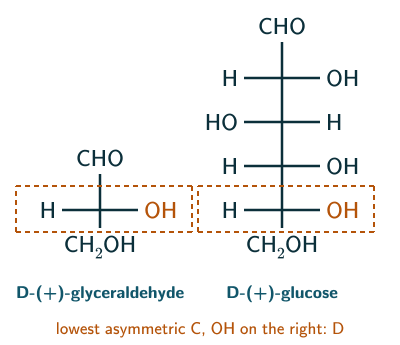
D and L. Fischer worked out the arrangement of the –OH groups. Glucose is written D-(+)-glucose: D gives the configuration and (+) shows that it is dextrorotatory. D and L have no relation to the sign of rotation, nor to d and l (NCERT page 284; see optical activity). D means that the –OH on the lowest asymmetric carbon lies on the right, as in (+)-glyceraldehyde, with the most oxidised carbon (–CHO) written at the top (NCERT pages 284–285).
Fructose is an important ketohexose. It comes with glucose from the hydrolysis of sucrose, and it occurs in fruits, honey and vegetables. It is also C6H12O6, with a straight chain of six carbons and a keto group at C2. It belongs to the D-series but is laevorotatory: D-(−)-fructose (NCERT page 286).
Open chain and cyclic structures of glucose
The open-chain structure could not explain three facts (NCERT page 285):
- Glucose does not give Schiff’s test and does not form the hydrogensulphite addition product with NaHSO3, although it has an aldehyde group.
- Glucose pentaacetate does not react with hydroxylamine, so it has no free –CHO group.
- Glucose exists in two crystalline forms: α (m.p. 419 K), crystallised from a concentrated solution at 303 K, and β (m.p. 423 K), from a hot saturated solution at 371 K.
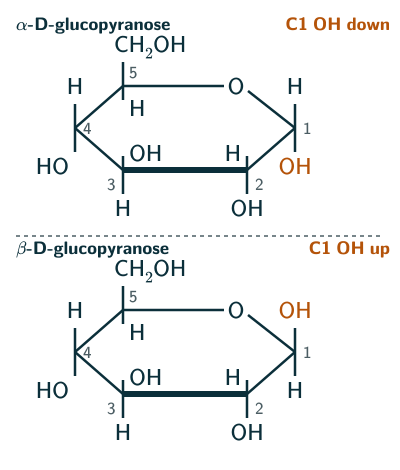
The answer is a ring. The –OH on C5 adds to the –CHO group to form a six-membered cyclic hemiacetal, as alcohols add to aldehydes (see hemiacetals). This removes the free –CHO group and gives two forms, α and β, which are in equilibrium with the open chain (NCERT page 285).
- Why glucose still reduces Fehling’s solution and Tollens’ reagent: these reagents oxidise the small amount of open-chain glucose in the equilibrium, and more rings open to replace what is used, so the reaction goes on. Schiff’s test and the hydrogensulphite addition do not show with so little free aldehyde (reasoned from NCERT pages 282 and 285).
- The two forms differ only in the configuration of the –OH on C1, the anomeric carbon; such isomers are called anomers (NCERT pages 285–286).
- The six-membered ring is a pyranose ring, named after pyran (one oxygen and five carbons in a ring), and it is best drawn as a Haworth structure (NCERT page 286).
- Fructose cyclises too: the –OH on C5 adds to the C2 keto group, giving a five-membered furanose ring, named after furan (one oxygen and four carbons). There are again two anomers, α and β (NCERT page 286).
Disaccharides
- A disaccharide is two monosaccharide units joined through an oxygen atom, an oxide linkage formed with the loss of a water molecule. This is a glycosidic linkage. Dilute acids or enzymes hydrolyse it (NCERT page 287).
- If the reducing groups (the aldehyde or keto groups) of both units are tied up in the linkage, the sugar is non-reducing, like sucrose. If one stays free, it is reducing, like maltose and lactose (NCERT page 287).
Sucrose, maltose and lactose
| Sugar | Units and linkage | Reducing? |
|---|---|---|
| sucrose | α-D-glucose C1 to β-D-fructose C2 | no |
| maltose | α-D-glucose C1 to α-D-glucose C4 | yes |
| lactose | β-D-galactose C1 to D-glucose C4 | yes |
- Sucrose is hydrolysed to an equimolar mixture of D-(+)-glucose and D-(−)-fructose. Both reducing groups are used in the glycosidic bond, so sucrose is non-reducing. Sucrose is dextrorotatory, but fructose’s laevorotation (−92.4°) outweighs glucose’s dextrorotation (+52.5°). The sign of rotation therefore changes from (+) to (−) on hydrolysis, and the product is called invert sugar (NCERT page 287).
- Maltose is two α-D-glucose units, C1 of one joined to C4 of the other. A free aldehyde group can form at C1 of the second unit in solution, so maltose is a reducing sugar (NCERT page 287).
- Lactose, milk sugar, joins C1 of β-D-galactose to C4 of glucose. A free aldehyde group can form at C1 of the glucose unit, so it too is reducing (NCERT page 288).
- Note on maltose and lactose (beyond the NCERT text): NCERT draws both units of maltose as α-D-glucose (page 287) and names lactose’s glucose unit β-D-glucose (page 288). But C1 of that second unit is not tied up in the glycosidic linkage: it is the carbon at which a free aldehyde group can form in solution, which is why both sugars are reducing (NCERT pages 287–288). When its ring closes again it can close either way, as glucose itself does (NCERT page 285), so that unit can be α or β. The linked unit is fixed: α in maltose, and always β for the galactose of lactose (Wikipedia, “Lactose”; reasoned). In an exam, write them as NCERT does: maltose from two α-D-glucose units, lactose from β-D-galactose and β-D-glucose, each linked C1 to C4.
Polysaccharides
Polysaccharides are many monosaccharide units joined by glycosidic linkages. They are the commonest carbohydrates in nature, and they act mainly as food stores or as structural materials (NCERT page 288).
- Starch is the main storage polysaccharide of plants and the most important dietary source for humans. Cereals, roots, tubers and some vegetables are rich in it. It is a polymer of α-glucose with two components (NCERT page 288):
- amylose, the water-soluble part, about 15–20% of starch: a long unbranched chain of 200–1000 α-D-(+)-glucose units joined C1–C4;
- amylopectin, insoluble in water, about 80–85%: a branched chain of α-D-glucose units, joined C1–C4 along the chain and C1–C6 at the branches.
- Cellulose is the most abundant organic substance in the plant kingdom and the main constituent of plant cell walls. It is a straight chain of β-D-glucose units only, joined C1–C4 (NCERT page 289).
- Glycogen stores carbohydrate in the animal body. It is called animal starch because its structure is like amylopectin, but more highly branched. It occurs in the liver, muscles and brain, and in yeast and fungi; enzymes break it down to glucose when the body needs it (NCERT page 289).
- NCERT slip (page 289): NCERT says cellulose “occurs exclusively in plants”. NCERT’s own Class 11 Biology book gives dinoflagellates, which are protists, a cell wall with stiff cellulose plates (Chapter 2, page 15). Beyond the NCERT text, some bacteria secrete cellulose, and tunicates (sea squirts), which are animals, make it (Wikipedia, “Cellulose”). In an exam, write that cellulose is the main structural polysaccharide of plant cell walls.
Importance of carbohydrates
- Carbohydrates form a major part of our food, and honey has long been used as an instant source of energy in ayurveda (NCERT page 289).
- Plants store them as starch and animals as glycogen.
- We use cellulose as wood for furniture and as cotton for clothes, and carbohydrates are raw materials for textiles, paper, lacquers and breweries (NCERT pages 289–290).
- The aldopentoses D-ribose and 2-deoxy-D-ribose are parts of nucleic acids, and carbohydrates are found combined with many proteins and lipids (NCERT page 290).
- NCERT slip (page 289): NCERT says the “cell wall of bacteria and plants is made up of cellulose”. Plant cell walls are mainly cellulose (NCERT Class 11 Biology, Chapter 2, page 19), but NCERT’s Class 11 Biology book gives the cell wall of Kingdom Monera, the bacteria, as non-cellulosic, made of polysaccharide and amino acid (Chapter 2, Table 2.1, page 11). Beyond the NCERT text, that polymer is peptidoglycan, made of sugars and amino acids (Wikipedia, “Peptidoglycan”). The same page also says cellulose occurs only in plants. In an exam, write cellulose for plant cell walls only.
Solved examples
Example 1: Glucose and fructose from sucrose
What masses of glucose and fructose does the complete hydrolysis of 34.2 g of sucrose give? (C = 12, H = 1, O = 16.)
Answer: M(C12H22O11) = 144 + 22 + 176 = 342 g mol−1, so 34.2 g is 0.100 mol. Each mole gives one mole of glucose and one of fructose, both C6H12O6, M = 72 + 12 + 96 = 180 g mol−1: 18.0 g of each (reasoned from NCERT page 287).
Example 2: Why invert sugar is laevorotatory
Using NCERT’s values, +52.5° for glucose and −92.4° for fructose, estimate the rotation of the equimolar mixture, taking it as the average of the two. Equal moles of two isomers are also equal masses.
Answer: (52.5 − 92.4)/2 = −19.95, about −20°. It is negative, so the mixture is laevorotatory, while sucrose itself is dextrorotatory (reasoned from NCERT page 287).
Common mistakes to avoid
Common mistake
Reading D as “dextrorotatory”
D and L describe configuration, compared with glyceraldehyde. D-fructose is laevorotatory: D-(−)-fructose.
Common mistake
Calling sucrose a reducing sugar
Both reducing groups, of glucose C1 and fructose C2, are tied up in the glycosidic bond, so sucrose does not reduce Fehling’s or Tollens’ reagent. Maltose and lactose do.
Quick revision summary
- Carbohydrates: optically active polyhydroxy aldehydes or ketones, or compounds that give them on hydrolysis. They are classed as mono-, oligo- and polysaccharides, and as reducing or non-reducing.
- Glucose: an aldohexose, D-(+); the open chain was shown by HI (straight chain), oxime and cyanohydrin (C=O), bromine water (CHO), the pentaacetate (5 OH) and HNO3 (primary OH).
- Cyclic glucose: the C5–OH adds to the CHO, giving the α and β anomers (pyranose). Fructose, a ketohexose, D-(−), forms a furanose ring.
- Sucrose (α-glucose C1, β-fructose C2) is non-reducing and gives invert sugar. Maltose (α-glucose C1–C4) and lactose (β-galactose C1, glucose C4) are reducing.
- Starch: amylose (15–20%, C1–C4) and amylopectin (80–85%, C1–C4 and C1–C6 branches). Cellulose: β-glucose, C1–C4. Glycogen: like amylopectin, more branched.
Formula sheet
- Sucrose + HO → glucose + fructose (H)
- (CHO) + nHO (H, 393 K) → nCHO
Practice questions
Try each question first, then open the answer to check your working.
-
Q1. What are the expected products of the hydrolysis of lactose? (NCERT Intext Question 10.2, page 290.)
Show answerHide answer
β-D-Galactose and β-D-glucose (NCERT page 288). Lactose is a disaccharide of these two units, joined C1 of galactose to C4 of glucose.
-
Q2. How do you explain the absence of an aldehyde group in the pentaacetate of D-glucose? (NCERT Intext Question 10.3, page 290.)
Show answerHide answer
In glucose the –CHO group is tied up in a cyclic hemiacetal with the –OH on C5. In the pentaacetate the five –OH groups, including the one on C1, are acetylated, so the ring cannot open to free the –CHO group, and the pentaacetate does not react with hydroxylamine (NCERT page 285; reasoned).