Proteins
NCERT Class 12 Chemistry Chapter 10 Section 10.2
Quick answer
Proteins are polymers of α-amino acids joined by peptide bonds, –CO–NH–, amide links formed with the loss of water. Amino acids exist as salt-like zwitter ions; they are neutral, acidic or basic, and essential if they must come from the diet. Protein structure has four levels, primary (the sequence), secondary (α-helix, β-pleated sheet), tertiary (overall folding) and quaternary (sub-units), and denaturation by heat or pH destroys the secondary and tertiary structure but leaves the primary intact.
With your textbook
NCERT Chemistry Part II (Class 12), Chapter 10 “Biomolecules”, Section 10.2 “Proteins”, pages 290–295.
Open the official NCERT chapter (PDF, 3.1 MB, ncert.nic.in) (opens in a new tab)
Checked against the 2026-27 reprint on .
What are proteins?
Proteins
Proteins are polymers of α-amino acids joined by peptide bonds. They are found in every part of the body, and milk, cheese, pulses, peanuts, fish and meat are rich sources. The word comes from the Greek proteios, “primary” or “of prime importance” (NCERT Section 10.2, page 290). NCERT opens the section with:
Proteins are the most abundant biomolecules of the living system.
NCERT Chemistry Part II (Class 12), Section 10.2, page 290
In plain words: amino acids are the beads, peptide bonds are the string, and the way the string coils and folds gives each protein its shape and its job.
Most abundant, but not more than water: NCERT’s Class 11 Biology book says water is the most abundant chemical in living organisms, 70–90 per cent of the mass of a cell, against 10–15 per cent for proteins, 5–7 for nucleic acids, 3 for carbohydrates and 2 for lipids (Chapter 9, Table 9.4, page 109). So proteins are the most abundant of the organic biomolecules (reasoned). If a question asks for the most abundant biomolecule, answer proteins; for the most abundant chemical in a cell, water.
Amino acids
- Amino acids contain an amino group, –NH2, and a carboxyl group, –COOH. By where the –NH2 sits relative to the –COOH they are α, β, γ, δ and so on; only α-amino acids come from the hydrolysis of proteins (NCERT page 290).
- An α-amino acid is R–CH(NH2)–COOH, where R is the side chain. The side chain may carry other functional groups (NCERT page 290).
- Amino acids have trivial names. Glycine is named for its sweet taste (Greek glykos, sweet), and tyrosine was first obtained from cheese (Greek tyros). Each has a three-letter symbol, and sometimes a one-letter code (NCERT page 290).
| Amino acid | Codes | Type |
|---|---|---|
| glycine | Gly, G | neutral |
| alanine | Ala, A | neutral |
| valine* | Val, V | neutral |
| leucine* | Leu, L | neutral |
| isoleucine* | Ile, I | neutral |
| arginine* | Arg, R | basic |
| lysine* | Lys, K | basic |
| glutamic acid | Glu, E | acidic |
| aspartic acid | Asp, D | acidic |
| glutamine | Gln, Q | neutral |
| asparagine | Asn, N | neutral |
| threonine* | Thr, T | neutral |
| serine | Ser, S | neutral |
| cysteine | Cys, C | neutral |
| methionine* | Met, M | neutral |
| phenylalanine* | Phe, F | neutral |
| tyrosine | Tyr, Y | neutral |
| tryptophan* | Trp, W | neutral |
| histidine* | His, H | basic |
| proline | Pro, P | neutral |
The names, codes and asterisks are NCERT Table 10.2 (pages 290–291); * marks an essential amino acid. The last column is ours, read from the side chains in that table: acidic ones carry a second –COOH, and basic ones a second basic nitrogen group (reasoned).
Classification of amino acids
An amino acid is neutral if it has equal numbers of amino and carboxyl groups, basic if it has more amino groups and acidic if it has more carboxyl groups (NCERT page 291). Glutamic acid, HOOC–CH2–CH2– as side chain, is acidic; lysine, H2N–(CH2)4–, is basic; glycine, with H as the side chain, is neutral (reasoned from NCERT Table 10.2).
Essential and non-essential amino acids
- Non-essential amino acids can be made in the body. Essential amino acids cannot, so they must come from the diet. NCERT marks ten with an asterisk in Table 10.2: valine, leucine, isoleucine, arginine, lysine, threonine, methionine, phenylalanine, tryptophan and histidine (NCERT pages 290–291).
- Note (beyond the NCERT text): for humans, nine amino acids are now usually called essential. Arginine is counted among the “conditionally essential” ones, which the body can usually make but sometimes not fast enough, for example in premature infants (Wikipedia, “Essential amino acid”). In an exam, use NCERT’s list of ten.
Zwitter ion form of amino acids
- Amino acids are usually colourless, crystalline, water-soluble solids with high melting points. They behave like salts rather than like simple amines or carboxylic acids, because each molecule has both an acidic and a basic group (NCERT page 292).
- In water the –COOH group loses a proton and the –NH2 group gains one, giving a dipolar ion, the zwitter ion: neutral overall, with both a positive and a negative charge. As a zwitter ion an amino acid is amphoteric: it reacts with both acids and bases (NCERT page 292).
- Except glycine, every naturally occurring α-amino acid is optically active, because its α-carbon is asymmetric. Most natural amino acids have the L configuration, drawn with –NH2 on the left when –COOH is at the top, as in the head of NCERT Table 10.2 (NCERT page 292; see optical activity).
Zwitter ion
R–CH(NH2)–COOH ⇌ R–CH(N+H3)–COO−
Structure of proteins
- Proteins are polymers of α-amino acids joined by peptide bonds (next section). A polypeptide with more than a hundred amino acid residues and a molecular mass above 10 000 u is called a protein. The line between a polypeptide and a protein is not sharp: insulin, with only 51 amino acids, is called a protein because it has a well-defined conformation (NCERT page 292).
- NCERT’s Summary adds that proteins made only of α-amino acids are called simple proteins (page 301).
- By shape, proteins are of two types (NCERT pages 292–293):
- Fibrous proteins have parallel polypeptide chains held together by hydrogen and disulphide bonds, giving fibres. They are generally insoluble in water: keratin (hair, wool) and myosin (muscles).
- Globular proteins have chains that coil into a spherical shape. They are usually soluble in water: insulin and albumins.
- NCERT slip (page 292): NCERT lists silk with hair and wool as containing keratin. Beyond the NCERT text, the silk fibre is made of fibroin, a different insoluble protein, coated with a glue-like protein, sericin (Wikipedia, “Fibroin”). In an exam, give keratin for hair and wool, and fibroin for silk if it is asked.
Peptide bond
- A peptide bond, or peptide linkage, is an amide, –CO–NH–. The amino group of one amino acid combines with the carboxyl group of another, and a water molecule is lost (NCERT page 292).
- When the carboxyl group of glycine combines with the amino group of alanine, the dipeptide glycylalanine (Gly-Ala) forms (NCERT page 292).
- Three amino acids give a tripeptide, with two peptide linkages; four, five or six give a tetra-, penta- or hexapeptide. More than ten amino acids give a polypeptide (NCERT page 292).
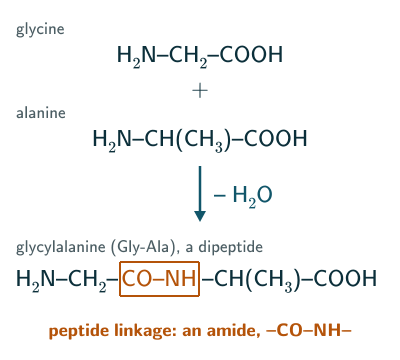
Glycylalanine
glycine + alanine → glycylalanine + H2O
glycylalanine: H2N–CH2–CO–NH–CH(CH3)–COOH
Primary, secondary, tertiary and quaternary structure
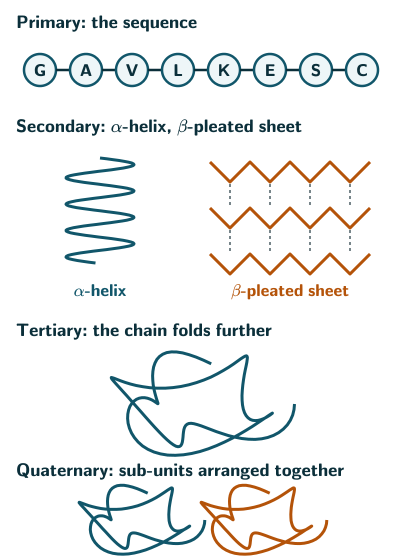
Protein structure is studied at four levels, each more complex than the last (NCERT pages 293–294):
- Primary: the sequence of amino acids in each polypeptide chain. Any change in the sequence makes a different protein.
- Secondary: the shape the long chain takes, from regular folding of the backbone held by hydrogen bonds between the >C=O and –NH– groups of the peptide bonds (see hydrogen bonding). There are two kinds:
- in the α-helix, the chain twists into a right-handed screw, with the –NH group of each residue hydrogen-bonded to a >C=O of the next turn;
- in the β-pleated sheet, the chains are stretched out almost fully and laid side by side, held by intermolecular hydrogen bonds, like the pleats of a drapery.
- Tertiary: the overall folding of the chain, a further folding of the secondary structure. It gives the two main shapes, fibrous and globular. Secondary and tertiary structures are held by hydrogen bonds, disulphide linkages, van der Waals forces and electrostatic attraction.
- Quaternary: in proteins with two or more chains (sub-units), the arrangement of the sub-units with respect to each other. NCERT Figure 10.4 (page 294) shows all four levels for haemoglobin, whose quaternary structure NCERT’s Class 11 Biology book gives as four sub-units, two of α type and two of β type (Chapter 9, page 112).
Denaturation of proteins
- A protein in its natural state, with its unique three-dimensional structure and biological activity, is a native protein (NCERT page 294).
- A physical change, such as a change in temperature, or a chemical change, such as a change in pH, disturbs the hydrogen bonds. The globules unfold, the helices uncoil, and the protein loses its biological activity: this is denaturation (NCERT pages 294–295).
- In denaturation the secondary and tertiary structures are destroyed, but the primary structure stays intact (NCERT page 295).
- Examples: egg white coagulates on boiling, and milk curdles when bacteria in it form lactic acid (NCERT page 295).
Solved examples
Example 1: How many tripeptides?
How many different tripeptides can be made from glycine, alanine and valine if each is used exactly once? How many peptide bonds does each contain?
Answer: The sequence matters, because a chain has an –NH2 end and a –COOH end: 3 × 2 × 1 = 6 tripeptides, such as Gly-Ala-Val and Val-Ala-Gly. Each has 2 peptide bonds (reasoned from NCERT page 292).
Example 2: Molar mass of glycylalanine
Glycine is C2H5NO2 and alanine C3H7NO2. What is the molar mass of glycylalanine? (C = 12, H = 1, N = 14, O = 16.)
Answer: Glycine: 24 + 5 + 14 + 32 = 75 g mol−1; alanine: 36 + 7 + 14 + 32 = 89 g mol−1. One water (18) is lost, so 75 + 89 − 18 = 146 g mol−1, which is C5H10N2O3 (reasoned from NCERT page 292).
Common mistakes to avoid
Common mistake
Thinking denaturation breaks peptide bonds
Denaturation destroys the secondary and tertiary structure. The sequence, the primary structure, stays intact.
Common mistake
Calling glycine optically active
Glycine’s side chain is H, so its α-carbon carries two hydrogens and is not asymmetric. Every other natural α-amino acid is optically active.
Common mistake
Counting the –CONH<sub>2</sub> of glutamine as an amino group
Glutamine and asparagine carry an amide group, –CONH2, in the side chain. Its nitrogen’s lone pair is shared with the C=O by resonance, as in acetanilide (NCERT Unit 9, pages 272–273), so it is not a basic amino group: both are neutral amino acids (reasoned from NCERT Table 10.2 and page 291).
Quick revision summary
- α-Amino acids: R–CH(NH2)–COOH. They are neutral, acidic or basic by the number of amino and carboxyl groups, and essential if they must come from the diet (ten in NCERT’s table).
- Zwitter ion: R–CH(N+H3)–COO−, amphoteric and salt-like. All natural α-amino acids except glycine are optically active, mostly L.
- Peptide bond: –CO–NH–, an amide, with water lost. Dipeptide, tripeptide, then polypeptide (more than 10); protein above 100 residues and 10 000 u.
- Fibrous (keratin, myosin; insoluble) and globular (insulin, albumins; soluble). Primary: the sequence; secondary: α-helix and β-pleated sheet (hydrogen bonds); tertiary: overall folding; quaternary: sub-units.
- Denaturation (heat, pH): secondary and tertiary structure lost, primary kept. Examples: boiled egg white, curdled milk.
Formula sheet
- R–CH(NH)–COOH ⇌ R–CH(NH)–COO
- Gly + Ala → Gly-Ala (dipeptide) + HO; peptide bond –CO–NH–
Practice questions
Try each question first, then open the answer to check your working.
-
Q1. The melting points and water solubility of amino acids are generally higher than those of the corresponding halo acids. Explain. (NCERT Intext Question 10.4, page 295.)
Show answerHide answer
Amino acids exist as zwitter ions, R–CH(N+H3)–COO−, so they behave like salts. The strong attractions between these ions raise the melting point, and their attraction to polar water molecules raises the solubility. Halo acids, R–CH(X)–COOH, are not ionic (reasoned from NCERT page 292).
-
Q2. Where does the water present in the egg go after the egg is boiled? (NCERT Intext Question 10.5, page 295.)
Show answerHide answer
Boiling denatures the egg proteins, which unfold and coagulate (NCERT page 295). The water is held within the coagulated protein, largely through hydrogen bonds to its polar groups, so it no longer flows (reasoned).