Biomacromolecules
NCERT Class 11 Biology Chapter 9 Section 9.3
Quick answer
Micromolecules, below 1000 daltons, make up the acid-soluble pool; macromolecules, the proteins, nucleic acids and polysaccharides of the acid-insoluble fraction, are polymers of about 10 000 daltons and above. Lipids also come down in that fraction because cell membranes break into insoluble vesicles, but they are not strictly macromolecules. Water is the most abundant chemical in cells, 70–90 per cent of their mass.
With your textbook
NCERT Biology (Class 11), Chapter 9 “Biomolecules”, Section 9.3 “Biomacromolecules”, pages 108–109.
Open the official NCERT chapter (PDF, 1.9 MB, ncert.nic.in) (opens in a new tab)
Checked against the 2026-27 reprint on .
Micromolecules and macromolecules
Biomacromolecules
Biomolecules are of two types (NCERT page 108):
- Micromolecules (or simply biomolecules): molecular weights below one thousand daltons. The compounds of the acid-soluble pool range from 18 to about 800 daltons (Da).
- Macromolecules (biomacromolecules): the compounds of the acid-insoluble fraction, which has only four types of organic compounds: proteins, nucleic acids, polysaccharides and lipids. Except for lipids, these have molecular weights typically described by NCERT as ten thousand daltons and above.
In plain words: a dalton is the same unit as the unified atomic mass unit used for molecular masses in chemistry (beyond the NCERT Biology text); 18 Da, the bottom of NCERT’s range, is about the mass of one water molecule (18.02 u). The small molecules of a cell, such as sugars, amino acids and nucleotides, stay dissolved when a tissue is ground in acid. The giant molecules built from them, proteins, nucleic acids and polysaccharides, come out in the insoluble part. Lipids also turn up there, though they are small, for a reason explained below.
Why lipids are in the acid-insoluble fraction
The molecules of the insoluble fraction, except lipids, are polymeric substances. Lipids, whose molecular weights NCERT gives as not above 800 Da, are small molecules, yet they come down in the acid-insoluble (macromolecular) fraction (pages 108–109):
- In the cell, lipids are present not only as such but also arranged into cell membranes and other membranes.
- Grinding a tissue breaks the cell structure. The membranes break into pieces and form vesicles, which are not water soluble.
- These membrane vesicles separate with the acid-insoluble pool, and so with the macromolecular fraction.
The mass limits are NCERT’s simplified ranges, not strict chemical definitions. Beyond NCERT, the NIST Chemistry WebBook gives the triglyceride tristearin a molecular mass of about 891.48 Da, above 800 Da; it is still a lipid. NCERT Class 12 Chemistry itself recognises insulin as a protein despite its smaller size. Solubility and assembly, not mass alone, determine fractionation.
Lipids are not strictly macromolecules.
NCERT Biology (Class 11), Section 9.3, page 109
The acid-soluble pool represents roughly the composition of the cytoplasm; the macromolecules of the cytoplasm and organelles form the acid-insoluble fraction. Together they represent the entire chemical composition of the tissue (page 109).
Average composition of cells
Arranged class by class, water is the most abundant chemical in living organisms (page 109). NCERT’s Table 9.4 (page 109) gives the average composition of cells:
| Component | % of total cellular mass |
|---|---|
| Water | 70–90 |
| Proteins | 10–15 |
| Carbohydrates | 3 |
| Lipids | 2 |
| Nucleic acids | 5–7 |
| Ions | 1 |
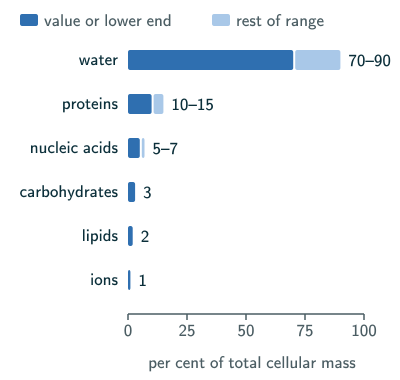
After water, proteins are the largest class, and nucleic acids come before carbohydrates and lipids. These are approximate textbook entries and ranges, not a single measured sample’s mass balance: do not choose all upper limits and treat their sum as one cell. A complete composition for one sample must total 100 per cent, allowing rounding.
Solved examples
Example 1: Micro or macro?
Sort into micromolecules and macromolecules: glucose, a protein, an amino acid, DNA, glycogen, a nucleotide.
Answer: micromolecules (below 1000 Da): glucose, the amino acid, the nucleotide. Macromolecules (in the range of 10 000 Da and above): the protein, DNA, glycogen (NCERT page 108).
Example 2: The lipid puzzle
NCERT describes lipids as small molecules. Why are they found in the acid-insoluble fraction?
Answer: in cells they form membranes. When the tissue is ground, the membranes break into water-insoluble vesicles, which separate with the acid-insoluble fraction, so lipids appear there though they are not strictly macromolecules (NCERT pages 108–109).
Example 3: Reading NCERT Table 9.4
Taking the lower value for proteins, how many times as much protein as lipid does a cell hold, by mass?
Answer: proteins 10 per cent against lipids 2 per cent: 10 ÷ 2 = 5, so five times as much for these table values; with the upper value, 15 ÷ 2 = 7.5 times (NCERT Table 9.4, page 109).
Example 4: What are macromolecules? (NCERT Exercise 1)
What are macromolecules? Give examples.
Answer: large molecules, with molecular weights in the range of ten thousand daltons and above, found in the acid-insoluble fraction; they are polymers. Examples: proteins, nucleic acids and polysaccharides (NCERT page 108). Lipids also come down in that fraction but are not strictly macromolecules (NCERT page 109).
Common mistakes to avoid
Common mistake
Calling lipids macromolecules
Typical fats and membrane lipids are not long repeating-unit polymers; NCERT’s about 800 Da limit is not universal. They only separate with the macromolecular fraction because they form membrane vesicles (NCERT pages 108–109).
Common mistake
Naming proteins the most abundant chemical
Water is the most abundant chemical in living organisms, 70–90 per cent of cell mass (NCERT page 109).
Quick revision summary
- Micromolecules: below 1000 Da; the acid-soluble pool holds compounds of 18 to about 800 Da.
- Macromolecules: the acid-insoluble fraction of proteins, nucleic acids and polysaccharides, in the range of 10 000 Da and above, all polymers; NCERT calls these three the true macromolecular fraction (page 111), and its Summary says only three types of macromolecules are found in living systems (page 118).
- Lipids come down with the macromolecules because membranes break into insoluble vesicles; they are not strictly macromolecules.
- The acid-soluble pool is roughly the cytoplasm’s composition; both fractions together are the whole chemical composition.
- Average cell: water 70–90, proteins 10–15, nucleic acids 5–7, carbohydrates 3, lipids 2, ions 1 per cent.
Formula sheet
- micromolecules: below 1000 Da (acid-soluble pool: 18 to about 800 Da)
- macromolecules: typically about 10 000 Da and above in NCERT
- acid-insoluble fraction: proteins, nucleic acids, polysaccharides, lipids
- NCERT average cell water: 70–90 per cent by mass
- NCERT average cell proteins: 10–15 per cent by mass
Questions students ask
What is the difference between micromolecules and macromolecules?
Micromolecules are biomolecules with molecular weights below one thousand daltons, found in the acid-soluble pool, whose compounds range from 18 to about 800 Da, while macromolecules are those of the acid-insoluble fraction, which, except lipids, have molecular weights in the range of ten thousand daltons and above (NCERT page 108). Micromolecules, which NCERT also calls simply biomolecules, include amino acids, sugars, fatty acids and nucleotides. Macromolecules, or biomacromolecules, are polymers built from such small units: proteins from amino acids, nucleic acids from nucleotides and polysaccharides from monosaccharides.
How many types of macromolecules are found in living systems?
Three types of macromolecules are found in living systems, according to NCERT’s chapter summary: proteins, nucleic acids and polysaccharides (page 118). The acid-insoluble fraction also holds a fourth class, lipids, but NCERT says lipids are not strictly macromolecules: they are small and come down in that fraction only as water-insoluble membrane vesicles (pages 108–109). Accordingly, NCERT calls nucleic acids, polysaccharides and polypeptides together the true macromolecular fraction of any living tissue or cell (page 111).
Why are biomacromolecules called polymers?
Biomacromolecules are called polymers because each is a long chain of many small building blocks, its monomers, joined together: NCERT says the molecules of the acid-insoluble fraction, except lipids, are polymeric substances (page 108). Proteins are polymers of amino acids, nucleic acids are polynucleotides and polysaccharides are long chains of sugars (pages 109–111). The building blocks may be of one type or of several: cellulose is a homopolymer of glucose alone, while a protein is a heteropolymer, as there are 20 types of amino acids.
Which is the most abundant organic compound in a cell?
In NCERT’s average-cell table, proteins are the largest organic class, at 10–15 per cent of the total cellular mass in NCERT’s Table 9.4, the average composition of cells (page 109). Water, at 70–90 per cent, is the most abundant chemical overall, but it is inorganic, so proteins are the answer when the question refers to this table; cell types differ in actual composition. Among proteins, NCERT names RuBisCO the most abundant in the whole biosphere (page 110), and, beyond the NCERT Biology text, NCERT Class 12 Chemistry calls cellulose the most abundant organic substance in the plant kingdom (Unit 10, page 289).
Practice questions
Try each question first, then open the answer to check your working.
-
Q1. What range of molecular weights do the compounds of the acid-soluble pool have?
Show answerHide answer
From 18 to about 800 daltons (NCERT page 108).
-
Q2. Which four types of organic compounds make up the acid-insoluble fraction?
Show answerHide answer
Proteins, nucleic acids, polysaccharides and lipids (NCERT page 108).
-
Q3. What does the acid-soluble pool roughly represent?
Show answerHide answer
The composition of the cytoplasm (NCERT page 109).