Primary and secondary metabolites
NCERT Class 11 Biology Chapter 9 Section 9.2
Quick answer
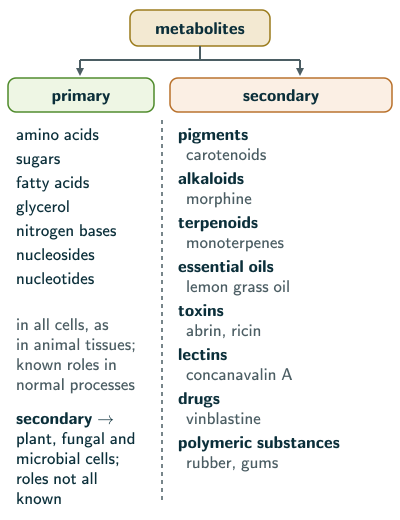
Primary metabolites, such as amino acids, sugars and nucleotides, have identifiable functions in normal physiological processes; NCERT notes them in animal tissues, and plant, fungal and microbial cells have them too. Secondary metabolites, the thousands of other compounds seen in plant, fungal and microbial cells, include alkaloids (morphine), toxins (ricin), lectins (concanavalin A), drugs (vinblastine), pigments, essential oils and rubber. Their roles are not all understood, but many are useful to people.
With your textbook
NCERT Biology (Class 11), Chapter 9 “Biomolecules”, Section 9.2 “Primary and Secondary Metabolites”, page 108.
Open the official NCERT chapter (PDF, 1.9 MB, ncert.nic.in) (opens in a new tab)
Checked against the 2026-27 reprint on .
Primary and secondary metabolites
Metabolites
The biomolecules of living organisms, thousands of organic compounds including amino acids and sugars, can be called metabolites (NCERT page 108).
- Primary metabolites: the categories of compounds of NCERT Figure 9.1 (amino acids, sugars, fatty acids, glycerol, fats and oils, nitrogen bases, nucleosides, nucleotides). NCERT notes all of them in animal tissues; plant, fungal and microbial cells contain them too. They have identifiable functions and play known roles in normal physiological processes (page 108).
- Secondary metabolites: the thousands of other compounds seen when plant, fungal and microbial cells are analysed, such as alkaloids, flavonoids, rubber, essential oils, antibiotics, coloured pigments, scents, gums and spices (page 108).
In plain words: primary metabolites participate in central processes such as growth and cellular metabolism. Secondary metabolites are specialised compounds, made by particular groups of plants, fungi and microbes, with ecological roles such as defence and signalling, although not every role is known, but many of which people use as medicines, spices, dyes and rubber.
NCERT says the reasons for the name “metabolites” are “given in section 9.10” (page 108), but the 2026–27 chapter ends at Section 9.8; there is no Section 9.10. Beyond the NCERT text: the name comes from metabolism, the enzyme-catalysed reactions that NCERT calls metabolic reactions and metabolic pathways (Section 9.8.1, page 114).
What is known about secondary metabolites
Primary metabolites have identifiable functions and known roles in normal physiological processes, but we do not yet understand the role or functions of all the secondary metabolites in the organisms that make them (page 108). Many of them are useful to human welfare, such as rubber, drugs, spices, scents and pigments (page 108).
Some secondary metabolites have ecological importance.
NCERT Biology (Class 11), Section 9.2, page 108
NCERT’s Class 12 book gives an example: many plants make chemicals such as nicotine, caffeine, quinine, strychnine and opium as defences against grazers and browsers (Biology Class 12, Chapter 11, page 198).
Classes of secondary metabolites
NCERT’s Table 9.3 (page 108) gives some secondary metabolites:
| Class | Examples |
|---|---|
| Pigments | carotenoids, anthocyanins |
| Alkaloids | morphine, codeine |
| Terpenoides | monoterpenes, diterpenes |
| Essential oils | lemon grass oil |
| Toxins | abrin, ricin |
| Lectins | concanavalin A |
| Drugs | vinblastin, curcumin |
| Polymeric substances | rubber, gums, cellulose |
Two of NCERT’s spellings differ from the standard ones: terpenoides is usually written terpenoids, and vinblastin is usually written vinblastine. Cellulose appears here as a polymeric substance, yet NCERT Section 9.5 (page 111) says plant cell walls are made of it: a central structural role; however, merely discovering a compound’s function does not turn a secondary metabolite into a primary one, and outside NCERT it is usually treated as one (beyond the 2026–27 NCERT text). In a NEET question built on Table 9.3, follow the table.
Solved examples
Example 1: Classify the compounds
Name the class in NCERT Table 9.3 to which each belongs: morphine, ricin, concanavalin A, curcumin, rubber, anthocyanins.
Answer: morphine, an alkaloid; ricin, a toxin; concanavalin A, a lectin; curcumin, a drug; rubber, a polymeric substance; anthocyanins, pigments (NCERT page 108).
Example 2: Primary or secondary?
How do primary metabolites differ from secondary metabolites?
Answer: primary metabolites, such as amino acids and sugars, are present in animal tissues and have identifiable functions with known roles in normal physiological processes. Secondary metabolites, found when plant, fungal and microbial cells are analysed, do not all have known roles in the organism, though many are useful to people (NCERT page 108).
Example 3: Uses to people
Give five secondary metabolites, or kinds of them, that NCERT names as useful to human welfare.
Answer: rubber, drugs, spices, scents and pigments (NCERT page 108).
Common mistakes to avoid
Common mistake
Thinking primary metabolites occur only in animals
NCERT notes them in animal tissues, but plant, fungal and microbial cells have them too: their secondary metabolites are compounds “other than these primary metabolites” (NCERT page 108).
Common mistake
Treating NCERT’s example categories as mutually exclusive
NCERT Table 9.3 lists curcumin under drugs (page 108). That table placement does not mean a compound cannot also be a pigment or belong to another chemical category; the categories mix chemistry, function and use.
Common mistake
Thinking secondary metabolites are useless
Their roles in the organism are not all understood, but many are useful to people and some have ecological importance (NCERT page 108).
Common mistake
Putting alkaloids among primary metabolites
Alkaloids such as morphine and codeine are secondary metabolites (NCERT Table 9.3, page 108).
Quick revision summary
- Biomolecules can be called metabolites.
- Primary metabolites (amino acids, sugars and the other categories of NCERT Figure 9.1) occur broadly across organisms, including animal tissues, and have known roles in normal physiology.
- Secondary metabolites occur in plant, fungal and microbial cells: alkaloids, flavonoids, rubber, essential oils, antibiotics, pigments, scents, gums, spices.
- Their roles are not all known; many are useful to human welfare, and some have ecological importance.
- NCERT Table 9.3: pigments, alkaloids, terpenoides, essential oils, toxins, lectins, drugs, polymeric substances.
Formula sheet
- alkaloids: morphine, codeine
- toxins: abrin, ricin
- lectins: concanavalin A
- drugs: vinblastine, curcumin
- polymeric substances: rubber, gums, cellulose
Questions students ask
What is the difference between primary and secondary metabolites?
Primary metabolites have identifiable functions and known roles in normal physiological processes, while secondary metabolites are compounds whose roles in the organism that makes them are not all understood (NCERT page 108). Primary metabolites participate in central cellular processes across organisms, including animal tissues, such as amino acids, sugars, fatty acids and nucleotides; secondary metabolites are the thousands of other compounds seen in plant, fungal and microbial cells, such as alkaloids, flavonoids, rubber, essential oils, antibiotics and pigments. Beyond the NCERT text, each secondary metabolite is usually made by only some species, as morphine is by the opium poppy.
Why do plants produce secondary metabolites?
Plants produce many secondary metabolites as chemical defences against herbivores, though NCERT notes that their roles are not all understood and that some have ecological importance (page 108). NCERT Class 12 Biology explains that plants cannot run away from their predators, so many produce and store chemicals that make the herbivore sick when eaten, inhibit its feeding or digestion, disrupt its reproduction or even kill it; the weed Calotropis makes highly poisonous cardiac glycosides, so cattle and goats do not browse it (Chapter 11, page 198). NCERT adds that nicotine, caffeine, quinine, strychnine and opium are produced by plants as defences against grazers and browsers.
What are alkaloids, and which examples does NCERT give?
Alkaloids are a class of secondary metabolites, and NCERT Table 9.3 gives morphine and codeine as its examples (page 108). Beyond the NCERT text, the IUPAC Gold Book defines alkaloids as mainly plant-derived basic nitrogen compounds, while also including some related neutral compounds; an -ine ending alone does not identify an alkaloid; nicotine, caffeine, quinine and strychnine, which NCERT Class 12 Biology names among plants’ chemical defences, are alkaloids too. Morphine and codeine both come from the opium poppy, which makes many different alkaloids.
Are antibiotics secondary metabolites?
Many naturally produced microbial antibiotics are secondary metabolites: NCERT lists them, with alkaloids, flavonoids, rubber and essential oils, among the thousands of compounds other than primary metabolites that are seen when plant, fungal and microbial cells are analysed (page 108). NCERT Class 12 Biology defines antibiotics as chemical substances produced by some microbes that can kill or retard the growth of other, disease-causing microbes (Chapter 8, page 152). Penicillin was named by Alexander Fleming after the mould Penicillium notatum, which produces it.
Practice questions
Try each question first, then open the answer to check your working.
-
Q1. Name two pigments that NCERT lists as secondary metabolites.
Show answerHide answer
Carotenoids and anthocyanins (NCERT Table 9.3, page 108).
-
Q2. Which essential oil does NCERT give as an example?
Show answerHide answer
Lemon grass oil (NCERT Table 9.3, page 108).
-
Q3. In which kinds of cells does NCERT say secondary metabolites are seen?
Show answerHide answer
Plant, fungal and microbial cells (NCERT page 108).