Nucleic acids
NCERT Class 11 Biology Chapter 9 Section 9.6
Quick answer
Nucleic acids are polynucleotides, built from nucleotides that each have a nitrogenous base, a sugar and a phosphate. Adenine and guanine are purines; cytosine, thymine and uracil are pyrimidines. DNA contains the sugar 2′-deoxyribose and RNA contains ribose, and nucleic acids serve as the genetic material.
With your textbook
NCERT Biology (Class 11), Chapter 9 “Biomolecules”, Section 9.6 “Nucleic Acids”, page 111.
Open the official NCERT chapter (PDF, 1.9 MB, ncert.nic.in) (opens in a new tab)
Checked against the 2026-27 reprint on .
Nucleic acids
Nucleic acids
Nucleic acids are macromolecules of the acid-insoluble fraction of any living tissue. They are polynucleotides, and together with polysaccharides and polypeptides they make up the true macromolecular fraction of a tissue or cell (NCERT page 111).
For nucleic acids, the building block is a nucleotide.
NCERT Biology (Class 11), Section 9.6, page 111
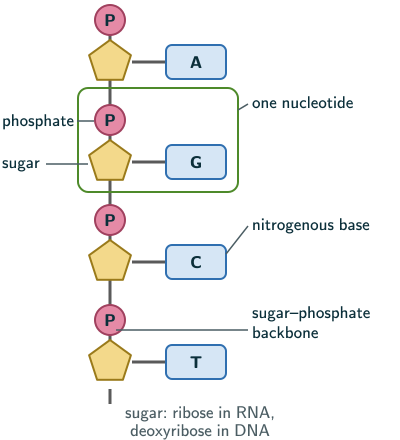
In plain words: a nucleic acid is a long chain of nucleotides, like beads on a string. Each bead has three parts, a ring-shaped base, a sugar and a phosphate, and the order of the bases along the chain is the stored information.
The nucleotide: base, sugar and phosphate
A nucleotide has three chemically distinct components (page 111):
- a heterocyclic compound, the nitrogenous base;
- a monosaccharide, the sugar;
- a phosphoric acid or phosphate.
Purines and pyrimidines
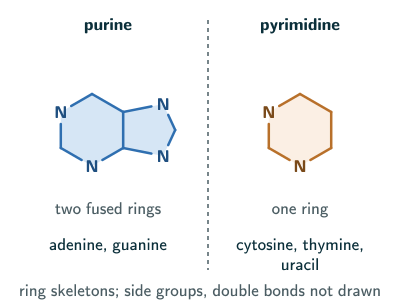
- The nitrogenous bases of nucleic acids are adenine, guanine, uracil, cytosine and thymine (page 111).
- Adenine and guanine are substituted purines; the rest, cytosine, uracil and thymine, are substituted pyrimidines. The skeletal heterocyclic rings are called purine and pyrimidine (page 111).
DNA and RNA
- The sugar in polynucleotides is either ribose (a monosaccharide pentose) or 2′-deoxyribose (page 111).
- “2′-deoxy” means one oxygen fewer: each ribose in RNA carries an –OH group at carbon 2′ that deoxyribose lacks (beyond the NCERT Class 11 text; NCERT Class 12 Biology, Chapter 5, page 87).
- A nucleic acid containing deoxyribose is deoxyribonucleic acid (DNA); one containing ribose is ribonucleic acid (RNA) (page 111).
- Nucleic acids serve as genetic material and carry hereditary information from parents to progeny (Summary, page 119).
Beyond the NCERT Class 11 text: the standard DNA bases are A, G, C and T, while the standard RNA bases are A, G, C and U (NCERT Class 12 Biology, Chapter 5, page 80).
NCERT’s chapter Summary says there are “5 types of nucleotides” (page 118). That counts one nucleotide per base, like the five NCERT names on page 106: adenylic, guanylic, cytidylic, thymidylic and uridylic acid. Counted with their sugar, nucleic acids have eight common nucleotides: four deoxyribonucleotides in DNA (with A, G, C, T) and four ribonucleotides in RNA (with A, G, C, U).
Solved examples
Example 1: Purine or pyrimidine?
Classify adenine, cytosine, guanine, thymine and uracil.
Answer: purines: adenine and guanine. Pyrimidines: cytosine, thymine and uracil (NCERT page 111).
Example 2: DNA or RNA?
A nucleic acid contains ribose. Is it DNA or RNA?
Answer: RNA, ribonucleic acid; DNA contains 2′-deoxyribose (NCERT page 111).
Example 3: Parts of a nucleotide
Name the three components of a nucleotide.
Answer: a heterocyclic nitrogenous base, a monosaccharide (pentose) sugar, and phosphoric acid or phosphate (NCERT page 111).
Example 4: Counting the nucleotides
How many different nucleotides occur commonly in DNA and RNA taken together?
Answer: eight: four deoxyribonucleotides (with A, G, C, T) in DNA and four ribonucleotides (with A, G, C, U) in RNA, 4 + 4 = 8. The A, G and C nucleotides of DNA and RNA differ in their sugar (beyond the NCERT text for the base content; NCERT page 111 for the sugars).
Common mistakes to avoid
Common mistake
Calling cytosine a purine
Only adenine and guanine are purines; cytosine, thymine and uracil are pyrimidines (NCERT page 111).
Common mistake
Mixing up five bases and eight nucleotides
NCERT’s “5 types of nucleotides” (page 118) counts one per base. Counted with the sugar there are eight, because A, G and C join deoxyribose in DNA and ribose in RNA, and DNA uses thymine where RNA uses uracil (beyond the NCERT Class 11 text). If a question quotes NCERT’s five, it means five kinds by base.
Common mistake
Calling a nucleoside a nucleotide
A nucleoside is a base joined to a sugar, such as adenosine; a nucleotide also has a phosphate esterified to the sugar, such as adenylic acid (NCERT page 106).
Quick revision summary
- Nucleic acids are polynucleotides in the acid-insoluble fraction; with polysaccharides and polypeptides they form the true macromolecular fraction.
- Nucleotide: nitrogenous base + sugar + phosphate.
- Purines: adenine, guanine; pyrimidines: cytosine, thymine, uracil.
- Ribose in RNA, 2′-deoxyribose in DNA; nucleic acids are genetic material.
Formula sheet
- nucleotide: base + sugar + phosphate
- purines: adenine, guanine
- pyrimidines: cytosine, thymine, uracil
- DNA: 2′-deoxyribose; RNA: ribose
Questions students ask
What is the difference between DNA and RNA?
DNA and RNA differ first in their sugar: DNA contains 2′-deoxyribose and RNA contains ribose (NCERT Class 11, page 111). Beyond the Class 11 text, NCERT Class 12 Biology adds that RNA has uracil in place of thymine, and that the extra –OH group at the 2′ position of every RNA nucleotide is reactive, making RNA labile and easily degradable, so DNA, chemically less reactive and structurally more stable, is the better genetic material (Chapter 5, pages 80–81 and 87). DNA is usually a double helix of two polynucleotide chains and is the genetic material of most organisms, while RNA is the genome of some viruses and has multiple cellular roles, including messenger RNA, transfer RNA and structural/catalytic ribosomal RNA (pages 79, 81 and 87).
What is the difference between purines and pyrimidines?
Purines and pyrimidines are the two kinds of nitrogenous bases in nucleic acids: adenine and guanine are substituted purines, while cytosine, thymine and uracil are substituted pyrimidines (NCERT page 111). A purine has two rings, a six-membered ring fused to a five-membered one, and a pyrimidine a single six-membered ring, as the drawings of adenine and uracil in NCERT Figure 9.1 show. In the DNA double helix, NCERT Class 12 Biology adds, adenine pairs with thymine by two hydrogen bonds and guanine with cytosine by three, so in these standard Watson–Crick pairs a purine comes opposite a pyrimidine, keeping the distance between the two strands approximately uniform (Chapter 5, page 81).
How are nucleotides joined to form a nucleic acid?
Nucleotides are joined into a nucleic acid by phosphodiester linkages: NCERT Class 12 Biology says two nucleotides are linked through a 3′–5′ phosphodiester linkage to form a dinucleotide, and more nucleotides joined in the same way form a polynucleotide chain (Chapter 5, page 80). The sugars and phosphates form the backbone of the chain, and the nitrogenous bases project from it. In NCERT’s linear-chain drawing, a 5′ phosphate marks the 5′ end and a free 3′–OH the 3′ end (page 81). These labels specify sugar-carbon direction; they do not imply that every natural nucleic acid has the same terminal chemistry or even free ends (circular DNA has none).
Why are nucleic acids called acids?
Nucleic acids are called acids because of their phosphate groups: the third component of every nucleotide is a phosphoric acid or phosphate (NCERT page 111), and a chain of nucleotides carries one in every unit. The ‘nucleic’ part comes from the nucleus: NCERT Class 12 Biology records that DNA was first identified as an acidic substance present in the nucleus by Friedrich Miescher (spelt Meischer in NCERT) in 1869, who named it ‘nuclein’ (Chapter 5, page 81).
Practice questions
Try each question first, then open the answer to check your working.
-
Q1. What is the building block of nucleic acids?
Show answerHide answer
The nucleotide (NCERT page 111).
-
Q2. What kind of sugar is ribose?
Show answerHide answer
A monosaccharide pentose (NCERT page 111).
-
Q3. Which three classes of compounds form the true macromolecular fraction of a cell?
Show answerHide answer
Nucleic acids, polysaccharides and polypeptides (NCERT page 111).