Structure of proteins
NCERT Class 11 Biology Chapter 9 Section 9.7
Quick answer
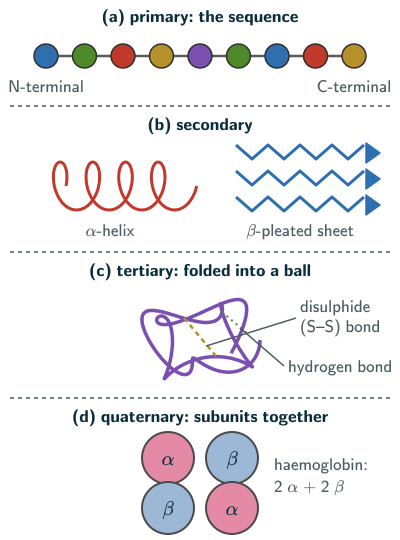
Biologists describe protein structure at four levels. The primary structure is the amino-acid sequence from the N-terminal to the C-terminal amino acid; secondary structure is the folding of parts of the chain into helices and other forms; tertiary structure is the folding of the whole chain like a hollow woollen ball, which proteins need for their activity. Quaternary structure is the arrangement of several subunits, as in haemoglobin with two α and two β chains.
With your textbook
NCERT Biology (Class 11), Chapter 9 “Biomolecules”, Section 9.7 “Structure of Proteins”, pages 111–112.
Open the official NCERT chapter (PDF, 1.9 MB, ncert.nic.in) (opens in a new tab)
Checked against the 2026-27 reprint on .
Structure of proteins
Levels of protein structure
Proteins are heteropolymers containing strings of amino acids, and biologists describe protein structure at four levels: primary, secondary, tertiary and quaternary (NCERT pages 111–112).
Tertiary structure is absolutely necessary for the many biological activities of proteins.
NCERT Biology (Class 11), Section 9.7, page 112
In plain words: a protein starts as a string of amino acids (primary), parts of the string coil or fold into regular shapes (secondary), the whole string then crumples into a particular three-dimensional shape (tertiary), and some proteins are made of several such folded strings fitted together (quaternary). For many proteins, activity depends on a particular folded shape; beyond NCERT, RCSB PDB’s Protein Hierarchical Structure guide explains that functional intrinsically disordered proteins or regions do not adopt one fixed fold.
NCERT illustrates several representations: molecular formulae, two-dimensional diagrams and three-dimensional structures (page111). These are representations used across chemistry and biology, not exclusive definitions assigned to different disciplines.
Primary structure
- The sequence of amino acids, that is, the positional information in a protein (which amino acid is first, which second, and so on), is its primary structure (page 111).
- A protein is imagined as a line: the left end is the first amino acid, the N-terminal amino acid, and the right end the last, the C-terminal amino acid (pages 111–112). The amino acids are joined by peptide bonds (page 109); the N-terminal amino acid carries the chain’s free amino (–NH) group and the C-terminal one its free carboxyl (–COOH) group (beyond the NCERT text).
Secondary structure
- A protein thread does not exist as an extended rigid rod. Some portions are folded into a helix, like a revolving staircase, and other regions are folded into other forms; this is the secondary structure (page 112). NCERT’s Figure 9.3 labels these forms the alpha-helix and the beta-pleated sheet.
- NCERT states that in proteins only right-handed helices are observed (page 112).
- Hydrogen bonds between the C=O and N–H groups of the backbone hold the alpha-helix and the beta-pleated sheet in shape, so hydrogen bonds are not only a tertiary-structure bond (beyond the NCERT Biology text).
The common alpha-helix formed from L-amino acids is right-handed; this is a strong preference, not a ban on every left-handed helical segment. Collagen, the protein NCERT names as the most abundant in the animal world (page 110), is different: NCERT’s Unit 3 opener credits G. N. Ramachandran with the discovery of its triple helical structure, published in Nature in 1954. Beyond the NCERT text, each of its three chains is coiled into a left-handed helix, and the three wind together into a right-handed triple helix. For NCERT-based exams, the answer for the alpha-helix is right-handed.
Tertiary structure
- The long protein chain is also folded upon itself like a hollow woollen ball, giving the tertiary structure, a three-dimensional view of the protein (page 112).
- Tertiary structure is absolutely necessary for the many biological activities of proteins. NCERT’s Figure 9.3 labels hydrogen bonds and disulphide bonds in it (page 112).
Quaternary structure
- Some proteins are an assembly of more than one polypeptide, or subunit. The way these folded subunits are arranged with respect to each other (a linear string of spheres, spheres arranged one upon another as a cube or plate, and so on) is the protein’s architecture, its quaternary structure (page 112).
- The predominant adult human haemoglobin has 4 subunits: two of α type and two of β type (HbA, page 112). This describes the predominant adult form, not every haemoglobin variant.
Solved examples
Example 1: Tertiary structure (NCERT Exercise 2)
What is meant by the tertiary structure of proteins?
Answer: the folding of the whole protein chain upon itself, like a hollow woollen ball, which gives the protein its three-dimensional shape. It is absolutely necessary for the many biological activities of proteins (NCERT page 112).
Example 2: Name the level
Name the level of structure in each: (a) the order of amino acids in insulin; (b) the helices in a protein thread; (c) the four subunits of haemoglobin.
Answer: (a) primary; (b) secondary; (c) quaternary (NCERT pages 111–112).
Example 3: The ends of a chain
Which amino acid of a protein is called the N-terminal amino acid, and which the C-terminal?
Answer: in the usual N-to-C drawing convention, the first residue at the left is N-terminal and the last at the right is C-terminal; these names refer to chemical groups, not an intrinsic left or right side (NCERT pages 111–112).
Common mistakes to avoid
Common mistake
Calling the amino-acid sequence the secondary structure
The sequence is the primary structure; secondary structure is the folding of parts of the chain into helices and other forms (NCERT pages 111–112).
Common mistake
Giving every protein a quaternary structure
Only proteins made of more than one polypeptide, such as haemoglobin, have a quaternary structure (NCERT page 112).
Quick revision summary
- Biologists describe protein structure at four levels.
- Primary: the amino-acid sequence, from the N-terminal (first) to the C-terminal (last) amino acid.
- Secondary: parts of the chain folded as helices (right-handed in NCERT) and other forms.
- Tertiary: the chain folded upon itself like a hollow woollen ball; needed for biological activity.
- Quaternary: the arrangement of subunits; predominant adult HbA has two α and two β subunits.
Formula sheet
- primary: the sequence of amino acids
- secondary: helix and other folded forms
- tertiary: three-dimensional folding of the whole chain
- quaternary: arrangement of subunits
- predominant adult haemoglobin HbA: 2 α + 2 β subunits
Questions students ask
What is the difference between primary and secondary structure of a protein?
The primary structure of a protein is the sequence of its amino acids, while the secondary structure is the folding of portions of that chain into a helix and into other forms (NCERT pages 111–112). The primary structure runs along the whole chain, its amino acids linked by peptide bonds (page 109), but only some portions of the thread form a helix, and NCERT describes these helices as right-handed (page 112); the usual alpha-helix is right-handed, while the collagen-chain exception is explained above. NCERT Class 12 Chemistry adds that the α-helix and β-pleated sheet arise from hydrogen bonds between the C=O and –NH– groups of peptide bonds, and that any change in the primary structure creates a different protein (Unit 10, page 293).
What is the difference between tertiary and quaternary structure of a protein?
Tertiary structure is the folding of one polypeptide chain upon itself into a three-dimensional shape, while quaternary structure is the arrangement of two or more such folded polypeptides, the subunits, with respect to each other (NCERT page 112). So a single-chain protein has a tertiary but no quaternary structure, while haemoglobin, with four subunits, has both. Myoglobin, the oxygen-storing pigment of muscle (NCERT Chapter 17, page 223), is one: a single globin chain with one haem group (beyond the NCERT text; MeSH, US National Library of Medicine). In either case the tertiary structure is the level NCERT calls absolutely necessary for the many biological activities of proteins.
Which bonds hold each level of protein structure?
Peptide bonds hold the primary structure, linking each amino acid to the next (NCERT page 109), and hydrogen bonds between the C=O and –NH– groups of the peptide bonds hold the secondary structure, the α-helix and β-pleated sheet (NCERT Class 12 Chemistry, Unit 10, page 293). The tertiary structure is held by the hydrogen bonds and disulphide bonds that NCERT Figure 9.3 labels, to which NCERT Class 12 Chemistry adds van der Waals and electrostatic forces. NCERT names no bonds for the quaternary structure: Class 12 Chemistry defines it only as the spatial arrangement of the subunits with respect to each other (Unit 10, page 293).
Why is tertiary structure necessary for a protein’s activity?
Tertiary structure is necessary for a protein’s activity because folding the chain gives the protein its working shape: in an enzyme, the folded chain criss-crosses itself, making crevices or pockets, and one is the active site into which the substrate fits (NCERT pages 112–113). So conditions that alter it, such as temperature and pH, change an enzyme’s activity, and high temperature destroys it because proteins are denatured by heat (page 116). NCERT Class 12 Chemistry adds that denaturation destroys the secondary and tertiary structures but leaves the primary structure intact, as when egg white coagulates on boiling (Unit 10, pages 294–295).
Practice questions
Try each question first, then open the answer to check your working.
-
Q1. How many subunits does predominant adult haemoglobin HbA have, and of what types?
Show answerHide answer
Four: two of α type and two of β type (NCERT page 112).
-
Q2. What does NCERT compare the helix of a protein thread to?
Show answerHide answer
A revolving staircase (NCERT page 112).
-
Q3. Which level of structure gives a protein its three-dimensional view?
Show answerHide answer
The tertiary structure (NCERT page 112).