Nucleic acids
NCERT Class 12 Chemistry Chapter 10 Section 10.5
Quick answer
Nucleic acids, DNA and RNA, are polynucleotides: each nucleotide is a base on C1′ of a pentose sugar with a phosphate on C5′, and phosphodiester links join the units 5′ to 3′. DNA has 2-deoxyribose and the bases A, G, C and T, while RNA has ribose and uracil in place of thymine. DNA is a double helix whose strands pair A with T and C with G through hydrogen bonds; it carries heredity and directs protein synthesis, and RNA is single-stranded.
With your textbook
NCERT Chemistry Part II (Class 12), Chapter 10 “Biomolecules”, Section 10.5 “Nucleic Acids”, pages 297–300.
Open the official NCERT chapter (PDF, 3.1 MB, ncert.nic.in) (opens in a new tab)
Checked against the 2026-27 reprint on .
What are nucleic acids?
Nucleic acids
Nucleic acids carry heredity, the passing of characteristics from one generation to the next. Together with proteins they make up the chromosomes in the cell nucleus. They are of two main types, deoxyribonucleic acid (DNA) and ribonucleic acid (RNA) (NCERT Section 10.5, page 297). Of their structure NCERT says:
Since nucleic acids are long chain polymers of nucleotides, so they are also called polynucleotides.
NCERT Chemistry Part II (Class 12), Section 10.5, page 297
In plain words: a nucleic acid is a long chain of repeating units. Each unit is a sugar carrying a base, and phosphate groups link the sugars together. The order of the bases along the chain is the stored information.
Chemical composition of nucleic acids
Complete hydrolysis of DNA or RNA gives three kinds of product: a pentose sugar, phosphoric acid and nitrogen-containing heterocyclic compounds called bases (NCERT page 297).
| Part | DNA | RNA |
|---|---|---|
| sugar | β-D-2-deoxyribose | β-D-ribose |
| bases | A, G, C, T | A, G, C, U |
The bases are adenine (A), guanine (G), cytosine (C), thymine (T) and uracil (U). DNA and RNA share A, G and C; DNA has thymine where RNA has uracil (NCERT page 298). NCERT’s box on James Watson calls them purine and pyrimidine bases (page 297); the Class 11 Biology page on nucleic acids shows which bases are which.
Structure of nucleic acids
- The sequence of nucleotides in a chain is the nucleic acid’s primary structure (NCERT page 299).
- Nucleotides are joined by phosphodiester linkages between the 5′ and 3′ carbon atoms of the pentose sugars (NCERT page 298). A simplified chain is …–sugar–phosphate–sugar–phosphate–…, with a base on each sugar (NCERT page 299).
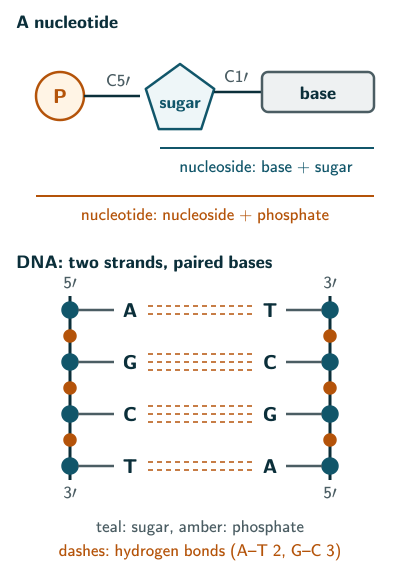
Nucleosides and nucleotides
- A nucleoside is a base attached at the 1′ position of the sugar; NCERT’s Class 12 Biology book calls this bond an N-glycosidic linkage (Chapter 5, page 80). The sugar carbons are numbered 1′, 2′, 3′ and so on, to tell them apart from the atoms of the base (NCERT page 298).
- A nucleotide is a nucleoside joined to phosphoric acid at the 5′ position of the sugar (NCERT page 298).
- So: nucleoside = base + sugar; nucleotide = base + sugar + phosphate (NCERT page 298).
Double helix of DNA
- James Watson and Francis Crick proposed that DNA is a double helix: two nucleic acid chains wound round each other and held together by hydrogen bonds between pairs of bases (NCERT page 299). Watson shared the 1962 Nobel Prize in Physiology and Medicine with Crick and Maurice Wilkins (NCERT page 297).
- The two strands are complementary, because hydrogen bonds form only between specific bases: adenine with thymine and cytosine with guanine (NCERT page 299).
- NCERT’s Class 12 Biology book adds the detail: A and T are joined by two hydrogen bonds and G and C by three (NCERT Figure 10.7 on page 299 already draws them as A=T and G≡C); the strands run in opposite directions; the helix is right-handed, with a pitch of 3.4 nm and about 10 base pairs per turn, so consecutive base pairs are about 0.34 nm apart (NCERT Class 12 Biology, Chapter 5, pages 81–82).
- RNA has a single-stranded helix, which sometimes folds back on itself. There are three types: messenger RNA (m-RNA), ribosomal RNA (r-RNA) and transfer RNA (t-RNA), which do different jobs (NCERT page 299).
Biological functions of nucleic acids
- DNA is the chemical basis of heredity, the store of genetic information. It is responsible for keeping each species’ identity over millions of years (NCERT page 300).
- DNA copies itself during cell division, and identical strands pass to the daughter cells (NCERT page 300).
- Nucleic acids direct protein synthesis: the proteins are made by RNA molecules, but the message for each protein is in the DNA (NCERT page 300).
- Har Gobind Khorana shared the 1968 Nobel Prize in Medicine and Physiology with Marshall Nirenberg and Robert Holley for cracking the genetic code (NCERT page 300).
DNA fingerprinting
- A person’s sequence of DNA bases is unique, and information about it is called DNA fingerprinting. It is the same in every cell, and NCERT notes that, unlike fingerprints, which surgery can alter, it cannot be altered by any known treatment (NCERT page 300).
- NCERT lists four uses (page 300):
- identifying criminals in forensic laboratories;
- settling the paternity of an individual;
- identifying bodies after an accident, by comparing their DNA with that of parents or children;
- identifying racial groups, to rewrite biological evolution.
- NCERT’s Class 12 Biology book explains the method and qualifies “unique” (Chapter 5, pages 105–107). About 99.9 per cent of the base sequence is the same in all humans, so DNA fingerprinting compares only regions of repetitive DNA, whose number of repeats varies greatly between people. The pattern differs from person to person except in identical (monozygotic) twins, who share it. The Biology book’s uses, forensic science, paternity testing and the study of population and genetic diversity, are in line with the list above. In an exam, give NCERT’s four uses; if asked whether a DNA fingerprint is always unique, name identical twins as the exception. The technique is on the Class 12 Biology page on DNA fingerprinting.
Solved examples
Example 1: Base composition of DNA
In a sample of double-stranded DNA, 22% of the bases are guanine. What percentages are cytosine, adenine and thymine?
Answer: Guanine pairs only with cytosine, so C = 22%. That leaves 100 − 44 = 56% for A and T, which pair with each other: A = T = 28% (reasoned from NCERT page 299; NCERT’s Class 12 Biology book records this equality as Chargaff’s observation, Chapter 5, page 81).
Example 2: Hydrogen bonds in a stretch of DNA
A stretch of double-stranded DNA has 10 base pairs, 4 of them A–T and 6 G–C. How many hydrogen bonds hold the strands together there?
Answer: 4 × 2 + 6 × 3 = 8 + 18 = 26 (A–T two bonds, G–C three: NCERT Class 12 Biology, page 81; reasoned).
Common mistakes to avoid
Common mistake
Dropping the primes on the sugar carbons
The sugar’s carbons are numbered 1′ to 5′, with primes, to tell them apart from the atoms of the base (NCERT page 298). So the base sits at C1′ and the phosphate at C5′. A number without a prime is a position in the base: in thymine, which NCERT’s Class 12 Biology book calls 5-methyl uracil (page 81), the 5 is a position on the base ring.
Common mistake
Putting thymine in RNA
RNA has uracil in place of thymine, and ribose in place of 2-deoxyribose.
Quick revision summary
- Nucleic acids (DNA, RNA) are polynucleotides; hydrolysis gives a pentose, phosphoric acid and bases.
- DNA: β-D-2-deoxyribose with A, G, C and T. RNA: β-D-ribose with A, G, C and U.
- Nucleoside: base at C1′ of the sugar. Nucleotide: nucleoside + phosphate at C5′. Phosphodiester links run between 5′ and 3′.
- DNA double helix (Watson and Crick): A pairs with T and C with G, through hydrogen bonds. RNA is single-stranded, of three types (m-, r-, t-RNA).
- Functions: heredity, self-duplication and protein synthesis. DNA fingerprinting (the same in every cell, and unique to each person except identical twins): forensics, paternity, identifying bodies.
Formula sheet
- Nucleoside: base + sugar (at C1′)
- Nucleotide: base + sugar + phosphate (at C5′)
- Base pairs: A with T, G with C
Practice questions
Try each question first, then open the answer to check your working.
-
Q1. What products would form when a nucleotide from DNA containing thymine is hydrolysed? (NCERT Intext Question 10.7, page 301.)
Show answerHide answer
Thymine, the sugar β-D-2-deoxyribose and phosphoric acid (NCERT pages 297–298).
-
Q2. When RNA is hydrolysed, there is no relationship among the quantities of the different bases obtained. What does this suggest about its structure? (NCERT Intext Question 10.8, page 301.)
Show answerHide answer
RNA is single-stranded. In double-stranded DNA each base is paired with its partner, so A equals T and G equals C; with no pairing partner strand, RNA’s base amounts need not match (reasoned from NCERT page 299).