DNA fingerprinting
NCERT Class 12 Biology Chapter 5 Section 5.10
Quick answer
DNA fingerprinting compares variable markers to assess identity or biological relationships. NCERT describes historical VNTR Southern blots; modern forensic profiles commonly use PCR-amplified STRs. A forensic match is weighed as a probability, and the band pattern differs from person to person except in identical twins.
With your textbook
NCERT Biology (Class 12), Chapter 5 “Molecular Basis of Inheritance”, Section 5.10 “DNA Fingerprinting”, pages 105–107.
Open the official NCERT chapter (PDF, 4.1 MB, ncert.nic.in) (opens in a new tab)
Checked against the 2026-27 reprint on .
What is DNA fingerprinting?
DNA fingerprinting
- About 99.9 per cent of the base sequence among humans is the same, and “It is these differences in sequence of DNA which make every individual unique in their phenotypic appearance” (page 105).
- Beyond the NCERT text: NHGRI calls 99.9 per cent a common but simplified figure, any two genomes being on average about 99.6 per cent identical, and notes that diet, environment, lifestyle and social context also contribute to a person’s uniqueness (NHGRI, Human Genomic Variation fact sheet). So appearance is not set by DNA alone; and DNA fingerprints differ from individual to individual except in monozygotic (identical) twins (NCERT page 106).
- Sequencing the DNA every time to find the genetic differences between two individuals, or among a population, would be a daunting and expensive task (page 105).
DNA fingerprinting is a very quick way to compare the DNA sequences of any two individuals.
NCERT Biology (Class 12), Section 5.10, page 105
In plain words: instead of reading all three billion letters of two people’s DNA, DNA fingerprinting looks only at a few stretches where people differ a lot, and produces a profile for comparison. NCERT describes the technique as it was first used, with VNTR band patterns (page 106). Beyond the NCERT text: national forensic systems now copy short tandem repeats (STRs, also called microsatellites) at a fixed set of core loci by PCR, and a match is given as a probability (Wikipedia, “DNA profiling”, facts in our words).
NCERT asks: assuming the human genome is 3 × 10 bp, at how many base positions would two people differ (page 105)? 0.1 per cent of 3 × 10 = 3 × 10 positions (Example 1).
Reading note (page 105): NCERT then speaks of comparing two sets of 3 × 10 base pairs. Sequencing two genomes means comparing two sets of about 3 × 10 bp each; 3 × 10 is the number of positions where they differ (our reading). If a question asks at how many positions two people differ, answer 3 × 10.
Repetitive DNA and satellite DNA
- DNA fingerprinting identifies differences in specific regions called repetitive DNA, in which a small stretch of DNA is repeated many times (page 105).
- In density gradient centrifugation, repetitive DNA separates from the bulk genomic DNA as different peaks: the bulk DNA forms a major peak, and the other, small peaks are called satellite DNA (page 105). Beyond the NCERT text: a repeat forms its own peak because its share of A : T and G : C pairs gives it a density different from that of bulk DNA; repeats whose base composition matches bulk DNA stay hidden in the main peak, as cryptic satellites (Wikipedia, “Satellite DNA”, facts in our words).
- Satellite DNA is classified by base composition (A : T rich or G : C rich), length of segment and number of repetitive units into categories such as micro-satellites and mini-satellites (page 105).
- These sequences normally do not code for any proteins, but they form a large part of the human genome, and they show a high degree of polymorphism, the basis of DNA fingerprinting (page 105).
- DNA from every tissue of an individual (blood, hair follicle, skin, bone, saliva, sperm and so on) shows the same degree of polymorphism, which makes it a very useful identification tool in forensic work; and because polymorphisms are inherited from parents to children, DNA fingerprinting is the basis of paternity testing in disputes (page 105).
- Reasoned from other NCERT pages: the DNA of a blood sample comes from its white cells, which are nucleated, as red cells have no nucleus in most mammals (NCERT Class 11 Biology, Chapter 15, page 194); and a single sperm has a haploid nucleus (NCERT Chapter 2, page 32), so it carries only one of a man’s two alleles at each autosomal locus; a semen sample, with its many sperm, still shows both.
DNA polymorphism
- Polymorphism, variation at the genetic level, arises from mutations (Chapter 4). New mutations may arise in somatic cells or in germ cells, the cells that generate gametes; if a germ-cell mutation does not seriously impair the ability to have offspring who can transmit it, it can spread to other members of the population through sexual reproduction (pages 105–106).
- An allelic sequence variation (see genes and alleles in Chapter 4) is called a DNA polymorphism if more than one variant (allele) at a locus occurs in the human population with a frequency greater than 0.01: this is how NCERT says a DNA polymorphism has traditionally been described (page 106). Being common does not make a variant harmless (our reasoning).
- Such variation is more likely in non-coding DNA, because mutations there may have no immediate effect on the ability to reproduce; they accumulate generation after generation (page 106). Beyond the NCERT text: non-coding DNA is not all idle; parts of it, such as the regulatory sequences that control gene expression, have functions (Wikipedia, “Non-coding DNA”, facts in our words), so a change there is not always harmless (our reasoning).
- Polymorphisms range from a single nucleotide change to very large-scale changes, and they play a very important role in evolution and speciation (page 106).
The technique: Alec Jeffreys and VNTRs
- The technique was first developed by Alec Jeffreys. He used as a probe a satellite DNA with a very high degree of polymorphism, the Variable Number of Tandem Repeats (VNTR) (page 106).
- As first used, it involved Southern blot hybridisation with a radiolabelled VNTR probe (page 106):
- isolation of DNA;
- digestion of DNA by restriction endonucleases;
- separation of the DNA fragments by electrophoresis;
- transferring (blotting) the separated fragments to synthetic membranes, such as nitrocellulose or nylon;
- hybridisation with the labelled VNTR probe;
- detection of the hybridised fragments by autoradiography.
- Beyond the NCERT text: before blotting, the separated fragments are denatured with alkali into single strands, so that the probe can pair with them (Wikipedia, “Southern blot”, facts in our words).
- The VNTR belongs to the mini-satellites: a small DNA sequence arranged tandemly in many copies. The copy number varies from chromosome to chromosome in an individual and is highly polymorphic, so VNTRs vary in size from 0.1 to 20 kb (page 106).
- After hybridisation, the autoradiogram shows many bands of different sizes, a pattern characteristic of an individual. It differs from person to person, except in monozygotic (identical) twins (see identical twins in Chapter 2) (page 106). Beyond the NCERT text: in forensic work a match is weighed by the chance that an unrelated person would show the same profile, so a match is a probability, not a proof on its own (Wikipedia, “DNA profiling”, facts in our words).
- The polymerase chain reaction (PCR), which you will study in Chapter 9, has made the technique so sensitive that DNA from a single cell is enough (page 106). Beyond the NCERT text: from so little DNA, chance effects in copying can miss one of a person’s two alleles at a locus (allelic dropout), so such low-template profiles are read with extra care (Wikipedia, “DNA profiling”, facts in our words).
- Besides forensic science, DNA fingerprinting is used to study population and genetic diversity; many different probes are now used (pages 106–107).
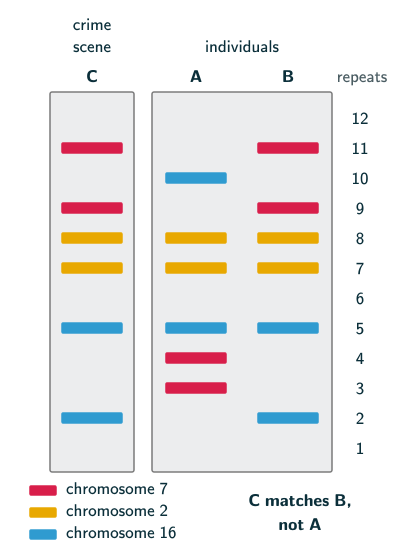
Reading NCERT Figure 5.16 (page 107): the chromosomes drawn for the crime scene (C) and individual B carry 11 and 9 repeats on chromosome 7, 8 and 7 on chromosome 2, and 5 and 2 on chromosome 16, and individual A carries 3 and 4, 8 and 7, and 5 and 10. So C matches B, not A. At the same locus, more repeats usually mean a longer fragment, which moves less far through the gel (reasoned from NCERT Chapter 9, page 168, where smaller fragments move farther). Across different loci, the size of the repeat unit and of the DNA flanking the repeats also set the fragment length, so the drawing assumes comparable lengths for illustration (our reasoning).
NCERT slip (page 107): in NCERT’s gel the two chromosome 2 bands of C and B are drawn about two repeats apart, though the chromosome drawings show 8 and 7 repeats; the figure above follows the chromosomes. The match of C with B is unaffected. If a question gives repeat numbers, place each band by its number.
Solved examples
Example 1: How many differences? (NCERT’s question, page 105)
If 99.9 per cent of the bases are the same in all humans and the genome is 3 × 10 bp, at how many positions do two people differ?
Answer: 100 − 99.9 = 0.1 per cent, and 0.1 per cent of 3 × 10 is 3 × 10 ÷ 1000 = 3 × 10 positions (NCERT page 105; our arithmetic).
Example 2: DNA fingerprinting and its uses (NCERT Exercise 13)
What is DNA fingerprinting? Mention its applications.
Answer: DNA fingerprinting is a very quick way to compare the DNA sequences of two individuals, using the polymorphism of repetitive DNA such as VNTRs: DNA is cut with restriction endonucleases, separated by electrophoresis, blotted, hybridised with a labelled VNTR probe and detected by autoradiography, giving a band pattern characteristic of the individual, which differs from person to person except in identical twins. Applications: identification in forensic science, paternity testing, and studies of population and genetic diversity (NCERT pages 105–107).
Example 3: Repetitive DNA and satellite DNA (NCERT Exercise 8 a)
Differentiate between repetitive DNA and satellite DNA.
Answer: repetitive DNA is DNA in which a small stretch is repeated many times. Satellite DNA is the part of it that separates from the bulk genomic DNA as small peaks in density gradient centrifugation; it is classified by base composition, segment length and number of repeats into micro-satellites, mini-satellites and so on, does not code for proteins and is highly polymorphic (NCERT page 105).
Example 4: A paternity question
At one VNTR locus a child has alleles of 6 and 9 repeats. The mother has 6 and 4. Man P has 9 and 12; man Q has 5 and 7. Which man could be the father?
Answer: the child got one allele from each parent. Assuming no mutation, dropout or sample error, the 6 can come from the mother and the 9 from the father. P carries a 9 and could be the father; Q has no 9, so he is excluded at this locus (our reasoning from NCERT’s point that polymorphisms are inherited from parents to children, page 105). P is compatible, not proven to be the father; real tests compare many loci and allow for new mutations and testing error (our reasoning).
Common mistakes to avoid
Common mistake
Thinking satellite DNA codes for proteins
Satellite DNA normally does not code for any proteins, though it forms a large part of the human genome (NCERT page 105).
Common mistake
Expecting identical twins to have different fingerprints
The band pattern differs from individual to individual except in monozygotic (identical) twins (NCERT page 106).
Common mistake
Calling every mutation a polymorphism
A variation is a DNA polymorphism when more than one allele at a locus occurs in the population at a frequency greater than 0.01 (NCERT page 106).
Common mistake
Blotting before separating
The DNA is first cut and separated by electrophoresis, and only then blotted onto the membrane and hybridised with the probe (NCERT page 106).
Quick revision summary
- 99.9 per cent of bases are the same in all humans; the 0.1 per cent difference, about 3 × 10 positions, makes individuals unique (NCERT; NHGRI gives about 99.6 per cent and adds non-DNA factors). DNA fingerprinting compares individuals quickly without full sequencing.
- Repetitive DNA separates as satellite DNA peaks in density gradient centrifugation; micro- and mini-satellites; non-coding but highly polymorphic; the same in every tissue; inherited (forensics, paternity).
- Polymorphism: inherited variation, more than one allele at a locus at a frequency above 0.01; commoner in non-coding DNA.
- Alec Jeffreys: VNTR (a mini-satellite, 0.1 to 20 kb) as probe; Southern blot: isolate, digest, electrophoresis, blot, hybridise, autoradiograph; unique bands except identical twins; PCR lets a single cell suffice.
Formula sheet
- 0.1 per cent of 3 × 10 = 3 × 10
- polymorphism: allele frequency above 0.01
- VNTR: mini-satellite, 0.1 to 20 kb
- steps: isolate, digest, electrophoresis, blot
- then hybridise with VNTR probe, autoradiograph
- unique pattern, except identical twins
Questions students ask
What is the difference between a VNTR and an STR?
A VNTR is a mini-satellite, as NCERT says (page 106), while, beyond the NCERT text, an STR (short tandem repeat) is a micro-satellite with much shorter repeat units: about 2 to 6 bp, against about 10 to 100 bp in a mini-satellite (Keerti and Ninave, Cureus, 2022, CC BY). Because STR regions are short, they are easily copied by PCR, and STR profiling has become the standard method of forensic DNA typing (the same review); the technique NCERT describes instead detected VNTRs by Southern blot hybridisation with a radiolabelled VNTR probe (page 106).
What is the difference between a VNTR and a VNTR probe?
A VNTR is a stretch of a person’s own DNA, a small sequence repeated tandemly in many copies, while a VNTR probe is a labelled, single-stranded piece of that repeat used to find such stretches: NCERT’s technique hybridises the blotted DNA fragments with a radiolabelled VNTR probe and detects them by autoradiography (page 106). NCERT Chapter 10 defines a probe as a single-stranded DNA or RNA tagged with a radioactive molecule, which hybridises to its complementary DNA (molecular diagnosis, page 183). So the VNTR is what is compared between people, and the probe is what makes it visible.
Is DNA fingerprinting the same as DNA profiling?
Beyond the NCERT text, which uses only the name DNA fingerprinting, DNA fingerprinting and DNA profiling are often used for each other but can be told apart: one 2022 review takes DNA fingerprinting to mean the older, lengthy VNTR-based methods and DNA profiling the PCR-based typing of STRs, a simpler method that can be automated, though its own title applies “DNA Fingerprinting” to STR typing (Keerti and Ninave, Cureus, 2022, CC BY; our reading of the title). NCERT itself notes that many different probes are now used to generate DNA fingerprints (page 107). Both compare people through polymorphism in repetitive DNA, which NCERT gives as the basis of DNA fingerprinting (page 105).
Practice questions
Try each question first, then open the answer to check your working.
-
Q1. Who first developed DNA fingerprinting, and what did he use as the probe?
Show answerHide answer
Alec Jeffreys; a highly polymorphic satellite DNA, the Variable Number of Tandem Repeats (VNTR) (NCERT page 106).
-
Q2. Onto which membranes are the separated DNA fragments blotted?
Show answerHide answer
Synthetic membranes such as nitrocellulose or nylon (NCERT page 106).
-
Q3. Why can DNA from hair, blood or saliva of the same person be used interchangeably in forensic work?
Show answerHide answer
Because DNA from every tissue of an individual shows the same degree of polymorphism (NCERT page 105).