Genetic code
NCERT Class 12 Biology Chapter 5 Section 5.6
Quick answer
The standard genetic code has 64 mRNA triplets: 61 specify amino acids and three are stop codons. It is degenerate, unambiguous within a specified reading frame and nearly universal; AUG specifies methionine and commonly initiates translation. tRNAs pair anticodons with codons, while release factors recognise standard stop codons.
With your textbook
NCERT Biology (Class 12), Chapter 5 “Molecular Basis of Inheritance”, Section 5.6 “Genetic Code”, pages 95–98.
Open the official NCERT chapter (PDF, 4.1 MB, ncert.nic.in) (opens in a new tab)
Checked against the 2026-27 reprint on .
What is the genetic code?
The genetic code
- In replication and transcription one nucleic acid is copied into another, by complementarity. Translation instead passes information from a polymer of nucleotides to a polymer of amino acids, and no complementarity exists between nucleotides and amino acids (page 95).
- There was ample evidence that changes in nucleic acids were responsible for changes in the amino acids of proteins (page 95).
This led to the proposition of a genetic code that could direct the sequence of amino acids during synthesis of proteins.
NCERT Biology (Class 12), Section 5.6, page 95
In plain words: the genetic code is the dictionary between the language of mRNA, written in four bases, and the language of proteins, written in 20 amino acids. Each three-base word, a codon, stands for one amino acid or for “stop”.
Cracking the code
Proposing and deciphering the code was the most challenging part of the story, and it needed physicists, organic chemists, biochemists and geneticists (page 95).
- George Gamow, a physicist, argued that with only 4 bases coding for 20 amino acids, the code must be a combination of bases. He suggested a code of three nucleotides, a bold proposal, because 4 = 4 × 4 × 4 = 64 codons, many more than required (page 95).
- Why not two? Our reasoning from Gamow’s numbers: pairs of bases give only 4 = 16 combinations, fewer than 20 amino acids.
- Har Gobind Khorana’s chemical method synthesised RNA molecules with defined combinations of bases (homopolymers and copolymers) (pages 95–96).
- Marshall Nirenberg’s cell-free system for protein synthesis finally helped decipher the code (page 96).
- Severo Ochoa’s enzyme, polynucleotide phosphorylase, was also helpful in polymerising RNA with defined sequences in a template-independent manner (enzymatic synthesis of RNA) (page 96). Give this line in an NCERT-based answer.
- NCERT slip (page 96): with no template, nothing sets the order of bases (our reasoning), and the early synthetic RNAs, poly-U and random two-base copolymers in set ratios, had a defined composition, not a defined order (Wikipedia, “Nirenberg and Matthaei experiment”, facts in our words). Ordered repeating sequences came from Khorana’s chemical method. In an NCERT-based answer, give NCERT’s line.
- Finally a checker-board of the code was prepared: NCERT Table 5.1 (page 96).
The codon table
NCERT Table 5.1 (page 96) lists the standard genetic code, with mRNA codons read 5′→3′. Below it is split by the first base. To find a codon, take the table for its first base, then the column for its second base and the row for its third base: UAC is in table U, column A, row C: Tyr.
First base U
| 3rd / 2nd | U | C | A | G |
|---|---|---|---|---|
| U | Phe | Ser | Tyr | Cys |
| C | Phe | Ser | Tyr | Cys |
| A | Leu | Ser | Stop | Stop |
| G | Leu | Ser | Stop | Trp |
First base C
| 3rd / 2nd | U | C | A | G |
|---|---|---|---|---|
| U | Leu | Pro | His | Arg |
| C | Leu | Pro | His | Arg |
| A | Leu | Pro | Gln | Arg |
| G | Leu | Pro | Gln | Arg |
First base A
| 3rd / 2nd | U | C | A | G |
|---|---|---|---|---|
| U | Ile | Thr | Asn | Ser |
| C | Ile | Thr | Asn | Ser |
| A | Ile | Thr | Lys | Arg |
| G | Met | Thr | Lys | Arg |
First base G
| 3rd / 2nd | U | C | A | G |
|---|---|---|---|---|
| U | Val | Ala | Asp | Gly |
| C | Val | Ala | Asp | Gly |
| A | Val | Ala | Glu | Gly |
| G | Val | Ala | Glu | Gly |
Features of the genetic code
NCERT lists the salient features (page 96):
- The codon is a triplet. 61 codons code for amino acids and 3 codons code for none: they are stop codons.
- Some amino acids are coded by more than one codon, so the code is degenerate.
- The codon is read in mRNA in a contiguous fashion: there are no punctuations.
- The code is nearly universal: from bacteria to humans, UUU codes for phenylalanine (Phe). Some exceptions have been found in mitochondrial codons and in some protozoans.
- AUG has dual functions: it codes for methionine (Met) and also acts as the initiator codon.
- UAA, UAG and UGA are the stop (terminator) codons.
Some amino acids are coded by more than one codon, hence the code is degenerate.
NCERT Biology (Class 12), Section 5.6, page 96
Reading NCERT Table 5.1 also shows that each codon stands for only one amino acid or for stop, never for two (our reading of the table). For a specified reading frame, start/stop sites and code, the amino-acid sequence is determined. An mRNA can contain multiple coding regions or undergo regulated recoding; one entire mRNA does not always mean one protein. Conversely, a protein sequence can correspond to many possible coding sequences; Examples 1 and 2 use this.
Mutations and the genetic code
- The relationship between genes and DNA is best understood through mutation studies. Large deletions and rearrangements in a segment of DNA may cause the loss or gain of a gene and so of a function (page 97).
- Point mutation: a classical example is a change of a single base pair in the gene for the beta globin chain that changes the amino acid residue glutamate to valine, causing sickle-cell anaemia (page 97).
- Insertions and deletions are explained with three-letter words, like codons (page 97):
| Change | The statement reads |
|---|---|
| none | RAM HAS RED CAP |
| insert B | RAM HAS BRE DCA P |
| insert BI | RAM HAS BIR EDC AP |
| insert BIG | RAM HAS BIG RED CAP |
| delete R | RAM HAS EDC AP |
| delete R, E | RAM HAS DCA P |
| delete R, E, D | RAM HAS CAP |
- In a coding region, an insertion/deletion whose length is not divisible by three changes the reading frame. A multiple of three preserves the downstream frame but can change junction codons if it is not codon-aligned; the word examples show aligned insertions/deletions (pages 97–98).
- NCERT slip (page 97): NCERT prints the inserted pair with an unpaired quote mark after BI; the inserted letters are just B and I, and the result is unaffected.
tRNA, the adapter molecule
- From the start, Francis Crick saw that something must read the code and link it to amino acids, because amino acids have no structural features that can read the code. He postulated an adapter molecule that would read the code on one side and bind a specific amino acid on the other (page 98).
- tRNA, then called sRNA (soluble RNA), was known before the genetic code was proposed, but its role as the adapter was recognised much later (page 98).
- tRNA has an anticodon loop with bases complementary to the code, and an amino acid acceptor end to which it binds its amino acid. tRNAs are specific for each amino acid (page 98).
- The anticodon pairs with the codon antiparallel, as the two DNA strands do: under the codon 5′-AGU-3′ (Ser) the anticodon reads 3′-UCA-5′, which written from its 5′ end is 5′-ACU-3′. NCERT Figure 5.12 and our figure write anticodons 3′ → 5′, left to right (reasoned from NCERT pages 81 and 99).
- For initiation there is a specific initiator tRNA. In ordinary standard-code termination, stop codons are recognised by release factors rather than tRNAs (page 98).
- NCERT Figure 5.12 (page 98) shows the secondary structure, which looks like a clover-leaf; the actual molecule is compact and looks like an inverted L (page 98).
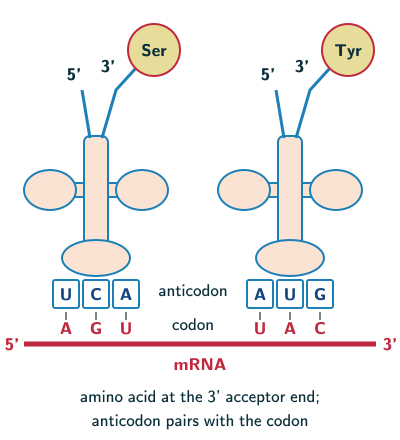
Useful scope: AUG is the usual start, but some organisms also use alternative start codons. In bacteria the initiator carries formylmethionine. Wobble pairing lets some tRNAs recognise more than one synonymous codon; special recoding contexts can use otherwise stop codons for amino acids such as selenocysteine. The table and exercises here use the standard code without recoding.
Solved examples
Example 1: Reading an mRNA (NCERT’s question, page 96)
Predict the amino acid sequence coded by the mRNA -AUG UUU UUC UUC UUU UUU UUC-.
Answer: from NCERT Table 5.1, AUG is Met, and both UUU and UUC are Phe: Met-Phe-Phe-Phe-Phe-Phe-Phe (NCERT page 96).
Example 2: Now the opposite (NCERT’s questions, page 97)
Predict the mRNA for Met-Phe-Phe-Phe-Phe-Phe-Phe. Is there any difficulty, and which two properties of the code does this show?
Answer: Met has one codon, AUG, but each Phe can be UUU or UUC, so the mRNA is AUG followed by six codons, each UUU or UUC: 2 = 64 possible sequences, and the protein alone cannot tell which one it came from. Reading forward gave one answer because each codon stands for one amino acid; going back is uncertain because the code is degenerate, some amino acids having more than one codon (NCERT page 96; our reasoning). The two properties: each codon codes for only one amino acid (the code is unambiguous; our reading of Table 5.1), and the code is degenerate.
Example 3: A frameshift in an mRNA
An mRNA reads 5′-AUG GCU UCA AAG UGG UAA-3′. What does it code for, and what does it code for after the first C (in GCU) is deleted?
Answer: before: AUG Met, GCU Ala, UCA Ser, AAG Lys, UGG Trp, UAA stop: Met-Ala-Ser-Lys-Trp. After the deletion the bases regroup from that point: AUG GUU CAA AGU GGU AA…, that is Met, Val, Gln, Ser, Gly, and the stop codon UAA is lost from the frame. In this example the downstream grouping changes: a frameshift. In general some amino acids can coincidentally remain the same, and translation may stop early (codons from NCERT Table 5.1, page 96; frameshift, page 97).
Example 4: Glutamate to valine
Using NCERT Table 5.1, which single base change in an mRNA codon turns glutamate into valine?
Answer: glutamate’s codons are GAA and GAG; valine’s include GUA and GUG. Changing the second base from A to U does it: GAA → GUA or GAG → GUG. In sickle-cell anaemia the change is in the sixth codon: GAG → GUG in the mRNA (GAG → GTG in the gene), glutamate (glutamic acid) → valine (NCERT Chapter 4, pages 74–75).
Example 5: The adapter (NCERT Exercises 11 b and 8 b)
What is the function of tRNA, and how does tRNA differ from mRNA?
Answer: tRNA is the adapter: its anticodon loop reads a codon by complementary pairing, and its acceptor end carries the matching amino acid (NCERT page 98). mRNA provides the template, the sequence of codons; tRNA brings amino acids and reads the genetic code (NCERT page 93). tRNAs are specific for each amino acid; there is a specific initiator tRNA, and there are no tRNAs for stop codons (page 98); a release factor binds to the stop codon (page 99).
Common mistakes to avoid
Common mistake
Saying all 64 codons code for amino acids
61 codons code for amino acids; UAA, UAG and UGA are stop codons that code for none (NCERT page 96).
Common mistake
Getting degeneracy backwards
Degenerate means one amino acid can have more than one codon (Phe: UUU, UUC); it does not mean one codon codes for several amino acids (NCERT page 96).
Common mistake
Writing the anticodon in the codon’s direction
For the codon 5′-AUG-3′ the anticodon is 3′-UAC-5′, that is 5′-CAU-3′, not 5′-UAC-3′: the two pair antiparallel (reasoned from NCERT pages 81 and 99).
Common mistake
Expecting a tRNA for each stop codon
In ordinary standard-code termination, release factors recognise stops; for initiation there is a specific initiator tRNA (NCERT page 98).
Quick revision summary
- No complementarity exists between nucleotides and amino acids, so a genetic code was proposed. Gamow: a triplet code, 4 = 64 codons; Khorana’s chemical synthesis, Nirenberg’s cell-free system and Ochoa’s enzyme helped decipher it into the checker-board of NCERT Table 5.1.
- Features: triplet; 61 codons for amino acids, 3 stop codons (UAA, UAG, UGA); degenerate; read contiguously without punctuation; nearly universal (exceptions in mitochondria and some protozoans); AUG codes for Met and starts translation.
- Point mutation: one base change, as in the beta globin gene (glutamate to valine, sickle-cell anaemia). Coding-region indels not divisible by three cause a frameshift; multiples of three preserve the downstream frame.
- tRNA (Crick’s adapter; once sRNA): anticodon loop and amino acid acceptor end; specific for each amino acid; initiator tRNA; ordinary termination uses release factors; clover-leaf in diagrams, inverted L in reality.
Formula sheet
- codon: triplet; 4 = 64 codons
- 61 for amino acids; 3 stop: UAA, UAG, UGA
- AUG: methionine and start
- degenerate: several codons for one amino acid
- coding indel not divisible by 3: frameshift
- coding indel divisible by 3: downstream frame preserved
- tRNA: anticodon loop, amino acid acceptor end
Questions students ask
Who discovered the genetic code?
The genetic code was cracked by several scientists rather than one: NCERT credits the physicist George Gamow with the idea of a three-base code, and the chemical synthesis of RNAs by Har Gobind Khorana, Marshall Nirenberg’s cell-free system and Severo Ochoa’s enzyme with deciphering it (pages 95–96). Beyond the NCERT text, Nirenberg first reported in August 1961 that a synthetic RNA of one repeated base made a chain of one amino acid, the code was complete within five years, and Robert Holley, Khorana and Nirenberg shared the 1968 Nobel Prize in Physiology or Medicine for interpreting it (Nobel Foundation, 1968).
What is the difference between a codon and an anticodon?
A codon is a triplet of bases in mRNA that stands for one amino acid or for stop, while an anticodon is the set of bases in the anticodon loop of a tRNA that is complementary to a codon (NCERT pages 96 and 98). Codons follow one another along the mRNA, read contiguously (page 96), while each tRNA has a single anticodon loop and is specific for one amino acid (page 98), and charged tRNAs pair with the codons one after another during translation (page 99). NCERT’s summary puts the link in one line: “The genetic code is read again on the principle of complementarity by tRNA that acts as an adapter molecule” (page 108).
Why is the genetic code a triplet code?
The genetic code is a triplet because three bases make the shortest code word that gives enough combinations for 20 amino acids: with 4 bases, single bases give only 4 words and pairs 4 = 16, too few (our arithmetic), while triplets give 4 = 64, as George Gamow argued (NCERT page 95). The 44 combinations beyond 20 are put to use: 61 codons code for amino acids, so some amino acids have more than one codon, and 3 are stop codons (page 96). Proposing the triplet was the easier part: NCERT calls providing proof that the codon was a triplet a more daunting task (page 95).
What is the difference between a codon and a gene?
A codon is a single three-base word of mRNA that stands for one amino acid or for stop (NCERT page 96), while a gene is the functional unit of inheritance, a far longer stretch of DNA: NCERT notes that a gene is difficult to define literally in terms of DNA sequence, and that DNA sequences coding for tRNA or rRNA also define genes (pages 92–93). A protein-coding gene thus carries, in DNA, the code for every codon of its polypeptide, since its coding strand has the same sequence as the RNA, with thymine in place of uracil (page 92). The gene is read when DNA is transcribed into RNA, the codon when tRNAs read the mRNA in translation (pages 91 and 98; our summary).
How is the mitochondrial genetic code different from the standard code?
The mitochondrial genetic code gives a few codons a different meaning from the standard code of NCERT Table 5.1, which is one reason NCERT calls the code nearly universal, with exceptions in mitochondrial codons (page 96). Beyond the NCERT text, in vertebrate mitochondria, human ones included, UGA codes for tryptophan instead of stop and AUA for methionine instead of isoleucine, among other changes, and yeast mitochondria differ again, reading CUU, CUC, CUA and CUG as threonine instead of leucine (NCBI, The Genetic Codes, tables 2 and 3). So there is no single mitochondrial code.
Practice questions
Try each question first, then open the answer to check your working.
-
Q1. Read the mRNA AUG GGA UGG CAC UAG with NCERT Table 5.1.
Show answerHide answer
AUG Met, GGA Gly, UGG Trp, CAC His, UAG stop: Met-Gly-Trp-His, then translation stops (NCERT page 96).
-
Q2. Which codon has two functions, and what are they?
Show answerHide answer
AUG: it codes for methionine and also acts as the initiator codon (NCERT page 96).
-
Q3. Where have exceptions to the universality of the code been found?
Show answerHide answer
In mitochondrial codons and in some protozoans (NCERT page 96).