The search for genetic material
NCERT Class 12 Biology Chapter 5 Section 5.2
Quick answer
Griffith (1928) found that a ‘transforming principle’ from heat-killed S bacteria made live R bacteria virulent, and Avery, MacLeod and McCarty (1933–44) showed that it was DNA. The unequivocal proof that DNA is the genetic material came from Hershey and Chase (1952): bacteria infected by phages with radioactive DNA became radioactive, while protein labelled with radioactive sulfur did not enter. DNA, being more stable, is preferred for storage of genetic information, and RNA for its transmission.
With your textbook
NCERT Biology (Class 12), Chapter 5 “Molecular Basis of Inheritance”, Section 5.2 “The Search for Genetic Material”, pages 84–88.
Open the official NCERT chapter (PDF, 4.1 MB, ncert.nic.in) (opens in a new tab)
Checked against the 2026-27 reprint on .
How was DNA shown to be the genetic material?
The genetic material
The unequivocal proof that DNA is the genetic material came from the experiments of Alfred Hershey and Martha Chase (1952).
NCERT Biology (Class 12), Section 5.2.1, page 85
- By 1926 the search had narrowed to the chromosomes in the nucleus, but which molecule carried the genes was still unknown (page 84).
- Three lines of work answered it: Griffith found a “transforming principle” (1928), Avery, MacLeod and McCarty showed it was DNA (1933–44), and Hershey and Chase gave the unequivocal proof that DNA is the genetic material, working with bacteriophages (1952) (pages 84–85).
In plain words: scientists knew genes sat on chromosomes, which hold both protein and DNA, and many expected protein to be the genetic material. A series of experiments with bacteria and their viruses showed that it is DNA that carries the information from one generation to the next.
Griffith’s transforming principle
- In 1928, Frederick Griffith worked with Streptococcus pneumoniae, the bacterium responsible for pneumonia (page 84).
- On a culture plate some bacteria form smooth, shiny colonies (S strain), which have a mucous (polysaccharide) coat, and others form rough colonies (R strain), which have none (page 84).
- Mice infected with the S strain die of pneumonia; mice infected with the R strain do not (page 84).
- Heat-killed S bacteria do not kill mice. But a mixture of heat-killed S and live R bacteria killed the mice, and living S bacteria were recovered from them (pages 84–85).
- Griffith concluded that the R bacteria had been transformed by the heat-killed S bacteria: some “transforming principle” passed from them let the R strain make a smooth polysaccharide coat and become virulent. This must be a transfer of genetic material, but the experiment did not show what it was chemically (page 85).
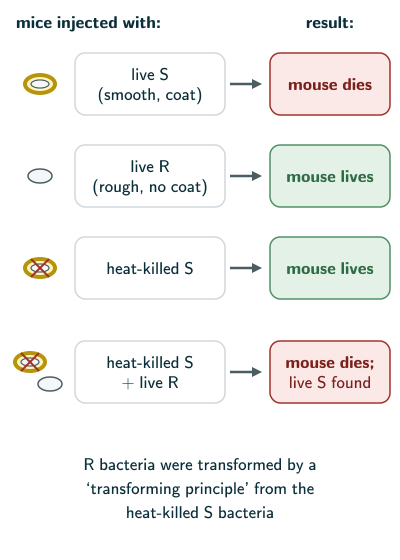
Avery, MacLeod and McCarty
- Before the work of Oswald Avery, Colin MacLeod and Maclyn McCarty (1933–44), the genetic material was thought to be a protein (page 85).
- They purified proteins, DNA, RNA and other biochemicals from heat-killed S cells to see which could transform live R cells into S cells. DNA alone from S bacteria transformed R bacteria (page 85).
- Proteases (protein-digesting enzymes) and RNases (RNA-digesting enzymes) did not affect transformation, so the transforming substance was neither protein nor RNA. DNase inhibited it, suggesting that DNA caused it (page 85).
- They concluded that DNA is the hereditary material, though not all biologists were convinced (page 85).
NCERT asks for a difference between DNA and DNase (page 85): DNA is the nucleic acid that carries the hereditary information, while DNase is an enzyme that digests DNA, which is why it blocked transformation.
Hershey and Chase’s experiment
- Alfred Hershey and Martha Chase (1952) worked with viruses that infect bacteria, called bacteriophages. A phage attaches to a bacterium, and its genetic material enters the cell, which then makes more virus particles (page 85). Beyond the NCERT text: the phage they used was T2 (Wikipedia, “Hershey–Chase experiment”, facts in our words).
- They grew some phages on a medium with radioactive phosphorus and others on a medium with radioactive sulfur. DNA contains phosphorus but protein does not, and DNA does not contain sulfur, so the first phages had radioactive DNA and the second radioactive protein (page 85). Beyond the NCERT text: the phages were grown in bacteria cultured on the labelled media, with P labelling the DNA and S the protein (Wikipedia, “Hershey–Chase experiment”, facts in our words); phages multiply only inside bacteria, as NCERT page 85 implies when it says the bacterial cell makes the virus particles (our reasoning).
- NCERT slip (page 85): “protein does not” contain phosphorus is too broad as a general rule. Amino acids have no phosphorus, but some proteins carry phosphate groups attached after they are made (Wikipedia, “Phosphoprotein” and “Hershey–Chase experiment”, facts in our words). In the experiment the phosphorus label still marked the phage DNA. In an exam, give NCERT’s reason: DNA contains phosphorus but protein does not.
- The radioactive phages infected E. coli. As the infection proceeded, a blender removed the viral coats, and a centrifuge separated the virus particles from the bacteria (page 86).
- Bacteria infected by phages with radioactive DNA were radioactive; bacteria infected by phages with radioactive protein were not. So DNA, not protein, passed from the virus into the bacteria: DNA is the genetic material (page 86).
- Beyond the NCERT text: the separation in the 1952 experiment was incomplete. About 20 per cent of the P stayed outside the cells, and the progeny phages carried the phosphorus label but not the sulfur label (Wikipedia, “Hershey–Chase experiment”, facts in our words). A 2016 history goes further: it judges the experiment so contaminated that it did not in fact show DNA to be the genetic material of viruses, notes that Hershey did not claim it did, and describes how DNA won acceptance gradually in the 1950s as several lines of evidence converged (Cobb, PLOS Biology, 2016, CC BY). In an exam, give NCERT’s account: the experiment gave the unequivocal proof that DNA is the genetic material (page 85).
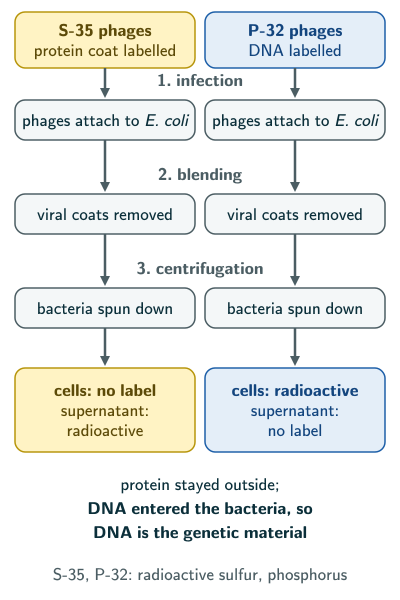
Properties of genetic material: DNA versus RNA
- DNA is the genetic material of cellular organisms and many viruses; in other viruses RNA is the genetic material, for example tobacco mosaic virus and the Qβ bacteriophage (pages 86–87).
NCERT slip (page 87): NCERT prints “QB bacteriophage”; the phage is Qβ (Q-beta), with a Greek beta (NCBI RefSeq NC_001890.1). Write Qβ in an answer.
Criteria for a genetic material
A molecule that acts as genetic material must (page 87):
- be able to generate its replica (replication);
- be stable chemically and structurally;
- provide scope for slow changes (mutation) needed for evolution;
- be able to express itself in the form of Mendelian characters.
Why DNA is more stable than RNA
- Replication: because of the rule of base pairing and complementarity, both DNA and RNA have the ability to direct their duplications; other molecules in the living system, such as proteins, fail to fulfil this first criterion itself (page 87). Beyond the NCERT text (our reading): “direct their duplications” means acting as templates, with the copying machinery and substrates; a naked nucleic acid does not copy itself unaided.
- Stability: the genetic material should be stable enough not to change with the stage of the life cycle, age or physiology. Griffith’s “transforming principle” showed that heat, which killed the bacteria, did not destroy some properties of the genetic material, and NCERT explains this by DNA’s two complementary strands coming together again, when appropriate conditions are provided, after heating separates them (page 87). Beyond the NCERT text (our reading): Griffith’s experiment itself did not show strand separation and reannealing as the mechanism.
- The 2′–OH group present at every nucleotide in RNA is a reactive group and makes RNA labile and easily degradable; RNA is also now known to be catalytic, hence reactive. So DNA is chemically less reactive and structurally more stable, and the presence of thymine in place of uracil confers additional stability on DNA (page 87). Beyond the NCERT text (our reasoning): being catalytic does not by itself make a molecule unstable; the 2′–OH is what makes RNA’s backbone easier to break.
- Mutation: both DNA and RNA are able to mutate; RNA, being unstable, mutates at a faster rate, so viruses having an RNA genome and a shorter life span mutate and evolve faster (page 87). Beyond the NCERT text: the RNA-copying enzymes of most RNA viruses cannot check and correct their own errors, as DNA polymerases do (Wikipedia, “RNA virus”, facts in our words); fast replication adds to this (our reasoning). Give NCERT’s reason in an NCERT-based answer.
- Expression: RNA can directly code for the synthesis of proteins, and so can easily express the characters; DNA depends on RNA for the synthesis of proteins, and the protein-synthesising machinery has evolved around RNA (page 87). Only mRNA provides the template for translation, rRNA and tRNA having other roles (NCERT page 93); beyond the NCERT text, negative-sense RNA viral genomes must first be copied into mRNA (Wikipedia, “RNA virus”, facts in our words).
Therefore, DNA chemically is less reactive and structurally more stable when compared to RNA.
NCERT Biology (Class 12), Section 5.2.2, page 87
So both RNA and DNA can function as genetic material, but DNA, being more stable, is preferred for storage of genetic information, and RNA is better for its transmission (pages 87–88). NCERT also asks for the two chemical differences between DNA and RNA (page 87): RNA has an extra 2′–OH on its ribose, and uracil in place of thymine (see DNA and RNA in Class 11).
Solved examples
Example 1: Telling DNA from protein (NCERT Exercise 7)
How did Hershey and Chase differentiate between DNA and protein in their experiment while proving that DNA is the genetic material?
Answer: they used the element that only one of the two contains. DNA contains phosphorus but protein does not, and DNA does not contain sulfur, so phages grown with radioactive phosphorus had radioactive DNA, and phages grown with radioactive sulfur had radioactive protein (NCERT page 85). After infection, blending and centrifuging, the bacteria infected by the phosphorus-labelled phages were radioactive and those infected by the sulfur-labelled phages were not, so DNA had entered the bacteria (NCERT page 86). Beyond the NCERT text: the separation was incomplete, as the notes above explain (Wikipedia, “Hershey–Chase experiment”; Cobb, PLOS Biology, 2016), and NCERT’s “protein does not” contain phosphorus is not true of every protein (see the NCERT slip above).
Example 2: Reading Griffith’s results
Which of Griffith’s four injections shows that the genetic material survives heat, and why?
Answer: heat-killed S + live R. Heat-killed S alone did not kill mice, yet with live R it did, and live S bacteria were recovered. Something in the heat-killed S cells survived the heat and changed R cells into S cells (NCERT pages 84–85, 87).
Example 3: Enzymes as tests
In Avery, MacLeod and McCarty’s work, what result did each enzyme give, and what did each rule out?
Answer: proteases left transformation unchanged, so the transforming substance is not protein; RNases left it unchanged, so it is not RNA; DNase stopped it, so DNA is the transforming substance (NCERT page 85).
Common mistakes to avoid
Common mistake
Crediting Griffith with identifying DNA
Griffith showed that a transforming principle exists; Avery, MacLeod and McCarty identified it as DNA, and Hershey and Chase gave the unequivocal proof that DNA is the genetic material, working with bacteriophages (NCERT pages 85–86).
Common mistake
Swapping the labels
Radioactive phosphorus labels DNA; radioactive sulfur labels protein (NCERT page 85).
Common mistake
Saying RNA cannot be a genetic material
RNA is the genetic material of some viruses, such as tobacco mosaic virus; DNA is preferred for storage because it is more stable (NCERT pages 87–88).
Quick revision summary
- Griffith (1928): heat-killed S + live R bacteria killed mice and live S were recovered: a transforming principle.
- Avery, MacLeod and McCarty (1933–44): DNA alone transformed R into S; proteases and RNases had no effect, DNase stopped it.
- Hershey and Chase (1952): phosphorus-labelled DNA, not sulfur-labelled protein, entered the bacteria: DNA is the genetic material.
- A genetic material must replicate, be stable, allow slow mutation and express itself as Mendelian characters.
- DNA is more stable (no reactive 2′–OH, thymine, complementary strands); mRNA supplies the template for translation. Beyond NCERT: viral mutation rates depend mainly on copying fidelity, not simply on RNA fragility.
Formula sheet
- Griffith 1928: transforming principle
- Avery, MacLeod, McCarty 1933–44: DNA
- Hershey, Chase 1952: unequivocal proof, DNA
- radioactive P → DNA; radioactive S → protein
- DNA: storage; RNA: transmission
Questions students ask
What is the difference between Griffith’s experiment and Avery’s experiment?
Griffith’s experiment and Avery’s differ in what they asked and how: Griffith (1928) used mice to show that something from heat-killed S bacteria could change live R bacteria into virulent S bacteria, while Avery, MacLeod and McCarty (1933–44) set out to find what that something was chemically (NCERT pages 84–85). Griffith read his result from whether the injected mice died and whether living S bacteria could be recovered from them; Avery’s team purified proteins, DNA, RNA and other biochemicals from heat-killed S cells and tested each for the power to turn live R cells into S cells, finding it in DNA alone (page 85). Both worked with the same bacterium, Streptococcus pneumoniae.
Why was the Hershey–Chase experiment needed after Avery’s experiment?
The Hershey–Chase experiment was needed because Avery, MacLeod and McCarty’s conclusion that DNA is the hereditary material did not convince all biologists (NCERT page 85); beyond the NCERT text, Avery’s colleague Alfred Mirsky, for one, argued that traces of protein in the purified DNA might be doing the transforming (Cobb, PLOS Biology, 2016, CC BY). Hershey and Chase (1952) needed no purified DNA: they labelled the DNA and the protein of whole bacteriophages separately, and the DNA label, not the protein label, entered E. coli (pages 85–86). Beyond the NCERT text, historians note that the separation was incomplete and that DNA was accepted only gradually in the 1950s (Cobb, 2016).
In which years were the Griffith, Avery and Hershey–Chase experiments done?
The three classic experiments on the genetic material date from 1928 for Frederick Griffith’s transforming principle, 1933–44 for Oswald Avery, Colin MacLeod and Maclyn McCarty’s identification of it as DNA, and 1952 for Alfred Hershey and Martha Chase’s work with bacteriophages (NCERT pages 84–85). They fall between Friedrich Miescher’s discovery of DNA, which he named ‘nuclein’, in 1869 (NCERT prints the name as Meischer) and Watson and Crick’s double helix of 1953 (page 81); by 1926 the search had already narrowed to the chromosomes (page 84). Beyond the NCERT text, Avery’s team published its key paper in 1944, in the Journal of Experimental Medicine (Cobb, PLOS Biology, 2016, CC BY).
Why was protein once thought to be the genetic material?
Protein was thought to be the genetic material until Avery, MacLeod and McCarty’s work (NCERT page 85) because, beyond the NCERT text, the endless variety that genes needed seemed to fit proteins, while DNA, believed to be a monotonous mix of its four bases in near-equal shares, seemed too uniform to carry specific instructions (Cobb, PLOS Biology, 2016, CC BY). Chromosomes hold both DNA and proteins, so either could have been the answer (NCERT pages 83–84).
Practice questions
Try each question first, then open the answer to check your working.
-
Q1. Which strain of Streptococcus pneumoniae has a polysaccharide coat, and is it virulent?
Show answerHide answer
The S strain (smooth colonies); it is virulent: mice infected with it die of pneumonia (NCERT page 84).
-
Q2. Name two examples NCERT gives of viruses with RNA as the genetic material.
Show answerHide answer
Tobacco mosaic virus and the Qβ bacteriophage, which NCERT prints as QB (NCERT page 87).
-
Q3. Why is RNA labile and easily degraded?
Show answerHide answer
The 2′–OH group present at every nucleotide in RNA is a reactive group and makes RNA labile and easily degradable; RNA is also catalytic, hence reactive (NCERT page 87). Beyond the NCERT text: the 2′–OH is what lets the backbone break (our reasoning).