Transcription
NCERT Class 12 Biology Chapter 5 Section 5.5
Quick answer
Transcription synthesises RNA 5′ → 3′ using a DNA template read 3′ → 5′. Bacterial sigma factors aid promoter recognition; termination can be rho-dependent or intrinsic. Eukaryotic nuclear polymerases I–III make different RNAs, and typical pre-mRNA undergoes capping, splicing and polyadenylation.
With your textbook
NCERT Biology (Class 12), Chapter 5 “Molecular Basis of Inheritance”, Section 5.5 “Transcription”, pages 91–95.
Open the official NCERT chapter (PDF, 4.1 MB, ncert.nic.in) (opens in a new tab)
Checked against the 2026-27 reprint on .
What is transcription?
Transcription
The process of copying genetic information from one strand of the DNA into RNA is termed as transcription.
NCERT Biology (Class 12), Section 5.5, page 91
- The principle of complementarity governs transcription too, except that adenine (NCERT writes “adenosine”, the nucleoside) now pairs with uracil instead of thymine (page 91).
- Unlike a complete genome-replication round, transcription copies only a segment of DNA and only one of its strands into RNA. So the region and the strand to be transcribed must be marked by boundaries (page 91).
In plain words: a gene’s instructions are read off one DNA strand and written as a single-stranded RNA copy, which the cell can use, for example to make a protein. Only the stretch needed is copied, and only from one strand.
Why only one strand is copied
For one transcription unit only one strand is the template; NCERT gives two reasons (page 91). Different genes can use opposite strands (reasoned from NCERT page 92: switching the promoter’s position reverses the template and coding strands):
- If both strands acted as templates, they would code for RNA molecules with different sequences (complementarity does not mean identical), and so for proteins with different amino acid sequences. One segment of DNA would code for two different proteins, which would complicate the transfer of genetic information.
- The two RNA molecules, made at the same time, would be complementary to each other and would form a double-stranded RNA. This would prevent the RNA from being translated into protein, and transcription would be futile (page 91). Double-stranded RNA is not always useless, though: in RNA interference, a method of cellular defence in all eukaryotes, a complementary double-stranded RNA silences a specific mRNA by preventing its translation (NCERT Chapter 10, page 180).
The transcription unit
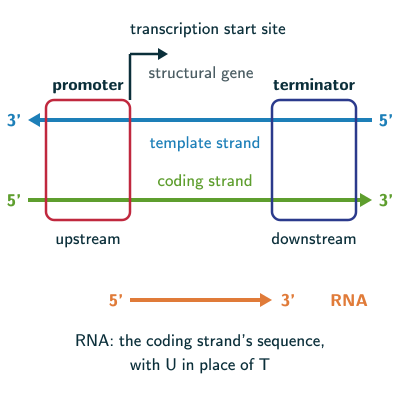
A transcription unit in DNA is defined by three regions (page 91): a promoter, the structural gene and a terminator.
- DNA-dependent RNA polymerase also polymerises in only one direction, 5′ → 3′. The enzyme reads its template 3′ → 5′ in the direction of transcription: the template strand (page 92).
- The other strand, with polarity 5′ → 3′ and the same sequence as the RNA (except thymine in place of uracil), is displaced during transcription. NCERT notes that, strangely, this strand, “which does not code for anything”, is referred to as the coding strand. All reference points of a transcription unit are given with respect to the coding strand (page 92). Beyond the NCERT text (our reasoning from page 92): it is called coding because its sequence corresponds to the RNA; not being this transcript’s template does not mean that it codes for nothing.
- The promoter lies towards the 5′ end (upstream) of the structural gene, with respect to the coding strand. It is a DNA sequence that provides the binding site for RNA polymerase, and its presence also defines which strand is the template and which the coding strand: by switching its position with the terminator, the definition of coding and template strands could be reversed (page 92). Beyond the NCERT text: it is the promoter’s orientation that sets the direction of transcription (our reasoning).
- The terminator lies towards the 3′ end (downstream) of the coding strand and usually defines the end of transcription. Further regulatory sequences may lie upstream or downstream of the promoter (page 92).
The transcription unit and the gene
- A gene is defined as the functional unit of inheritance. Genes are on the DNA, but a gene is hard to define as a DNA sequence: the DNA that codes for a tRNA or an rRNA molecule also defines a gene (pages 92–93).
- A cistron is a segment of DNA coding for a polypeptide. The structural gene of a transcription unit is monocistronic mostly in eukaryotes and polycistronic mostly in bacteria and other prokaryotes (page 93).
- In eukaryotes the monocistronic structural genes have interrupted coding sequences: the genes are split. The coding or expressed sequences are exons, the sequences that appear in the mature or processed RNA; they are interrupted by introns (page 93). Beyond the NCERT text: exons also include the untranslated stretches at the two ends of an mRNA, and some exons are wholly non-coding (NHGRI Talking Glossary, public domain; Wikipedia, “Exon”, facts in our words); yeast has very few introns (Wikipedia, “Exon”); and in alternative splicing, exons from the same gene are joined in different combinations, giving different but related mRNAs (NHGRI Talking Glossary).
Introns or intervening sequences do not appear in mature or processed RNA.
NCERT Biology (Class 12), Section 5.5.2, page 93
- Inheritance of a character is also affected by the promoter and regulatory sequences of a structural gene, so the regulatory sequences are sometimes loosely called regulatory genes, even though these sequences do not code for any RNA or protein (page 93). A regulatory gene in the strict sense does code for a product: the lac operon’s regulatory gene, the i gene, codes for the repressor (NCERT page 100), whereas a promoter is a control sequence in the DNA itself (reasoned from NCERT pages 92, 93 and 100).
Three types of RNA
In bacteria there are three major types of RNA, and all three are needed to make a protein (page 93):
- mRNA (messenger RNA) provides the template;
- tRNA (transfer RNA) brings amino acids and reads the genetic code;
- rRNA (ribosomal RNA) plays structural and catalytic roles during translation.
Transcription in bacteria
- A single DNA-dependent RNA polymerase transcribes all types of RNA in bacteria (page 93).
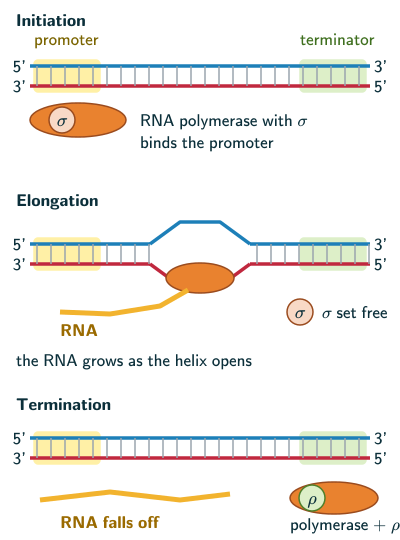
- Initiation: the RNA polymerase binds to the promoter and starts transcription (page 93).
- Elongation: it uses nucleoside triphosphates as substrates and polymerises in a template-dependent way, following the rule of complementarity. It also helps open the helix as it moves on. Only a short stretch of RNA stays bound to the enzyme (pages 93–94).
- Termination: when the polymerase reaches the terminator, the nascent RNA falls off, and so does the RNA polymerase (page 94).
The RNA polymerase is only capable of catalysing the process of elongation.
NCERT Biology (Class 12), Section 5.5.3, page 94
- It associates transiently with the initiation-factor (σ) and the termination-factor (ρ) to initiate and terminate transcription, respectively; association with these factors alters the specificity of the RNA polymerase to either initiate or terminate (page 94). In an NCERT-based answer, name σ as the initiation factor and ρ as the termination factor.
- Beyond the NCERT text: sigma lets bacterial RNA polymerase recognise the promoter, and the polymerase itself makes the first bonds as well as elongating; termination can be rho-dependent or rho-independent (intrinsic), where a hairpin in the RNA stalls the polymerase (Wikipedia, “Bacterial transcription”, facts in our words). So NCERT’s “only capable of catalysing the process of elongation” and a universal rho requirement are simplifications.
- In bacteria the mRNA does not require any processing to become active, and transcription and translation take place in the same compartment: there is no separation of cytosol and nucleus in prokaryotic cells. So translation can often begin before the mRNA is fully transcribed: transcription and translation can be coupled in bacteria (page 94).
Transcription in eukaryotes
Eukaryotes have two additional complexities (pages 94–95).
1. At least three RNA polymerases in the nucleus, besides the RNA polymerase of the organelles, with a clear division of labour:
| Enzyme | Transcribes |
|---|---|
| RNA polymerase I | rRNAs (28S, 18S and 5.8S) |
| RNA polymerase II | the precursor of mRNA, the heterogeneous nuclear RNA (hnRNA) |
| RNA polymerase III | tRNA, 5S rRNA and snRNAs (small nuclear RNAs) |
The table follows NCERT (pages 94–95); give it in an NCERT-based answer. Beyond the NCERT text: polymerase II also makes many other non-coding RNAs, including most snRNAs (the Sm class, such as U1, U2, U4 and U5), while polymerase III makes the Lsm-class snRNAs, notably U6 (Wikipedia, “Small nuclear RNA”, facts in our words).
NCERT slip (page 95): NCERT prints “5srRNA” in the polymerase III list; it is 5S rRNA, S being the Svedberg unit as in 28S, 18S and 5.8S one line above. In an answer, write 5S rRNA.
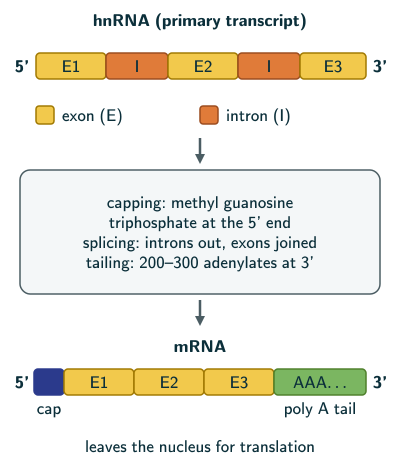
2. Processing of the primary transcript. The primary transcripts contain both the exons and the introns and are non-functional (page 95); NCERT calls the precursor of mRNA hnRNA (page 95). Beyond the NCERT text: hnRNA is a broader heterogeneous nuclear-RNA category, and not every eukaryotic transcript has introns or receives all the modifications below (our reading; yeast has very few introns, Wikipedia, “Exon”):
- Splicing: the introns are removed and the exons are joined in a defined order.
- Capping: an unusual nucleotide, methyl guanosine triphosphate, is added to the 5′ end of hnRNA (page 95). Beyond the NCERT text: the cap is a 7-methylguanosine, joined to the RNA by a triphosphate bridge between the two 5′ ends (Wikipedia, “Five-prime cap”, facts in our words).
- Tailing: a poly(A) tail is added; NCERT uses 200–300 adenylate residues (page 95); beyond the NCERT text, the length varies (our reading). These are added at the 3′ end, in a template-independent manner.
- The processed mRNA is transported out of the nucleus for translation.
Beyond the NCERT text: alternative splicing assembles different mRNAs from one gene (above), and the cap helps the mRNA’s export from the nucleus, protects it from breakdown and promotes its translation (Wikipedia, “Five-prime cap”, facts in our words). NCERT connects splicing with an ancient RNA world (page 95). NCERT says the split-gene arrangements represent “probably an ancient feature of the genome” (page 95): an interpretation, not a proof of how introns arose (our reading).
Solved examples
Example 1: RNA from NCERT’s sample unit (NCERT’s question, page 92)
NCERT gives a template strand 3′-ATGCATGCATGCATGCATGCATGC-5′ and a coding strand 5′-TACGTACGTACGTACGTACGTACG-3′. Write the RNA transcribed from it.
Answer: the RNA is complementary to the template strand and runs 5′ → 3′, so it has the coding strand’s sequence with U in place of T: 5′-UACGUACGUACGUACGUACGUACG-3′ (NCERT page 92).
Example 2: mRNA from a coding strand (NCERT Exercise 4)
The coding strand in a transcription unit is 5′-ATGCATGCATGCATGCATGCATGCATGC-3′. Write the sequence of the mRNA.
Answer: the mRNA has the coding strand’s sequence, with uracil in place of thymine: 5′-AUGCAUGCAUGCAUGCAUGCAUGCAUGC-3′ (NCERT page 92).
Example 3: Types of nucleic acid polymerases (NCERT Exercise 6)
Depending on the template (DNA or RNA) and the nucleic acid made from it (DNA or RNA), list the types of nucleic acid polymerases.
Answer:
- DNA-dependent DNA polymerase: DNA template, makes DNA; used in replication (NCERT page 90).
- DNA-dependent RNA polymerase: DNA template, makes RNA; used in transcription (NCERT page 92).
- RNA-dependent DNA polymerase, the reverse transcriptase: RNA template, makes DNA. NCERT notes that in some viruses information flows from RNA to DNA (page 83), and names reverse transcriptase in HIV (NCERT Chapter 7, page 140).
- RNA-dependent RNA polymerase: RNA template, makes RNA. Beyond the NCERT text: most RNA viruses that never make a DNA copy carry a gene for this enzyme, which builds RNA on an RNA template (Wikipedia, “RNA-dependent RNA polymerase”, facts in our words).
Example 4: Template and coding strands (NCERT Exercise 8 c)
Differentiate between the template strand and the coding strand.
Answer: the template strand has polarity 3′ → 5′ and is the strand copied into RNA. The coding strand has polarity 5′ → 3′, has the same sequence as the RNA (T in place of U), is not the template for that transcription event, but all reference points of the transcription unit are given with respect to it (NCERT page 92).
Example 5: How long is the mRNA?
An hnRNA has three exons of 120, 90 and 150 nucleotides and two introns of 300 and 240 nucleotides. After splicing and a tail of 250 adenylates, how many nucleotides does the mRNA have, not counting the cap?
Answer: the hnRNA has 120 + 300 + 90 + 240 + 150 = 900 nucleotides. Splicing removes the introns: 120 + 90 + 150 = 360 nucleotides of exons. Tailing adds 250: 360 + 250 = 610 nucleotides (processing steps from NCERT page 95).
Common mistakes to avoid
Common mistake
Saying the coding strand is copied
The template strand (3′ → 5′) is copied; the RNA has the coding strand’s sequence, with U for T (NCERT page 92).
Common mistake
Leaving T in an RNA sequence
RNA has uracil where DNA has thymine; adenine in the template pairs with uracil in the RNA (NCERT pages 91–92).
Common mistake
Giving RNA polymerase I the job of making mRNA
Polymerase I makes the 28S, 18S and 5.8S rRNAs; polymerase II makes hnRNA, the precursor of mRNA; polymerase III makes tRNA, 5S rRNA and snRNAs (NCERT pages 94–95). Beyond the NCERT text: most snRNAs are in fact made by polymerase II, and U6 by polymerase III (Wikipedia, “Small nuclear RNA”, facts in our words).
Common mistake
Calling the poly A tail template-made
The 200–300 adenylate residues of the tail are added at the 3′ end in a template-independent manner (NCERT page 95).
Quick revision summary
- Transcription copies one DNA strand into RNA, only a segment; A pairs with U. Template choice is specific to a transcription unit; different genes may use opposite DNA strands.
- Transcription unit: promoter (upstream, binds RNA polymerase), structural gene, terminator (downstream). Template strand 3′ → 5′; coding strand 5′ → 3′, same sequence as the RNA (T for U).
- Cistron: DNA coding for a polypeptide; monocistronic mostly in eukaryotes, polycistronic mostly in prokaryotes; exons stay in mature RNA, introns do not.
- Bacteria: one RNA polymerase for all RNAs, associating with the initiation-factor σ and the termination-factor ρ (NCERT); beyond NCERT, σ helps recognise the promoter and termination may also be intrinsic; transcription and translation can be coupled.
- Eukaryotic nuclear polymerases (NCERT): I makes the rRNAs (28S, 18S, 5.8S); II makes hnRNA, the precursor of mRNA; III makes tRNA, 5S rRNA and snRNAs. Beyond NCERT: most snRNAs are made by II, and U6 by III. hnRNA is processed by splicing, capping (an unusual nucleotide, methyl guanosine triphosphate, added to the 5′-end) and tailing (200–300 adenylate residues added at the 3′-end) (NCERT page 95).
Formula sheet
- template strand: 3′ → 5′
- coding strand: 5′ → 3′, sequence as RNA
- promoter upstream; terminator downstream
- σ: initiation factor; ρ: termination factor
- polymerase I: 28S, 18S, 5.8S rRNA
- polymerase II: hnRNA (precursor of mRNA)
- polymerase III: tRNA, 5S rRNA, snRNAs
- cap at 5′; tail of 200–300 A at 3′
Questions students ask
What is the difference between transcription and translation?
Transcription copies the genetic information of one DNA strand into RNA, while translation joins amino acids into a polypeptide in the order set by an mRNA’s bases (NCERT pages 91 and 98). Transcription is done by DNA-dependent RNA polymerase following base complementarity, with uracil in place of thymine; translation happens on ribosomes, where tRNAs pair with the mRNA’s codons through their anticodons and amino acids are linked by peptide bonds (pages 91 and 98–99). Transcription makes all three major types of RNA, but only mRNA is translated, from a start codon to a stop codon (pages 93 and 99).
What is the difference between transcription in prokaryotes and eukaryotes?
Transcription in prokaryotes uses a single DNA-dependent RNA polymerase for every type of RNA, whereas the eukaryotic nucleus has at least three, polymerase I for the major rRNAs, II for the hnRNA that becomes mRNA and III for tRNA and 5S rRNA (NCERT pages 93–95). Eukaryotic hnRNA, copied from split genes, has its introns removed by splicing and is capped and tailed, while a bacterial mRNA needs no such cap, splicing or tail to become active (pages 94–95). Bacterial transcription and translation share one compartment and can be coupled, while a eukaryotic mRNA is translated only after it has been transported out of the nucleus (pages 94–95).
In what order are capping, splicing and tailing done?
Beyond the NCERT text, the usual order of eukaryotic mRNA processing is capping first, then splicing, then cleavage and tailing at the 3′ end, though the steps overlap and can be coupled (Yang and colleagues, International Journal of Molecular Sciences, 2021, CC BY). The cap is added to the 5′ end while transcription is still going on, after only about the first 20 to 40 nucleotides have been made, and splicing and tailing too happen largely while the RNA is being made (Wilusz, AIDS Research and Therapy, 2013, CC BY). NCERT itself lists splicing, capping and tailing without fixing an order, and only the fully processed RNA, now called mRNA, leaves the nucleus (page 95).
What is the difference between monocistronic and polycistronic genes?
A monocistronic structural gene codes for one polypeptide and a polycistronic one for several, a cistron being a segment of DNA that codes for a polypeptide (NCERT page 93). NCERT places monocistronic genes mostly in eukaryotes and polycistronic genes mostly in bacteria and other prokaryotes (page 93); its example of the second kind is the lac operon, whose polycistronic structural gene holds the z, y and a genes under one common promoter (page 100).
Practice questions
Try each question first, then open the answer to check your working.
-
Q1. A template strand reads 3′-TACCGGAT-5′. Write the RNA transcribed from it.
Show answerHide answer
5′-AUGGCCUA-3′: each base is paired by its complement, with U opposite A (NCERT pages 91–92).
-
Q2. What is the function of the promoter in a transcription unit? (NCERT Exercise 11 a)
Show answerHide answer
It is the DNA sequence that provides the binding site for RNA polymerase; it lies upstream of the structural gene and its presence defines the template and coding strands (NCERT page 92).
-
Q3. Which factors does bacterial RNA polymerase associate with to start and to stop transcription?
Show answerHide answer
With the initiation-factor (σ) to initiate and the termination-factor (ρ) to terminate; these factors alter its specificity (NCERT page 94). Beyond the NCERT text: σ helps recognise the promoter, and intrinsic termination needs no ρ (Wikipedia, “Bacterial transcription”, facts in our words).