Translation
NCERT Class 12 Biology Chapter 5 Section 5.7
Quick answer
Translation reads an mRNA 5′ → 3′ and builds a polypeptide from its amino to carboxyl end. Aminoacyl-tRNA synthetases charge tRNAs using ATP, and the ribosome coordinates codon recognition and rRNA-catalysed peptide-bond formation. Initiation establishes the reading frame; elongation extends the chain and a release factor terminates it at a stop codon.
With your textbook
NCERT Biology (Class 12), Chapter 5 “Molecular Basis of Inheritance”, Section 5.7 “Translation”, pages 98–99.
Open the official NCERT chapter (PDF, 4.1 MB, ncert.nic.in) (opens in a new tab)
Checked against the 2026-27 reprint on .
What is translation?
Translation
- Translation is the process of polymerisation of amino acids to form a polypeptide (page 98).
The order and sequence of amino acids are defined by the sequence of bases in the mRNA.
NCERT Biology (Class 12), Section 5.7, page 98
- The amino acids are joined by peptide bonds, and forming a peptide bond needs energy (page 98).
In plain words: translation reads an mRNA codon by codon and strings the matching amino acids together into a protein chain. tRNAs bring the amino acids, the ribosome holds everything in place and makes the bonds, and the chain grows until a stop codon is reached.
Charging of tRNA
- Formation of a peptide bond requires energy, so in the first phase amino acids are activated in the presence of ATP and linked to their cognate tRNA; this is charging of tRNA, or aminoacylation (page 98). Beyond the NCERT text: the enzymes that do this are the aminoacyl-tRNA synthetases (Wikipedia, “Translation (biology)”, facts in our words).
- If two such charged tRNAs are brought close enough, the formation of a peptide bond between them is favoured energetically, and a catalyst enhances the rate (pages 98–99). Beyond the NCERT text: GTP hydrolysis also powers steps such as moving the ribosome one codon along (Wikipedia, “Translation (biology)”).
The ribosome
The cellular factory responsible for synthesising proteins is the ribosome.
NCERT Biology (Class 12), Section 5.7, page 99
- The ribosome consists of structural RNAs and about 80 different proteins. In its inactive state it exists as two subunits, a large and a small subunit (page 99). Beyond the NCERT text: about 80 proteins fits the eukaryotic 80S ribosome; the bacterial 70S ribosome has about 50 (Wikipedia, “Ribosome”, facts in our words). (NCERT Class 11 Biology, Chapter 8: the prokaryotic ribosome is the 70S, of 50S and 30S subunits.)
- When the small subunit encounters an mRNA, the process of translation of the mRNA to protein begins (page 99).
- There are two sites in the large subunit for subsequent amino acids to bind to, so that they are close enough to each other for the formation of a peptide bond (page 99). Beyond the NCERT text: biologists name A, P and E tRNA-binding sites: A receives an aminoacyl-tRNA (or a release factor), P holds the peptidyl-tRNA, and E is the exit site for an emptied tRNA; NCERT’s two sites are the A and P sites (our reading; site names: Wikipedia, “Ribosome”, facts in our words).
- The ribosome also acts as the catalyst for peptide bond formation: in bacteria, 23S rRNA is the enzyme, a ribozyme (page 99).
The translational unit and UTRs
- A translational unit in mRNA is the sequence of RNA flanked by the start codon (AUG) and the stop codon, which codes for a polypeptide (page 99).
- An mRNA also has sequences that are not translated, the untranslated regions (UTRs), at both the 5′ end (before the start codon) and the 3′ end (after the stop codon). They are required for efficient translation (page 99).
Initiation, elongation and termination
- Initiation: the ribosome binds to the mRNA at the start codon (AUG), which is recognised only by the initiator tRNA (page 99). Beyond the NCERT text: the initiator tRNA sits in the P site; a few alternative start codons are used occasionally, and an AUG inside the coding sequence is read by an ordinary tRNA for methionine (reasoned from NCERT page 98: tRNAs are specific for each amino acid, and initiation uses another specific tRNA; other details: Wikipedia, “Translation (biology)”, facts in our words).
- Elongation: complexes of an amino acid linked to its tRNA bind in turn to the appropriate codon of the mRNA, by complementary base pairing with the tRNA anticodon. The ribosome moves from codon to codon along the mRNA, and amino acids are added one by one in the sequence dictated by DNA and represented by mRNA (page 99).
- Termination: at the end, a release factor binds to the stop codon, terminating translation and releasing the complete polypeptide from the ribosome (page 99). There are no tRNAs for stop codons (NCERT page 98). Beyond the NCERT text: the release factor binds when a stop codon occupies the ribosome’s A site (Wikipedia, “Translation (biology)”).
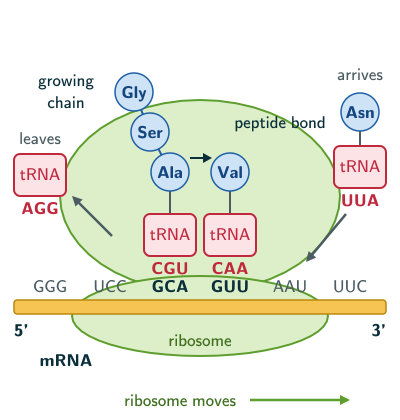
Direction: the ribosome reads mRNA 5′→3′, and the polypeptide grows from its amino (N) terminus towards its carboxyl (C) terminus.
Reading NCERT Figure 5.13 (page 99) as a check: the tRNAs in the ribosome have the anticodons 3′-CGU-5′ and 3′-CAA-5′, sitting on the codons GCA (Ala) and GUU (Val), and the next codon, AAU, is met by a tRNA with the anticodon 3′-UUA-5′ carrying Asn, just as NCERT Table 5.1 predicts (our reading of the figure).
Solved examples
Example 1: Two roles of the ribosome (NCERT Exercise 9)
List two essential roles of the ribosome during translation.
Answer: (i) It provides two sites in the large subunit for amino acids to bind, so that they are close enough for a peptide bond to form (NCERT page 99); beyond the NCERT text, these are the A and P sites (our reading). (ii) It catalyses the formation of the peptide bond: in bacteria the 23S rRNA is the enzyme, a ribozyme (NCERT page 99).
Example 2: Find the translational unit
An mRNA reads 5′-GCCAUGUCUGGAUGGUAACAU-3′. Mark the UTRs, and write the polypeptide.
Answer: assuming initiation at the first AUG in this simplified example, after GCC: so the 5′ UTR is GCC. Reading in threes from there: AUG (Met), UCU (Ser), GGA (Gly), UGG (Trp), UAA (stop). The polypeptide is Met-Ser-Gly-Trp, and the 3′ UTR after the stop codon is CAU (NCERT page 99; codons from NCERT Table 5.1, page 96). The AUG inside GGAUGG is out of frame and is not read as a start.
Example 3: Counting for a small protein
A polypeptide has 150 amino acids. How many codons, nucleotides of the translational unit and peptide bonds are involved?
Answer: 150 codons for the amino acids plus 1 stop codon = 151 codons, so the translational unit has 151 × 3 = 453 nucleotides; the 150 amino acids are joined by 150 − 1 = 149 peptide bonds (our arithmetic from NCERT pages 96–99).
Example 4: Translation, briefly (NCERT Exercise 14 c)
Briefly describe translation.
Answer: translation is the polymerisation of amino acids into a polypeptide in the order set by the mRNA. Amino acids are first activated with ATP and attached to their tRNAs (charging). The small ribosomal subunit binds the mRNA and the ribosome starts at the AUG start codon, recognised by the initiator tRNA. Charged tRNAs pair with successive codons through their anticodons, the ribosome joins their amino acids by peptide bonds and moves codon by codon, and at the stop codon a release factor ends translation and frees the polypeptide (NCERT pages 98–99).
Common mistakes to avoid
Common mistake
Mixing up NCERT’s two sites and the modern three
NCERT names two sites in the large subunit for amino acids to bind (page 99); give that in an NCERT answer. Beyond the NCERT text: the ribosome has A, P and E tRNA-binding sites, and peptide-bond catalysis occurs in the large-subunit rRNA centre (Wikipedia, “Ribosome”, facts in our words).
Common mistake
Saying the UTRs are translated
UTRs lie before the start codon and after the stop codon and are not translated, though they are needed for efficient translation (NCERT page 99).
Common mistake
Expecting a tRNA at the stop codon
Translation ends when a release factor binds to the stop codon (NCERT page 99); there are no tRNAs for stop codons (NCERT page 98).
Common mistake
Crediting ribosomal proteins with the peptide bond
The catalyst is RNA: in bacteria the 23S rRNA is the enzyme, a ribozyme (NCERT page 99).
Quick revision summary
- Translation: polymerisation of amino acids into a polypeptide; the order is set by the bases of the mRNA; peptide bonds need energy.
- Charging (aminoacylation): amino acids activated with ATP and linked to their tRNAs.
- Ribosome: structural RNAs and about 80 different proteins in two subunits, with two sites in the large subunit for amino acids (NCERT); beyond NCERT, A, P and E tRNA sites. Bacterial 23S rRNA is the ribozyme for the peptide bond.
- Translational unit: start codon AUG to stop codon; UTRs at the 5′ and 3′ ends are not translated but aid translation.
- Initiation at AUG with the initiator tRNA; elongation codon by codon through anticodon pairing; termination when a release factor binds the stop codon.
Formula sheet
- charging: amino acid + tRNA, using ATP
- ribosome: structural RNAs + about 80 proteins; two sites in the large subunit
- peptide bond catalyst: 23S rRNA (ribozyme)
- translational unit: AUG to stop codon
- UTRs at the 5′ and 3′ ends: not translated
- stop codon: release factor ends translation
Questions students ask
Is protein synthesis the same as translation?
In NCERT’s usage, translation and protein synthesis are the same process: its summary says “The site of translation (protein synthesis) is ribosomes” (page 108), and translation is defined as the polymerisation of amino acids to form a polypeptide (page 98). Making a protein from a gene needs a step before translation, transcription of the gene into mRNA, so in a wider sense protein synthesis covers both stages and translation is the second (our reading); NCERT notes that both are energetically very expensive and so have to be tightly regulated (page 108).
What is the difference between a ribosome and a ribozyme?
A ribosome is the cellular factory where proteins are made, a particle of structural RNAs and proteins in a large and a small subunit, while a ribozyme is a nucleic acid that behaves like an enzyme (NCERT page 99; NCERT Class 11 Biology, Chapter 9, page 112). The two meet in translation, because the ribosome contains a ribozyme: in bacteria its 23S rRNA is the enzyme for the formation of peptide bonds (page 99). So “ribosome” names a whole RNA–protein particle, the site of protein synthesis, while “ribozyme” names any RNA that acts as a catalyst, inside a ribosome or not (our summary).
What is the difference between a charged and an uncharged tRNA?
A charged tRNA carries its amino acid at its amino acid acceptor end, while an uncharged tRNA carries none (NCERT page 98), and it is the charged ones, amino acid–tRNA complexes, that bind in turn to the codons of the mRNA during elongation (page 99). Beyond the NCERT text, charging runs in two steps through an enzyme-bound intermediate, aminoacyl-AMP (aminoacyl adenylate), and when amino acids run short uncharged tRNAs build up; in bacteria one entering the ribosome’s A site stalls it and sets off the stringent response, a stress response (Rubio Gomez and Ibba, RNA, 2020, CC BY).
Where does translation take place in a cell?
Translation takes place on ribosomes, which NCERT calls the site of protein synthesis (Class 11 Biology, Chapter 8, page 91; Class 12, page 108). In a eukaryotic cell, ribosomes occur freely in the cytoplasm or on the rough endoplasmic reticulum, which is common in cells active in protein synthesis and secretion, and mitochondria and chloroplasts have ribosomes of their own (Class 11, pages 95, 97, 98 and 102); in prokaryotes, ribosomes are associated with the plasma membrane (Class 11, page 91). Several ribosomes can translate one mRNA together, forming a chain called a polysome (Class 11, page 91).
Practice questions
Try each question first, then open the answer to check your working.
-
Q1. Which tRNA recognises the start codon, and which codon is it?
Show answerHide answer
The initiator tRNA recognises the start codon, AUG (NCERT page 99).
-
Q2. What is aminoacylation of tRNA, and what supplies its energy?
Show answerHide answer
The charging of a tRNA: an amino acid is activated and linked to its cognate tRNA, in the presence of ATP (NCERT page 98).
-
Q3. Where are the untranslated regions of an mRNA, and why are they needed?
Show answerHide answer
At the 5′ end, before the start codon, and at the 3′ end, after the stop codon; they are required for efficient translation (NCERT page 99).