DNA: structure and packaging
NCERT Class 12 Biology Chapter 5 Section 5.1
Quick answer
DNA has antiparallel nucleotide strands with complementary A–T and G–C pairing. In eukaryotic chromatin, DNA wraps round a histone octamer to form a nucleosome, and a typical nucleosome contains 200 bp of DNA (NCERT page 83); beyond NCERT, only about 146–147 bp wind round the octamer, the rest being linker DNA. NCERT estimates the DNA of a typical mammalian cell at about 2.2 m, from 6.6 × 10 bp × 0.34 nm per bp.
With your textbook
NCERT Biology (Class 12), Chapter 5 “Molecular Basis of Inheritance”, Section 5.1 “The DNA”, pages 80–84.
Open the official NCERT chapter (PDF, 4.1 MB, ncert.nic.in) (opens in a new tab)
Checked against the 2026-27 reprint on .
What is DNA?
DNA
DNA is a long polymer of deoxyribonucleotides.
NCERT Biology (Class 12), Section 5.1, page 80
- DNA is the genetic material in most organisms. RNA acts as the genetic material in some viruses and mostly works as a messenger; it also works as an adapter, a structural molecule and, in some cases, a catalytic molecule (Chapter 5, Introduction, page 79).
- The length of DNA is usually defined as the number of nucleotides, or of base pairs, present in it, and this is also a characteristic of an organism (page 80). A single strand is counted in nucleotides, a duplex in base pairs (our reasoning).
In plain words: DNA is a very long chain built from four kinds of units. Two such chains wind round each other, held together by pairs of bases, and the cell folds this enormous molecule many times over to fit it into a nucleus far smaller than its length.
Length of DNA
NCERT gives these lengths (page 80):
| Organism | Length of DNA |
|---|---|
| bacteriophage φX174 | 5386 nucleotides |
| bacteriophage lambda | 48 502 bp |
| Escherichia coli | 4.6 × 10 bp |
| human, haploid content | 3.3 × 10 bp |
NCERT slip (page 80): NCERT prints the phage’s name as φ×174, with a multiplication sign; the name is φX174 (phi X 174), with the letter X. Its DNA is a single-stranded circle of 5386 nucleotides, which is why it is counted in nucleotides, not base pairs (Wikipedia, “Phi X 174”, facts in our words). Write φX174 in an answer.
Structure of a polynucleotide chain
- A nucleotide has three parts: a nitrogenous base, a pentose sugar (ribose in RNA, deoxyribose in DNA) and a phosphate group (page 80).
- The bases are of two types: purines (adenine and guanine) and pyrimidines (cytosine, uracil and thymine). Cytosine occurs in both DNA and RNA; thymine is in DNA, and uracil takes its place in RNA (page 80).
Nucleosides, nucleotides and phosphodiester bonds
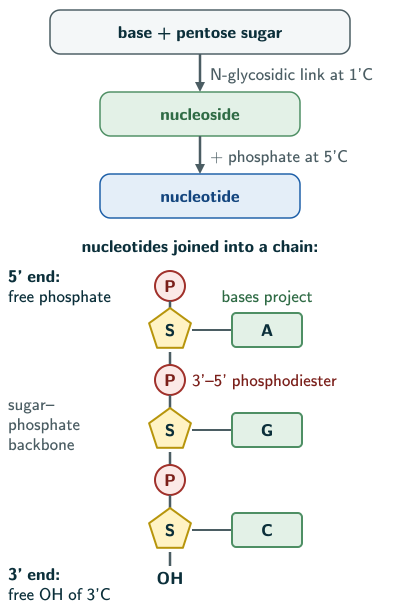
- A base linked to the OH of the 1′C of the pentose sugar by an N-glycosidic linkage forms a nucleoside: adenosine or deoxyadenosine, guanosine or deoxyguanosine, cytidine or deoxycytidine, and uridine or deoxythymidine (page 80).
- A phosphate group linked to the OH of the 5′C of a nucleoside by a phosphoester linkage gives a nucleotide (page 80).
- Two nucleotides joined by a 3′–5′ phosphodiester linkage form a dinucleotide; more joined in the same way form a polynucleotide (page 80).
- The chain has a free phosphate at the 5′-end and a free OH of the 3′C at the 3′-end. The backbone is made of sugars and phosphates, and the bases project from it (pages 80–81).
How RNA differs from DNA
- In RNA, every nucleotide has an extra –OH group at the 2′ position of the ribose (page 81).
- RNA has uracil in place of thymine; thymine is also called 5-methyl uracil (page 81).
Watson and Crick’s double helix
- DNA, an acidic substance in the nucleus, was first identified in 1869; its discoverer named it “Nuclein”. Isolating such a long polymer intact was technically hard, so its structure stayed unknown for a long time (page 81).
- In 1953, James Watson and Francis Crick, using X-ray diffraction data from Maurice Wilkins and Rosalind Franklin, proposed the double helix model. A hallmark of their proposal is base pairing between the two strands (page 81).
- It also rested on Erwin Chargaff’s observation that in double-stranded DNA the ratios of adenine to thymine and of guanine to cytosine are constant and equal one (page 81).
- Base pairing makes the two strands complementary: from the sequence of one strand, the other can be predicted. If each parental strand serves as a template for a new strand, the two daughter DNA molecules are identical to the parent, which made the genetic meaning of the structure clear (page 81).
NCERT slip (pages 81 and 84): NCERT names the discoverer of DNA “Friedrich Meischer”. The surname is usually spelt Miescher, as on the DNA fact sheet of the US National Human Genome Research Institute (a public-domain source). The correct spelling is Friedrich Miescher; recognise NCERT’s “Meischer” as Miescher in an NCERT-based question.
Features of the double helix
NCERT lists five salient features (pages 81–82). Beyond the NCERT text: they describe B-DNA, the usual form of the double helix in cells, with about 10–10.5 bp per turn; DNA can also take other forms, such as A-DNA and Z-DNA (Wikipedia, “Nucleic acid double helix”, facts in our words).
- Two polynucleotide chains, with the sugar-phosphate backbone outside and the bases projecting inside.
- The chains have anti-parallel polarity: if one runs 5′→3′, the other runs 3′→5′.
- The bases pair by hydrogen bonds: adenine with thymine by two H-bonds, guanine with cytosine by three. So a purine always faces a pyrimidine, which keeps the distance between the two strands roughly uniform.
- The chains are coiled right-handed. The pitch is 3.4 nm, with roughly 10 bp per turn, so adjacent base pairs are about 0.34 nm apart.
- The plane of one base pair stacks over the next; this, with the H-bonds, gives the helix its stability.
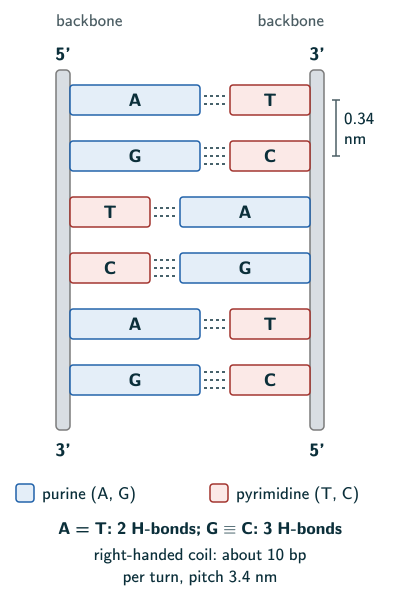
NCERT asks why the distance between the two chains stays almost constant (page 82). Every base pair is one purine with one pyrimidine (page 81). A purine has two fused rings and a pyrimidine one (NCERT Class 11 Biology, Chapter 9, Figure 9.1, page 107; see purines and pyrimidines), so every rung of the ladder has about the same length.
Central dogma
- Francis Crick soon proposed the central dogma of molecular biology: genetic information flows from DNA → RNA → protein (page 82).
- In some viruses the information flows in reverse, from RNA to DNA (page 83). NCERT asks for a name for this process: it is reverse transcription, as making RNA from DNA is transcription.
- Beyond the NCERT text: Crick’s own dogma, first published in 1958 and restated in a 1970 paper, is a rule about sequence information: none of it can flow out of a protein, either to another protein or to a nucleic acid; so reverse transcription, RNA to DNA, does not break it. Reverse transcriptase is used not only by retroviruses but also by mobile genetic elements and by eukaryotic cells to extend the telomeres of their chromosomes (Wikipedia, “Central dogma of molecular biology” and “Reverse transcriptase”, facts in our words).
Packaging of the DNA helix
- NCERT calculates the length of the DNA double helix in a typical mammalian cell by multiplying the total number of base pairs by 0.34 nm: 6.6 × 10 bp × 0.34 × 10 m/bp ≈ 2.2 metres, far more than the size of a typical nucleus, about 10 m (page 83).
Nucleoid in prokaryotes
- Prokaryotes such as E. coli have no defined nucleus, but their DNA is not scattered: the negatively charged DNA is held by positively charged proteins in a region called the nucleoid, organised in large loops held by proteins (page 83). (See genomic DNA in prokaryotic cells in Class 11.)
Histones and nucleosomes
- Eukaryotes have histones: positively charged, basic proteins, rich in the basic amino acids lysine and arginine (page 83).
- Eight histone molecules form a histone octamer. The negatively charged DNA wraps round it to form a nucleosome, which contains about 200 bp of DNA (page 83); give 200 bp in an NCERT-based answer. Beyond the NCERT text: the octamer has two copies each of H2A, H2B, H3 and H4; only about 146–147 bp are wound round it, in the core particle, and the rest of the 200 is linker DNA joining one core to the next, a nucleosome being strictly a core particle plus one linker (Wikipedia, “Nucleosome”, facts in our words).
- NCERT Figure 5.4a (page 83) also shows an H1 histone, drawn outside the octamer on the DNA; the octamer is the core of the nucleosome.
- Nucleosomes are the repeating unit of chromatin, the thread-like stained bodies seen in the nucleus; under the electron microscope chromatin looks like beads-on-string (page 83).
- The beads-on-string are packaged into chromatin fibres, which are coiled and condensed at metaphase into chromosomes. Packaging at the higher levels needs non-histone chromosomal (NHC) proteins (pages 83–84).
Packaging sequence: DNA + histone octamers → nucleosomes, seen as beads-on-string → chromatin fibres → condensed metaphase chromosomes (page 83). Beyond the NCERT text: H1, a linker histone, is not one of the eight core histones; it sits near where the DNA enters and leaves the nucleosome and helps compact the chromatin (Wikipedia, “Nucleosome”, facts in our words).
Euchromatin and heterochromatin
- Loosely packed regions of chromatin, which stain light, are euchromatin; they are transcriptionally active (page 84).
- Densely packed regions, which stain dark, are heterochromatin; they are inactive (page 84).
- Beyond the NCERT text: these are tendencies, not rules; much euchromatin is being transcribed, but not all of it, and the old view that heterochromatin is always silent has been questioned (Wikipedia, “Euchromatin” and “Heterochromatin”, facts in our words). In an exam, give NCERT’s active and inactive.
Solved examples
Example 1: Chargaff’s rule (NCERT Exercise 2)
A double-stranded DNA has 20 per cent cytosine. Calculate the per cent of adenine.
Answer: cytosine pairs with guanine, so G = C = 20 per cent, and G + C = 40 per cent. The rest, 60 per cent, is A + T, and A = T, so adenine = 30 per cent (Chargaff’s ratios equal one, NCERT page 81).
Example 2: The complementary strand (NCERT Exercise 3)
One strand of DNA is 5′-ATGCATGCATGCATGCATGCATGCATGC-3′. Write the complementary strand in the 5′→3′ direction.
Answer: pair each base (A with T, G with C) to get 3′-TACGTACGTACGTACGTACGTACGTACG-5′, then read it from its 5′ end: 5′-GCATGCATGCATGCATGCATGCATGCAT-3′. The strands are antiparallel, so the complementary strand must be read backwards (NCERT page 81).
Example 3: Bases or nucleosides? (NCERT Exercise 1)
Group as nitrogenous bases and nucleosides: adenine, cytidine, thymine, guanosine, uracil, cytosine.
Answer: nitrogenous bases: adenine, thymine, uracil, cytosine. Nucleosides (base + sugar): cytidine, guanosine (NCERT page 80).
Example 4: Counting from lengths
(a) The DNA of E. coli is 1.36 mm long. How many base pairs does it have? (b) About how many nucleosomes would the DNA of a mammalian cell form? (Both questions are asked on NCERT page 83.)
Answer (with NCERT’s 0.34 nm per bp and 200 bp per nucleosome):
- (a) 1.36 × 10 m ÷ 0.34 × 10 m/bp = 4.0 × 10 bp. NCERT’s 4.6 × 10 bp (page 80) would be about 1.56 mm long; use the length the question gives.
- (b) 6.6 × 10 bp ÷ 200 bp per nucleosome = 3.3 × 10 nucleosomes.
Common mistakes to avoid
Common mistake
Writing the complementary strand without reversing it
The complement of 5′-ATGC-3′ is 3′-TACG-5′, which written 5′→3′ is 5′-GCAT-3′; the strands are antiparallel (NCERT page 81).
Common mistake
Mixing up nucleoside and nucleotide
A nucleoside is base + sugar; a nucleotide is a nucleoside + phosphate (NCERT page 80).
Common mistake
Giving A and G the same percentage by default
Chargaff’s rule pairs A with T and G with C; A and G are equal only if all four bases happen to be 25 per cent (NCERT page 81). For a canonical fully base-paired duplex, A + G = T + C: purines equal pyrimidines (reasoned from NCERT page 81).
Common mistake
Calling heterochromatin the active chromatin
Euchromatin, loosely packed and lightly stained, is transcriptionally active; heterochromatin is inactive (NCERT page 84). Beyond the NCERT text: these are tendencies rather than rules (Wikipedia, “Euchromatin” and “Heterochromatin”, facts in our words).
Quick revision summary
- DNA is a long polymer of deoxyribonucleotides; its length in bp is characteristic of an organism (human haploid: 3.3 × 10 bp).
- A nucleoside is a base + pentose sugar (N-glycosidic bond at 1′C); a nucleotide adds a phosphate at 5′C; nucleotides join by 3′–5′ phosphodiester bonds.
- RNA has an extra 2′–OH and uracil in place of thymine.
- Watson and Crick (1953), using Wilkins and Franklin’s X-ray data and Chargaff’s rules, proposed the double helix.
- Antiparallel strands; A=T (2 H-bonds), G≡C (3 H-bonds); right-handed; pitch 3.4 nm, 10 bp per turn, 0.34 nm per bp.
- Central dogma: DNA → RNA → protein; some viruses copy RNA into DNA.
- The DNA of a typical mammalian cell, 6.6 × 10 bp in NCERT’s example, is about 2.2 m long; in eukaryotes it wraps round histone octamers into nucleosomes (about 200 bp), beads-on-string chromatin, fibres and metaphase chromosomes.
- Euchromatin is loose and active; heterochromatin is dense and inactive.
Formula sheet
- nucleoside: base + sugar
- nucleotide: nucleoside + phosphate
- Chargaff: A = T, G = C; A + G = T + C
- A=T: 2 H-bonds; G≡C: 3 H-bonds
- pitch 3.4 nm; 10 bp per turn
- 0.34 nm per bp
- length = bp × 0.34 nm
- 6.6 × 10 bp → about 2.2 m
- nucleosome: octamer + 200 bp
Questions students ask
What is the difference between a nucleosome, chromatin and a chromosome?
A nucleosome is the repeating unit of DNA packaging in eukaryotes, chromatin is the thread-like material made of many nucleosomes in a row, and a chromosome is chromatin at its most coiled and condensed, at metaphase of cell division (NCERT pages 83–84). In each nucleosome, negatively charged DNA is wrapped round a positively charged histone octamer; under the electron microscope the nucleosomes of chromatin look like beads-on-string, and these are packed into chromatin fibres that coil further into chromosomes, a step that needs non-histone chromosomal (NHC) proteins (pages 83–84). So the three are successive levels of packing of the same DNA with its proteins, not different molecules.
How many histones are there in a nucleosome?
A nucleosome has eight histone molecules in its core: NCERT says histones are organised into a unit of eight molecules, the histone octamer, and the DNA is wrapped round it (page 83). NCERT Figure 5.4a draws a further H1 histone outside the octamer, on the DNA, so H1 is not one of the eight; beyond the NCERT text, the octamer holds two copies each of histones H2A, H2B, H3 and H4 (RCSB Protein Data Bank, entry 1AOI). Counting NCERT’s 200 bp of DNA per nucleosome, linker included, a 20 000 bp stretch of chromatin would form about 100 nucleosomes, with some 800 histone molecules in their cores.
What is the difference between a nucleosome and a nucleotide?
A nucleotide is a single building block of a nucleic acid, made of a nitrogenous base, a pentose sugar and a phosphate group, while a nucleosome is a packaging unit of eukaryotic chromatin, a histone octamer with DNA wrapped round it (NCERT pages 80 and 83). They differ hugely in size: NCERT’s typical nucleosome contains 200 bp of DNA, that is 400 nucleotides, besides its eight histone molecules (page 83). Every DNA and RNA is made of nucleotides, but nucleosomes form only where DNA is wrapped on histones.
How is DNA packaging in prokaryotes different from that in eukaryotes?
DNA packaging in prokaryotes is simpler: a prokaryote such as E. coli has no defined nucleus, and its negatively charged DNA is held by positively charged proteins in a region called the nucleoid, organised in large loops (NCERT page 83). In eukaryotes the organisation is much more complex: the DNA is wrapped round histone octamers to form nucleosomes, and the chromatin they make is folded further, with the help of non-histone chromosomal (NHC) proteins, until it condenses into chromosomes at metaphase (pages 83–84). The eukaryotic scheme copes with far more DNA: NCERT’s typical mammalian cell has about 2.2 metres of it in a nucleus of about 10 m (page 83).
What is Chargaff’s rule, and does it apply to RNA?
Chargaff’s rule states that in double-stranded DNA the ratios of adenine to thymine and of guanine to cytosine are constant and equal one, so A = T and G = C (NCERT page 81); a duplex with 18 per cent guanine, for example, has 18 per cent cytosine and 32 per cent each of adenine and thymine. The rule does not apply to single-stranded RNA: reasoned from NCERT page 81, the equal amounts come from base pairing between two complementary strands, and a single strand has no partner to fix its ratios. So in an RNA, or in any single-stranded nucleic acid, A and U (or T), and G and C, can occur in unequal amounts.
Practice questions
Try each question first, then open the answer to check your working.
-
Q1. Which two amino acids make histones positively charged?
Show answerHide answer
Lysine and arginine, basic amino acids with positively charged side chains (NCERT page 83).
-
Q2. How many hydrogen bonds join a G-C pair and an A-T pair?
Show answerHide answer
Three in a G-C pair and two in an A-T pair (NCERT page 81).
-
Q3. A double-stranded DNA has 35 per cent adenine. What per cent is guanine?
Show answerHide answer
T = A = 35 per cent, so A + T = 70 per cent; G + C = 30 per cent, and G = C = 15 per cent.