Regulation of gene expression
NCERT Class 12 Biology Chapter 5 Section 5.8
Quick answer
Gene expression is regulated at transcription and at later steps of RNA and protein production. In the lac system, LacI repressor limits lacZYA transcription until allolactose, formed from lactose, reduces repressor binding. Strong expression also depends on glucose availability through CAP–cAMP regulation; the operon is not an absolute on/off switch.
With your textbook
NCERT Biology (Class 12), Chapter 5 “Molecular Basis of Inheritance”, Section 5.8 “Regulation of Gene Expression”, pages 99–101.
Open the official NCERT chapter (PDF, 4.1 MB, ncert.nic.in) (opens in a new tab)
Checked against the 2026-27 reprint on .
What is regulation of gene expression?
Regulation of gene expression
- Regulation of gene expression is a very broad term: gene expression can produce a functional RNA or, for protein-coding genes, a polypeptide, so it can be regulated at several levels (page 99).
Therefore, in simple terms, it is the metabolic, physiological or environmental conditions that regulate the expression of genes.
NCERT Biology (Class 12), Section 5.8, page 100
In plain words: a cell does not make every protein all the time. It switches genes on when their products are needed and off when they are not, which saves energy and lets cells respond to what is around them.
Levels of regulation in eukaryotes
In eukaryotes, NCERT highlights four levels of regulation (page 99):
- the transcriptional level, the formation of the primary transcript;
- the processing level, the regulation of splicing;
- the transport of mRNA from the nucleus to the cytoplasm;
- the translational level.
Additional control includes mRNA degradation, protein modification and protein turnover. Expression is often graded rather than a perfectly binary switch.
Why genes are switched on and off
- Genes are expressed to perform a particular function or set of functions. If E. coli makes the enzyme beta-galactosidase, it uses it to hydrolyse the disaccharide lactose into galactose and glucose, which the bacteria use as a source of energy. If there is no lactose around them, they no longer need to make the enzyme (page 100).
- The development and differentiation of an embryo into an adult organism also result from the coordinated regulation of the expression of several sets of genes (page 100).
Control in prokaryotes: operators, activators and repressors
- In prokaryotes, control of the rate of transcriptional initiation is the predominant site for control of gene expression (page 100).
- The activity of RNA polymerase at a promoter is regulated by accessory proteins that affect its ability to recognise start sites. These regulatory proteins can act positively (activators) and negatively (repressors) (page 100).
- The accessibility of the promoter is often regulated by proteins binding to sequences called operators. The operator lies next to the promoter in most operons, and in most cases it binds a repressor protein (page 100).
- DNA-binding regulators recognise particular sequences; the lac repressor preferentially recognises lac operators. NCERT’s one-operon/one-repressor wording is a simplified example, not a universal rule: some regulators control multiple operons and some operons are mainly activated (page 100).
The lac operon
- The lac operon was worked out by a geneticist, François Jacob, and a biochemist, Jacques Monod, the first to elucidate a transcriptionally regulated system (page 100).
- In the lac operon (lac for lactose), the lacZYA structural genes form a polycistronic transcription unit under a common promoter and operator control. Such an arrangement, very common in bacteria, is an operon: for example the lac, trp, ara, his and val operons (page 100).
- NCERT discusses the i regulatory gene with the three structural genes z, y and a. More precisely, lacI is separately transcribed from its own promoter, while lacZYA share the operon transcript (page 100):
| Gene | Product | Role |
|---|---|---|
| i | the repressor | keeps the operon off; i is from inhibitor, not inducer |
| z | beta-galactosidase (β-gal) | hydrolyses lactose into galactose and glucose |
| y | permease | increases the cell’s permeability to β-galactosides |
| a | transacetylase | the third enzyme of the operon |
- In NCERT Figure 5.14 (page 101) the order is p, i, p, o, z, y, a: the i gene has its own promoter; the operon’s promoter (p) and operator (o) come before z, y and a (our reading of the figure).
- LacZ and LacY provide lactose cleavage and uptake. LacA is a transacetylase but is not required for ordinary lactose catabolism; NCERT’s claim that all three are necessary is too broad. Generally, in most operons the genes work together in the same or related metabolic pathway (page 100).
NCERT slip (page 100): NCERT spells the biochemist’s first name “Jacque”; it is Jacques (as recorded by the Nobel Foundation). In an answer, write Jacob and Monod.
Switching the operon on: induction by lactose
- Lactose supplies the substrate and indirectly induces the operon. The physiological inducer that binds LacI is allolactose, made from lactose by beta-galactosidase; NCERT uses lactose as shorthand (page 101).
- When there is no preferred carbon source such as glucose and lactose is supplied, lactose enters the cells through permease. A very low level of expression of the lac operon must be present all the time; otherwise lactose could not enter (page 101).
- The repressor is made all the time (constitutively) from the i gene. It binds the operator and prevents RNA polymerase from transcribing the operon (page 101).
- With the physiological inducer allolactose, the repressor is inactivated by interacting with it. RNA polymerase can then reach the promoter, and transcription proceeds (page 101).
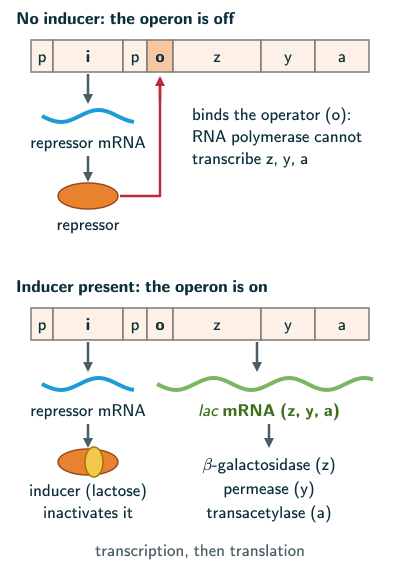
Essentially, regulation of lac operon can also be visualised as regulation of enzyme synthesis by its substrate.
NCERT Biology (Class 12), Section 5.8.1, page 101
- Glucose or galactose cannot act as inducers of the lac operon (page 101).
- Regulation of the lac operon by the repressor is negative regulation. Positive regulation by cAMP–CAP/CRP helps explain stronger expression when glucose is scarce. Glucose can also limit lactose uptake through inducer exclusion; lactose presence alone does not guarantee maximal expression (page 101).
Solved examples
Example 1: Why the operon shuts down (NCERT Exercise 10)
Lactose was added to a medium where E. coli was growing, and it induced the lac operon. Why does the lac operon shut down some time after the lactose is added?
Answer: our reasoning from NCERT page 101. Lactose supplies allolactose, which reduces repressor binding and the operon is transcribed. But the operon’s own enzyme, beta-galactosidase, hydrolyses the lactose into galactose and glucose, which cannot act as inducers. When the lactose is used up, the repressor, made all the time from the i gene, is no longer inactivated, binds the operator again, and transcription falls towards its basal level. This is the simple inducer-depletion model, with expression also dependent on glucose and other conditions, which also answers NCERT’s question on page 101.
Example 2: On or off?
Is the lac operon of a bacterium on or off when the medium has (a) no lactose, (b) lactose and no glucose, (c) galactose only?
Answer: (a) off, apart from the very low basal level NCERT mentions (page 101): no inducer, so the repressor sits on the operator. (b) on: lactose enters through permease, produces allolactose that inactivates the repressor, and the operon is transcribed. (c) off: galactose cannot act as an inducer (NCERT page 101).
Example 3: Two faulty repressors
Predict what happens to the lac operon if a mutation (a) stops the repressor from binding the operator, (b) stops the repressor from binding the inducer.
Answer: our reasoning from the mechanism on NCERT page 101. (a) With the promoter and other machinery intact, lac-repressor control is lost and expression becomes inducer-independent. This does not remove glucose/cAMP or other regulatory effects. (b) If operator binding remains intact, the repressor is not relieved by inducer, so expression remains repressed even with lactose; low basal transcription can remain.
Example 4: Where can eukaryotes regulate?
At which four levels can gene expression be regulated in eukaryotes?
Answer: transcription (forming the primary transcript), processing (regulating splicing), transport (moving mRNA from the nucleus to the cytoplasm) and translation (NCERT page 99).
Common mistakes to avoid
Common mistake
Reading i as inducer
The i gene codes for the repressor; its name comes from inhibitor, not inducer (NCERT page 100).
Common mistake
Saying the inducer binds the operator
The repressor binds the operator; the inducer binds the repressor and inactivates it (NCERT page 101).
Common mistake
Thinking the repressor is made only when lactose is absent
The repressor is made all the time, constitutively, from the i gene; allolactose changes its operator-binding activity (NCERT page 101).
Common mistake
Calling glucose an inducer of the *lac* operon
Glucose and galactose cannot act as inducers; allolactose is the physiological inducer made from lactose (NCERT page 101).
Quick revision summary
- Gene expression is regulated by metabolic, physiological or environmental conditions; in eukaryotes at transcription, splicing, mRNA transport and translation; in prokaryotes mainly at the initiation of transcription.
- Regulatory proteins act as activators (positive) or repressors (negative); repressors bind operators next to promoters; regulator specificity does not imply one exclusive regulator per operon.
- Lac operon (Jacob and Monod): separately transcribed lacI makes the repressor; structural genes z (beta-galactosidase), y (permease) and a (transacetylase), with a common promoter; polycistronic.
- The repressor, made constitutively, binds the operator and blocks transcription; the inducer allolactose, derived from lactose, inactivates it and the operon is transcribed. Glucose and galactose are not inducers. This is negative regulation.
Formula sheet
- lac operon order: p, i, p, o, z, y, a
- i: repressor (i from inhibitor)
- z: β-galactosidase; y: permease
- a: transacetylase
- lactose → allolactose → reduced repressor binding
- repressor on operator: operon off
Questions students ask
Which chapter is the lac operon in, and is it in the NEET syllabus?
The lac operon is in NCERT Biology Class 12, Chapter 5, Molecular Basis of Inheritance, Section 5.8.1 (pages 100–101), and it is in the NEET (UG) 2026 syllabus: Unit 7, Genetics and Evolution, lists “Gene expression and regulation - Lac Operon” in its entry on the molecular basis of inheritance (National Medical Commission, Syllabus for NEET (UG) 2026). NCERT’s chapter summary calls it “the prototype operon in bacteria” (page 108).
What is the difference between the lac operon and the trp operon?
The lac operon is switched on by its substrate: NCERT calls lactose the inducer, and in the presence of an inducer such as lactose or allolactose the repressor is inactivated (page 101). Beyond the NCERT text, the trp operon works the other way round: its repressor can grip the trp operator only once tryptophan, the end product of the operon’s enzymes, is attached to it, so when tryptophan is plentiful the cell stops making the enzymes that build it (Arvidson and colleagues, Nucleic Acids Research, 1994). So one operon is induced by its substrate and makes enzymes that break a sugar down, the other is repressed by its product and makes enzymes that build an amino acid (our summary).
What is the difference between an operon, an operator and a promoter?
An operon is a whole unit of genes, such as the z, y and a structural genes of the lac operon, that share a common promoter and are regulated together (NCERT page 100), while the promoter and operator are DNA sequences within it. The promoter is the binding site for RNA polymerase, where transcription starts (pages 92–93), and the operator, next to the promoter in most operons, usually binds a repressor protein, as the lac operator binds the lac repressor (page 100). So the operator controls access to the promoter: while the repressor sits on it, RNA polymerase cannot transcribe the operon (page 101).
What is the difference between positive and negative regulation of the lac operon?
Negative regulation of the lac operon works through a repressor that keeps it off, and positive regulation through an activator that raises its expression: NCERT names both kinds of regulatory protein (page 100), calls the lac repressor’s control negative regulation and says the operon is under positive regulation as well (page 101). Beyond the NCERT text, the activator is the cAMP receptor protein (CRP): cAMP builds up when glucose is absent and binds CRP, and the CRP–cAMP complex helps RNA polymerase bind the lac promoter, so strong expression needs both lactose and little glucose (Ro and colleagues, PLoS ONE, 2021, CC0; Pinto and colleagues, Frontiers in Microbiology, 2021).
Are operons found in eukaryotes?
Operons are typical of bacteria, where NCERT says the arrangement is very common (page 100); beyond the NCERT text, they are uncommon in eukaryotes, nematode worms being the notable exception: in the model nematode Caenorhabditis elegans, more than 1100 operons hold about 15 per cent of its genes (Qian and Zhang, Genome Research, 2008). The single RNA copied from a worm operon is then cut into separate mRNAs, one per gene, by spliced-leader trans-splicing (Wenzel and colleagues, BMC Bioinformatics, 2021, CC BY).
Practice questions
Try each question first, then open the answer to check your working.
-
Q1. Name the three structural genes of the lac operon and their products.
Show answerHide answer
z: beta-galactosidase; y: permease; a: transacetylase (NCERT page 100).
-
Q2. What is the predominant site for control of gene expression in prokaryotes?
Show answerHide answer
The rate of transcriptional initiation (NCERT page 100).
-
Q3. Why must a very low level of lac operon expression be present in the cell all the time?
Show answerHide answer
Otherwise there would be no permease, and lactose could not enter the cells to induce the operon (NCERT page 101).