DNA replication
NCERT Class 12 Biology Chapter 5 Section 5.4
Quick answer
DNA replication is semiconservative: each daughter molecule contains one parental strand and one new strand. Meselson and Stahl’s isotope experiment supported this model with hybrid DNA after one generation and hybrid plus light DNA after two. Polymerases extend a primed strand only 5′ → 3′, producing continuous leading-strand and discontinuous lagging-strand synthesis.
With your textbook
NCERT Biology (Class 12), Chapter 5 “Molecular Basis of Inheritance”, Section 5.4 “Replication”, pages 88–91.
Open the official NCERT chapter (PDF, 4.1 MB, ncert.nic.in) (opens in a new tab)
Checked against the 2026-27 reprint on .
What is DNA replication?
DNA replication
- DNA replication is the copying of a DNA molecule. Watson and Crick proposed a scheme for it at once, while proposing the double helix (page 88).
The scheme suggested that the two strands would separate and act as a template for the synthesis of new complementary strands.
NCERT Biology (Class 12), Section 5.4, page 88
- After replication, each DNA molecule has one parental and one newly synthesised strand. This scheme is called semiconservative DNA replication (page 88).
In plain words: the double helix unzips, and each old strand is used as a pattern to build a new partner strand, base by base. Each of the two daughter molecules keeps half of the parent, one old strand, and gets one new strand: half is conserved, hence semiconservative.
Watson and Crick’s semiconservative scheme
- In 1953 Watson and Crick wrote that the specific base pairing they had proposed “immediately suggests a possible copying mechanism for the genetic material” (Watson and Crick, 1953, quoted by NCERT on page 88).
- The pairing is complementary: adenine pairs with thymine and guanine with cytosine (NCERT Section 5.1, page 81). So the sequence of one strand fixes the sequence of its partner, and each separated strand can act as a template for a new complementary strand (page 88).
- NCERT Figure 5.6 (page 88) draws this: the parental double helix opens, and each of the two daughter helices has one old and one new strand.
Meselson and Stahl’s experiment
It is now proven that DNA replicates semiconservatively. It was shown first in Escherichia coli and subsequently in higher organisms, such as plants and human cells (pages 88–89). Matthew Meselson and Franklin Stahl did the experiment in 1958 (page 89); on the date of Taylor’s plant work, see the NCERT slip below.
- They grew E. coli for many generations in a medium whose only nitrogen source was NHCl. N, the heavy isotope of nitrogen, was built into newly made DNA (and other nitrogen-containing compounds). This heavy DNA can be told apart from normal DNA by centrifugation in a cesium chloride (CsCl) density gradient. N is not radioactive: it is separated from N only by its density (page 89).
- They moved the cells to a medium with normal NHCl, took samples at definite time intervals as the cells multiplied, extracted the double-stranded DNA and measured its density on CsCl gradients (page 89).
- NCERT uses a 20-minute generation for its worked model; generation time depends on conditions. DNA extracted one generation after the transfer (20 minutes) had a hybrid, intermediate density. DNA extracted after another generation (40 minutes) was made of equal amounts of hybrid and light DNA (pages 89–90).
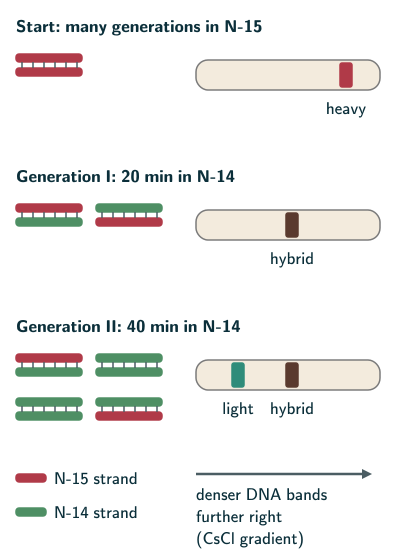
The one-generation hybrid band rules out the simple conservative model, but not a dispersive model. The two-generation hybrid-plus-light pattern distinguishes semiconservative replication from the simple dispersive prediction of one progressively lighter intermediate band.
Why the semiconservative model gives these results: after one generation every molecule has one old N strand and one new N strand, so all of it is hybrid. In the next generation each strand is a template again: the two old N strands still end up in hybrid molecules, while the new N strands give light molecules (our reasoning from NCERT pages 88–90).
Density separation: in equilibrium CsCl centrifugation, DNA bands where the solution has the same buoyant density. This distinguishes heavy, hybrid and light DNA; it is not merely a race in which heavier fragments sediment faster. The original 1958 paper reports generation times of 0.81 and 0.85 hours in its experiments, distinct from NCERT’s convenient 20-minute exercise assumption.
Reading note (page 89): the arrow beside the tubes in NCERT Figure 5.7 is labelled Gravitational force. In a centrifuge the force that moves the DNA comes from the spin, which is why the text asks about centrifugal force; the arrow shows its direction, and the densest DNA lies furthest along it (our reading). In an answer, say the DNA was separated by centrifugation in a CsCl density gradient.
Taylor’s experiment on Vicia faba
- Very similar experiments, using radioactive thymidine to follow where newly made DNA went in the chromosomes, were done on Vicia faba (faba beans) by Taylor and colleagues (page 90).
- They proved that the DNA in chromosomes also replicates semiconservatively (page 90).
- Why thymidine? Thymine is found in DNA, while RNA has uracil in its place (NCERT page 80; see DNA and RNA in Class 11), so labelled thymidine marks new DNA only (our reasoning).
- NCERT slip (page 90): NCERT dates Taylor’s experiment to 1958, the year of Meselson and Stahl’s. The paper in which Taylor, Woods and Hughes reported it, on the duplication of chromosomes followed with tritium-labelled (radioactive) thymidine, was published in the Proceedings of the National Academy of Sciences on 15 January 1957 (volume 43, pages 122–128); it used Vicia faba root cells (Crossref record of the paper; Wikipedia, “Vicia faba”, facts in our words). In a question built on NCERT’s line, give NCERT’s 1958; otherwise note that the paper is from 1957.
DNA polymerase: fast, accurate and costly
- Replication needs a set of enzymes. The main one is DNA-dependent DNA polymerase, so called because it uses a DNA template to catalyse the polymerisation of deoxynucleotides (page 90).
- NCERT rate example: E. coli, with 4.6 × 10 bp (a human diploid cell has 6.6 × 10 bp), completes replication within 18 minutes, so the average rate of polymerisation has to be approximately 2000 bp per second (page 90).
- Accurate: any mistake during replication would result in mutations (page 90). Beyond the NCERT text: many DNA polymerases proofread, removing a wrongly paired nucleotide with their 3′ → 5′ exonuclease activity, so the errors that escape proofreading and repair become mutations (Wikipedia, “DNA polymerase”, facts in our words).
- Costly in energy: deoxyribonucleoside triphosphates serve two purposes. They are the substrates, and they also provide the energy for polymerisation: their two terminal phosphates are high-energy phosphates, as in ATP (page 90).
- Many other enzymes are also needed to complete replication with high accuracy (page 90).
Reading note (page 90): 4.6 × 10 bp in 18 minutes (1080 s) is about 4300 bp per second for the whole chromosome, about twice NCERT’s figure. A two-fork calculation reconciles the approximate numbers: the E. coli chromosome, like most bacterial chromosomes, is circular with a single origin of replication, oriC, and replication runs from it in both directions, with two forks moving apart (standard bacterial replication model). Each fork then copies about 2100 bp per second. These are calculations from NCERT’s stated values, not a universal measured fork rate under all conditions.
The replication fork
- For long DNA molecules the two strands cannot be separated along their entire length, because that would need very high energy. So replication occurs within a small opening of the helix, the replication fork (page 90).
- DNA-dependent DNA polymerases catalyse polymerisation only in one direction, 5′ → 3′. Taking template directions in the direction the fork advances (page 90):
- on the template with polarity 3′ → 5′, replication is continuous;
- on the template with polarity 5′ → 3′, it is discontinuous.
- The discontinuously synthesised fragments are later joined by the enzyme DNA ligase (page 90). Beyond the NCERT text: each fragment starts from a short RNA primer, which is removed and replaced with DNA before ligase seals the remaining nicks (Wikipedia, “Okazaki fragments”, facts in our words).
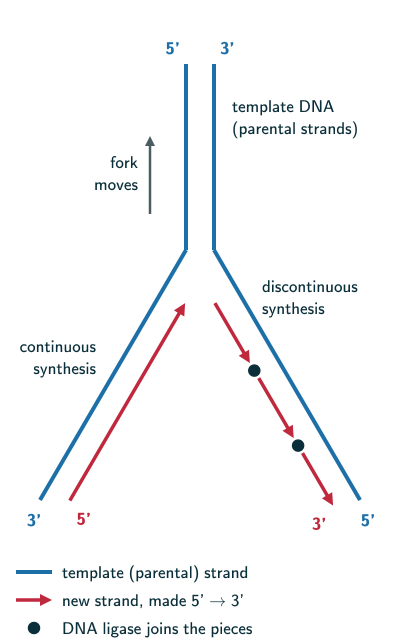
Why the difference (our reasoning from NCERT page 90): a new strand runs antiparallel to its template and can only grow at its 3′ end. On one template, growing 5′ → 3′ means moving into the fork, so the new strand can keep up as the fork opens. On the other template, growing 5′ → 3′ means moving away from the fork, so each piece stops, and a new piece must start nearer the fork as more DNA opens.
Beyond the NCERT text, mechanistic detail (Wikipedia, “Okazaki fragments”, facts in our words): the continuously made strand is called the leading strand and the one made in pieces the lagging strand; its pieces are Okazaki fragments, after Reiji and Tsuneko Okazaki, who studied replication in E. coli in the 1960s. The enzyme DNA helicase separates the strands at the fork, and primase lays down short RNA primers from which the polymerase builds each new piece. Repeated primers are needed for the successive lagging-strand fragments.
Origin of replication
The DNA polymerases on their own cannot initiate the process of replication.
NCERT Biology (Class 12), Section 5.4.2, page 90
- Replication also does not start at random places in the DNA (page 90).
- There is a definite region in E. coli DNA where replication originates: the origin of replication (page 90).
- This is why a piece of DNA that has to be propagated in recombinant DNA procedures needs a vector: a cloning vector can provide an origin recognised by the host (page 91). This applies to autonomous vector replication; DNA integrated into a host chromosome can instead be copied with that chromosome.
- Beyond the NCERT text: as the fork section notes, primase first lays down short RNA primers from which DNA polymerase builds each new piece (primer requirement).
Replication and the cell cycle
- Not every detail of replication is understood well (page 91).
- In eukaryotes, DNA replication takes place in the S-phase of the cell cycle (page 91); see the S phase in Class 11.
- Replication and the cell division cycle must be highly coordinated: a failure in cell division after DNA replication results in polyploidy, a chromosomal anomaly (page 91). Beyond the NCERT text: simply being in G with doubled DNA is not polyploidy, and failed cytokinesis can at first give a cell with two diploid nuclei (reasoned from the cell cycle, NCERT Class 11 Biology, Chapter 10).
Solved examples
Example 1: Why semiconservative? (NCERT Exercise 5)
Which property of the DNA double helix led Watson and Crick to hypothesise the semiconservative mode of DNA replication? Explain.
Answer: the specific, complementary base pairing of its two strands: adenine with thymine and guanine with cytosine (NCERT page 81). Because each strand’s sequence fixes its partner’s, the two strands can separate and each can act as a template for a new complementary strand. Each daughter molecule then has one parental and one new strand, which is semiconservative replication (NCERT page 88).
Example 2: Growth for 80 minutes (NCERT’s question, page 90)
In Meselson and Stahl’s experiment, what would be the proportions of light and hybrid DNA after 80 minutes in the N medium?
Answer: using the question’s 20-minute generation assumption (NCERT page 89), so 80 minutes is 80 ÷ 20 = 4 generations. One heavy molecule gives 2 = 16 molecules. Its two N strands are never copied away: they sit in 2 hybrid molecules. The other 16 − 2 = 14 are light. So hybrid : light = 2 : 14 = 1 : 7, that is 1/8 (12.5 per cent) hybrid and 7/8 (87.5 per cent) light.
Example 3: How long with one fork?
At NCERT’s rate of about 2000 bp per second, how long would one fork take to copy all the DNA of a human diploid cell (6.6 × 10 bp)?
Answer: 6.6 × 10 ÷ 2000 = 3.3 × 10 s, and 3.3 × 10 ÷ 86 400 s per day ≈ 38 days (numbers from NCERT page 90; our arithmetic). Beyond the NCERT text: linear eukaryotic chromosomes have many origins of replication (the standard multiple-origin model), so many forks work at once and the copying takes far less time.
Example 4: Which strand is continuous?
At a replication fork that moves to the right, the upper template strand runs 3′ (left) to 5′ (right) and the lower one 5′ (left) to 3′ (right). On which template is the new strand made continuously?
Answer: on the upper template. Its new strand runs antiparallel, 5′ (left) to 3′ (right), so growing 5′ → 3′ carries it to the right, into the fork: continuous. The lower template has polarity 5′ → 3′ in the direction the fork moves, so its new strand grows to the left, away from the fork, in pieces that DNA ligase joins (NCERT page 90).
Common mistakes to avoid
Common mistake
Calling N a radioactive label
N is a heavy isotope, not a radioactive one; Meselson and Stahl separated it from N only by density, on a CsCl gradient (NCERT page 89). The radioactive label was Taylor’s thymidine (page 90).
Common mistake
Swapping the continuous and discontinuous templates
Read these template polarities relative to fork movement: continuous on 3′ → 5′ and discontinuous on 5′ → 3′ (NCERT page 90).
Common mistake
Expecting the hybrid DNA to disappear
In N medium the two original N strands stay in two hybrid molecules in every generation; only the hybrid share falls, by half each generation (reasoned from NCERT pages 89–90).
Common mistake
Saying DNA polymerase can start replication anywhere
DNA polymerases cannot initiate replication on their own, and replication begins only at a definite region, the origin of replication (NCERT page 90).
Quick revision summary
- Semiconservative replication (Watson and Crick): the two strands separate, each acts as a template, and each daughter DNA has one parental and one new strand.
- Meselson and Stahl (1958), E. coli: N DNA (heavy) moved to N; after one generation all hybrid; after two generations half hybrid, half light; N is not radioactive; CsCl density gradient.
- Taylor and colleagues, Vicia faba: radioactive thymidine showed that chromosomal DNA also replicates semiconservatively (NCERT dates it 1958; the paper is from 1957).
- DNA-dependent DNA polymerase: fast (NCERT’s rounded whole-genome rate is about 2000 bp per second, not a universal rate for one polymerase), accurate, energy from deoxyribonucleoside triphosphates; works only 5′ → 3′.
- At the replication fork: continuous on the 3′ → 5′ template, discontinuous on the 5′ → 3′ template; DNA ligase joins the fragments. Replication starts at the origin of replication; vectors provide one; in eukaryotes it happens in S-phase.
Formula sheet
- semiconservative: one old + one new strand
- Meselson and Stahl 1958: N, then N
- assuming 20-min generations: 20 min all hybrid; 40 min half hybrid/half light
- at 20 min/generation, 80 min: 1/8 hybrid, 7/8 light
- polymerase builds 5′ → 3′ only
- template 3′ → 5′ along fork movement: continuous
- template 5′ → 3′ along fork movement: discontinuous
- DNA ligase joins the fragments
Questions students ask
What is the difference between DNA replication and transcription?
DNA replication copies all the DNA of an organism once it begins, while transcription copies only a segment of DNA, and only one of its strands, into RNA (NCERT page 91). Replication uses DNA-dependent DNA polymerase, builds DNA from deoxyribonucleotides and starts at an origin of replication (page 90); transcription uses DNA-dependent RNA polymerase, runs from a promoter to a terminator and pairs adenine with uracil instead of thymine (pages 91–92). Replication yields two daughter DNA molecules, each with one parental strand, and transcription a single-stranded RNA such as mRNA, tRNA or rRNA (pages 88 and 93).
What is the difference between conservative, semiconservative and dispersive replication?
Semiconservative replication, the scheme DNA actually follows, gives each daughter molecule one parental and one newly synthesised strand (NCERT page 88). Beyond the NCERT text, two other schemes are possible on paper: in conservative replication the parental helix would stay whole and the copy would be all new, and in dispersive replication every strand of both daughters would be a patchwork of old and new pieces. Reasoned from Meselson and Stahl’s results (NCERT pages 89–90), the single hybrid band after one generation in N excludes the conservative scheme, and the equal hybrid and light bands after two exclude the dispersive one, which predicts a single band that only grows lighter.
What is the difference between an origin of replication and a replication fork?
An origin of replication is a fixed region of DNA where copying begins, while a replication fork is the moving point where the helix is opened and its two strands are copied: NCERT says replication does not start at random but at a definite region of E. coli DNA, the origin, and takes place within a small opening of the helix, the replication fork (page 90). Beyond the NCERT text, replication runs in both directions from an origin, so each origin gives rise to two forks that move apart; E. coli, with a single origin on its circular chromosome, copies it with two forks that finally meet on the opposite side of the circle (Goodall and colleagues, Frontiers in Microbiology, 2023, CC BY).
Why does DNA replication go only in the 5′ → 3′ direction?
In DNA replication each new strand is made only in the 5′ → 3′ direction, because DNA-dependent DNA polymerases catalyse polymerisation in that one direction (NCERT page 90). Beyond the NCERT text, the chemistry behind it is that the enzyme joins each incoming nucleotide only to the free 3′–OH at the chain’s growing end, making a 3′–5′ phosphodiester bond, so a new strand lengthens at its 3′ end and never at its 5′ end (our reasoning from NCERT pages 80–81). As the new strand is antiparallel to its template, the template is read 3′ → 5′, and the same one-way rule holds for the RNA polymerase of transcription (NCERT page 92).
How is DNA replication in eukaryotes different from that in prokaryotes?
DNA replication in eukaryotes differs from that in prokaryotes in timing and scale: in eukaryotes it happens in the S phase of the cell cycle, coordinated with cell division (NCERT page 91), whereas NCERT’s prokaryote, E. coli, copies its 4.6 × 10 bp within 18 minutes from one definite origin (page 90). Beyond the NCERT text, eukaryotic DNA lies in several linear chromosomes, each copied from many origins, while most bacteria have one circular chromosome with a single origin (Goodall and colleagues, 2023, CC BY). Eukaryotic DNA is also copied inside the nucleus, wrapped in nucleosomes (NCERT page 83).
Practice questions
Try each question first, then open the answer to check your working.
-
Q1. In Meselson and Stahl’s experiment, what fraction of the DNA would be hybrid after 60 minutes in the N medium?
Show answerHide answer
60 ÷ 20 = 3 generations, so 2 = 8 molecules, of which 2 are hybrid: 2/8 = 1/4 hybrid and 3/4 light (NCERT pages 89–90).
-
Q2. Why is the main replication enzyme called DNA-dependent DNA polymerase?
Show answerHide answer
Because it uses a DNA template to catalyse the polymerisation of deoxynucleotides (NCERT page 90).
-
Q3. What two roles do deoxyribonucleoside triphosphates play in replication?
Show answerHide answer
They act as substrates, and they provide the energy for polymerisation: their two terminal phosphates are high-energy phosphates, as in ATP (NCERT page 90).