Tools of recombinant DNA technology
NCERT Class 12 Biology Chapter 9 Section 9.2
Quick answer
Recombinant DNA work uses nucleases, polymerases, ligases, vectors and suitable hosts. Restriction enzymes cut DNA, ligase seals compatible ends, and vectors carry DNA for replication or expression. Selection identifies transformants, while screening and confirmation establish which contain the intended insert.
With your textbook
NCERT Biology (Class 12), Chapter 9 “Biotechnology: Principles and Processes”, Section 9.2 “Tools of Recombinant DNA Technology”, pages 165–171.
Open the official NCERT chapter (PDF, 3.1 MB, ncert.nic.in) (opens in a new tab)
Checked against the 2026-27 reprint on .
What are the tools of recombinant DNA technology?
Tools of recombinant DNA technology
Now we know from the foregoing discussion that genetic engineering or recombinant DNA technology can be accomplished only if we have the key tools, i.e., restriction enzymes, polymerase enzymes, ligases, vectors and the host organism.
NCERT Biology (Class 12), Section 9.2, page 165
In plain words: to move a gene, we need scissors that cut DNA at exact places, glue that joins the cut ends, a carrier that can multiply inside a cell, and a cell that will take the carrier in.
Restriction enzymes
- In 1963, the two enzymes responsible for restricting the growth of bacteriophage in Escherichia coli were isolated. One added methyl groups to DNA; the other cut DNA and was called restriction endonuclease (page 165). Beyond the NCERT text: the pair forms a restriction–modification system, in which the methylating enzyme marks the cell’s own DNA so that the restriction enzyme cuts only foreign DNA, such as a phage’s (Wikipedia, “Restriction enzyme”, facts in our words).
- The first restriction endonuclease, Hind II, whose action depends on a specific DNA nucleotide sequence, was isolated and characterised five years later. It always cuts DNA at a particular point by recognising a specific sequence of six base pairs: its recognition sequence (page 165).
- Besides Hind II, today we know of “more than 900 restriction enzymes that have been isolated from over 230 strains of bacteria”, each recognising a different recognition sequence (page 165).
- Beyond the NCERT text (Wikipedia, “Restriction enzyme”, facts in our words): histories date these steps differently. In the 1960s, Werner Arber’s and Matthew Meselson’s laboratories traced restriction to an enzyme that cuts the incoming phage’s DNA, and Hamilton Smith, Thomas Kelly and Kent Wilcox isolated and characterised Hind II in 1970. More than 3600 restriction endonucleases are now known, and different enzymes can recognise the same sequence; these are isoschizomers. In an exam, give NCERT’s account: 1963, Hind II five years later, and more than 900 enzymes.
Naming restriction enzymes
- The first letter of the name comes from the genus, and the second two letters from the species of the prokaryotic cell from which the enzyme was isolated. For example, EcoRI comes from Escherichia coli RY 13: the letter ‘R’ is derived from the name of the strain (pages 165–166).
- Roman numbers after the name indicate the order in which the enzymes were isolated from that strain (page 166).
Exonucleases and endonucleases
- Restriction enzymes belong to a larger class of enzymes called nucleases, of two kinds (page 166):
- exonucleases remove nucleotides from the ends of the DNA;
- endonucleases make cuts at specific positions within the DNA.
- Each restriction endonuclease ‘inspects’ the length of a DNA sequence. Once it finds its specific recognition sequence, it binds to the DNA and cuts each of the two strands of the double helix at specific points in their sugar-phosphate backbones (page 166).
Palindromes and sticky ends
- Each restriction endonuclease recognises a specific palindromic nucleotide sequence in the DNA (page 166).
- A word palindrome, such as “MALAYALAM”, reads the same forward and backward. A palindrome in DNA is a sequence of base pairs that reads the same on the two strands when the orientation of reading is kept the same: 5′ GAATTC 3′ on one strand and 5′ GAATTC 3′ on the other, read 5′ to 3′ (pages 166–167).
- Restriction enzymes cut the strand a little away from the centre of the palindrome, but between the same two bases on the opposite strands. This leaves single-stranded overhanging stretches at the ends, called sticky ends, named so because they form hydrogen bonds with their complementary cut counterparts. This stickiness helps the enzyme DNA ligase (page 167). EcoRI, for example, cuts between G and A on each strand, leaving 5′ AATT overhangs (NCERT Figure 9.1, page 166).
- DNA fragments cut by the same restriction enzyme have the same kind of sticky ends and can be joined end to end by DNA ligases (page 167). So, unless the vector and the source DNA are cut with the same restriction enzyme, the recombinant vector molecule cannot normally be created (page 168).
- Beyond the NCERT text: not every restriction enzyme leaves sticky ends; some, such as SmaI, cut both strands at the centre of the site and leave blunt ends, and some (Type IIS enzymes) recognise a site that is not a palindrome and cut at a set distance from it (Wikipedia, “Restriction enzyme”, facts in our words). DNA ligase joins the pieces by forming phosphodiester bonds in the backbone, and it can join blunt ends too, under different reaction conditions (Wikipedia, “DNA ligase”, facts in our words). NCERT’s description fits EcoRI; in a NEET question, follow NCERT.
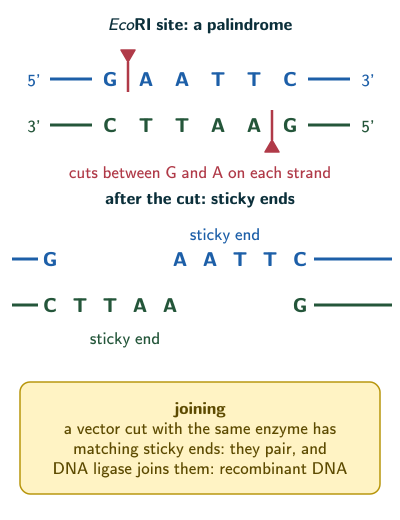
NCERT slip (page 166): the label in the middle of NCERT Figure 9.1 prints EcoR1, with the digit 1; the figure’s other label, its caption and the text print EcoRI, where the Roman I gives the order of isolation. Write EcoRI.
Gel electrophoresis and elution
- The fragments made by restriction endonucleases are separated by gel electrophoresis. DNA fragments are negatively charged, so an electric field forces them through a matrix towards the anode (page 168).
- The most commonly used matrix is agarose, a natural polymer extracted from sea weeds. The fragments separate (resolve) by size through the sieving effect of the gel: the smaller the fragment, the farther it moves (page 168). Beyond the NCERT text: the size rule is for linear pieces; a plasmid is a ring, so to read its size against the usual linear markers it is first opened with a restriction enzyme (Wikipedia, “Agarose gel electrophoresis”, facts in our words).
- The fragments can be seen only after staining with ethidium bromide and exposure to UV radiation, as bright orange bands; pure DNA cannot be seen in visible light without staining (page 168). Beyond the NCERT text: laboratories also use other stains, such as SYBR Green or GelRed (Wikipedia, “Agarose gel electrophoresis”, facts in our words).
- The separated bands are cut out of the agarose gel and extracted from the gel piece: elution. The purified fragments are used to construct recombinant DNA by joining them with cloning vectors (page 168).
NCERT asks at which end of the gel in its Figure 9.3 the samples were loaded (page 168). At the end with the wells, the end nearest the cathode: the negatively charged fragments move away from it towards the anode, the smallest farthest (reasoned from NCERT page 168).
Cloning vectors
- Plasmids and bacteriophages can replicate within bacterial cells independently of the control of chromosomal DNA. Bacteriophages have very high copy numbers of their genome per cell; some plasmids have only one or two copies per cell, others 15–100 or even more (page 168).
- An alien piece of DNA linked with a bacteriophage or plasmid DNA is multiplied to the copy number of the plasmid or bacteriophage. Present-day vectors are engineered to make it easy to link foreign DNA and to select recombinants from non-recombinants (page 168).
The features needed to facilitate cloning into a vector (pages 169–170):
- Origin of replication (ori): the sequence from where replication starts. Any piece of DNA linked to it can be made to replicate within the host cells, and ori also controls the copy number of the linked DNA: to recover many copies, clone in a vector whose ori supports a high copy number.
- Selectable marker: helps identify and eliminate non-transformants and lets the transformants grow selectively. Transformation is the procedure by which a piece of DNA is introduced into a host bacterium. Genes for resistance to ampicillin, chloramphenicol, tetracycline or kanamycin are useful selectable markers for E. coli, since normal E. coli cells resist none of these antibiotics.
- Cloning sites: the vector needs very few, preferably single, recognition sites for the commonly used restriction enzymes; more than one site would cut the vector into several fragments and complicate gene cloning.
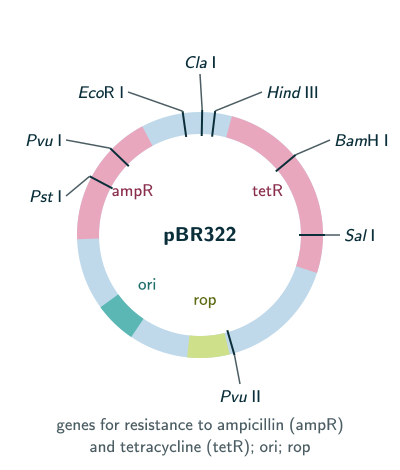
pBR322 and insertional inactivation
- The alien DNA is ligated at a restriction site inside one of the two antibiotic resistance genes, for example at the BamH I site of the tetracycline resistance gene of pBR322 (page 169).
- The recombinant plasmids lose tetracycline resistance because of the insert, but transformants can still be picked out by plating them on ampicillin medium. They are then transferred to a medium containing tetracycline: recombinants grow on ampicillin but not on tetracycline, while non-recombinants grow on both (page 169). As the recombinants do not grow on the tetracycline plate, they are picked up from the matching spots on the ampicillin plate (our reasoning).
- NCERT slip (page 169): read on its own, NCERT’s sentence says the recombinants “can still be selected out from non-recombinant ones by plating the transformants on ampicillin containing medium”. Ampicillin plating alone cannot do that, because recombinants and non-recombinants both resist ampicillin: it selects the transformants, and the tetracycline plate that follows tells the recombinants (sensitive) apart, as NCERT’s next sentences show. In an exam: ampicillin selects the transformants; sensitivity to tetracycline marks the recombinants.
- So one resistance gene selects the transformants, and the other, ‘inactivated due to insertion’ of alien DNA, helps select the recombinants (pages 169–170).
- Because this needs simultaneous plating on two plates, alternative markers were developed that tell recombinants by colour. The insert goes into the coding sequence of the enzyme β-galactosidase, inactivating it: insertional inactivation. With a chromogenic substrate, colonies whose plasmid has no insert turn blue; colonies with the insert give no colour and are identified as recombinants (page 170).
- Beyond the NCERT text (Wikipedia, “Blue–white screen”, facts in our words): this is blue–white screening. The chromogenic substrate used is X-gal, and the vector carries only a short part of the β-galactosidase gene (lacZ), which makes a working enzyme together with a defective version in the host strain; an insert in that part stops this. White colonies are then checked further, since a white colony can lack the intended recombinant plasmid, for example when the ligation went wrong. In an NCERT-based answer: blue, no insert; colourless, recombinant.
Vectors for plants and animals
- Bacteria and viruses have long known how to deliver genes into eukaryotic cells, and we have learnt from them (page 170). Agrobacterium tumefaciens, a pathogen of several dicot plants, delivers a piece of DNA called ‘T-DNA’ that transforms normal plant cells into a tumor and directs them to make the chemicals the pathogen needs (page 170).
- Its tumor inducing (Ti) plasmid has been modified into a cloning vector that is no longer pathogenic to plants but can still deliver genes of our interest into a variety of plants (page 170).
- Retroviruses in animals have the ability to transform normal cells into cancerous cells. Retroviruses have also been disarmed and are now used to deliver desirable genes into animal cells (page 170).
NCERT slip (page 170): the species is Agrobacterium tumefaciens, with an e; NCERT prints “tumifaciens”. The NCBI Taxonomy database (US National Library of Medicine, public domain) lists Agrobacterium tumefaciens and finds no “tumifaciens”. In an exam, write Agrobacterium tumefaciens; an option printed as NCERT spells it means the same bacterium.
Competent host
- DNA is a hydrophilic molecule and cannot pass through cell membranes (page 170). NCERT asks why: the interior of the cell membrane is formed by the hydrophobic tails of its lipid bilayer, which a large water-loving molecule cannot cross (reasoned from NCERT Class 11 Biology, Chapter 8).
- To make bacteria take up a plasmid, they are first made ‘competent’ by treating them with a specific concentration of a divalent cation such as calcium, which increases the efficiency with which DNA enters the bacterium through pores in its cell wall (pages 170–171).
- The cells are incubated with recombinant DNA on ice, placed briefly at 42 °C (heat shock), and put back on ice; this lets the bacteria take up the recombinant DNA (page 171). Beyond the NCERT text: this is induced, or artificial, competence; some bacteria are naturally competent and take up DNA from their surroundings under natural conditions (Wikipedia, “Natural competence”, facts in our words).
Other ways to introduce alien DNA into host cells (page 171):
- micro-injection: recombinant DNA is injected directly into the nucleus of an animal cell;
- biolistics (gene gun): suitable for plants; cells are bombarded with high-velocity micro-particles of gold or tungsten coated with DNA;
- disarmed pathogen vectors, which transfer the recombinant DNA into the host cell when allowed to infect it.
Solved examples
Example 1: A restriction enzyme at work
Make a chart showing a restriction enzyme, the substrate DNA on which it acts, the site at which it cuts DNA and the product it produces. (NCERT Exercise 2, page 175.)
Answer: enzyme: EcoRI. Substrate: double-stranded DNA containing its palindromic recognition sequence, 5′ GAATTC 3′ paired with 3′ CTTAAG 5′. Site: on each strand, between G and A. Product: two fragments, each with a single-stranded sticky end (5′ AATT overhang) that can pair with any end cut by the same enzyme (NCERT pages 166–167; the figure above shows it).
Example 2: Making palindromes
Give five palindromic DNA sequences, and create one by following base-pair rules. (NCERT Exercise 7, page 175.)
Answer: a sequence is palindromic when its complementary strand, read 5′ to 3′, is the same sequence. Examples: GAATTC (NCERT page 167), GGATCC, AAGCTT, GTCGAC and CTGCAG. To create one, write any three bases, say GCA, and follow them with the complements of the same bases in reverse order, TGC: GCATGC, whose partner strand 5′ to 3′ is again GCATGC (base pairing A with T and G with C; our worked rule).
Example 3: Telling recombinants by colour
How can a reporter enzyme be used to monitor transformation of host cells by foreign DNA, in addition to a selectable marker? (NCERT Exercise 9, page 175.)
Answer: insert the foreign DNA within the coding sequence of the enzyme β-galactosidase in the vector. The selectable marker picks out the transformants; then, on a chromogenic substrate, colonies whose plasmid has no insert make the enzyme and turn blue, while colonies with the insert, in which the gene is inactivated (insertional inactivation), stay colourless: these are the recombinants (NCERT page 170). Beyond the NCERT text, the colourless colonies are then checked for the right insert (Wikipedia, “Blue–white screen”, facts in our words).
Common mistakes to avoid
Common mistake
Thinking the larger fragments move farther
In gel electrophoresis the smaller the fragment, the farther it moves through the agarose sieve (NCERT page 168).
Common mistake
Picking the blue colonies as recombinants
Blue colonies have plasmids without an insert; the recombinants, with β-galactosidase inactivated by the insert, give no colour (NCERT page 170).
Common mistake
Expecting pBR322 recombinants to resist tetracycline
An insert at the BamH I site inactivates the tetracycline resistance gene: recombinants grow on ampicillin but not on tetracycline (NCERT page 169).
Common mistake
Assuming every insert in pBR322 costs tetracycline resistance
Pvu I and Pst I lie in the ampicillin resistance gene, as NCERT Figure 9.4 (page 169) shows. An insert there inactivates ampR instead: recombinants grow on tetracycline but not on ampicillin (reasoned from NCERT page 169).
Quick revision summary
- Key tools: restriction enzymes, polymerase enzymes, ligases, vectors and the host organism.
- Restriction endonucleases: first found in 1963; Hind II the first characterised (six-base-pair recognition sequence); over 900 known from over 230 bacterial strains (NCERT; beyond the NCERT text, Wikipedia dates Hind II to 1970). Naming: genus letter, two species letters, strain letter, Roman number for order (EcoRI from E. coli RY 13).
- Exonucleases trim ends; endonucleases cut within. Restriction enzymes cut palindromic sites between the same two bases on both strands, leaving sticky ends that DNA ligase joins (NCERT; beyond the NCERT text, some enzymes such as SmaI leave blunt ends, Wikipedia).
- Gel electrophoresis: DNA moves to the anode through agarose; smaller fragments farther; ethidium bromide and UV show orange bands; elution recovers them.
- Vectors: ori (copy number), selectable marker (antibiotic resistance), single cloning sites. pBR322: insert at BamH I in tetR, so recombinants grow on ampicillin but not tetracycline. β-galactosidase: blue without insert, colourless recombinants (beyond the NCERT text, the colourless colonies are checked further, Wikipedia). Ti plasmid of Agrobacterium and disarmed retroviruses for plants and animals.
- Competent host: calcium, ice, 42 °C heat shock, ice; also micro-injection, biolistics (gene gun) and disarmed pathogens.
Formula sheet
- EcoRI site: GAATTC, a palindrome
- sticky ends: single-stranded overhangs
- DNA runs to the anode; small ones farthest
- pBR322: ori, rop, ampR, tetR
- insert in tetR: grows on amp, not tet
- blue colony: no insert; colourless: recombinant
- competent cells: calcium, ice, 42 °C, ice
Questions students ask
Why are restriction enzymes called restriction enzymes and molecular scissors?
Restriction enzymes take their name from restricting the growth of bacteriophages in bacteria, and they are called molecular scissors because they cut DNA at specific locations (NCERT pages 164–165). NCERT’s profile of Herbert Boyer adds that the E. coli restriction enzymes he studied left ‘sticky ends’, which made “pasting together pieces of DNA a precise exercise” (page 162).
Why do restriction enzymes recognise palindromic sequences?
Beyond the NCERT text, most restriction enzymes that recognise palindromes, EcoRI among them, do so because they work as homodimers: two identical protein subunits, each with its own catalytic site, bind the two halves of a site that reads the same on both strands, and so usually cut both strands in one binding event (Pingoud, Wilson and Wende, Nucleic Acids Research, 2014, CC BY). The same review calls working as homodimers “the most efficient use of genetic resources”, since one gene serves both halves of the enzyme (our reading), and says that is why such enzymes are “more common than they would otherwise be”, even though DNA holds more asymmetric sequences than symmetric ones.
What is the difference between a cloning vector and an expression vector?
A cloning vector carries a piece of DNA into a host to be multiplied there, while an expression vector, a term beyond the NCERT text, also lets the host make that DNA’s protein: NCERT lists a cloning vector’s needs as an origin of replication, a selectable marker and cloning sites (pages 169–170). An expression vector adds signals for expression: a promoter before its cloning site, often one that can be switched on, such as the lac promoter, and a ribosome binding site (Rosano and Ceccarelli on E. coli expression plasmids, Frontiers in Microbiology, 2014, CC BY). NCERT gives the reason: the ultimate aim of almost all recombinant technologies is a desirable protein (page 173).
How many fragments does a restriction enzyme make from linear and circular DNA?
A restriction enzyme that cuts a DNA molecule at all of its n recognition sites makes n + 1 fragments if the DNA is linear but only n fragments if it is circular, such as a plasmid, because the first cut merely opens the ring into one linear piece (our arithmetic). So an enzyme with 3 sites gives 4 fragments from a linear DNA and 3 from a circular one, and an enzyme with a single site in a circular vector simply opens it, ready to take the alien DNA. That is why NCERT wants a vector to have very few, preferably single, recognition sites for the commonly used enzymes (page 169).
Practice questions
Try each question first, then open the answer to check your working.
-
Q1. In EcoRI, what do the letters E, co and R stand for?
Show answerHide answer
E for the genus Escherichia, co for the species coli, and R for the strain RY 13 (NCERT pages 165–166).
-
Q2. Which compound is used to see DNA bands in a gel, and what colour are they?
Show answerHide answer
Ethidium bromide, followed by exposure to UV light; the bands are bright orange (NCERT page 168).
-
Q3. Name three methods besides heat shock for introducing alien DNA into host cells.
Show answerHide answer
Micro-injection into the nucleus of an animal cell; biolistics (gene gun) with gold or tungsten particles for plants; and disarmed pathogen vectors (NCERT page 171).