Biotechnological applications in medicine
NCERT Class 12 Biology Chapter 10 Section 10.2
Quick answer
Biotechnology produces recombinant medicines and supports gene therapy and molecular diagnosis. Human insulin has A and B chains, while ADA gene addition can restore missing enzyme function in suitable cells. Recombinant DNA technology (including probes), PCR and ELISA serve the purpose of early diagnosis, which conventional methods such as serum and urine analysis cannot give.
With your textbook
NCERT Biology (Class 12), Chapter 10 “Biotechnology and Its Applications”, Section 10.2 “Biotechnological Applications in Medicine”, pages 181–183.
Open the official NCERT chapter (PDF, 1.5 MB, ncert.nic.in) (opens in a new tab)
Checked against the 2026-27 reprint on .
What are biotechnological applications in medicine?
Biotechnology in medicine
The recombinant DNA technological processes have made immense impact in the area of healthcare by enabling mass production of safe and more effective therapeutic drugs.
NCERT Biology (Class 12), Section 10.2, page 181
In plain words: once a human gene can be put into a bacterium, the bacterium can make the human protein in bulk. The same tools let doctors replace a faulty gene, and find a disease from a trace of its nucleic acid before symptoms appear.
Recombinant therapeutics
- Recombinant therapeutics do not induce unwanted immunological responses, as is common with similar products isolated from non-human sources (page 181).
- About 30 recombinant therapeutics have been approved for human use the world over; in India, 12 of these are being marketed (page 181).
- NEET (UG) 2026 also lists vaccine production. NCERT describes recombinant vaccines in Chapter 7: antigenic polypeptides of a pathogen are produced in bacteria or yeast, for example the hepatitis B vaccine produced from yeast (NCERT Section 7.2.4, page 136); see vaccination and immunisation.
Genetically engineered insulin
- Adult-onset diabetes can be managed by taking insulin at regular time intervals (page 181). Insulin is a hormone of the pancreas (NCERT Class 11 Biology, Chapter 19).
- Insulin used for diabetes was earlier extracted from the pancreas of slaughtered cattle and pigs. Insulin from an animal source caused some patients to develop allergy or other reactions to the foreign protein (page 181).
- Insulin consists of two short polypeptide chains, A and B, linked together by disulphide bridges (page 181).
- In mammals, including humans, insulin is synthesised as a pro-hormone, which needs processing before it becomes a mature, functional hormone. The pro-hormone contains an extra stretch called the C peptide, which is not present in mature insulin and is removed during maturation (page 182).
- The main challenge in producing insulin by rDNA techniques was getting it assembled into a mature form (page 182).
- In 1983, Eli Lilly, an American company, prepared two DNA sequences corresponding to the A and B chains of human insulin and introduced them in plasmids of E. coli. The chains were produced separately, extracted and combined by creating disulfide bonds to form human insulin (page 182).
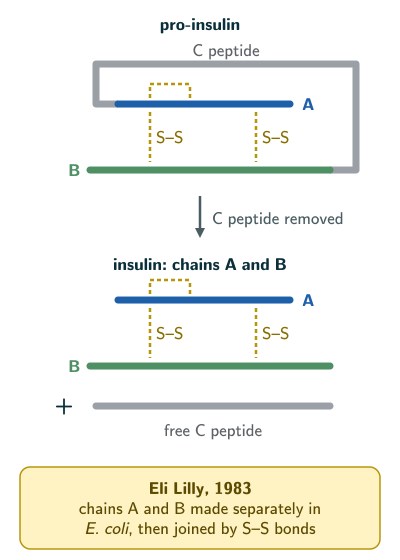
NCERT asks whether insulin can be given to diabetic people by mouth (page 181). Ordinary insulin cannot: insulin is a protein of two polypeptide chains, and in the gut it would be digested by protein-digesting enzymes before it could act (reasoned from NCERT page 181). That is why it is injected.
Gene therapy
- Gene therapy is a collection of methods that allows correction of a gene defect diagnosed in a child or embryo. Genes are inserted into a person’s cells and tissues to treat a disease: a normal gene is delivered to take over the function of, and compensate for, the non-functional gene (page 182).
- The first clinical gene therapy was given in 1990 to a 4-year-old girl with adenosine deaminase (ADA) deficiency. This enzyme is crucial for the immune system to function. NCERT says the disorder is caused by the deletion of the gene for adenosine deaminase (page 182).
- In some children ADA deficiency can be cured by bone marrow transplantation; in others it is treated by enzyme replacement therapy, in which functional ADA is given by injection. NCERT then says both approaches are not completely curative (page 182). The two sentences sit uneasily together: read them as saying that neither approach works fully for every child, which is why gene therapy was tried (our reading). In an exam, give NCERT’s point that both are not completely curative.
- The gene therapy steps (page 182):
- lymphocytes from the patient’s blood are grown in a culture outside the body;
- a functional ADA cDNA is introduced into them using a retroviral vector;
- the lymphocytes are returned to the patient.
- These cells are not immortal, so the patient needs periodic infusions of the genetically engineered lymphocytes. If the gene isolated from marrow cells producing ADA were introduced into cells at early embryonic stages, it could be a permanent cure (page 182).
Reading note (page 182): beyond the NCERT text, MedlinePlus Genetics (US National Library of Medicine, public domain) describes ADA deficiency more generally, as caused by variants (mutations) in the ADA gene that reduce or eliminate the enzyme’s activity; without the enzyme, a breakdown product of DNA builds up and kills immature lymphocytes. In an exam, give NCERT’s line: the gene for adenosine deaminase is deleted.
Molecular diagnosis
- For effective treatment, early diagnosis and an understanding of the disease’s pathophysiology are very important. Conventional methods (serum and urine analysis, etc.) cannot detect a disease early (pages 182–183).
- Recombinant DNA technology, the polymerase chain reaction (PCR) and the enzyme linked immuno-sorbent assay (ELISA) serve the purpose of early diagnosis (page 183).
- A pathogen is normally suspected only once it has produced a symptom, when its concentration in the body is already very high. A very low concentration of a bacterium or virus can be detected by amplifying its nucleic acid by PCR (page 183).
- PCR is now routinely used to detect HIV in suspected AIDS patients and to detect mutations in genes in suspected cancer patients; it can identify many other genetic disorders (page 183).
- Probes: a single-stranded DNA or RNA tagged with a radioactive molecule (the probe) is allowed to hybridise to its complementary DNA in a clone of cells, followed by detection using autoradiography. The clone with the mutated gene does not appear on the photographic film, because the probe is not complementary to it (page 183).
- ELISA is based on the principle of antigen-antibody interaction. Infection can be detected by the presence of antigens (proteins, glycoproteins and so on) or of the antibodies synthesised against the pathogen (page 183). NCERT Chapter 7 names ELISA as a widely used diagnostic test for AIDS (page 140).
NCERT asks how PCR can detect very low amounts of DNA (page 183). Each cycle doubles the target, so a few copies become millions or billions after enough cycles, enough to be detected (reasoned from NCERT Section 9.3, pages 172–173; see PCR).
Solved examples
Example 1: Gene therapy for ADA deficiency
What is gene therapy? Illustrate using the example of adenosine deaminase (ADA) deficiency. (NCERT Exercise 8, page 187.)
Answer: gene therapy is a collection of methods for correcting a diagnosed gene defect by delivering a normal gene into a person’s cells or tissues, where it takes over the function of the non-functional gene. In 1990 a 4-year-old girl with ADA deficiency received the first clinical gene therapy: lymphocytes from her blood were grown in culture, a functional ADA cDNA was introduced into them with a retroviral vector, and the cells were returned to her. As the cells are not immortal, the infusions must be repeated; putting the gene into cells at early embryonic stages could be a permanent cure (NCERT page 182).
Example 2: Transgenic bacteria
What are transgenic bacteria? Illustrate using any one example. (NCERT Exercise 5, page 187.)
Answer: bacteria whose DNA has been manipulated to carry and express a foreign gene (reasoned from NCERT’s definition of transgenic animals, page 183). Example: E. coli carrying the DNA sequences for the A and B chains of human insulin in its plasmids, prepared by Eli Lilly in 1983; the bacteria make the two chains, which are extracted and joined by disulphide bonds into human insulin (NCERT page 182).
Example 3: Copies from a trace of DNA
A blood sample holds 12 copies of a virus’s DNA. If every PCR cycle doubles the target, how many copies are there after 22 cycles?
Answer: copies = 12 × 222 = 12 × 4 194 304 = 50 331 648, about fifty million (doubling each cycle, reasoned from NCERT Section 9.3, pages 172–173). This is why PCR can detect a pathogen while its concentration is still very low, before symptoms are visible (NCERT page 183).
Common mistakes to avoid
Common mistake
Putting the C peptide in mature insulin
The C peptide is in pro-insulin only; it is removed during maturation, and mature insulin is chains A and B joined by disulphide bridges (NCERT pages 181–182).
Common mistake
Calling the 1990 gene therapy a one-time cure
The engineered lymphocytes are not immortal, so the patient needs periodic infusions; NCERT adds that a gene introduced into cells at early embryonic stages could be a permanent cure (NCERT page 182).
Common mistake
Expecting the mutated clone to show up with a normal probe
A probe hybridises only with complementary DNA, so the clone with the mutated gene does not appear on the film (NCERT page 183).
Quick revision summary
- Recombinant therapeutics: safe, more effective, no unwanted immune responses; about 30 approved worldwide, 12 marketed in India. Recombinant vaccines: hepatitis B vaccine from yeast.
- Insulin: chains A and B joined by disulphide bridges; made as pro-insulin with a C peptide that is removed. Eli Lilly, 1983: A and B chains made separately in E. coli, then joined. Animal insulin caused allergy in some patients.
- Gene therapy: a normal gene inserted to make up for a defective one. First clinical use 1990, ADA deficiency: lymphocytes cultured, given ADA cDNA by a retroviral vector, returned; periodic infusions needed.
- Molecular diagnosis: PCR (HIV, mutations in cancer), radioactive probes with autoradiography (the mutated clone does not show), ELISA (antigen or antibody).
Formula sheet
- insulin: chains A and B, disulphide bridges
- pro-insulin: C peptide removed
- ADA gene therapy, 1990: lymphocytes
- vector for ADA cDNA: retrovirus
- ELISA: antigen-antibody interaction
- copies after n cycles = 2n × start
Questions students ask
Is ADA deficiency the same as SCID?
No, ADA deficiency is not the same as SCID but one of its causes: NCERT’s Chapter 10 says only that adenosine deaminase “is crucial for the immune system to function” (page 182). Beyond the NCERT text, about 80 per cent of people with ADA deficiency have severe combined immunodeficiency (SCID), which leaves them almost without immune protection, others have milder or later-starting forms, and ADA deficiency lies behind about 15 per cent of all SCID (MedlinePlus Genetics, US National Library of Medicine, public domain). So, by our reading, most cases of SCID have other causes.
What is the difference between somatic and germline gene therapy?
Beyond the NCERT text, somatic gene therapy alters body cells, so a patient’s children do not inherit the change, whereas germline gene therapy would alter egg or sperm cells, so the change would pass to future generations (MedlinePlus Genetics, public domain). The same source adds that research now targets somatic cells, for example cells of the bone marrow or blood, and that germline change is controversial, partly because those affected are not yet born and cannot choose. By our reading, the 1990 ADA treatment of the patient’s lymphocytes (NCERT page 182) was somatic, while NCERT’s idea of introducing the gene at early embryonic stages (page 182) could reach the germ cells too.
Is genetically engineered insulin the same as human insulin?
Genetically engineered human insulin is the same molecule as the insulin of the human body: NCERT’s summary says that human insulin is made in bacteria “yet its structure is absolutely identical to that of the natural molecule” (page 186). Only its source differs: genetically engineered bacteria, not the human pancreas. Beyond the NCERT text, recombinant DNA technology also makes insulin analogues, whose amino acids are deliberately changed: in insulin lispro, for example, the proline at position 28 of chain B and the lysine at position 29 trade places (US FDA-approved label, 2019).
Why is a retrovirus used as the vector in ADA gene therapy?
A retrovirus is used as the vector because it builds its genes into the DNA of the cell it infects: NCERT’s summary says that viruses which “introduce their genetic material into the host cell as part of their replication cycle are used as vectors to transfer healthy genes” (page 186), and in HIV, a retrovirus, the viral DNA “gets incorporated into host cell’s DNA” (NCERT Chapter 7, pages 138 and 140). In the ADA therapy a functional ADA cDNA was introduced into the patient’s lymphocytes with a retroviral vector (page 182), using retroviruses that have been “disarmed” (NCERT Chapter 9, page 170). By our reading, the gene then becomes part of each modified lymphocyte’s DNA.
What is the difference between gene therapy and genetic engineering?
By our reading, gene therapy is one medical use of genetic engineering rather than a separate technique: NCERT defines genetic engineering as “techniques to alter the chemistry of genetic material (DNA and RNA), to introduce these into host organisms and thus change the phenotype of the host organism” (Chapter 9, pages 163–164), while in gene therapy “genes are inserted into a person’s cells and tissues to treat a disease” (page 182). So genetic engineering can change many kinds of organism, a bacterium or a crop plant among them, whereas gene therapy changes a patient’s cells to correct a diagnosed gene defect (our reading).
Practice questions
Try each question first, then open the answer to check your working.
-
Q1. Why did insulin from cattle and pigs cause problems for some patients?
Show answerHide answer
It is a foreign protein, so some patients developed allergy or other reactions to it (NCERT page 181).
-
Q2. Besides gene therapy, how else can ADA deficiency be treated, and why are these not enough?
Show answerHide answer
By bone marrow transplantation in some children, or by enzyme replacement therapy, injecting functional ADA, in others; neither is completely curative (NCERT page 182).
-
Q3. In a probe test, why does the clone with the mutated gene not appear on the photographic film?
Show answerHide answer
The radioactive probe hybridises only with complementary DNA; it is not complementary to the mutated gene, so it does not bind to that clone, and autoradiography shows nothing there (NCERT page 183).