Transgenic animals
NCERT Class 12 Biology Chapter 10 Section 10.3
Quick answer
Transgenic animals carry introduced genetic sequences and can express them. They help study gene function and disease, produce biological products, and support selected vaccine or toxicity tests. NCERT’s Rosie example describes milk containing human alpha-lactalbumin; this alone does not establish suitability as an infant feed.
With your textbook
NCERT Biology (Class 12), Chapter 10 “Biotechnology and Its Applications”, Section 10.3 “Transgenic Animals”, pages 183–184.
Open the official NCERT chapter (PDF, 1.5 MB, ncert.nic.in) (opens in a new tab)
Checked against the 2026-27 reprint on .
What are transgenic animals?
Transgenic animals
Animals that have had their DNA manipulated to possess and express an extra (foreign) gene are known as transgenic animals.
NCERT Biology (Class 12), Section 10.3, page 183
In plain words: a transgenic animal carries an extra (foreign) gene and expresses it. Scientists make such animals to learn what genes do, to copy human diseases for research, to make useful human proteins, and to test vaccines and chemicals for safety.
Which animals are made transgenic
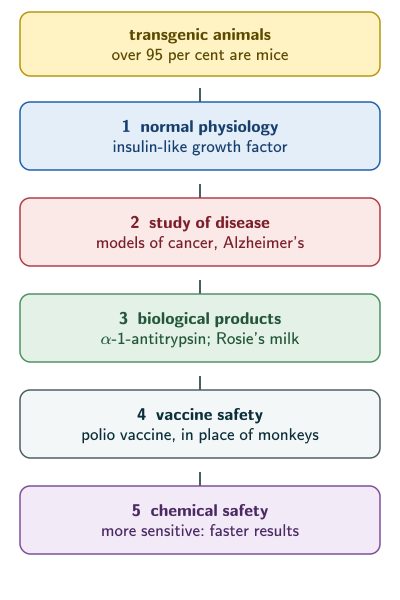
- Transgenic rats, rabbits, pigs, sheep, cows and fish have been produced, although over 95 per cent of all existing transgenic animals are mice (page 183). The figure is NCERT’s estimate, not a current census (our reading).
- NCERT then asks why these animals are produced and how humans can benefit (page 183). It gives five common reasons, below.
Why transgenic animals are made
- Normal physiology and development. Transgenic animals can be designed to study how genes are regulated and how they affect the normal functions of the body and its development. For example, to study complex growth factors such as insulin-like growth factor, genes from other species that alter its formation are introduced, and the biological effects that result show the factor’s role in the body (page 183).
- Study of disease. Many transgenic animals are made to show how genes contribute to the development of disease. They serve as models for human diseases, so that new treatments can be investigated. Transgenic models exist for cancer, cystic fibrosis, rheumatoid arthritis and Alzheimer’s (page 183).
- Biological products. Medicines required to treat certain human diseases can contain biological products, but such products are often expensive to make. Transgenic animals that produce them can be created by introducing the portion of DNA (or genes) that codes for a particular product, such as the human protein α-1-antitrypsin, used to treat emphysema. Similar attempts are being made for the treatment of phenylketonuria (PKU) and cystic fibrosis (page 184). Beyond the NCERT text: α-1-antitrypsin is given to people whose lung disease is due to an inherited α-1-antitrypsin deficiency, and the product in use is made from donated human plasma (Wikipedia, “Alpha-1 antitrypsin deficiency”, facts in our words). The first medicine made in genetically engineered animals was antithrombin (ATryn), from the milk of genetically modified goats, approved in the United States in 2009 (Wikipedia, “ATryn”, facts in our words).
- Vaccine safety. Transgenic mice are being developed for use in testing the safety of vaccines before they are used on humans, and are being used to test the safety of the polio vaccine. If successful and found to be reliable, they “could replace the use of monkeys” to test the safety of batches of the vaccine (page 184).
- Chemical safety testing (toxicity/safety testing). Transgenic animals are made that carry genes which make them more sensitive to toxic substances than non-transgenic animals. They are exposed to the toxic substances and the effects studied, so that results are obtained in less time (page 184).
Rosie the transgenic cow
- NCERT: in 1997 the first transgenic cow, Rosie, produced human protein-enriched milk (2.4 grams per litre); the milk contained the human alpha-lactalbumin (page 184); give these in an NCERT-based answer. Beyond the NCERT text: transgenic dairy cattle were reported earlier, in 1991 (Krimpenfort and colleagues, Bio/Technology, 1991).
- NCERT: the milk was nutritionally a more balanced product for human babies than natural cow-milk (page 184). This does not make it an approved, complete infant feed or a replacement for human milk (our reading).
Solved examples
Example 1: Protein in Rosie’s milk
Rosie’s milk carried 2.4 grams of human protein per litre (NCERT page 184). How much of the protein is in 3.5 litres of her milk, and how many litres hold 6 grams?
Answer: 2.4 g/L × 3.5 L = 8.4 g; 6 g ÷ 2.4 g/L = 2.5 L (our arithmetic).
Example 2: Mice for the polio vaccine
Why are transgenic mice being developed for vaccine testing, and what could they replace?
Answer: transgenic mice are being developed to test the safety of vaccines before they are used on humans, and are being used to test the safety of the polio vaccine. If successful and found to be reliable, they could replace the use of monkeys to test the safety of batches of the vaccine (NCERT page 184).
Example 3: Matching reasons to examples
Match each example to NCERT’s reason for making transgenic animals: (a) insulin-like growth factor; (b) a model of Alzheimer’s; (c) α-1-antitrypsin; (d) animals more sensitive to toxic substances.
Answer: (a) normal physiology and development; (b) study of disease; (c) biological products; (d) chemical safety testing (NCERT pages 183–184).
Common mistakes to avoid
Common mistake
Thinking most transgenic animals are farm animals
Rats, rabbits, pigs, sheep, cows and fish have been made transgenic, but NCERT says over 95 per cent of all existing transgenic animals are mice (NCERT page 183).
Common mistake
Giving Rosie’s milk the wrong human protein
Rosie’s milk contained human alpha-lactalbumin; α-1-antitrypsin is the human protein NCERT gives as used to treat emphysema (NCERT page 184).
Common mistake
Making toxicity-test animals less sensitive
Toxicity-test animals carry genes that make them more sensitive to toxic substances than non-transgenic animals, not less (NCERT page 184).
Quick revision summary
- Transgenic animals possess and express an extra (foreign) gene. Rats, rabbits, pigs, sheep, cows and fish have been made; over 95 per cent of all existing transgenic animals are mice (NCERT).
- Five reasons: normal physiology and development (insulin-like growth factor); study of disease (models of cancer, cystic fibrosis, rheumatoid arthritis, Alzheimer’s); biological products (α-1-antitrypsin, used to treat emphysema); vaccine safety (polio vaccine, in place of monkeys); chemical safety testing (animals more sensitive to toxic substances).
- NCERT: Rosie (1997), the first transgenic cow, gave human protein-enriched milk (2.4 g per litre) containing human alpha-lactalbumin, nutritionally more balanced for human babies than natural cow milk (page 184). Beyond the NCERT text: transgenic dairy cattle were reported in 1991 (Krimpenfort and colleagues, Bio/Technology, 1991).
Formula sheet
- transgenic animal: expresses a foreign gene
- most transgenic animals: mice
- α-1-antitrypsin: used to treat emphysema (NCERT)
- Rosie, 1997: human alpha-lactalbumin
- Rosie’s milk: 2.4 g protein per litre
- transgenic mice: polio vaccine safety
Questions students ask
What is the difference between a transgenic mouse and a knockout mouse?
A transgenic mouse gains a gene, while a knockout mouse loses the use of one of its own: NCERT defines transgenic animals as animals whose DNA has been manipulated to possess and express an extra (foreign) gene (page 183). Beyond the NCERT text, a knockout mouse is one in which researchers have “inactivated, or ‘knocked out,’ an existing gene by replacing it or disrupting it with an artificial piece of DNA”, and studying the animal that results gives clues to the gene’s normal job (US National Human Genome Research Institute, public domain). By our reading, the first kind tells scientists what an added gene does, and the second what a missing gene does.
Is a transgenic animal the same as a GMO?
A transgenic animal is one kind of GMO, by our reading of NCERT’s two definitions: GMOs are “plants, bacteria, fungi and animals whose genes have been altered by manipulation” (page 179), while transgenic animals have had their DNA manipulated to possess and express an extra (foreign) gene (page 183). So GMO is the wider term, covering crops, bacteria and fungi too, while transgenic animal names only the animals among them (our reading). Transgenic is not an animals-only word either: NCERT calls the tobacco plant protected by RNA interference a “transgenic plant” (page 180).
Why are most transgenic animals mice?
Most transgenic animals are mice, over 95 per cent of all existing ones, NCERT says (page 183), because, beyond the NCERT text, mice breed fast, as frequently as once in nine weeks, cost little to keep, resemble humans closely in their genes and body systems, and have a genome that is easy to change and study (US National Human Genome Research Institute, 2002, public domain). The same source notes that mice can be given human diseases they do not normally develop, cystic fibrosis and Alzheimer’s among them, by changing their genome and environment.
What does α-1-antitrypsin do in the body?
Beyond the NCERT text, α-1-antitrypsin is a protein that shields the body’s tissues, the lungs above all, from neutrophil elastase, a strong enzyme that white blood cells release to fight infection but that harms normal tissue when it is not held in check (MedlinePlus Genetics, US National Library of Medicine, public domain). When a person inherits too little working α-1-antitrypsin, the unchecked elastase destroys alveoli, the air sacs of the lungs, which is why many such people develop emphysema (same source).
Which methods are used to produce transgenic animals?
Beyond the NCERT text, transgenic animals have most often been produced by microinjecting the chosen gene into a pronucleus of a zygote, the fertilised egg, while embryonic stem cells and somatic cell nuclear transfer are other routes (Shakweer and others, J Genet Eng Biotechnol, 2023, CC BY). The same review finds the yield low: only about 1 to 4 transgenic mice for every hundred injected eggs. The method builds on micro-injection as NCERT Chapter 9 describes it, recombinant DNA injected directly into the nucleus of an animal cell (page 171).
Practice questions
Try each question first, then open the answer to check your working.
-
Q1. Name four human diseases for which transgenic animal models exist.
Show answerHide answer
Cancer, cystic fibrosis, rheumatoid arthritis and Alzheimer’s (NCERT page 183).
-
Q2. Why do toxicity tests in transgenic animals give results in less time?
Show answerHide answer
The animals carry genes that make them more sensitive to toxic substances than non-transgenic animals, so the effects of a substance show up sooner (NCERT page 184).
-
Q3. How are transgenic animals that make a useful biological product created?
Show answerHide answer
By introducing the portion of DNA (or the genes) that codes for that product, for example the human protein α-1-antitrypsin (NCERT page 184).