Disorders of the respiratory system
NCERT Class 11 Biology Chapter 14 Section 14.6
Quick answer
NCERT covers asthma, emphysema and occupational respiratory disorders. Asthma involves inflamed, variably narrowed airways; emphysema damages alveolar walls and reduces gas-exchange surface. Hazardous occupational dust can cause inflammation and fibrosis, so prevention controls exposure and uses suitable respiratory protection when required.
With your textbook
NCERT Biology (Class 11), Chapter 14 “Breathing and Exchange of Gases”, Section 14.6 “Disorders of Respiratory System”, pages 190–191.
Open the official NCERT chapter (PDF, 2.1 MB, ncert.nic.in) (opens in a new tab)
Checked against the 2026-27 reprint on .
Disorders of the respiratory system
Respiratory disorders
NCERT describes three disorders of the respiratory system: asthma, emphysema and occupational respiratory disorders (NCERT Section 14.6, pages 190–191). These examples emphasise airway inflammation, alveolar destruction and dust-related lung fibrosis; occupational disease is a category of causes, not one disease affecting one exclusive compartment.
In plain words: breathing well needs open airways, a huge surface of thin alveolar walls, and lung tissue that is soft and stretchy. Asthma narrows the airways, emphysema destroys the alveolar walls, and inhaled hazardous dust can inflame and scar lung tissue.
Asthma
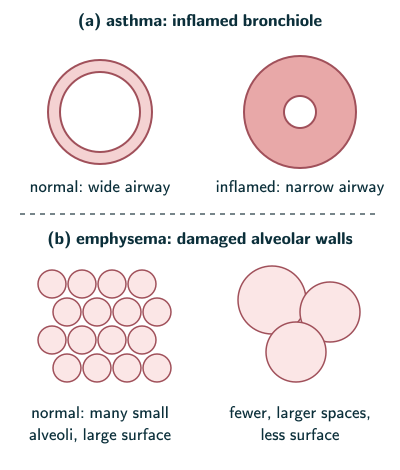
Asthma is a difficulty in breathing causing wheezing due to inflammation of bronchi and bronchioles.
NCERT Biology (Class 11), Section 14.6, page 190
- The problem is in the conducting airways: the bronchi and bronchioles are inflamed (page 190).
- Wheezing is “a whistling sound when you breathe out” (beyond the NCERT text; the US National Heart, Lung, and Blood Institute, “Asthma: Symptoms”, public domain).
Emphysema
Emphysema is a chronic disorder in which alveolar walls are damaged due to which respiratory surface is decreased.
NCERT Biology (Class 11), Section 14.6, page 190
- The problem is in the exchange part: with the alveolar walls damaged, there is less surface for the diffusion of O and CO (page 190).
- One of the major causes is cigarette smoking (page 190).
Occupational respiratory disorders
- In certain industries, especially those involving grinding or stone-breaking, so much dust is produced that the body’s defence mechanism cannot fully cope (NCERT page 191).
- Long exposure can cause inflammation leading to fibrosis, the proliferation of fibrous tissue, and so serious lung damage (page 191).
- NCERT advises protective masks (page 191). Beyond NCERT, effective prevention first controls dust at its source with methods such as wet cutting and extraction; where respiratory protection is needed, it must be an appropriate, correctly fitted respirator. An ordinary loose mask does not reliably prevent harmful dust exposure (CDC/NIOSH, “Safe Work Practices” and “A Guide to Respirators Used for Dust in Construction”).
Beyond the NCERT text, two well-known examples:
- Silicosis is “a lung disease caused by inhaling excessive amounts of respirable crystalline silica”. Cutting, grinding, polishing and drilling can raise such dust, as in stonecutting and quarry work. Silicosis is not reversible, but it is preventable (CDC, National Institute for Occupational Safety and Health, “Silica and Worker Health”).
- Asbestosis is “a diffuse interstitial fibrosis of lung tissue resulting from inhalation of asbestos fibers”, and the fibrosis can progress even after exposure ends (Agency for Toxic Substances and Disease Registry, ATSDR, “Asbestos Toxicity”).
| Disorder | Part affected | What happens |
|---|---|---|
| Asthma | bronchi, bronchioles | inflammation; wheezing |
| Emphysema | alveolar walls | damaged; less surface |
| Dust-related occupational fibrosis | lung tissue | inflammation; scarring |
(NCERT pages 190–191.)
Solved examples
Example 1: Which disorder?
Match these textbook descriptions to the disorder: (a) a stone-quarry worker’s lungs become scarred after years of breathing dust; (b) a long-time smoker has damaged alveolar walls; (c) a person wheezes because the bronchioles are inflamed.
Answer: (a) an occupational respiratory disorder, with fibrosis; (b) emphysema; (c) asthma in this textbook matching exercise (NCERT pages 190–191). Beyond the NCERT text, other conditions can also cause wheezing, so it does not by itself show asthma (NHLBI, “Asthma: Symptoms”).
Example 2: Why emphysema causes breathlessness
Why does a person with emphysema get less oxygen into the blood?
Answer: gas exchange happens by diffusion across the alveolar walls (NCERT pages 187–188). Damaged alveolar walls decrease the respiratory surface (page 190), so diffusion capacity is reduced. Loss of elastic recoil and airflow limitation can also impair ventilation; blood oxygen is not determined by surface area alone (NHLBI, “COPD: Causes and Risk Factors”).
Example 3: Masks at work
Why does NCERT advise protective masks for workers in grinding and stone-breaking industries?
Answer: such work produces so much dust that the body’s defences cannot fully cope; long exposure causes inflammation and then fibrosis, which seriously damages the lungs. NCERT recommends protective masks (page 191); appropriate fitted respirators reduce inhaled dust exposure when required, alongside source controls (CDC/NIOSH).
Example 4: Conducting part or exchange part?
Which part of the respiratory system does each disorder mainly affect: (a) asthma, (b) emphysema?
Answer: (a) the conducting part, the bronchi and bronchioles; (b) the exchange part, the alveoli (NCERT pages 185 and 190).
Common mistakes to avoid
Common mistake
Placing asthma in the alveoli
Asthma is inflammation of the bronchi and bronchioles; it is emphysema that damages the alveolar walls (NCERT page 190).
Common mistake
Calling emphysema a short illness
NCERT calls emphysema a chronic disorder, with cigarette smoking as one of its major causes (page 190).
Common mistake
Thinking fibrosis is the dust itself
Fibrosis is the proliferation of fibrous tissue in the lungs, a result of long inflammation caused by the dust (NCERT page 191).
Quick revision summary
- Asthma: difficulty in breathing with wheezing, from inflammation of the bronchi and bronchioles.
- Emphysema: a chronic disorder in which alveolar walls are damaged and the respiratory surface decreases; cigarette smoking is a major cause.
- Occupational respiratory disorders: dust from grinding or stone-breaking causes inflammation and fibrosis; prevention uses dust controls and suitable fitted respiratory protection when required.
Formula sheet
- asthma: inflamed bronchi and bronchioles; wheezing
- emphysema: damaged alveolar walls; less respiratory surface; smoking
- dust-related occupational fibrosis: hazardous dust → inflammation → scarring
- protection: control dust at source; use appropriate fitted respirators when required
Questions students ask
Is asthma the same as emphysema, and can asthma lead to emphysema?
Asthma is not the same as emphysema: asthma inflames the airways, the bronchi and bronchioles, while emphysema is a chronic disorder that damages the alveolar walls and so reduces the respiratory surface (NCERT page 190). In asthma the airways become inflamed and narrowed at times (NHLBI, “Asthma”), whereas emphysema causes lasting alveolar damage and can worsen over time (MedlinePlus, “COPD”); treatment can control asthma and help manage COPD symptoms and progression, although neither currently has a cure (NHLBI, “Asthma” and “COPD”). Beyond the NCERT text, asthma does not usually turn into emphysema: people with asthma have a higher risk of COPD, the group of diseases that includes emphysema, but most people with asthma will not get it (MedlinePlus, “COPD”).
Is emphysema the same as COPD?
Emphysema is one type of COPD, not another name for it: COPD, chronic obstructive pulmonary disease, is a group of lung diseases that make it hard to breathe and get worse over time, and its two main types are emphysema and chronic bronchitis (MedlinePlus, “COPD”). In emphysema the walls between many of the air sacs are damaged (NHLBI, “COPD”), as in NCERT’s damaged alveolar walls (NCERT page 190), while in chronic bronchitis the lining of the airways is repeatedly irritated and inflamed (NHLBI, “COPD”). The term COPD is beyond the NCERT text, which names asthma, emphysema and occupational disorders.
Why does cigarette smoking cause emphysema?
Cigarette smoking causes emphysema because smoke breathed in over many years damages the lungs: the walls between many air sacs are destroyed and the air sacs lose their elastic quality (NHLBI, “COPD: Causes and Risk Factors”). NCERT names cigarette smoking as one of the major causes of emphysema, the disorder in which damaged alveolar walls decrease the respiratory surface (NCERT page 190). Beyond the NCERT text, smoking is the main risk factor for COPD, and long exposure to other lung irritants, such as air pollution, chemical fumes and dust at work, and smoke from cooking or heating fuels in unventilated homes, also raises the risk (same source).
Are silicosis and asbestosis in NCERT and the NEET syllabus?
Silicosis and asbestosis are not named in NCERT or in the NEET (UG) 2026 syllabus, whose list of disorders ends with “Occupational respiratory disorders”, but they are two well-known examples of that group. Both are pneumoconioses, lung diseases caused by the lung’s reaction to breathing in certain dusts: silicosis comes from silica dust and asbestosis from asbestos fibres (CDC, NIOSH, “Pneumoconioses”). They fit NCERT’s account of industrial dust that, over long exposure, causes inflammation and then fibrosis (NCERT page 191); they cannot be cured but can be prevented by controlling the dust (CDC, NIOSH, as above), and NCERT advises protective masks, with the practical respirator/source-control distinction explained above.
Practice questions
Try each question first, then open the answer to check your working.
-
Q1. What is one of the major causes of emphysema?
Show answerHide answer
Cigarette smoking (NCERT page 190).
-
Q2. What is fibrosis?
Show answerHide answer
The proliferation of fibrous tissue, which seriously damages the lungs (NCERT page 191).
-
Q3. Inflammation of which structures causes asthma?
Show answerHide answer
The bronchi and bronchioles (NCERT page 190).