Mechanism of breathing and lung volumes
NCERT Class 11 Biology Chapter 14 Section 14.2
Quick answer
During spontaneous inspiration, diaphragm and external intercostal contraction enlarge the chest, lower alveolar pressure and draw air in. Quiet expiration follows muscle relaxation and elastic recoil; forced expiration recruits muscles. NCERT’s tidal volume is about 500 mL, and vital capacity equals ERV + TV + IRV.
With your textbook
NCERT Biology (Class 11), Chapter 14 “Breathing and Exchange of Gases”, Section 14.2 “Mechanism of Breathing”, pages 185–187.
Open the official NCERT chapter (PDF, 2.1 MB, ncert.nic.in) (opens in a new tab)
Checked against the 2026-27 reprint on .
Mechanism of breathing
Inspiration and expiration
Breathing has two stages: inspiration, during which atmospheric air is drawn in, and expiration, by which the alveolar air is released out (NCERT page 185).
The movement of air into and out of the lungs is carried out by creating a pressure gradient between the lungs and the atmosphere.
NCERT Biology (Class 11), Section 14.2, page 185
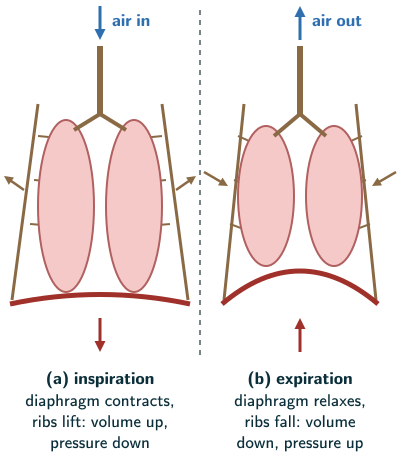
In plain words: the lungs work like a syringe with no plunger of their own. The diaphragm pulls the floor of the chest down and the rib muscles lift the ribs and sternum, the lungs follow, the air pressure inside drops, and air rushes in. Let the muscles relax, the chest springs back, the pressure inside rises a little, and air flows out.
Inspiration and expiration
- Inspiration can occur if the pressure inside the lungs (intra-pulmonary pressure) is less than atmospheric pressure, that is, if there is a negative pressure in the lungs with respect to the atmosphere (NCERT page 185).
- Expiration takes place when the intra-pulmonary pressure is higher than atmospheric pressure (page 185).
| Feature | Inspiration | Expiration |
|---|---|---|
| Muscles (quiet breathing) | contract | relax |
| Thoracic volume | increases | decreases |
| Lung pressure | below atmospheric | slightly above |
| Air | in | out |
(NCERT pages 185–186.)
These pressure differences apply while air flows. At the end of an unforced inspiration or expiration, airflow stops as alveolar pressure equals atmospheric pressure; pleural pressure is a different pressure.
Diaphragm and intercostal muscles
The diaphragm and a specialised set of muscles between the ribs, the external and internal intercostals, generate the pressure gradients (NCERT page 185).
Inspiration (pages 185–186):
- The diaphragm contracts, increasing the volume of the thoracic chamber by moving downward and increasing its vertical dimension. NCERT calls this the “antero-posterior axis”; in standard human anatomy anterior–posterior means front–back, so that textbook label should not replace the correct direction of diaphragm motion.
- The external intercostal muscles contract, lifting the ribs and sternum and increasing the volume of the thoracic chamber in the front–back and transverse dimensions; NCERT describes the dorso-ventral increase.
- The overall increase in thoracic volume causes a similar increase in pulmonary volume, which lowers the intra-pulmonary pressure below atmospheric pressure, and air from outside moves into the lungs.
Expiration (page 186):
- The diaphragm and the intercostal muscles relax, returning the diaphragm and sternum to their normal positions.
- This reduces the thoracic volume and so the pulmonary volume.
- The intra-pulmonary pressure rises to slightly above atmospheric pressure, and air is expelled from the lungs.
NCERT mentions additional abdominal muscles for stronger breathing (page 186). More precisely, abdominal contraction mainly assists forced expiration; neck and other accessory inspiratory muscles can help expand the chest during increased inspiratory effort (NHLBI, “How Your Body Controls Breathing”).
- On average, a healthy human breathes 12–16 times a minute (NCERT page 186).
- The volume of air involved in breathing can be estimated with a spirometer, which helps in the clinical assessment of pulmonary functions (page 186).
- A spirometer records the air that moves in and out, so it cannot record the residual volume, which never leaves the lungs, or the capacities that include it, FRC and TLC (a reasoned point from NCERT’s definitions, pages 186–187).
Respiratory volumes and capacities
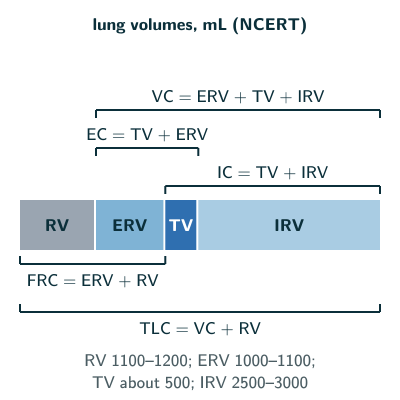
The respiratory volumes below are NCERT’s approximate teaching values, not fixed normal limits for every person; lung volumes vary with body size, age and other factors (NCERT Section 14.2.1, pages 186–187):
| Volume | Meaning | Average (mL) |
|---|---|---|
| Tidal volume (TV) | air inspired or expired in a normal breath | about 500 |
| Inspiratory reserve volume (IRV) | extra air inspired by a forcible inspiration | 2500–3000 |
| Expiratory reserve volume (ERV) | extra air expired by a forcible expiration | 1000–1100 |
| Residual volume (RV) | air left in the lungs even after a forcible expiration | 1100–1200 |
With a tidal volume of about 500 mL, a healthy person inspires or expires about 6000 to 8000 mL of air a minute (page 186).
The pulmonary capacities, sums of these volumes, are used in clinical diagnosis (page 187):
| Capacity | Meaning | Sum |
|---|---|---|
| Inspiratory capacity (IC) | air inspired after a normal expiration | TV + IRV |
| Expiratory capacity (EC) | air expired after a normal inspiration | TV + ERV |
| Functional residual capacity (FRC) | air left after a normal expiration | ERV + RV |
| Vital capacity (VC) | most air breathed in after a forced expiration, or out after a forced inspiration | ERV + TV + IRV |
| Total lung capacity (TLC) | air in the lungs after a forced inspiration | VC + RV |
Expiratory capacity is NCERT’s term; use NCERT’s definition of EC (TV + ERV) in NEET answers.
Solved examples
Example 1: Capacities from the volumes
Using NCERT’s averages (TV 500 mL, IRV 2500–3000 mL, ERV 1000–1100 mL, RV 1100–1200 mL), find the ranges of IC, EC, FRC, VC and TLC.
Answer:
- IC = 500 + (2500 to 3000) = 3000–3500 mL
- EC = 500 + (1000 to 1100) = 1500–1600 mL
- FRC = (1000 to 1100) + (1100 to 1200) = 2100–2300 mL
- VC = (1000 to 1100) + 500 + (2500 to 3000) = 4000–4600 mL
- TLC = VC + RV = 5100–5800 mL
(Volumes from NCERT pages 186–187.)
Example 2: Tidal volume in an hour (NCERT Exercise 14)
What is tidal volume? Find the approximate tidal volume for a healthy human in an hour.
Answer: the tidal volume is the volume of air inspired or expired in a normal breath, about 500 mL. At 12–16 breaths a minute, that is 6000–8000 mL a minute (NCERT page 186), so in an hour: 6000 × 60 = 360 000 mL to 8000 × 60 = 480 000 mL, that is, about 360–480 litres ventilated over the hour. This is cumulative ventilation, not a tidal volume of hundreds of litres: tidal volume remains about 500 mL per breath.
Example 3: Air left after a normal breath (NCERT Exercise 2)
State the volume of air remaining in the lungs after a normal breathing.
Answer: taking “after a normal breathing” to mean the end of a normal expiration, this is the functional residual capacity, FRC = ERV + RV = (1000 to 1100) + (1100 to 1200) = 2100–2300 mL (NCERT pages 186–187). (Not the residual volume, 1100–1200 mL, which remains after a forcible expiration.)
Example 4: Vital capacity (NCERT Exercise 1)
Define vital capacity. What is its significance?
Answer: vital capacity is the maximum volume of air a person can breathe in after a forced expiration, or breathe out after a forced inspiration; it includes ERV, TV and IRV, about 4000–4600 mL by NCERT’s averages (pages 186–187). Its significance: it measures the most air a person can move in one breath, and, like the other capacities, it is used in the clinical assessment of the lungs (page 187).
Example 5: Inspiration under normal conditions (NCERT Exercise 6)
Explain the process of inspiration under normal conditions.
Answer: the diaphragm contracts and descends, increasing the thorax’s vertical dimension, and the external intercostal muscles contract, lifting the ribs and sternum to enlarge the chest. The pulmonary volume rises with the thoracic volume, the intra-pulmonary pressure falls below atmospheric pressure, and air moves into the lungs (NCERT pages 185–186).
Example 6: Pairs of volumes and capacities (NCERT Exercise 13)
Distinguish between (a) IRV and ERV, (b) inspiratory capacity and expiratory capacity, (c) vital capacity and total lung capacity.
Answer: (a) IRV is the extra air a person can inspire by a forcible inspiration (2500–3000 mL); ERV is the extra air expired by a forcible expiration (1000–1100 mL). (b) IC is the total air inspired after a normal expiration (TV + IRV); EC is the total air expired after a normal inspiration (TV + ERV). (c) VC is the most air breathed out after a forced inspiration (ERV + TV + IRV); TLC is all the air in the lungs at the end of a forced inspiration, VC + RV (NCERT pages 186–187).
Common mistakes to avoid
Common mistake
Moving the diaphragm the wrong way
In inspiration the diaphragm contracts and the thoracic volume increases; in expiration it relaxes and returns to its normal position (NCERT pages 185–186).
Common mistake
Putting the residual volume into the vital capacity
Vital capacity is ERV + TV + IRV; the residual volume stays in the lungs and is added only for the total lung capacity (NCERT page 187).
Common mistake
Mixing up the axes
NCERT says the diaphragm enlarges the thorax in the antero-posterior axis, and the external intercostals, by lifting the ribs and sternum, in the dorso-ventral axis (NCERT pages 185–186). Identify those labels when quoting NCERT, but do not transfer the head-to-tail convention to standard human anatomy. In a standing person, the diaphragm descends and makes the chest taller (superior–inferior), while rib/sternal movement increases front–back and side-to-side dimensions (NHLBI, “What Breathing Does for the Body”).
Quick revision summary
- Air moves by a pressure gradient: inspiration when intra-pulmonary pressure is below atmospheric, expiration when it is above.
- Inspiration: the diaphragm and external intercostals contract, thoracic and pulmonary volume rise, pressure falls, air enters. Expiration: they relax, volume falls, pressure rises slightly above atmospheric, air leaves. Abdominal muscles assist forced expiration; accessory inspiratory muscles assist deeper inspiration.
- A healthy human breathes 12–16 times a minute; a spirometer estimates the volumes.
- Volumes: TV about 500, IRV 2500–3000, ERV 1000–1100, RV 1100–1200 mL. Capacities: IC = TV + IRV, EC = TV + ERV, FRC = ERV + RV, VC = ERV + TV + IRV, TLC = VC + RV.
Formula sheet
- IC = TV + IRV; EC = TV + ERV
- FRC = ERV + RV
- VC = ERV + TV + IRV
- TLC = VC + RV = RV + ERV + TV + IRV
- TV about 500 mL; 12–16 breaths a minute; 6000–8000 mL a minute
Questions students ask
Why can the residual volume never be breathed out?
Residual volume remains after maximal expiration because lung/chest-wall mechanics and closure of small airways limit further emptying (beyond the NCERT text, which defines it only as the air remaining in the lungs even after a forcible expiration, NCERT page 187; StatPearls, “Physiology, Residual Volume”). This is not just a rigid minimum chest size. Between normal breaths, the larger functional residual capacity provides the gas reservoir; pleural pressure and surfactant also help keep alveoli open (NHLBI, “The Respiratory System”).
Is expiration active or passive?
Normal, quiet expiration is passive, while inspiration is active: inspiration starts with the contraction of the diaphragm and external intercostal muscles, but in normal expiration they simply relax, the diaphragm and sternum return to their normal positions and the thoracic volume falls (NCERT pages 185–186). The lungs then shrink back by themselves, like an elastic balloon left open, so breathing out needs no effort at rest (NHLBI, “How the Lungs Work”). Forced expiration, as in exercise, is active, because extra muscles are used to push the air out (NCERT page 186; NHLBI, as above).
How is vital capacity calculated?
Vital capacity is calculated by adding three volumes, VC = ERV + TV + IRV, or, when a capacity is known, as VC = IC + ERV or VC = TLC − RV, both of which follow from NCERT’s definitions (NCERT page 187). For example, a person with an inspiratory capacity of 3200 mL and an ERV of 1000 mL has VC = 3200 + 1000 = 4200 mL, and one with a total lung capacity of 5600 mL and an RV of 1150 mL has VC = 5600 − 1150 = 4450 mL. A spirometer can also record vital capacity directly, as the air breathed out after the deepest possible breath in (a reasoned point from NCERT pages 186–187).
What is the difference between tidal volume and vital capacity?
Tidal volume is the air moved in one normal breath, about 500 mL, while vital capacity is the most air that can be moved in one breath, breathed out after a forced inspiration (NCERT pages 186–187). Vital capacity contains the tidal volume together with both reserve volumes, ERV and IRV, so by NCERT’s averages it is about 8 to 9 times as large. So quiet breathing uses only a small part of the lungs’ capacity, and the reserve volumes are drawn on only in forcible breathing (NCERT pages 186–187).
How is residual volume measured if a spirometer cannot record it?
Residual volume is found indirectly: the functional residual capacity is first measured by body plethysmography or by a gas method such as nitrogen washout or helium dilution, and the expiratory reserve volume, which a spirometer can record, is subtracted from it (beyond the NCERT text; NHLBI, “Pulmonary Function Tests”; StatPearls, “Physiology, Residual Volume”). The subtraction uses NCERT’s definition FRC = ERV + RV (NCERT page 187), so RV = FRC − ERV; for example, an FRC of 2200 mL and an ERV of 1050 mL give RV = 2200 − 1050 = 1150 mL.
Practice questions
Try each question first, then open the answer to check your working.
-
Q1. Which instrument estimates the volumes of air involved in breathing?
Show answerHide answer
A spirometer (NCERT page 186).
-
Q2. What is the residual volume, and what is its average?
Show answerHide answer
The volume of air remaining in the lungs even after a forcible expiration; it averages 1100–1200 mL (NCERT page 187).
-
Q3. Which muscles lift the ribs and sternum during inspiration?
Show answerHide answer
The external intercostal muscles (NCERT pages 185–186).