Human skeletal system: axial and appendicular
NCERT Class 11 Biology Chapter 17 Section 17.3
Quick answer
The standard adult human skeleton has 206 bones: 80 axial and 126 appendicular. The axial skeleton includes the skull and associated bones, 26 vertebral-column bones, sternum and ribs; the appendicular skeleton comprises limbs and girdles. Each limb contains 30 bones.
With your textbook
NCERT Biology (Class 11), Chapter 17 “Locomotion and Movement”, Section 17.3 “Skeletal System”, pages 224–226.
Open the official NCERT chapter (PDF, 4.5 MB, ncert.nic.in) (opens in a new tab)
Checked against the 2026-27 reprint on .
Skeletal system
Skeletal system
The skeleton is the framework the muscles pull on. NCERT defines it:
Skeletal system consists of a framework of bones and a few cartilages.
NCERT Biology (Class 11), Section 17.3, page 224
In plain words: the skeleton is the body’s frame and its set of levers. The central column of skull, backbone, breastbone and ribs protects the brain, spinal cord and chest organs; the limbs, hung on the shoulder and hip girdles, give the levers for walking, lifting and gripping.
Bone and cartilage
- Bone and cartilage are specialised connective tissues (NCERT page 224; see connective tissue).
- Bone has a hard, mineralised matrix containing calcium salts; NCERT associates cartilage’s pliable matrix with chondroitin salts (page 224). Beyond that shorthand, cartilage is a hydrated matrix of collagen and proteoglycans containing chondroitin sulfate; its mechanical properties come from this whole structure, not a mineral deposit like bone (Introduction to Cartilage, Royal Society of Chemistry).
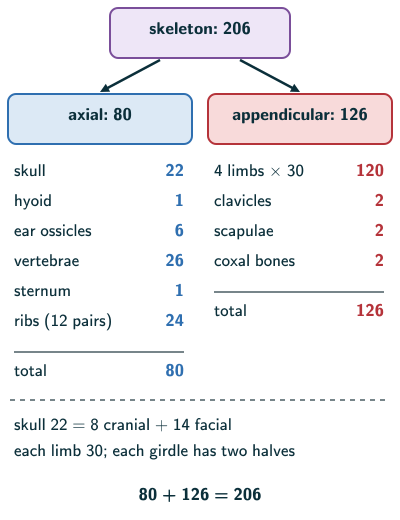
- The standard adult human skeleton is counted as 206 bones and a few cartilages, in two principal divisions, the axial and the appendicular skeleton (page 224).
Axial skeleton: skull, vertebral column, sternum and ribs
The axial skeleton has 80 bones along the main axis of the body: the skull, vertebral column, sternum and ribs (NCERT page 224).
Skull (pages 224–225):
- Two sets of bones, cranial and facial, totalling 22: 8 cranial bones form the hard protective cranium for the brain, and 14 facial elements form the front of the skull.
- A single U-shaped hyoid bone lies at the base of the buccal cavity.
- Each middle ear has three tiny bones, the malleus, incus and stapes, together called the ear ossicles.
- The skull joins the top of the vertebral column by two occipital condyles: a dicondylic skull.
Vertebral column (page 225):
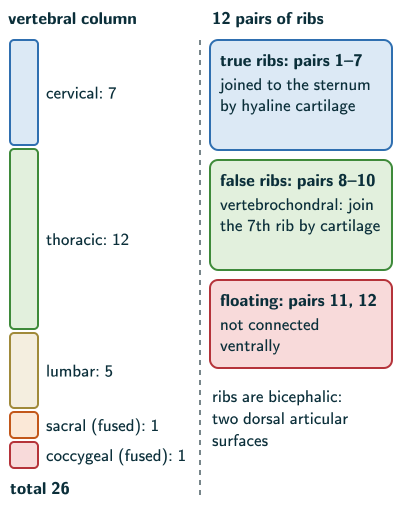
- 26 adult bones, placed dorsally from the base of the skull: 24 separate vertebrae plus the sacrum and coccyx, each counted as one fused bone. NCERT calls these 26 units vertebrae; the column is the main framework of the trunk.
- The vertebral openings collectively form the vertebral (neural) canal, protecting the spinal cord and nerve roots. The adult spinal cord normally ends near L1–L2; lower in the canal are descending nerve roots, not a cord extending through every bone (StatPearls, “Physiology, Spinal Cord”). The first vertebra, the atlas, articulates with the occipital condyles.
- Regions, from the skull: cervical (7), thoracic (12), lumbar (5), sacral (1, fused) and coccygeal (1, fused). Almost all mammals, including humans, have seven cervical vertebrae.
- It protects the spinal cord, supports the head, and gives attachment to the ribs and the muscles of the back.
Sternum and ribs (page 225):
- The sternum is a flat bone on the ventral midline of the thorax.
- There are 12 pairs of ribs. Each is a thin flat bone joined dorsally to the vertebral column; at the front, a rib joins the sternum directly, joins it through the seventh rib, or stays free, as below. NCERT calls ribs bicephalic, referring to two articulation surfaces at the dorsal end (page 225). This is a general textbook description, not a universal rule for every rib: atypical ribs differ; the 11th and 12th have a single articular facet (StatPearls, “Anatomy, Thorax, Ribs”). NCERT’s general sentence says every rib is connected ventrally to the sternum, but its own next lines show that pairs 8–10 join it only through the seventh rib and pairs 11–12 not at all.
- True ribs, the first 7 pairs, join the thoracic vertebrae dorsally and the sternum ventrally, by hyaline cartilage.
- The 8th, 9th and 10th pairs do not join the sternum directly but join the seventh rib by hyaline cartilage: vertebrochondral (false) ribs.
- The last 2 pairs (11th and 12th) are not connected ventrally: floating ribs.
- The thoracic vertebrae, ribs and sternum together form the rib cage, whose movement in breathing NCERT describes in Chapter 14 (see breathing muscles).
Appendicular skeleton: limbs and girdles
The bones of the limbs, with their girdles, make up the appendicular skeleton. Each limb has 30 bones (NCERT page 225).
- Upper limb (fore limb): humerus, radius and ulna, carpals (wrist bones, 8), metacarpals (palm bones, 5) and phalanges (digits, 14) (page 226).
- Lower limb (hind limb): femur (thigh bone, the longest bone), tibia and fibula, tarsals (ankle bones, 7), metatarsals (5) and phalanges (14); a cup-shaped patella covers the knee ventrally (knee cap) (page 226).
- Pectoral and pelvic girdles join the upper and lower limbs to the axial skeleton. Each girdle has two halves (page 226).
- Pectoral girdle: each half is a clavicle and a scapula.
- The scapula is a large, triangular, flat bone in the dorsal part of the thorax, between the second and seventh ribs. Its ridge, the spine, ends as a flat expanded process, the acromion, with which the clavicle articulates. Below the acromion, the glenoid cavity takes the head of the humerus to form the shoulder joint.
- The clavicle, or collar bone, is a long slender bone with two curvatures (page 226).
- Pelvic girdle: two coxal bones, each formed by the fusion of the ilium, ischium and pubis. Where they fuse is a cavity, the acetabulum, to which the thigh bone articulates. The two halves meet ventrally at the pubic symphysis, which contains fibrous cartilage (page 226).
Solved examples
Example 1: Counting the limb bones
Show that each human limb has 30 bones, as NCERT says.
Answer: fore limb: humerus 1 + radius 1 + ulna 1 + carpals 8 + metacarpals 5 + phalanges 14 = 30. Hind limb: femur 1 + tibia 1 + fibula 1 + tarsals 7 + metatarsals 5 + phalanges 14 + patella 1 = 30 (from NCERT pages 225–226).
Example 2: Adding up to 206
Using NCERT’s counts, show how the axial skeleton reaches 80 and the whole skeleton 206.
Answer: axial: skull 22 + hyoid 1 + ear ossicles 6 + vertebrae 26 + sternum 1 + ribs 24 = 80. Appendicular: four limbs 4 × 30 = 120, plus 2 clavicles, 2 scapulae and 2 coxal bones = 126. Total: 80 + 126 = 206 (from NCERT pages 224–226).
Example 3: True or false? (NCERT Exercise 4c–e)
(c) The human skeleton has 206 bones. (d) There are 11 pairs of ribs in man. (e) The sternum is present on the ventral side of the body.
Answer: (c) true (NCERT page 224). (d) False: there are 12 pairs of ribs (page 225). (e) True: the sternum is a flat bone on the ventral midline of the thorax (page 225).
Example 4: Pectoral and pelvic girdles (NCERT Exercise 5c)
Write the differences between the pectoral and the pelvic girdle.
Answer: the pectoral girdle joins the upper limbs to the axial skeleton; each half is a clavicle and a scapula, and the glenoid cavity of the scapula takes the head of the humerus (shoulder joint). The pelvic girdle joins the lower limbs; each half is a coxal bone formed by the fused ilium, ischium and pubis, whose acetabulum takes the thigh bone, and the two halves meet at the pubic symphysis (NCERT page 226).
Example 5: Fill in the blanks (NCERT Exercise 10a, b, e, f)
(a) All mammals (except a few) have ___ cervical vertebrae. (b) The number of phalanges in each limb of a human is ___. (e) The ___ and ___ pairs of ribs are called floating ribs. (f) The human cranium is made of ___ bones.
Answer: (a) seven; (b) 14; (e) 11th and 12th; (f) 8 (NCERT pages 224–226).
Common mistakes to avoid
Common mistake
Joining the false ribs to the sternum
The 8th, 9th and 10th pairs do not join the sternum directly; they join the seventh rib by hyaline cartilage (NCERT page 225).
Common mistake
Counting the skull as 8 bones
The cranium has 8 bones, but the skull has 22: 8 cranial and 14 facial (NCERT page 224). The hyoid and the six ear ossicles are not in the 22; NCERT counts them separately within the axial 80 (page 224). Some references count the ossicles in the skull (NCI SEER Training Modules list a skull of 28), so use NCERT’s 22.
Common mistake
Leaving the patella out of the leg
Without the patella the leg’s bones add up to 29; the cup-shaped patella, the knee cap, makes the 30 that NCERT gives for each limb (NCERT pages 225–226).
Quick revision summary
- The standard adult skeleton has 206 bones and associated cartilage; bone is mineralised, while cartilage has a hydrated collagen–proteoglycan matrix (NCERT: chondroitin salts).
- Axial skeleton, 80 bones: skull 22 (8 cranial, 14 facial), hyoid, 6 ear ossicles, 26 vertebral-column bones, sternum, 12 pairs of ribs. The skull is dicondylic.
- Adult vertebral-column bones: cervical 7, thoracic 12, lumbar 5, sacrum 1 (fused), coccyx 1 (fused); the atlas is the first.
- Ribs: true (1–7, to the sternum), vertebrochondral or false (8–10, to the seventh rib), floating (11, 12); NCERT’s general bicephalic description has anatomical exceptions.
- Appendicular skeleton: each limb 30 bones; pectoral girdle (clavicle, scapula) and pelvic girdle (coxal bone of ilium, ischium, pubis; acetabulum; pubic symphysis).
Formula sheet
- 206 = axial 80 + appendicular 126
- skull 22 = 8 cranial + 14 facial
- adult vertebral-column bones 26 = 7 + 12 + 5 + 1 + 1
- ribs: 7 true + 3 false + 2 floating = 12 pairs
- each limb = 30 bones
Questions students ask
What is the difference between the axial and the appendicular skeleton?
The axial skeleton is the 80 bones along the main axis of the body, the skull, vertebral column, sternum and ribs, while the appendicular skeleton is the bones of the limbs with their pectoral and pelvic girdles (NCERT pages 224–225). The axial bones guard the central organs: the cranium covers the brain, the vertebral column protects the spinal cord, and the thoracic vertebrae, ribs and sternum form the rib cage (pages 224–225). The appendicular skeleton, four limbs of 30 bones each with the girdles that join them to the axial skeleton, makes up the other 126 of the 206 bones by NCERT’s counts (pages 224–226).
What are the functions of the skeletal system?
The skeletal system is the body’s framework with a significant role in movement: we could not chew without jaw bones or walk without limb bones, and each joint acts as a fulcrum for muscle force (NCERT pages 224 and 227). Its bones also protect and support: the cranium covers the brain, and the vertebral column protects the spinal cord and supports the head (pages 224–225). Beyond the NCERT text, bones store calcium, releasing it when blood levels fall, and red marrow forms blood cells and platelets (NCI SEER Training Modules, Skeletal System). The NEET (UG) 2026 syllabus lists “Skeletal system and its functions (To be dealt with the relevant practical of Practical syllabus)”.
Is the vertebral column the same as the spinal cord?
No. The vertebral column is the bony backbone: 24 separate adult vertebrae, the sacrum and the coccyx, giving NCERT’s count of 26 units. The spinal cord is central nervous tissue, continuous with the brain, housed in the upper part of the vertebral canal. In adults it normally ends around L1–L2; bundles of descending spinal nerve roots continue below it (StatPearls, “Physiology, Spinal Cord”). Thus the cord and the column differ in both tissue and length; the cord is not a bone or merely a peripheral nerve.
Why does NCERT count 26 vertebrae when some books give 33?
NCERT counts 26 vertebrae because it counts the sacrum and the coccyx as one fused bone each: cervical 7, thoracic 12, lumbar 5, sacral 1 and coccygeal 1, and 7 + 12 + 5 + 1 + 1 = 26 (page 225). Beyond the NCERT text, the sacrum is formed from five vertebrae fused together and the coccyx from three to five (MeSH, “Sacrum”, “Coccyx”), so a count of the separate pieces, taking four for the coccyx, gives 7 + 12 + 5 + 5 + 4 = 33. Read what the question counts: 26 adult bones is NCERT’s convention; 33 vertebral segments is the usual count before sacral and coccygeal fusion. The sacrum and coccyx are not each a single unfused vertebra.
Why are the 11th and 12th pairs called floating ribs?
The 11th and 12th pairs are called floating ribs because, although they are joined dorsally to the vertebral column like every rib, they are not connected ventrally, so their front ends are free (NCERT page 225). They differ from the first 7 pairs, the true ribs, which reach the sternum by hyaline cartilage, and from the 8th, 9th and 10th pairs, the vertebrochondral or false ribs, which join the seventh rib instead (page 225).
Practice questions
Try each question first, then open the answer to check your working.
-
Q1. Which is the longest bone in the body?
Show answerHide answer
The femur, the thigh bone (NCERT page 226).
-
Q2. What is the acetabulum?
Show answerHide answer
The cavity at the point where the ilium, ischium and pubis fuse in each coxal bone; the thigh bone articulates with it (NCERT page 226).
-
Q3. Why is the human skull called dicondylic?
Show answerHide answer
Because it joins the vertebral column by two occipital condyles (NCERT page 225).