Joints: fibrous, cartilaginous and synovial
NCERT Class 11 Biology Chapter 17 Section 17.4
Quick answer
Joints connect bones or bones and cartilage; their structural types are fibrous, cartilaginous and synovial. NCERT’s examples are immovable skull sutures, slightly movable vertebral-body disc joints and freely movable synovial joints such as the shoulder and knee. Structural type and exact range of movement are related but are not identical classifications.
With your textbook
NCERT Biology (Class 11), Chapter 17 “Locomotion and Movement”, Section 17.4 “Joints”, pages 226–227.
Open the official NCERT chapter (PDF, 4.5 MB, ncert.nic.in) (opens in a new tab)
Checked against the 2026-27 reprint on .
Joints
Joints
Joints connect skeletal elements and allow movements between them. NCERT defines them:
Joints are points of contact between bones, or between bones and cartilages.
NCERT Biology (Class 11), Section 17.4, page 227
In plain words: bones are rigid, so the body bends only where two of them meet. Some meeting points are locked tight, as in the skull; some give a little, as between the vertebrae; and some, with a fluid-filled gap, swing freely, as in the shoulder and knee.
Fibrous joints
- Joints are essential for all movements of the bony parts, including locomotion. The force made by muscles is used to move the bones through the joints, and the joint acts as a fulcrum (NCERT pages 226–227).
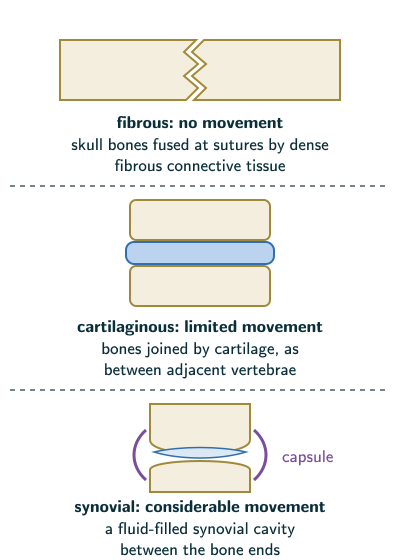
- By structure, joints are of three major forms: fibrous, cartilaginous and synovial (page 227).
- NCERT: “Fibrous joints do not allow any movement” (page 227); give this in an NCERT-based answer. NCERT’s example is the skull sutures, where the flat skull bones fuse end-to-end with the help of dense fibrous connective tissue to form the cranium (page 227; see connective tissue). Beyond the NCERT text: fibrous names the connecting tissue; most fibrous joints are immovable, but syndesmoses are slightly movable (Wikipedia, “Fibrous joint”, facts in our words).
Cartilaginous joints
- In cartilaginous joints, the bones are joined together by cartilage (NCERT page 227).
- NCERT’s example is the joint between adjacent vertebrae, which permits limited movement (page 227). Beyond the NCERT text: these are the vertebral-body joints with discs; the facet joints between the articular processes of adjacent vertebrae are synovial, so not every joint connecting vertebrae is cartilaginous (Wikipedia, “Facet joint”, facts in our words).
- The pubic symphysis, where the two halves of the pelvic girdle meet, contains fibrous cartilage (page 226); by NCERT’s definition, it too is a cartilaginous joint.
Synovial joints
- Synovial joints have a fluid-filled synovial cavity between the articulating surfaces of the two bones, which allows considerable movement. They help in locomotion and many other movements (NCERT page 227).
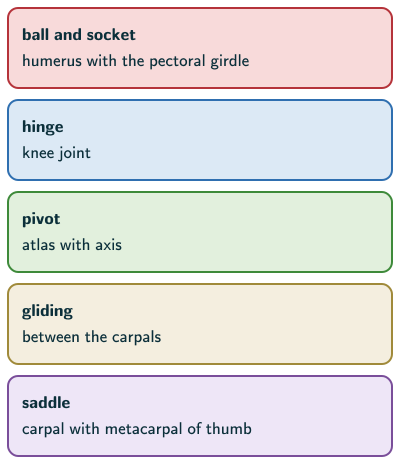
- NCERT’s examples (page 227):
- ball and socket joint: between the humerus and the pectoral girdle;
- hinge joint: the knee joint;
- pivot joint: between the atlas and the axis;
- gliding joint: between the carpals;
- saddle joint: between the carpal and metacarpal of the thumb.
- NCERT calls these five “some examples” (page 227), not an exhaustive classification. Beyond the NCERT text: anatomy also includes condyloid (ellipsoid) joints, such as the finger knuckle joints (StatPearls, “Anatomy, Joints”). The knee is a modified hinge, permitting flexion–extension with some rotation as well (review, “Understanding the human knee and its relationship to total knee replacement”, 2017).
- Beyond the NCERT text, the US National Cancer Institute’s training module describes the parts: the bone ends are covered with articular cartilage and separated by the joint cavity; the joint is enclosed in a dense fibrous capsule, whose inner layer, the synovial membrane, “secretes synovial fluid into the joint cavity for lubrication” (NCI SEER Training Modules, Articulations).
Solved examples
Example 1: Name the joint (NCERT Exercise 9)
Name the type of joint between: (a) atlas and axis; (b) carpal and metacarpal of the thumb; (c) phalanges; (d) femur and acetabulum; (e) cranial bones; (f) the pubic bones in the pelvic girdle.
Answer:
- (a) pivot joint, a synovial joint (NCERT page 227).
- (b) saddle joint (page 227).
- (c) hinge joints. NCERT does not name the joints between phalanges; beyond the NCERT text, the interphalangeal joints of the fingers are hinge joints (Saunders and colleagues, Journal of Anatomy, 2025).
- (d) ball and socket joint: the thigh bone articulates with the acetabulum (NCERT page 226). Beyond the NCERT text, MedlinePlus explains that the hip is a ball-and-socket joint, with a ball at the end of the femur that fits into a socket in the pelvis (MedlinePlus, Hip Injuries and Disorders).
- (e) fibrous joint: sutures (page 227).
- (f) cartilaginous joint: the pubic symphysis contains fibrous cartilage (pages 226–227).
Example 2: Skull and sutures (NCERT Exercise 6d)
Match the skull with one of: (i) myoglobin, (ii) thin filament, (iii) sutures, (iv) involuntary.
Answer: (iii) sutures: the flat skull bones join at fibrous sutures to form the cranium (NCERT page 227).
Example 3: Joint as a fulcrum
When you bend your knee to climb a step, which part of the system is the lever, which the force and which the fulcrum?
Answer: following NCERT, the force is generated by the muscles and is used to move the bones, and the joint acts as the fulcrum (page 227): the leg bones are the lever, the leg muscles give the force, and the knee, a hinge joint, is the fulcrum.
Common mistakes to avoid
Common mistake
Calling the joints between vertebrae immovable
NCERT: the joint between adjacent vertebrae is cartilaginous and permits limited movements (page 227). Beyond the NCERT text: the facet joints between vertebrae are synovial, so the spine has more than one structural joint type (Wikipedia, “Facet joint”, facts in our words).
Common mistake
Giving the knee a ball and socket joint
NCERT’s example of a hinge joint is the knee; its ball and socket example is the joint between the humerus and the pectoral girdle (page 227).
Common mistake
Calling all joints movable
NCERT: fibrous joints, such as the skull sutures, do not allow any movement (page 227). Beyond the NCERT text: syndesmoses, a kind of fibrous joint, are slightly movable (Wikipedia, “Fibrous joint”, facts in our words).
Common mistake
Putting the pivot joint between the skull and the atlas
The atlas articulates with the occipital condyles of the skull (NCERT page 225), but NCERT’s pivot joint is the one between the atlas and the axis (page 227).
Quick revision summary
- Joints are points of contact between bones, or between bones and cartilage; the joint acts as a fulcrum for muscle force.
- Fibrous joints: dense fibrous connective tissue; do not allow any movement (NCERT; skull sutures). Beyond the NCERT text: syndesmoses are slightly movable (Wikipedia, “Fibrous joint”, facts in our words).
- Cartilaginous joints: bones joined by cartilage; limited movement (NCERT; between adjacent vertebrae).
- Synovial joints: a fluid-filled synovial cavity, considerable movement. Examples: ball and socket (humerus–pectoral girdle), hinge (knee), pivot (atlas–axis), gliding (between carpals), saddle (carpal–metacarpal of thumb).
Formula sheet
- fibrous: dense fibrous connective tissue; no movement (skull sutures)
- cartilaginous: adjacent vertebrae, limited movement
- synovial: considerable movement (fluid-filled cavity)
- ball and socket: humerus–pectoral girdle; hinge: knee
- pivot: atlas–axis; gliding: carpals; saddle: thumb carpal–metacarpal
Questions students ask
Which joint lets the head turn from side to side?
The head turns from side to side at the pivot joint between the atlas, the first vertebra, and the axis: NCERT gives this joint as its example of a pivot joint (pages 225 and 227), and beyond the NCERT text, pivot joints like the one in the neck allow a rotating or twisting movement (NIAMS, Learning About Joints). The axis carries a tooth-like peg, the odontoid process, that articulates with the atlas above it (MeSH, “Odontoid Process”). Nodding uses a different joint, where the skull rests on the atlas by its two occipital condyles (NCERT page 225); beyond the NCERT text, its movements give the forward and backward nodding of the head (Gray, Anatomy of the Human Body, 1918).
Is the elbow a hinge joint or a ball and socket joint?
Beyond the NCERT text, the elbow is a hinge joint, not a ball and socket joint: MeSH defines the elbow joint as a hinge joint connecting the forearm to the arm, and NIAMS says hinge joints mainly allow bending and straightening in one plane, while ball-and-socket joints such as shoulders and hips allow movement in many directions (MeSH, “Elbow Joint”; NIAMS, Learning About Joints). So the elbow works like NCERT’s hinge example, the knee, while NCERT’s ball and socket example is the joint between the humerus and the pectoral girdle, the shoulder joint (pages 226–227). Both kinds are synovial joints, with a fluid-filled synovial cavity between the bones (page 227).
What movement does the saddle joint of the thumb allow?
The first carpometacarpal joint, between the trapezium and the first metacarpal, is NCERT’s saddle-joint example (page 227). Its main movements are flexion–extension and abduction–adduction. Together with coupled rotation they allow opposition, bringing the thumb pad towards the fingers. Simplified accounts describe saddle joints as biaxial, but “no rotation at all” is too absolute for the thumb: in-vivo studies document rotation during opposition (“In Vivo 3-Dimensional Kinematics of Thumb Carpometacarpal Joint During Thumb Opposition”, 2017).
What is the difference between a synovial joint and a cartilaginous joint?
A cartilaginous joint holds bones together with cartilage; NCERT’s example, the disc joint between adjacent vertebral bodies, permits limited movement, while a synovial joint has a fluid-filled synovial cavity between the articulating surfaces of the two bones, which allows considerable movement (NCERT page 227). So the knee, NCERT’s example of a hinge joint, is synovial, not cartilaginous (page 227). The cartilage between adjacent vertebrae is the intervertebral disc labelled in NCERT Figure 17.7 (page 225); beyond the NCERT text, each disc is a plate of fibrocartilage between the bodies of the vertebrae (MeSH, “Intervertebral Disc”).
Are the joints between the skull bones immovable from birth?
The newborn skull has flexible sutures and membrane-covered fontanelles, allowing moulding during birth and brain growth. Fontanelles close as bone grows, but this is not the same as all sutures fusing into bone immediately afterwards. Adult sutures are functionally immovable fibrous joints; their later ossification varies. NCERT describes the adult functional example (page 227), while NIAMS’s Learning About Joints and StatPearls’ Anatomy, Joints explain the developmental context.
Practice questions
Try each question first, then open the answer to check your working.
-
Q1. What kind of joint is found between the atlas and the axis?
Show answerHide answer
A pivot joint, a kind of synovial joint (NCERT page 227).
-
Q2. What fills the cavity of a synovial joint?
Show answerHide answer
Synovial fluid. NCERT calls the cavity fluid-filled (page 227); beyond the NCERT text, the NCI SEER training module names the fluid and says the synovial membrane secretes it (NCI SEER Training Modules, Articulations).
-
Q3. Which joints hold the flat bones of the cranium together?
Show answerHide answer
Fibrous joints, in the form of sutures of dense fibrous connective tissue (NCERT page 227).