Regulation of respiration
NCERT Class 11 Biology Chapter 14 Section 14.5
Quick answer
Brainstem networks generate and adjust breathing, with the medulla central to rhythm and pontine centres modifying its pattern. CO-related acidity is a major chemical influence under ordinary conditions. Peripheral chemoreceptors also sense arterial oxygen, and a substantial fall in pO can strongly increase ventilation.
With your textbook
NCERT Biology (Class 11), Chapter 14 “Breathing and Exchange of Gases”, Section 14.5 “Regulation of Respiration”, page 190.
Open the official NCERT chapter (PDF, 2.1 MB, ncert.nic.in) (opens in a new tab)
Checked against the 2026-27 reprint on .
Regulation of respiration
Regulation of respiration
Human beings have a significant ability to maintain and moderate the respiratory rhythm to suit the demands of the body tissues.
NCERT Biology (Class 11), Section 14.5, page 190
This regulation is done by the neural system (page 190).
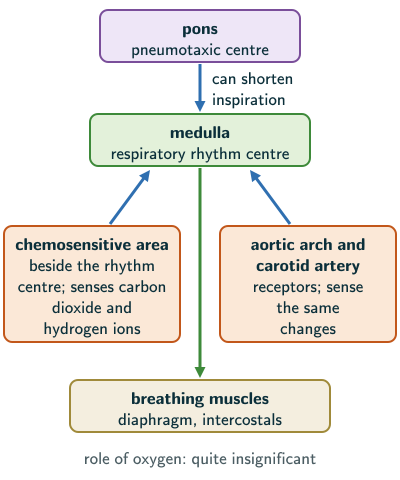
In plain words: breathing runs on autopilot from the brainstem. A network in the medulla generates the rhythm, a centre in the pons trims it, and sensors keep watch on the blood. When carbon dioxide and acid build up, they tell the pacemaker to breathe harder to increase CO removal and help restore acid–base balance; H itself is not exhaled.
Respiratory rhythm centre
- A specialised centre in the medulla region of the brain, the respiratory rhythm centre, is primarily responsible for regulating respiration (NCERT page 190).
- The muscles that do the breathing are the diaphragm and the external and internal intercostals between the ribs (NCERT Section 14.2, page 185; see muscle tissue).
Pneumotaxic centre
- Another centre, in the pons region of the brain, the pneumotaxic centre, can moderate the functions of the respiratory rhythm centre (NCERT page 190).
- A neural signal from it can reduce the duration of inspiration, and so alter the respiratory rate (page 190). Shortening inspiration can increase breathing frequency if expiration does not lengthen, but rate depends on the duration of the whole breathing cycle, not inspiration alone.
Chemosensitive area and chemoreceptors
- A chemosensitive area lies adjacent to the rhythm centre and is highly sensitive to CO and hydrogen ions (NCERT page 190).
- An increase in these substances activates it, and it signals the rhythm centre to adjust the respiratory process to increase CO elimination and thereby reduce CO-related acidity (page 190). Hydrogen ions are not directly breathed out.
- Receptors associated with the aortic arch and carotid artery also recognise changes in CO and H concentration and signal the rhythm centre for remedial action (page 190).
The role of oxygen in the regulation of respiratory rhythm is quite insignificant.
NCERT Biology (Class 11), Section 14.5, page 190
Beyond NCERT: this oxygen statement is not a universal rule. Carotid and aortic bodies sense low arterial pO, with a steep ventilatory response in marked hypoxaemia. Central chemoreception chiefly detects brain-fluid H generated when CO crosses the blood–brain barrier; circulating H does not cross as readily (StatPearls, “Physiology, Respiratory Drive”; Clinical Methods, “Respiratory Rate and Pattern”).
Solved examples
Example 1: How respiration is regulated (NCERT Exercise 7)
How is respiration regulated?
Answer: by the neural system. The respiratory rhythm centre in the medulla is primarily responsible. The pneumotaxic centre in the pons moderates it, and its signal can shorten inspiration and so change the rate. A chemosensitive area next to the rhythm centre, highly sensitive to CO and H, and receptors at the aortic arch and carotid artery detect rises in these and signal the rhythm centre to adjust breathing. NCERT calls oxygen’s role insignificant (page 190), but this must be limited to ordinary conditions: marked arterial hypoxaemia strongly stimulates peripheral chemoreceptors.
Example 2: Holding your breath
Why does holding your breath normally create an increasing urge to breathe?
Answer: CO rises and changes acidity, increasing chemical drive to breathe; falling O also becomes important if it falls sufficiently. Central sensors respond chiefly to the CO-related change in brain-fluid H, while peripheral sensors monitor arterial blood. This expands NCERT’s CO/H explanation (page 190) using StatPearls, “Physiology, Respiratory Drive”.
Example 3: Going up a hill (NCERT Exercise 9)
What happens to the respiratory process in a man going up a hill?
Answer: climbing increases ventilation because exercise raises metabolic demand. Beyond the NCERT text, at sufficiently high altitude the barometric pressure is lower, so the partial pressure of O in the air is lower, a state called hypobaric hypoxia (Silina and colleagues, Frontiers in Molecular Biosciences, 2025). The lower inspired and alveolar pO reduces blood oxygenation (NCERT’s diffusion principle, page 187). Peripheral chemoreceptors respond to falling arterial pO by increasing ventilation; this immediate response precedes the slower RBC adaptation (StatPearls, “Physiology, Respiratory Drive”). Over a longer stay, the kidneys respond to the shortage by making more erythropoietin, which raises the production of red blood cells and so the oxygen the blood can carry (Silina and colleagues, Frontiers in Molecular Biosciences, 2025); NCERT names erythropoietin as the kidney hormone that stimulates the formation of RBCs (Chapter 19, page 247). During ordinary exercise, ventilation normally rises enough to keep arterial CO near its resting value; increased CO production does not require sustained arterial CO accumulation (Shea and colleagues, Journal of Physiology, 1993).
Example 4: Hypoxia (NCERT Exercise 12)
Have you heard about hypoxia? Try to gather information about it, and discuss with your friends.
Answer: beyond the NCERT text: hypoxia means inadequate oxygen availability or use at the tissue level. It can start outside the body, as at high altitude, where the lower barometric pressure lowers the pO of the air, or in an oxygen-depleted atmosphere. A stuffy room is not automatically an oxygen-deficient atmosphere. It can also start inside the body: from disease of the respiratory organs, from poor circulation, from blood that can carry less oxygen (as in anaemia), or from a fault in the cells’ own use of oxygen (Silina and colleagues, Frontiers in Molecular Biosciences, 2025).
Common mistakes to avoid
Common mistake
Putting the rhythm centre in the pons
The respiratory rhythm centre is in the medulla; the pneumotaxic centre is in the pons (NCERT page 190).
Common mistake
Making oxygen the main controller
NCERT emphasises CO/H control under usual conditions (page 190). It would be incorrect to infer that oxygen is never sensed: the carotid and aortic bodies respond strongly when arterial pO becomes low.
Common mistake
Saying the pneumotaxic centre lengthens inspiration
Its signal can reduce the duration of inspiration, which changes the respiratory rate (NCERT page 190); a shorter inspiration can increase frequency if the rest of the cycle is unchanged.
Quick revision summary
- Breathing is regulated by the neural system: the respiratory rhythm centre in the medulla is primarily responsible.
- The pneumotaxic centre in the pons moderates the rhythm centre; its signal can shorten inspiration and change the rate.
- A chemosensitive area next to the rhythm centre senses CO and H; receptors at the aortic arch and carotid artery also sense them. Rises in these speed up breathing.
- NCERT emphasises CO/H under ordinary conditions; low arterial pO can strongly stimulate peripheral chemoreceptors.
Formula sheet
- respiratory rhythm centre: medulla (primary control)
- pneumotaxic centre: pons; can shorten inspiration
- chemosensitive area: beside the rhythm centre; senses CO and H
- aortic arch and carotid artery receptors: sense CO and H
- oxygen: small influence near normal pO; strong peripheral drive when arterial pO falls substantially
Questions students ask
What is the difference between central and peripheral chemoreceptors?
Central chemoreceptors are in the brain, while peripheral chemoreceptors lie outside it, on the large arteries: NCERT does not use these names, but its chemosensitive area next to the respiratory rhythm centre, in the medulla, is the central one, and its receptors associated with the aortic arch and carotid artery are the peripheral ones (NCERT pages 190–191). Both recognise rises in CO and H and signal the rhythm centre (NCERT page 190). Beyond the NCERT text, the peripheral receptors, the carotid and aortic bodies, also sense blood oxygen (MeSH, “Carotid Body” and “Aortic Bodies”), and their ventilatory response becomes much stronger as arterial pO falls into the roughly 50–60 mm Hg range (Pittman, 2011).
What is the apneustic centre, and is it in NCERT?
The apneustic centre is a second breathing centre in the pons that drives inspiration and makes each breath in last longer, the opposite of the pneumotaxic centre, which cuts inspiration short; it is beyond the NCERT text (StatPearls, “Physiology, Respiratory Drive”). NCERT names only two centres: the respiratory rhythm centre in the medulla, and the pneumotaxic centre in the pons, whose signal can reduce the duration of inspiration (NCERT page 190). In NEET answers, name the pneumotaxic centre, the only pons centre in NCERT.
Why does oxygen play only a small part in regulating breathing?
Near normal arterial oxygen levels, CO-related acidity is a major chemical influence on ventilation; this is the context for NCERT calling oxygen’s role “quite insignificant” (NCERT page 190). CO crosses the blood–brain barrier and alters brain-fluid H, which central chemoreceptors detect; peripheral chemoreceptors also respond to arterial acidity (StatPearls, “Physiology, Respiratory Drive”). Beyond the NCERT text, the aortic and carotid bodies do sense oxygen (MeSH, “Carotid Body”), with a markedly stronger ventilatory response as arterial pO falls to about 50–60 mm Hg, far below the 95 mm Hg of oxygenated blood in NCERT Table 14.1 (Pittman, Regulation of Tissue Oxygenation, 2011; sources differ on the exact level).
What is the difference between chemoreceptors and baroreceptors?
Chemoreceptors sense chemicals in the blood, while baroreceptors sense the stretch of artery walls, that is, the blood pressure. The respiratory chemoreceptors NCERT describes, the chemosensitive area and the receptors at the aortic arch and carotid artery, detect CO and H and signal the respiratory rhythm centre (NCERT page 190). Baroreceptors, beyond the NCERT text, lie in the walls of the aorta and of the carotid sinus, the widened part of the carotid artery where it branches, and when a rise in blood pressure stimulates them, the heart slows and the pressure falls (MeSH, US National Library of Medicine, “Pressoreceptors” and “Carotid Sinus”).
Practice questions
Try each question first, then open the answer to check your working.
-
Q1. Where is the respiratory rhythm centre located?
Show answerHide answer
In the medulla region of the brain (NCERT page 190).
-
Q2. To which two substances is the chemosensitive area highly sensitive?
Show answerHide answer
CO and hydrogen ions (NCERT page 190).
-
Q3. Which centre in the pons moderates the respiratory rhythm centre?
Show answerHide answer
The pneumotaxic centre (NCERT page 190).