Central neural system: the brain
NCERT Class 11 Biology Chapter 18 Section 18.4
Quick answer
The brain includes forebrain, midbrain and hindbrain. The cerebrum supports sensory, motor and association functions; the hypothalamus regulates temperature, hunger, thirst and endocrine activity; and the cerebellum helps coordination and balance. The brain stem consists of midbrain, pons and medulla, with centres regulating breathing and cardiovascular activity.
With your textbook
NCERT Biology (Class 11), Chapter 18 “Neural Control and Coordination”, Section 18.4 “Central Neural System”, pages 235–236.
Open the official NCERT chapter (PDF, 4.3 MB, ncert.nic.in) (opens in a new tab)
Checked against the 2026-27 reprint on .
Central neural system: the brain
The brain
The central neural system, one of the two parts of the human neural system, is the brain and the spinal cord (NCERT Section 18.2, page 231). NCERT Section 18.4 is about the brain:
The brain is the central information processing organ of our body, and acts as the ‘command and control system’.
NCERT Biology (Class 11), Section 18.4, page 235
In plain words: the brain is the body’s head office. The large, folded cerebrum, the major part of the brain, does the thinking, sensing and deciding; a small region at its base keeps the body’s temperature, hunger and thirst in check; and the brain stem, joined to the spinal cord, regulates breathing and cardiovascular activity without conscious effort. The heart’s own pacemaker initiates its beats; the brain modifies its activity.
Functions of the brain
NCERT lists what the brain does (page 235):
- It controls voluntary movements, the balance of the body, the functioning of vital involuntary organs (lungs, heart, kidneys and others), thermoregulation, hunger and thirst, the circadian (24-hour) rhythms of the body, the activities of several endocrine glands, and human behaviour.
- It is the site for processing vision, hearing, speech, memory, intelligence, emotions and thoughts.
Meninges
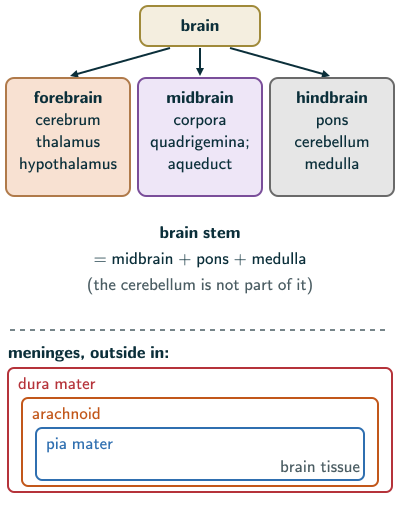
The brain is well protected by the skull. Inside the skull, it is covered by the cranial meninges, three layers (NCERT page 235):
- Dura mater: the outer layer.
- Arachnoid: a very thin middle layer.
- Pia mater: the inner layer, in contact with the brain tissue.
The brain has three major parts: the forebrain, the midbrain and the hindbrain (page 235).
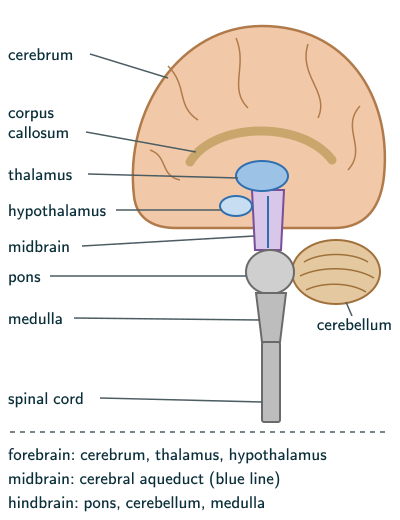
Forebrain
The forebrain consists of the cerebrum, thalamus and hypothalamus (NCERT Section 18.4.1, page 236).
- Cerebrum: the major part of the human brain. A deep cleft divides it lengthwise into the left and right cerebral hemispheres, joined by a major tract of nerve fibres, the corpus callosum.
- Cerebral cortex: the layer of cells covering each hemisphere, thrown into prominent folds. It is the grey matter, greyish because the neuron cell bodies are concentrated there. It has motor areas, sensory areas, and large association areas that are neither clearly sensory nor motor and handle complex functions such as intersensory associations, memory and communication.
- White matter: the fibres of the tracts, covered with the myelin sheath, form the inner part of each hemisphere and give it an opaque white look. This cortex-outside/white-matter-inside description is a useful overview, not a claim that all deeper tissue is white: deep grey-matter nuclei also occur (NINDS, Know Your Brain).
- Thalamus: the cerebrum wraps around it. It is a major coordinating centre for sensory and motor signalling.
- Hypothalamus: lies at the base of the thalamus. It has centres that control body temperature and the urge for eating and drinking, and groups of neurosecretory cells that secrete the hypothalamic hormones.
- Limbic system (NCERT also calls it the limbic lobe): the inner parts of the cerebral hemispheres with deep structures such as the amygdala and hippocampus. With the hypothalamus, it is involved in sexual behaviour, emotional reactions (excitement, pleasure, rage and fear) and motivation (page 236). NCERT’s Summary adds olfaction and autonomic responses (page 237).
Which part keeps time? NCERT says the brain controls the body’s circadian rhythms (page 235) but does not name the clock. Beyond the NCERT text, the human master clock is the suprachiasmatic nucleus, or SCN, a cluster of nerve cells in the brain (US National Institute of General Medical Sciences, Circadian Rhythms), and a 2016 review places this “master pacemaker located in the suprachiasmatic nucleus (SCN) of the hypothalamus” (Matsui and colleagues, International Journal of Molecular Sciences, 2016, CC BY 4.0).
Midbrain
- The midbrain lies below the thalamus/hypothalamus region of the forebrain and above the pons of the hindbrain (NCERT Section 18.4.2, page 236).
- A canal, the cerebral aqueduct, passes through it. (NCERT prints “passess”.)
- Its dorsal part has four round swellings, collectively the corpora quadrigemina (page 236).
- NCERT’s Summary adds that the midbrain receives and integrates visual, tactile and auditory inputs (page 237).
Hindbrain
The hindbrain comprises the pons, cerebellum and medulla (medulla oblongata) (NCERT Section 18.4.3, page 236):
- Pons: fibre tracts that interconnect different regions of the brain. Chapter 14 adds that the pons holds the pneumotaxic centre, which can moderate the respiratory rhythm centre (NCERT page 190).
- Cerebellum: a very convoluted surface, which gives room for many more neurons (page 236). NCERT’s Summary names inputs from the semicircular canals and the auditory system (page 237). For balance, distinguish vestibular signals from hearing: the cerebellum integrates vestibular, proprioceptive and visual/motor information (Purves and colleagues, Neuroscience, “Projections to the Cerebellum”). Beyond the NCERT text, the cerebellum is “the area of the brain that controls coordination and balance” (US National Institute of Neurological Disorders and Stroke, Cerebellar Degeneration).
- Medulla: connected to the spinal cord. It contains centres that control respiration, cardiovascular reflexes and gastric secretions (page 236), among them the respiratory rhythm centre and the centre that moderates the heart through the autonomic nerves (Chapters 14 and 15, pages 190 and 202).
Brain stem
- Three major regions make up the brain stem: the midbrain, pons and medulla oblongata (NCERT page 236).
- The brain stem forms the connection between the brain and the spinal cord (page 236).
- NCERT’s Summary says the CNS consists of the brain and “spiral cord” (page 237); it means the spinal cord.
Solved examples
Example 1: Structure of the brain (NCERT Exercises 1 and 4b)
Briefly describe the structure of the brain.
Answer: inside the skull, the brain is covered by three cranial meninges: dura mater, arachnoid and pia mater. It has three parts. The forebrain has the cerebrum (two hemispheres joined by the corpus callosum, with an outer grey cerebral cortex and inner white matter), the thalamus and the hypothalamus. The midbrain lies between the thalamus and hypothalamus and the pons, with the cerebral aqueduct and the corpora quadrigemina. The hindbrain has the pons, cerebellum and medulla; the midbrain, pons and medulla form the brain stem (NCERT pages 235–236). For a labelled diagram, draw the section above and label the cerebrum, corpus callosum, thalamus, hypothalamus, midbrain with the cerebral aqueduct, pons, cerebellum, medulla and spinal cord (NCERT Figure 18.4, page 235).
Example 2: Forebrain, midbrain, hindbrain (NCERT Exercise 5b–d)
Write short notes on (b) the forebrain, (c) the midbrain, (d) the hindbrain.
Answer: (b) Forebrain: cerebrum, thalamus and hypothalamus; the cerebral cortex has motor, sensory and association areas; the thalamus coordinates sensory and motor signalling; the hypothalamus controls body temperature, eating and drinking and secretes hypothalamic hormones; with the limbic system it regulates emotions, sexual behaviour and motivation. (c) Midbrain: between the thalamus and hypothalamus and the pons; the cerebral aqueduct passes through it; its dorsal part has four swellings collectively called the corpora quadrigemina; NCERT’s Summary adds that it receives and integrates visual, tactile and auditory inputs (page 237). (d) Hindbrain: pons (fibre tracts linking brain regions), cerebellum (very convoluted surface; beyond the NCERT text, it controls coordination and balance) and medulla (centres for respiration, cardiovascular reflexes and gastric secretions) (NCERT page 236).
Example 3: Thalamus and hypothalamus (NCERT Exercise 8c)
Differentiate between the thalamus and the hypothalamus.
Answer: the thalamus is the structure the cerebrum wraps around, a major coordinating centre for sensory and motor signalling. The hypothalamus lies at the base of the thalamus; it has centres for body temperature and the urge to eat and drink, and neurosecretory cells that secrete hypothalamic hormones (NCERT page 236).
Example 4: Cerebrum and cerebellum (NCERT Exercise 8d)
Differentiate between the cerebrum and the cerebellum.
Answer: the cerebrum is part of the forebrain and the major part of the brain: two hemispheres joined by the corpus callosum, with a grey cortex of motor, sensory and association areas. The cerebellum is part of the hindbrain, with a very convoluted surface that gives room for many more neurons (NCERT page 236); NCERT’s Summary names inputs from the semicircular canals and the auditory system (page 237). For balance, distinguish vestibular signals from hearing: the cerebellum integrates vestibular, proprioceptive and visual/motor information (Purves and colleagues, Neuroscience, “Projections to the Cerebellum”). Beyond the NCERT text, the cerebellum controls coordination and balance (US National Institute of Neurological Disorders and Stroke).
Example 5: Most developed part, and the master clock (NCERT Exercise 9a, b)
(a) Which part of the human brain is the most developed? (b) Which part of the central neural system acts as a master clock?
Answer: (a) the cerebrum, which forms the major part of the human brain (NCERT page 236). Beyond the NCERT text, “The forebrain is the largest and most highly developed part of the human brain: it consists primarily of the cerebrum” (US National Institute of Neurological Disorders and Stroke, Brain Basics: Know Your Brain). (b) The hypothalamus, through its suprachiasmatic nucleus. NCERT says only that the brain controls circadian rhythms (page 235); the suprachiasmatic nucleus of the hypothalamus is named beyond the NCERT text (Matsui and colleagues, International Journal of Molecular Sciences, 2016). Do not answer the pineal gland: NCERT Chapter 19 says its hormone melatonin plays a very important role in the 24-hour (diurnal) rhythm (page 242), but beyond the NCERT text it is the SCN that controls melatonin production (US National Institute of General Medical Sciences, Circadian Rhythms).
Common mistakes to avoid
Common mistake
Putting the cerebellum in the brain stem
The brain stem is the midbrain, pons and medulla oblongata; the cerebellum is part of the hindbrain but not of the brain stem (NCERT page 236).
Common mistake
Calling the cerebral cortex white matter
The cortex is the grey matter, where neuron cell bodies are concentrated; the myelinated fibre tracts inside make the white matter (NCERT page 236).
Common mistake
Getting the meninges in the wrong order
From outside in: dura mater, arachnoid, pia mater; the pia mater is in contact with the brain tissue (NCERT page 235).
Quick revision summary
- The brain is the command and control system: it controls movement, balance, vital organs, temperature, hunger, thirst, circadian rhythms and endocrine glands, and processes vision, hearing, speech, memory, emotions and thought.
- Meninges, outside in: dura mater, arachnoid, pia mater.
- Forebrain: cerebrum (hemispheres, corpus callosum, grey cortex, white matter), thalamus, hypothalamus; with the limbic system.
- Midbrain: cerebral aqueduct and corpora quadrigemina.
- Hindbrain: pons, cerebellum, medulla (respiration, cardiovascular reflexes, gastric secretions).
- Brain stem: midbrain, pons and medulla, linking the brain and spinal cord.
Formula sheet
- meninges (outside in): dura mater → arachnoid → pia mater
- forebrain = cerebrum + thalamus + hypothalamus
- midbrain: cerebral aqueduct, corpora quadrigemina
- hindbrain = pons + cerebellum + medulla
- brain stem = midbrain + pons + medulla
Questions students ask
Which part of the brain controls memory?
Memory depends on interacting brain systems, including the cerebral cortex and hippocampus: NCERT says the association areas of the cortex are responsible for complex functions like intersensory associations, memory and communication (NCERT page 236). Beyond the NCERT text, the hippocampus, one of the deep structures NCERT places in the limbic system (page 236), acts as a memory indexer, sending memories to the right parts of the cerebral hemispheres for long-term storage and retrieving them when needed (NINDS, Brain Basics: Know Your Brain). Do not confuse the hippocampus with the hypothalamus, whose centres control body temperature and the urge for eating and drinking (page 236).
Why is the hypothalamus called a link between the neural and endocrine systems?
The hypothalamus links the neural and endocrine systems because it is a part of the brain that also secretes hormones: NCERT places it in the forebrain at the base of the thalamus, with several groups of neurosecretory cells that secrete hypothalamic hormones (NCERT page 236). These hormones regulate the synthesis and secretion of pituitary hormones (NCERT Chapter 19, page 240; see the endocrine hypothalamus), so through the hypothalamus the brain steers the pituitary gland. Beyond the NCERT text, nerve cells that make and secrete hormones form a neurosecretory system (MeSH, “Neurosecretory Systems”).
What does the corpus callosum do?
The corpus callosum joins the left and right cerebral hemispheres: NCERT describes it as the tract of nerve fibres that connects the two hemispheres of the cerebrum (page 236). Beyond the NCERT text, it is a broad tract of myelinated fibres linking many cortical regions across the hemispheres, including matching and non-matching regions (review, “Intrinsic organization of the corpus callosum”, 2024), and it is a major pathway for communication between the hemispheres (NINDS, Brain Basics: Know Your Brain). NINDS adds that each hemisphere mainly controls the opposite side of the body, the right hemisphere the left side and the left hemisphere the right.
Why is the cerebral cortex folded?
The cerebral cortex is folded because, beyond the NCERT text, folds add to its surface area and so increase the amount of grey matter and the volume of information the brain can process (NINDS, Brain Basics: Know Your Brain). NCERT notes that the cortex, the layer of cells covering each cerebral hemisphere, is thrown into prominent folds, and that its association areas handle complex functions such as memory and communication (page 236).
Why is the cerebellum called the little brain?
The cerebellum is called the little brain because its name is Latin for little brain and it is smaller than the cerebrum (beyond the NCERT text; Fiez and Stoodley, Neurobiology of Language, 2024, CC BY 4.0). Small as it is, estimates place more than half of the human brain’s neurons there: the cited review reports over 50 billion, more than twice the cerebral-cortex count. These are population estimates rather than a fixed count for every person, which fits NCERT’s statement that its very convoluted surface provides the additional space for many more neurons (page 236). Beyond the NCERT text, it coordinates voluntary movements, maintains balance and helps in learning motor skills (MeSH, “Cerebellum”).
How is the human brain protected?
The human brain is protected by the bony skull and, inside the skull, by three cranial meninges, the dura mater, the arachnoid and the pia mater (NCERT page 235). Beyond the NCERT text, cerebrospinal fluid adds a cushion that helps protect the brain and spinal cord from sudden impact or injury (MedlinePlus, Cerebrospinal Fluid (CSF) Analysis); this watery fluid circulates around them and fills the subarachnoid space between the arachnoid and the pia mater (MeSH, “Cerebrospinal Fluid” and “Subarachnoid Space”).
Practice questions
Try each question first, then open the answer to check your working.
-
Q1. Which three regions make up the brain stem, and what does it connect?
Show answerHide answer
The midbrain, pons and medulla oblongata; the brain stem connects the brain and the spinal cord (NCERT page 236).
-
Q2. Which part of the brain contains the centres that control respiration, cardiovascular reflexes and gastric secretions?
Show answerHide answer
The medulla (NCERT page 236).
-
Q3. What are the corpora quadrigemina?
Show answerHide answer
Four round swellings (lobes) on the dorsal part of the midbrain (NCERT page 236).