Human neural system: CNS and PNS
NCERT Class 11 Biology Chapter 18 Section 18.2
Quick answer
The CNS comprises the brain and spinal cord; the PNS includes peripheral nerves and ganglia. Afferent fibres carry sensory input towards the CNS, while efferent fibres carry output away. Somatic motor output activates skeletal muscle in voluntary and reflex actions; autonomic output regulates smooth muscle, cardiac muscle and glands.
With your textbook
NCERT Biology (Class 11), Chapter 18 “Neural Control and Coordination”, Section 18.2 “Human Neural System”, page 231.
Open the official NCERT chapter (PDF, 4.3 MB, ncert.nic.in) (opens in a new tab)
Checked against the 2026-27 reprint on .
Human neural system
Human neural system
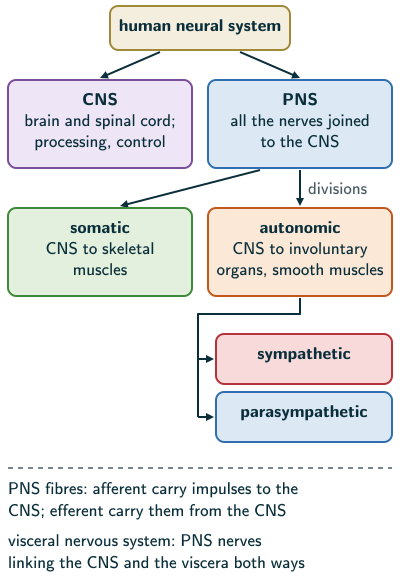
NCERT divides the human neural system into two parts (Section 18.2, page 231): the central neural system (CNS) and the peripheral neural system (PNS). Of the first:
The CNS includes the brain and the spinal cord and is the site of information processing and control.
NCERT Biology (Class 11), Section 18.2, page 231
In plain words: the brain and spinal cord are the head office; the nerves running out to every part of the body are the phone lines. Some lines bring news in, others carry orders out, and the orders go either to muscles you control at will or, automatically, to your internal organs.
Central and peripheral neural systems
- CNS: the brain and the spinal cord; the site of information processing and control (NCERT page 231).
- PNS: NCERT describes all the nerves associated with the CNS (brain and spinal cord) (page 231). Broader anatomy also includes peripheral ganglia and sensory endings; it is not just a set of wires (NCI SEER, Peripheral Nervous System).
- Beyond the NCERT text, the US National Cancer Institute’s training module gives the nerves’ numbers: twelve pairs of cranial nerves emerge from the brain, and thirty-one pairs of spinal nerves emerge from the spinal cord (NCI SEER Training Modules, Peripheral Nervous System).
Afferent and efferent fibres
The nerve fibres of the PNS are of two types (NCERT page 231):
- Afferent fibres carry impulses from tissues and organs to the CNS.
- Efferent fibres carry regulatory impulses from the CNS to the tissues and organs concerned.
Somatic and autonomic neural systems
NCERT describes somatic and autonomic divisions by their outgoing motor roles (page 231). Keep this distinct from the afferent/efferent classification above: sensory input exists as well as motor output.
- The somatic neural system relays impulses from the CNS to the skeletal muscles.
- The autonomic motor system regulates smooth muscle, cardiac muscle and glands (NCERT: involuntary organs and smooth muscles).
- Skeletal muscles are under voluntary control, while smooth (visceral) and cardiac muscles are involuntary (NCERT Chapter 17, pages 218–219; see types of muscle). The somatic motor system also carries involuntary reflex commands to skeletal muscle; “somatic” does not mean every action is conscious. The autonomic system regulates visceral effectors, such as heart rate (NCERT Chapter 15, page 202; StatPearls, “Physiology, Withdrawal Response”).
Sympathetic and parasympathetic neural systems
- NCERT further classifies the autonomic neural system into the sympathetic and the parasympathetic neural systems (NCERT page 231).
- Chapter 15 gives an example of the two working in opposite ways: sympathetic signals raise the heart rate and cardiac output, and parasympathetic signals lower them (NCERT page 202; see regulation of cardiac activity).
Visceral nervous system
- The visceral nervous system is the part of the PNS made of the whole complex of nerves, fibres, ganglia and plexuses through which impulses travel from the CNS to the viscera and from the viscera to the CNS (NCERT page 231).
Solved examples
Example 1: CNS and PNS (NCERT Exercise 2a)
Compare the central neural system (CNS) and the peripheral neural system (PNS).
Answer: the CNS is the brain and the spinal cord, the site of information processing and control. The PNS is all the nerves associated with the CNS; its afferent fibres carry impulses to the CNS and its efferent fibres carry regulatory impulses out, and it has somatic and autonomic divisions (NCERT page 231).
Example 2: Afferent and efferent (NCERT Exercise 10a)
Distinguish between afferent neurons and efferent neurons.
Answer: afferent neurons carry impulses to the CNS: their fibres transmit impulses from tissues and organs to the CNS. Efferent neurons carry impulses away from the CNS: their fibres transmit regulatory impulses from the CNS to the tissues and organs concerned (NCERT page 231). Beyond the NCERT text, the afferent division is also called the sensory division and the efferent division the motor division, so afferent neurons are sensory neurons and efferent neurons are motor neurons (NCI SEER Training Modules, Organization of the Nervous System).
Example 3: Cranial and spinal nerves (NCERT Exercise 10f)
Distinguish between cranial nerves and spinal nerves.
Answer: both belong to the PNS, the nerves associated with the CNS (NCERT page 231). Beyond the NCERT text (NCI SEER Training Modules, Peripheral Nervous System):
- Origin: cranial nerves emerge from the lower surface of the brain; spinal nerves emerge from the spinal cord.
- Number: twelve pairs of cranial nerves; thirty-one pairs of spinal nerves (8 cervical, 12 thoracic, 5 lumbar, 5 sacral, 1 coccygeal).
- Fibres: three pairs of cranial nerves are sensory only, five are mainly motor and four are mixed; every spinal nerve is mixed, with sensory and motor fibres.
- Area served: cranial nerves mainly supply the head and neck; the vagus also reaches thoracic and abdominal viscera; each pair of spinal nerves corresponds to one segment of the spinal cord and is named after it.
(NCERT numbers this item (f), after (a) and (b), with no (c) to (e) on page 238.)
Example 4: Which division?
Name the division of the PNS that carries impulses to (a) the biceps of the arm, (b) the smooth muscle of the gut.
Answer: (a) the somatic neural system, which serves skeletal muscles; (b) the autonomic neural system, which serves the involuntary organs and smooth muscles (NCERT page 231).
Common mistakes to avoid
Common mistake
Putting the spinal cord in the PNS
The CNS includes both the brain and the spinal cord (NCERT page 231).
Common mistake
Swapping afferent and efferent
Afferent fibres carry impulses towards the CNS; efferent fibres carry them away, to the tissues and organs (NCERT page 231).
Common mistake
Sending autonomic impulses to skeletal muscles
Somatic motor fibres directly activate skeletal muscle. Autonomic fibres regulate smooth muscle, cardiac muscle and glands, including blood vessels supplying skeletal muscle; they do not directly drive skeletal-muscle contraction (NCERT page 231).
Common mistake
Placing the visceral nervous system in the CNS
The visceral nervous system is part of the PNS, and its impulses travel both ways, from the CNS to the viscera and from the viscera to the CNS (NCERT page 231).
Quick revision summary
- CNS: brain and spinal cord, for information processing and control. PNS: all the nerves joined to the CNS.
- PNS fibres: afferent (to the CNS) and efferent (from the CNS).
- Motor output: somatic (to skeletal muscles, voluntary and reflex actions) and autonomic (to smooth muscle, cardiac muscle and glands). NCERT names sympathetic and parasympathetic autonomic divisions.
- The visceral nervous system links the CNS and the viscera both ways.
Formula sheet
- neural system = CNS (brain, spinal cord) + PNS (nerves)
- afferent: organs → CNS; efferent: CNS → organs
- motor output: somatic + autonomic
- NCERT autonomic divisions: sympathetic + parasympathetic
Questions students ask
What is the difference between the visceral and the autonomic nervous system?
In NCERT’s definitions, the visceral nervous system and the autonomic neural system differ in direction: the visceral system carries impulses from the CNS to the viscera and from the viscera to the CNS, while the autonomic system carries them one way, from the CNS to the involuntary organs and smooth muscles (NCERT page 231). So in NCERT’s terms the visceral system is the wider one: it also takes in the sensory fibres from the viscera, called visceral afferents beyond the NCERT text (MeSH, “Visceral Afferents”). Outside NCERT the two names often mean one system, and MeSH lists “Visceral Nervous System” as another name for the autonomic nervous system, so for NEET use NCERT’s definitions.
What is the difference between the somatic and the visceral nervous system?
The somatic neural system serves the skeletal muscles, while the visceral nervous system serves the internal organs, the viscera: NCERT says the somatic system relays impulses from the CNS to the skeletal muscles, while the visceral system carries impulses from the CNS to the viscera and from the viscera back to the CNS (page 231). Beyond the NCERT text, somatic sensory pathways serve skin, muscles and joints, while somatic motor pathways activate skeletal muscles in both voluntary and reflex actions, while autonomic nerves, the outgoing part of the visceral system, connect the CNS to visceral organs such as the heart, stomach and intestines and mediate unconscious ones (NCI SEER Training Modules, Peripheral Nervous System).
How do the sympathetic and parasympathetic systems work together?
Sympathetic and parasympathetic effects depend on the target organ; in some cases they oppose one another: in NCERT’s example, sympathetic signals increase the rate of heart beat and parasympathetic signals decrease it (NCERT Chapter 15, page 202). Beyond the NCERT text, many visceral organs get fibres from both, one stimulating and the other inhibiting, a balance that helps maintain homeostasis (NCI SEER Training Modules, Peripheral Nervous System). The sympathetic system helps mobilise resources during stress, while parasympathetic activity often supports maintenance and digestion. They are not universal on/off opposites: some targets, including most blood vessels and sweat glands, are mainly sympathetically supplied (McCorry, “Physiology of the Autonomic Nervous System”, 2007).
How can you remember afferent and efferent?
An easy way to remember afferent and efferent is that afferent impulses arrive at the CNS and efferent impulses exit it: NCERT’s afferent fibres carry impulses from tissues and organs to the CNS, and its efferent fibres carry regulatory impulses from the CNS to them (page 231). Beyond the NCERT text, the words themselves name a direction, towards a centre or away from it (MeSH, “Afferent Pathways”, “Efferent Pathways”), and the kidney uses the same pair for blood vessels: the afferent arteriole brings blood into the glomerulus and the efferent arteriole carries it away (NCERT Chapter 16, page 207).
Is the visceral nervous system in the NEET syllabus?
The visceral nervous system is in the NEET (UG) 2026 syllabus: Unit 5, Human Physiology, lists “Nervous system in humans-central nervous system, peripheral nervous system and visceral nervous system” under Neural control and coordination. NCERT gives it a single sentence, in Section 18.2 (page 231), which makes it the part of the peripheral nervous system by which impulses travel from the CNS to the viscera and from the viscera to the CNS. Learn that sentence closely, since the NCERT chapter says nothing more about it.
Practice questions
Try each question first, then open the answer to check your working.
-
Q1. Which part of the neural system is the site of information processing and control?
Show answerHide answer
The CNS, the brain and spinal cord (NCERT page 231).
-
Q2. Into which two systems is the autonomic neural system classified?
Show answerHide answer
The sympathetic and parasympathetic neural systems (NCERT page 231).
-
Q3. What does the visceral nervous system consist of?
Show answerHide answer
The whole complex of nerves, fibres, ganglia and plexuses by which impulses travel between the CNS and the viscera (NCERT page 231).