Neural system and coordination
NCERT Class 11 Biology Chapter 18 Section 18.1
Quick answer
The neural and endocrine systems coordinate organ activity to maintain homeostasis. Neurons transmit signals through neural connections, while hormones act on cells with suitable receptors. NCERT compares cnidarians’ network of neurons, the insect brain and ganglia, and the more centralised vertebrate neural system.
With your textbook
NCERT Biology (Class 11), Chapter 18 “Neural Control and Coordination”, Section 18.1 “Neural System”, page 231.
Open the official NCERT chapter (PDF, 4.3 MB, ncert.nic.in) (opens in a new tab)
Checked against the 2026-27 reprint on .
Neural system
Coordination and the neural system
The functions of the organs and organ systems must be coordinated to maintain homeostasis (NCERT page 230, the chapter’s opening). NCERT defines coordination:
Coordination is the process through which two or more organs interact and complement the functions of one another.
NCERT Biology (Class 11), Chapter 18, Introduction, page 230
In plain words: when you run, your muscles need more oxygen, so breathing and cardiac output usually rise, with more blood directed to active muscles, and settle down together afterwards. Two systems keep the organs in step: nerves, which send fast, point-to-point messages, and hormones, which carry chemical messages through the blood to cells with the right receptors. Hormonal effects often last longer, but speed is a useful comparison rather than an absolute rule.
Neural and chemical coordination
- Example: during physical exercise, the energy demand of the muscles rises, so the supply of oxygen must rise. That needs a faster rate of respiration, a faster heart beat and increased blood flow to active muscles. This does not mean flow rises equally in every organ; circulation is redistributed during exercise. When exercise stops, the nerves, lungs, heart and kidney gradually return to normal (NCERT page 230, the chapter’s opening).
- In our body the neural system and the endocrine system jointly coordinate and integrate the activities of all the organs, so they work in a synchronised way (page 230).
- The neural system gives an organised network of point-to-point connections for quick coordination; the endocrine system gives chemical integration through hormones (page 230).
Neurons
- The neural system of animals that possess one includes highly specialised signalling cells called neurons, which can detect, receive and transmit different kinds of stimuli (NCERT Section 18.1, page 231; see neural tissue).
- Neurons are its signalling units (NCERT Summary, page 237); nervous tissue also includes supporting glial cells (see the linked neural-tissue lesson).
- Beyond the NCERT text: sponges are animals with no nerve cells connected by synapses (Jékely, Paps and Nielsen, EvoDevo, 2015), so NCERT’s “all animals” means all animals that have a neural system.
Neural systems of cnidarians, insects and vertebrates
NCERT compares three levels of organisation (page 231):
- Lower invertebrates: very simple. In Hydra, the neural system is a network of neurons.
- Insects: better organised, with a brain and a number of ganglia and neural tissues.
- Vertebrates: a more centralised neural system, described by NCERT as more developed; in humans it has two parts, the central and peripheral neural systems (NCERT Section 18.2).
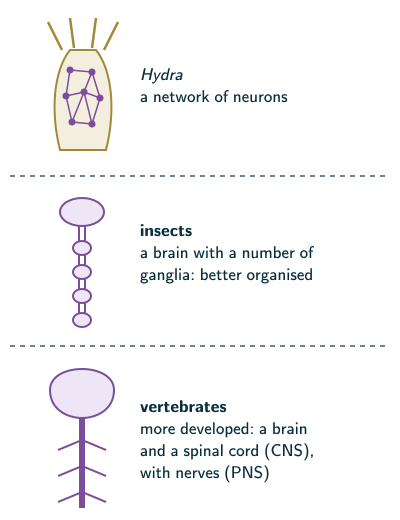
NCERT’s comparison describes differences in organisation; it is not an evolutionary chain in which living Hydra became insects and insects became vertebrates. These are distinct animal lineages.
Solved examples
Example 1: Neural coordination (NCERT Exercise 5a)
Write a short note on neural coordination.
Answer: coordination is the process by which two or more organs interact and complement each other’s functions, so that the body maintains homeostasis. In neural coordination, neurons detect, receive and transmit stimuli, and the neural system provides an organised network of point-to-point connections, so it coordinates the organs quickly; the messages travel as nerve impulses and pass from neuron to neuron across synapses (NCERT pages 230–231). NCERT contrasts generally fast, short-lived neural responses with endocrine coordination; the endocrine system, working chemically through hormones, shares the work: the two jointly coordinate and integrate all the organs (NCERT page 230; NCERT Chapter 19, page 239). For example, during exercise the rates of respiration, heart beat and blood flow rise together to supply more oxygen to the muscles, and return to normal afterwards (NCERT page 230).
Example 2: Quick or slow?
A sudden noise makes you turn your head at once; your body keeps growing steadily for years. Which coordinating system suits each, and why?
Answer: turning the head suits the neural system: its point-to-point connections give quick coordination (NCERT page 230). Growth suits the endocrine system: hormones help coordinate growth over long periods and act on target cells with suitable receptors, including cells without direct nerve contacts (NCERT Chapter 19, page 239).
Example 3: Rank the neural systems
Arrange Hydra, an insect and a vertebrate in order of the organisation of their neural systems, giving one feature of each.
Answer: Hydra (a simple network of neurons) → insect (a brain with a number of ganglia) → vertebrate (a more developed neural system) (NCERT page 231).
Common mistakes to avoid
Common mistake
Saying the neural system works alone
The neural and endocrine systems jointly coordinate and integrate the activities of the organs (NCERT page 230).
Common mistake
Giving *Hydra* a brain
Hydra’s neural system is a network of neurons; insects provide NCERT’s example of a brain with ganglia (NCERT page 231).
Common mistake
Giving insects a dorsal nerve cord
NCERT’s comparison of chordates and non-chordates (NCERT Table 4.1, page 46) contrasts the central neural system of chordates, dorsal, hollow and single, with that of non-chordates, ventral, solid and double. So an insect’s nerve cord with its ganglia runs along the belly side, while a vertebrate’s spinal cord runs along the back (see chordates).
Common mistake
Calling hormones point-to-point
Point-to-point connections are the neural system’s; the endocrine system works through hormones (NCERT page 230).
Quick revision summary
- Coordination: two or more organs interact and complement each other, as in exercise, when breathing, heart beat and blood flow rise together.
- The neural system (quick, point-to-point) and the endocrine system (chemical, through hormones) coordinate and integrate the organs.
- Neurons detect, receive and transmit stimuli.
- Hydra: a network of neurons; insects: a brain with ganglia; vertebrates: a more developed neural system.
Formula sheet
- neural coordination: quick, point-to-point
- endocrine coordination: chemical, by hormones
- cnidarians: a network of neurons → insects: brain + ganglia → vertebrates: more developed
Questions students ask
Is the neural system the same as the nervous system?
The neural system and the nervous system are the same thing: NCERT’s Class 11 book uses “neural”, as in the central neural system (CNS) and the peripheral neural system (PNS), while most other texts say “nervous”. NCERT itself uses the second word in Section 18.2, where the visceral nervous system is “the part of the peripheral nervous system” linked both ways with the “central nervous system” (page 231). The NEET (UG) 2026 syllabus also writes “Nervous system in humans-central nervous system, peripheral nervous system and visceral nervous system”, so the CNS and the PNS name the same parts under either word.
What is the structural and functional unit of the nervous system?
The neuron is the structural and functional unit of the nervous system: NCERT titles Section 18.3 “Neuron as Structural and Functional Unit of Neural System”, and its Summary calls neurons the functional units of the neural system (pages 231 and 237). Each neuron is a single cell with three major parts, a cell body, dendrites and an axon (page 231). Do not confuse it with the nephron, which NCERT calls the functional unit of the kidney (Chapter 16, page 207; see nephron).
What is a nerve net?
A nerve net, a term beyond the NCERT text, is a mesh-like network of interconnected nerve cells (MeSH, US National Library of Medicine, “Nerve Net”): the simple kind of neural system that NCERT gives Hydra, which “is composed of a network of neurons” (NCERT Section 18.1, page 231). A net can distribute activity in several directions through its connections; this does not mean every synapse in every cnidarian is bidirectional. “Nerve net” and NCERT’s “network of neurons” describe the same basic organisation here.
What is homeostasis, and how does the neural system help maintain it?
Homeostasis is the keeping of the body’s internal environment balanced and stable (beyond the NCERT text; MeSH, “Homeostasis”), and NCERT opens Chapter 18 by saying that organ functions must be coordinated to maintain it (page 230). In NCERT’s Summary, the neural system coordinates and integrates functions as well as metabolic and homeostatic activities of all the organs (page 237). For example, the hypothalamus has centres that control body temperature, and the medulla has centres that control respiration and cardiovascular reflexes (page 236).
How do the rationalised NCERT chapter and the NEET 2026 syllabus describe this topic?
The 2026–27 NCERT chapter contains sections 18.1–18.4: neural system, human neural system, neuron/impulse transmission and central neural system. It has no separate sections on reflex action or the eye and ear. The NEET (UG) 2026 syllabus names neurons and nerves, the central, peripheral and visceral nervous systems, and generation and conduction of nerve impulses. Textbook chapter boundaries and exam-syllabus headings are different: absence of a separate heading is not a guarantee about every possible question. These statements refer specifically to the cited edition and 2026 syllabus.
Practice questions
Try each question first, then open the answer to check your working.
-
Q1. What three things can neurons do with stimuli?
Show answerHide answer
Detect, receive and transmit them (NCERT page 231).
-
Q2. Which two systems jointly coordinate the organs of the body?
Show answerHide answer
The neural system and the endocrine system (NCERT page 230).
-
Q3. What is the neural system of Hydra like?
Show answerHide answer
A network of neurons (NCERT page 231).