Endocrine glands and hormones
NCERT Class 11 Biology Chapter 19 Section 19.1
Quick answer
Endocrine glands are ductless and release hormones that act as chemical signals. NCERT defines hormones as non-nutrient intercellular messengers produced in trace amounts; hormone-producing cells also occur in organs such as the heart and kidney.
With your textbook
NCERT Biology (Class 11), Chapter 19 “Chemical Coordination and Integration”, Section 19.1 “Endocrine Glands and Hormones”, page 239.
Open the official NCERT chapter (PDF, 2.1 MB, ncert.nic.in) (opens in a new tab)
Checked against the 2026-27 reprint on .
Endocrine glands and hormones
Hormone
Endocrine glands lack ducts, so they are called ductless glands, and their secretions are called hormones (NCERT Section 19.1, page 239). NCERT gives the current definition of a hormone:
Hormones are non-nutrient chemicals which act as intercellular messengers and are produced in trace amounts.
NCERT Biology (Class 11), Section 19.1, page 239
In plain words: nerves are like telephone wires to particular organs, fast but reaching only where they are laid. Hormones are like a broadcast: a tiny amount of a chemical messenger is released and carried around the body, and only the cells tuned to it respond. The body uses both.
Why the body needs chemical coordination
NCERT opens Chapter 19 with the reason (page 239):
- The neural system gives a point-to-point, rapid coordination among organs, but neural coordination is fast and short-lived.
- Nerve fibres do not innervate all cells of the body, and cellular functions need to be regulated continuously.
- So a special kind of coordination and integration is needed, and hormones provide it.
- The neural system and the endocrine system jointly coordinate and regulate the physiological functions of the body.
This is a broad comparison, not a timing rule for every signal. Hormonal effects can be rapid: NCERT describes adrenaline release during emergencies (page 244). Neural activity can also produce lasting changes. The key point is that neural and endocrine regulation work together.
Ductless glands
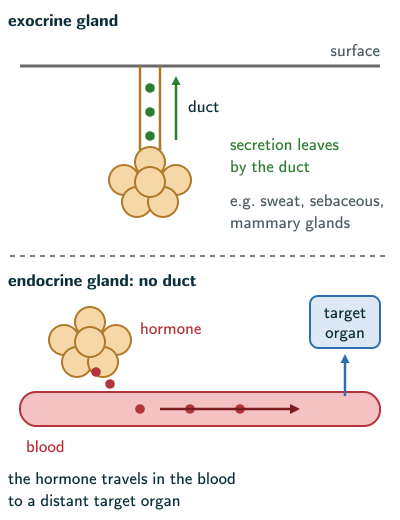
- Endocrine glands have no ducts: they are the ductless glands, and their secretions are hormones (NCERT page 239).
- Exocrine glands are the opposite. Beyond the NCERT text: “Exocrine glands have ducts that carry their secretory product to a surface. These glands include the sweat, sebaceous, and mammary glands and, the glands that secrete digestive enzymes” (NCI SEER Training Modules, Introduction to the Endocrine System). See also glandular epithelium.
- One gland can be both. NCERT calls the pancreas a composite gland that acts as both an exocrine and an endocrine gland (Section 19.2.8, page 245).
Definition of a hormone
NCERT sets two definitions side by side (page 239):
- Classical definition: a hormone is a chemical produced by endocrine glands, released into the blood and transported to a distantly located target organ.
- Current definition: hormones are non-nutrient chemicals that act as intercellular messengers and are produced in trace amounts.
- The current definition is wider. It covers a number of new molecules besides the hormones of the organised endocrine glands. For example, the atrial wall of the heart secretes atrial natriuretic factor, and the kidney erythropoietin, though neither organ is a dedicated endocrine gland (NCERT Section 19.3, page 247).
- NCERT’s comparison: it describes invertebrate endocrine systems as simpler, with fewer hormones than vertebrate systems (page 239). Treat this as the textbook’s broad comparison, not a measured count for every animal group.
Solved examples
Example 1: Exocrine gland, endocrine gland, hormone (NCERT Exercise 1)
Define (a) an exocrine gland, (b) an endocrine gland, (c) a hormone.
Answer: (a) An exocrine gland has ducts that carry its secretion to a surface, as the sweat, sebaceous and mammary glands and the digestive glands do (beyond the NCERT text: NCI SEER Training Modules). (b) An endocrine gland lacks ducts, so it is a ductless gland; its secretions, the hormones, are released into the blood and carried to their target organs (NCERT page 239). (c) Hormones are non-nutrient chemicals that act as intercellular messengers and are produced in trace amounts (page 239); the classical definition was a chemical produced by an endocrine gland, released into the blood and transported to a distantly located target organ (page 239).
Example 2: Old and new definitions
Atrial natriuretic factor is made by the wall of the heart’s atria. Why is it a hormone even though the heart is not a dedicated endocrine gland?
Answer: ANF is a non-nutrient intercellular messenger released by specialised heart cells (NCERT pages 239 and 247). Its endocrine action also involves blood transport to distant targets. The broader definition avoids restricting hormone sources to dedicated glands; it does not mean ANF fails to act as a classical circulating hormone.
Example 3: Why not nerves alone?
Give two reasons, from NCERT, why the body needs hormones as well as nerves.
Answer: nerve fibres do not innervate all the cells of the body, and cellular functions need to be regulated continuously, while neural coordination is fast but short-lived (NCERT page 239).
Common mistakes to avoid
Common mistake
Calling hormones nutrients
NCERT’s definition says hormones are non-nutrient chemicals, made in trace amounts (page 239).
Common mistake
Thinking only endocrine glands make hormones
The heart, kidney and gastrointestinal tract are not endocrine glands, yet they secrete hormones (NCERT pages 240 and 247).
Common mistake
Giving endocrine glands ducts
Endocrine glands lack ducts; that is why they are called ductless glands (NCERT page 239).
Quick revision summary
- Neural coordination is point-to-point, fast and short-lived; nerves do not reach every cell, so hormones give continuous chemical coordination. The two systems work together.
- Endocrine glands are ductless; their secretions are hormones. Exocrine glands have ducts.
- Classical hormone: made by an endocrine gland, carried in the blood to a distant target organ. Current hormone: a non-nutrient chemical, an intercellular messenger, made in trace amounts.
- NCERT broadly contrasts simpler invertebrate endocrine systems with vertebrate systems; this is not a hormone count for every taxon.
Formula sheet
- endocrine gland: no duct (ductless) → hormone into the blood
- exocrine gland: duct → secretion to a surface
- hormone: non-nutrient, intercellular messenger, trace amounts
- neural: fast, short-lived; hormonal: continuous regulation
Questions students ask
What is the difference between hormones and enzymes?
Hormones and enzymes do different jobs: a hormone is a messenger, which NCERT defines as a non-nutrient chemical produced in trace amounts (Section 19.1, page 239), while an enzyme is a catalyst whose active site speeds up a particular reaction (NCERT Chapter 9, page 113). Almost all enzymes are proteins (page 112), whereas hormones fall into four chemical groups, and steroid hormones such as cortisol are not proteins at all (chemical nature, Chapter 19, page 248). NCERT’s Table 9.5 lists the two as separate functions of proteins: insulin as a hormone and trypsin as an enzyme (page 109).
Why are hormones called chemical messengers?
Hormones are called chemical messengers because they carry information between cells as molecules, not as nerve impulses: NCERT’s current definition calls them non-nutrient chemicals which act as “intercellular messengers” (Section 19.1, page 239). Only cells with the hormone’s specific receptor respond to the message (receptors, page 247). Beyond the NCERT text, MedlinePlus uses the same name and notes that a tiny amount of a hormone can cause large changes in cells or the whole body (MedlinePlus, Hormones).
What is the difference between hormones and pheromones?
Hormones and pheromones differ in whom they act on: a hormone works within the body that makes it, as an intercellular messenger produced in trace amounts (NCERT page 239), while, beyond the NCERT text, a pheromone is a chemical that an organism releases into its surroundings to set off a behavioural or physiological response in other members of the same species, sensed by smell or by contact (MeSH, US National Library of Medicine, “Pheromones”). So a hormone usually carries its message within one body, whereas a pheromone carries it from one individual to another. MeSH also lists ectohormones as another name for pheromones.
What is the difference between hormones and vitamins?
Hormones are chemical signals made within the body; vitamins are nutrients needed in small amounts, usually supplied by food. Many vitamins help enzymes function, but that is not the role of every vitamin. The distinction is not absolute: vitamin D can be made in skin and converted to the hormone calcitriol; intestinal bacteria produce vitamin K and may contribute to requirements (NIH Office of Dietary Supplements). NCERT calls hormones non-nutrient intercellular messengers (page 239) and explains vitamin-derived coenzymes in Chapter 9 (page 118).
What is the study of endocrine glands and hormones called?
The study of endocrine glands and hormones is called endocrinology: beyond the NCERT text, MeSH describes endocrinology as the subspecialty of internal medicine concerned with the metabolism, physiology and disorders of the endocrine system (MeSH, US National Library of Medicine, “Endocrinology”). NCERT does not use the word, but its Chapter 19 covers the same ground: the endocrine glands and the hormone-producing diffused tissues and cells that together make up the endocrine system (page 240).
Practice questions
Try each question first, then open the answer to check your working.
-
Q1. Why are endocrine glands called ductless glands?
Show answerHide answer
Because they lack ducts (NCERT page 239).
-
Q2. Which gland does NCERT call a composite gland, and why?
Show answerHide answer
The pancreas, because it acts as both an exocrine and an endocrine gland (NCERT page 245).
-
Q3. How does NCERT broadly compare invertebrate and vertebrate endocrine systems?
Show answerHide answer
NCERT describes vertebrates as having many hormones and invertebrates as having simpler systems with fewer hormones (page 239). This is a textbook generalisation, not a precise count for every group.