Mechanism of hormone action
NCERT Class 11 Biology Chapter 19 Section 19.4
Quick answer
Hormones bind specific receptors on or inside target cells. Surface receptors activate intracellular signalling, often through second messengers, while intracellular steroid and thyroid-hormone receptors mainly regulate gene expression.
With your textbook
NCERT Biology (Class 11), Chapter 19 “Chemical Coordination and Integration”, Section 19.4 “Mechanism of Hormone Action”, pages 247–249.
Open the official NCERT chapter (PDF, 2.1 MB, ncert.nic.in) (opens in a new tab)
Checked against the 2026-27 reprint on .
Mechanism of hormone action
Hormone receptor
A hormone acts only on cells that carry its receptor. NCERT begins:
Hormones produce their effects on target tissues by binding to specific proteins called hormone receptors located in the target tissues only.
NCERT Biology (Class 11), Section 19.4, page 247
In plain words: a circulating hormone reaches many tissues through the blood, but it is like a key that fits only certain locks. A suitable receptor lets a cell detect the hormone; the cell’s signalling machinery determines the response. Some keys work at the cell’s front door and send a messenger inside; others slip inside and act on the genes directly.
Hormone receptors
NCERT Section 19.4 (pages 247–248):
- Receptors are of two kinds: membrane-bound receptors, on the cell membrane of the target cells, and intracellular receptors, inside the target cell, mostly nuclear receptors.
- A hormone binding to its receptor forms a hormone-receptor complex.
- NCERT states: “Each receptor is specific to one hormone only and hence receptors are specific” (page 247). Give this sentence in an NCERT-based answer.
- Beyond the NCERT text: the rule is a simplification. Receptors are selective rather than strictly one-to-one: related hormones can share a receptor, and one hormone can act through several receptor types. For example, β-adrenergic receptors are equally sensitive to adrenaline (epinephrine) and noradrenaline (norepinephrine), and adrenaline also acts on the other adrenergic receptor classes (MeSH, US National Library of Medicine, “Receptors, Adrenergic, beta-1” and “Receptors, Adrenergic”).
- Forming the complex leads to biochemical changes in the target tissue; target tissue metabolism, and so physiological functions, are regulated by hormones.
Chemical nature of hormones
By chemical nature, NCERT divides hormones into four groups (page 248):
- Peptide, polypeptide and protein hormones: insulin, glucagon, pituitary hormones, many hypothalamic hormones such as GnRH and somatostatin.
- Steroids: cortisol, testosterone, estradiol and progesterone.
- Iodothyronines: the thyroid hormones.
- Amino-acid derivatives: epinephrine.
These are NCERT’s teaching groups. Thyroid hormones are chemically iodinated tyrosine derivatives, although listed separately here. Not every hypothalamic hormone is a peptide: dopamine, which inhibits prolactin release, is an amine (NCBI Bookshelf, The pituitary gland).
Second messengers
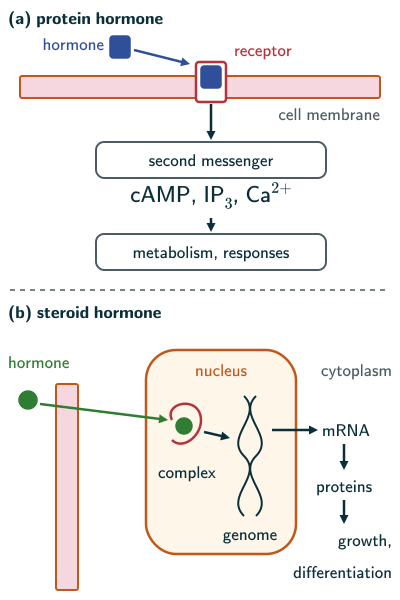
- Hormones that act through membrane-bound receptors normally do not enter the target cell. Many activate pathways with second messengers, such as cyclic AMP, IP and Ca, which regulate cellular metabolism (NCERT page 248). Not every surface receptor uses the same pathway: insulin activates a receptor tyrosine kinase and downstream protein phosphorylation (Endotext).
- FSH’s major signalling pathway is receptor → G protein → adenylyl cyclase → cAMP → protein kinase A (Endotext, Morphology and Physiology of the Ovary). NCERT’s Figure 19.5a shows this with FSH, a protein hormone, acting on an ovarian cell: binding to the receptor gives a first response at the membrane, then a second messenger (cyclic AMP or Ca), then biochemical and finally physiological responses such as ovarian growth (page 248).
Hormone action on genes
- Hormones that act through intracellular receptors, such as steroid hormones and iodothyronines, mostly regulate gene expression or chromosome function, through the hormone-receptor complex interacting with the genome (NCERT page 248). This changes transcription and protein production; it does not mean the hormone rewrites the DNA sequence.
- The cumulative biochemical actions give physiological and developmental effects (page 248). NCERT’s Figure 19.5b follows a steroid hormone, estrogen, into a uterine cell: the hormone-receptor complex acts on the genome, mRNA and then proteins are made, and the result is tissue growth and differentiation (page 249). Some steroid receptors are initially cytoplasmic and move to the nucleus after activation; the diagram summarises the genomic route. NCERT’s Figure 19.5 caption prints “Diagramatic”, a misspelling of “Diagrammatic”, the spelling its Figure 19.2 caption uses (pages 249 and 241).
Solved examples
Example 1: Mechanism of action of FSH (NCERT Exercise 8)
Briefly mention the mechanism of action of FSH.
Answer: FSH is a pituitary hormone, and NCERT puts the pituitary hormones among the peptide, polypeptide and protein hormones (page 248). NCERT’s Figure 19.5a, captioned “Protein hormone” (pages 248–249), takes FSH itself as its example: the hormone binds a specific receptor on the membrane of an ovarian cell and normally does not enter the cell. For FSH, the principal pathway involves G protein, adenylyl cyclase, cAMP and protein kinase A (beyond NCERT’s general second-messenger diagram); the biochemical responses lead to physiological responses, in the figure ovarian growth. FSH stimulates the growth and development of the ovarian follicles in females, and in males FSH and androgens regulate spermatogenesis (pages 241–242).
Example 2: Sort the hormones
Classify by chemical nature: insulin, cortisol, thyroxine, epinephrine, glucagon, progesterone.
Answer: peptide or protein: insulin, glucagon; steroid: cortisol, progesterone; iodothyronine: thyroxine; amino-acid derivative: epinephrine (NCERT page 248).
Example 3: Inside or outside?
Which of these hormones mostly act through intracellular receptors on gene expression: testosterone, glucagon, thyroid hormones?
Answer: testosterone (a steroid) and the thyroid hormones (iodothyronines); glucagon, a peptide, acts through membrane-bound receptors and second messengers (NCERT page 248).
Common mistakes to avoid
Common mistake
Letting protein hormones enter the cell
Hormones that act through membrane-bound receptors normally do not enter the target cell; they transmit the signal through intracellular pathways, often involving second messengers (NCERT page 248).
Common mistake
Calling thyroid hormones steroids
NCERT lists iodothyronines, the thyroid hormones, as a group of their own, separate from the steroids (page 248).
Common mistake
Mixing up NCERT’s receptor rule and the modern account
For an NCERT-based answer, write NCERT’s rule: each receptor is specific to one hormone only, and hence receptors are specific (page 247). Beyond the NCERT text, the rule is simplified: receptors are selective, and related hormones may share a receptor, as adrenaline and noradrenaline share β-adrenergic receptors (MeSH, US National Library of Medicine, “Receptors, Adrenergic, beta-1”).
Quick revision summary
- Hormones act on target tissues by binding specific hormone receptors there, forming a hormone-receptor complex; in NCERT, each receptor is specific to one hormone only (beyond NCERT: selective rather than strictly one-to-one).
- Receptors are membrane-bound or intracellular (mostly nuclear).
- Chemical groups: peptide, polypeptide and protein (insulin, glucagon, pituitary hormones and many hypothalamic hormones); steroids (cortisol, testosterone, estradiol, progesterone); iodothyronines (thyroid hormones); amino-acid derivatives (epinephrine).
- Membrane-bound route: intracellular signalling, often second messengers (cyclic AMP, IP, Ca) regulate metabolism. Intracellular route: the complex acts on the genome and regulates gene expression.
Formula sheet
- protein hormone → membrane receptor → intracellular signalling → response
- steroid, iodothyronine → intracellular receptor → genome → mRNA → proteins
- groups: peptide/protein; steroid; iodothyronine; amino-acid derivative
Questions students ask
Why can steroid hormones enter cells when peptide hormones normally do not?
Reasoning from NCERT, steroid hormones can enter target cells because they are lipid-like (NCERT Chapter 8, page 95), so they can cross the nonpolar lipid bilayer, which large polar peptides cross poorly (cell membrane, page 94). Chapter 19 says hormones on membrane-bound receptors normally do not enter the target cell, while steroids act through intracellular receptors (page 248). Beyond the NCERT text, a 2019 study found that cells take up steroids rapidly, partly by a passive route favouring the more lipophilic ones and partly by active uptake (McManus and colleagues, PLOS ONE, 2019, CC BY).
What is the difference between a first messenger and a second messenger?
The first messenger is the hormone that brings a signal to the target cell, and the second messenger is the molecule that relays it inside; NCERT names only the second, and beyond the NCERT text, MeSH calls the hormone or neurotransmitter the primary messenger (MeSH, “Second Messenger Systems”). In NCERT, hormones on membrane-bound receptors normally do not enter the target cell but generate second messengers, such as cyclic AMP, which regulate cellular metabolism (page 248). One second messenger serves many hormones: cyclic AMP mediates the action of epinephrine, glucagon and ACTH (MeSH, “Cyclic AMP”), although selective receptors and their coupling determine the response.
Are all hormones steroids?
Not all hormones are steroids: steroids are only one of NCERT’s four chemical groups of hormones, beside the peptide and protein hormones, the iodothyronines and the amino-acid derivatives; pituitary hormones and many hypothalamic hormones are peptides or proteins; hypothalamic dopamine is an amine (NCERT page 248). Nor are all steroids hormones: beyond the NCERT text, the steroid family also includes cholesterol, bile acids and the precursors of some vitamins (MeSH, US National Library of Medicine, “Steroids”). What makes a molecule a steroid is a shared fused ring system of 17 carbon atoms (same source), not its job, so only some steroids work as hormones.
Why do steroid hormones act more slowly than peptide hormones?
Steroid hormones usually act more slowly because their route runs through the genes, a timing from beyond the NCERT text: NCI’s SEER training module calls the surface-receptor route of protein hormones relatively rapid and the inside route of steroid hormones relatively slow, because it involves the synthesis of proteins (NCI SEER Training Modules, Characteristics of Hormones). NCERT describes the two routes without timing them: hormones that bind intracellular receptors, such as steroid hormones, mostly regulate gene expression or chromosome function through the hormone-receptor complex acting on the genome, while many membrane-bound receptors activate second-messenger pathways (page 248). This is a common timing comparison, not an absolute rule; rapid non-genomic steroid effects also occur.
What is a feedback mechanism in hormone secretion?
In negative feedback, a response reduces the stimulus that originally produced it. For example, low blood calcium increases PTH secretion, and the resulting rise in calcium reduces that stimulus. Feedback may involve a gland sensing a regulated substance or hormones acting on the hypothalamus and pituitary. An increase in blood flow to the atria can cause ANF release, which dilates blood vessels and lowers blood pressure, and an increase in body fluid volume can switch off the osmoreceptors and suppress ADH release. Do not reduce all feedback to one gland directly sensing its own hormone (NCERT pages 243 and 247; Chapter 16, page 212).
Practice questions
Try each question first, then open the answer to check your working.
-
Q1. Name three second messengers given by NCERT.
Show answerHide answer
Cyclic AMP, IP and Ca (NCERT page 248).
-
Q2. Where are most intracellular hormone receptors present?
Show answerHide answer
In the nucleus: they are mostly nuclear receptors (NCERT page 247).
-
Q3. To which chemical group does epinephrine belong?
Show answerHide answer
The amino-acid derivatives (NCERT page 248).