Hormones of heart, kidney and gastrointestinal tract
NCERT Class 11 Biology Chapter 19 Section 19.3
Quick answer
The heart releases ANF, which helps lower blood pressure, and the kidney releases erythropoietin, which supports red-cell production. Gut hormones include gastrin, secretin, CCK and GIP; they coordinate digestive activity, and GIP also promotes glucose-dependent insulin secretion.
With your textbook
NCERT Biology (Class 11), Chapter 19 “Chemical Coordination and Integration”, Section 19.3 “Hormones of Heart, Kidney and Gastrointestinal Tract”, page 247.
Open the official NCERT chapter (PDF, 2.1 MB, ncert.nic.in) (opens in a new tab)
Checked against the 2026-27 reprint on .
Hormones of the heart, kidney and gut
Hormones from non-endocrine tissues
Hormones are also secreted by some tissues that are not endocrine glands (NCERT Section 19.3, page 247). NCERT’s first example:
For example, the atrial wall of our heart secretes a very important peptide hormone called atrial natriuretic factor (ANF), which decreases blood pressure.
NCERT Biology (Class 11), Section 19.3, page 247
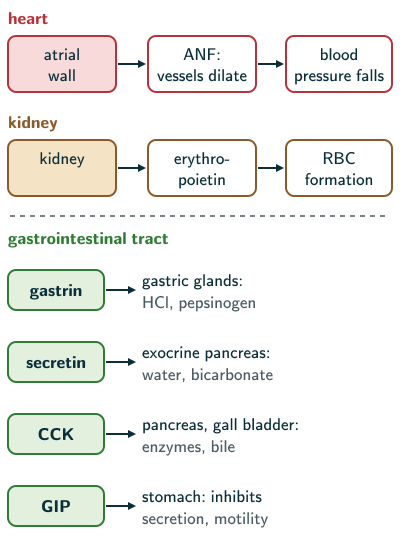
In plain words: some organs with a different main job also send chemical messages. Stretch of the atria, often from increased blood volume, stimulates a heart hormone, the kidney signals the need for more red blood cells, and the gut signals the stomach, pancreas and gall bladder when food arrives.
Atrial natriuretic factor
- The atrial wall of the heart secretes atrial natriuretic factor (ANF), a peptide hormone that decreases blood pressure (NCERT page 247).
- NCERT links increased blood pressure with ANF release and dilation of blood vessels (page 247). More precisely, atrial stretch is an important stimulus. ANF also promotes renal sodium excretion (natriuresis) and water loss, helping reduce circulating volume (Endotext).
- Chapter 16 adds that an increase in blood flow to the atria can cause ANF release, and that the ANF mechanism acts as a check on the renin-angiotensin mechanism (NCERT page 212; see ANF and the kidney).
Erythropoietin
- NCERT says the juxtaglomerular cells of the kidney produce a peptide hormone, erythropoietin, which stimulates erythropoiesis, the formation of RBCs (page 247; see red blood cells).
- NCERT slip (page 247): that the kidney makes erythropoietin is right; the cell named is not the one current research identifies. Beyond the NCERT text, a 2022 review notes that “The identity of the renal cells that produce Epo has been debated for decades”, and that, with more sensitive ways of detecting mRNA in tissue, “it is now undisputed that only fibroblast-like cells located in the intertubular space, often referred to as ‘interstitial’ cells, produce Epo mRNA” (Dahl and colleagues, Pflügers Archiv, 2022, CC BY 4.0). In NCERT’s own Chapter 16, the juxtaglomerular (JG) cells, part of the juxtaglomerular apparatus, are the cells that release renin (page 212).
- Keep the source distinction explicit: NCERT names juxtaglomerular cells, whereas current renal physiology identifies interstitial fibroblast-like cells as the adult renal EPO source; JG cells release renin. In NEET and other NCERT-based questions, give NCERT’s answer: if an option names the juxtaglomerular cells of the kidney, choose it; if the options name only organs, choose the kidney.
Gastrointestinal hormones
Endocrine cells in different parts of the gastrointestinal tract secrete four major peptide hormones (NCERT page 247):
- Gastrin: acts on the gastric glands, stimulating secretion of hydrochloric acid and pepsinogen.
- Secretin: acts on the exocrine pancreas, stimulating secretion of water and bicarbonate ions.
- Cholecystokinin (CCK): acts on both the pancreas and the gall bladder, stimulating secretion of pancreatic enzymes and the release of bile juice. The gall bladder does not make bile: beyond the NCERT text, it “stores bile, a fluid made by your liver to digest fat” and releases it through the common bile duct (MedlinePlus, Gallbladder Diseases).
- Gastric inhibitory peptide (GIP): NCERT describes inhibition of gastric secretion and motility. Its modern name, glucose-dependent insulinotropic peptide, highlights its major incretin action: enhancing insulin secretion when blood glucose is elevated (NLM MeSH, Gastric Inhibitory Polypeptide).
NCERT’s Summary sums them up: these hormones regulate the secretion of digestive juices and help in digestion (page 250).
Growth factors: several other non-endocrine tissues secrete hormones called growth factors, essential for the normal growth of tissues and their repair or regeneration (page 247). Many growth factors act locally, so do not assume every one is transported in blood to a distant organ.
Solved examples
Example 1: Atrium, kidney, gut (NCERT Exercise 3j–l)
List the hormones secreted by (j) the atrium, (k) the kidney, (l) the gastrointestinal tract.
Answer: (j) atrial natriuretic factor (ANF); (k) erythropoietin; (l) gastrin, secretin, cholecystokinin (CCK) and gastric inhibitory peptide (GIP) (NCERT page 247).
Example 2: A blood-pressure-lowering hormone (NCERT Exercise 6e)
Give an example of a hormone that lowers blood pressure, and say how it works.
Answer: atrial natriuretic factor, from the atrial wall of the heart. Atrial stretch stimulates release; ANF promotes vasodilation and sodium/water loss, helping reduce pressure and volume. NCERT emphasises vasodilation (page 247).
Example 3: Match the hormone to its target
Match gastrin, secretin and CCK with (i) the exocrine pancreas, releasing water and bicarbonate, (ii) the gastric glands, releasing HCl and pepsinogen, (iii) the pancreas and the gall bladder.
Answer: gastrin–(ii), secretin–(i), CCK–(iii) (NCERT page 247).
Example 4: Not a gland, still a hormone
Why does NCERT count ANF as a hormone even though the heart is not an endocrine gland?
Answer: under the current definition, hormones are non-nutrient chemicals that act as intercellular messengers and are produced in trace amounts, whatever tissue makes them (NCERT page 239). ANF, a peptide from the atrial wall, carries a message that dilates blood vessels, so it qualifies (page 247).
Common mistakes to avoid
Common mistake
Letting ANF raise blood pressure
ANF decreases blood pressure by dilating the blood vessels (NCERT page 247).
Common mistake
Confusing secretin’s and gastrin’s listed actions
NCERT pairs secretin with pancreatic water/bicarbonate secretion and gastrin with gastric HCl/pepsinogen secretion (page 247). These are the listed actions, not a claim that secretin has no effect on gastric function.
Common mistake
Calling GIP a stimulator of gastric secretion
GIP inhibits gastric secretion and motility; it does not stimulate them (NCERT page 247).
Quick revision summary
- Some non-endocrine tissues secrete hormones.
- Heart: the atrial wall secretes ANF, which dilates blood vessels and lowers blood pressure.
- Kidney: erythropoietin stimulates RBC formation. NCERT names juxtaglomerular cells, so give that in NCERT-based answers; current research identifies interstitial fibroblast-like cells.
- Gut: gastrin (HCl and pepsinogen), secretin (water and bicarbonate from the pancreas), CCK (pancreatic enzymes and bile), GIP (inhibits gastric secretion and motility).
- Growth factors help tissues grow and repair.
Formula sheet
- heart (atrial wall) → ANF → vessels dilate → blood pressure falls
- kidney → erythropoietin → erythropoiesis (RBC formation)
- gastrin → gastric glands: HCl, pepsinogen
- secretin → exocrine pancreas: water, bicarbonate
- CCK → pancreas (enzymes) + gall bladder (bile); GIP → inhibits gastric secretion, motility
Questions students ask
Is atrial natriuretic factor the same as atrial natriuretic peptide (ANP)?
Atrial natriuretic factor (ANF) and atrial natriuretic peptide (ANP) are two names for the same heart hormone: NCERT calls it ANF, a peptide hormone of the atrial wall that decreases blood pressure (page 247), and beyond the NCERT text, MeSH lists ANP and atrial natriuretic peptide as other names under “Atrial Natriuretic Factor” (MeSH, US National Library of Medicine). Also beyond the NCERT text, a related hormone, B-type natriuretic peptide (BNP), is produced by cardiac muscle, with increased ventricular production during wall stress (Endotext). Why it is called natriuretic is explained with the kidney.
Why does kidney failure cause anaemia?
Beyond the NCERT text, kidney failure causes anaemia mainly because damaged kidneys make less erythropoietin, the peptide hormone that NCERT says stimulates erythropoiesis, the formation of RBCs (NCERT page 247; NIDDK, Anemia in Chronic Kidney Disease). With less erythropoietin the bone marrow makes fewer red blood cells, so less oxygen reaches the organs and tissues, and red cells that die sooner than normal and low levels of iron, vitamin B12 or folate can add to the anaemia (same source). This is why such patients may be given erythropoiesis-stimulating agents, medicines that signal the bone marrow to make more red blood cells (same source).
What is the difference between erythropoietin and erythropoiesis?
Erythropoietin is a hormone and erythropoiesis is the process it drives: NCERT says the kidney produces a peptide hormone called erythropoietin, which stimulates erythropoiesis, the formation of RBCs (page 247), and in adults RBCs are formed in the red bone marrow (NCERT Chapter 15, page 194; see red blood cells). Beyond the NCERT text, erythropoietin acts on the erythroid progenitor cells of the bone marrow, making them multiply and differentiate, and it comes chiefly from the kidney in adults but from the liver in the foetus (MeSH, US National Library of Medicine, “Erythropoietin”).
What is the other name of gastric inhibitory peptide (GIP)?
Gastric inhibitory peptide (GIP) is also called glucose-dependent insulinotropic peptide, a name from beyond the NCERT text that keeps the initials GIP (MeSH, US National Library of Medicine, “Gastric Inhibitory Polypeptide”). This second name points to a role NCERT does not give: MeSH describes GIP as a strong stimulus for insulin secretion that inhibits gastric acid secretion only weakly. NCERT’s account states that GIP is one of the four major peptide hormones of the gastrointestinal tract and inhibits gastric secretion and motility (NCERT page 247); the insulin it promotes comes from the β-cells of the pancreas, not from the stomach (page 245).
What is the difference between gastrin and gastric juice?
Gastrin is a hormone and gastric juice is a digestive secretion: gastrin is a peptide hormone from endocrine cells of the gastrointestinal tract that acts on the gastric glands and stimulates their secretion (NCERT page 247). Beyond the NCERT text, gastric juice is the liquid secretion of the stomach lining (MeSH, “Gastric Juice”). So gastrin is a signal and the juice a response: the gastric glands release the juice into the stomach, while gastrin reaches the glands without a duct, as endocrine secretions do.
Practice questions
Try each question first, then open the answer to check your working.
-
Q1. Which hormone stimulates the formation of red blood cells?
Show answerHide answer
Erythropoietin, from the kidney (NCERT page 247).
-
Q2. Which gastrointestinal hormone acts on both the pancreas and the gall bladder?
Show answerHide answer
Cholecystokinin (CCK): it stimulates the secretion of pancreatic enzymes and bile juice (NCERT page 247).
-
Q3. What are growth factors?
Show answerHide answer
Hormones secreted by several non-endocrine tissues, essential for the normal growth of tissues and their repair and regeneration (NCERT page 247).