Urine formation: filtration, reabsorption, secretion
NCERT Class 11 Biology Chapter 16 Section 16.2
Quick answer
Urine formation combines glomerular filtration, tubular reabsorption and secretion. NCERT’s typical GFR is 125 mL/min, or 180 litres daily, of which nearly 99 per cent is reabsorbed. For a solute, excretion equals filtration minus reabsorption plus secretion.
With your textbook
NCERT Biology (Class 11), Chapter 16 “Excretory Products and their Elimination”, Section 16.2 “Urine Formation”, pages 208–209.
Open the official NCERT chapter (PDF, 1.8 MB, ncert.nic.in) (opens in a new tab)
Checked against the 2026-27 reprint on .
Urine formation
Urine formation
NCERT names the three steps by which the nephron makes urine (Section 16.2, page 208):
Urine formation involves three main processes namely, glomerular filtration, reabsorption and secretion, that takes place in different parts of the nephron.
NCERT Biology (Class 11), Section 16.2, page 208
In plain words: the kidney first filters a large volume of water and small solutes from plasma, retaining blood cells and most proteins, and then takes almost all the water back. Whatever it does not take back, plus a few substances the tubule cells add to it, leaves as urine.
Glomerular filtration
- The first step is the filtration of blood by the glomerulus, called glomerular filtration (NCERT page 208).
- On average, 1100–1200 mL of blood is filtered by the kidneys per minute, roughly one-fifth of the blood pumped out by each ventricle in a minute (page 208). Read this as the blood that flows through the glomeruli each minute: about 125 mL of plasma-derived fluid passes the filter as filtrate (below).
- The glomerular capillary blood pressure drives the filtration through three layers (page 208):
- the endothelium of the glomerular blood vessels;
- a basement membrane between the other two;
- the epithelium of Bowman’s capsule, whose cells, the podocytes, are arranged to leave minute spaces called filtration slits or slit pores.
- The filtering is so fine that almost all the constituents of the plasma except the proteins pass into the lumen of Bowman’s capsule, so it is called ultrafiltration (page 208).
- NCERT’s Summary adds that filtration is non-selective, and that the 1200 mL of blood filtered each minute forms 125 mL of filtrate (pages 214–215). So only about a tenth of that volume of blood becomes filtrate: 125 ÷ 1200 ≈ 0.10.
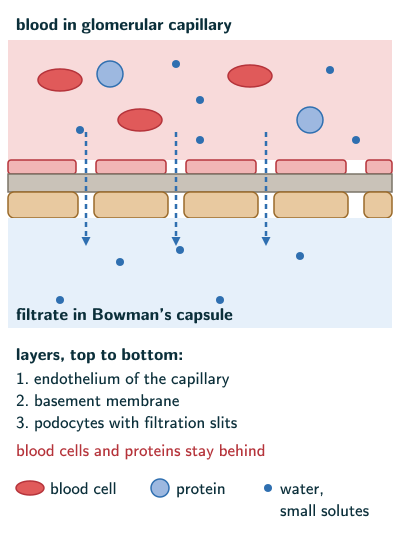
“Non-selective” means the filter does not distinguish a useful small molecule such as glucose from a waste such as urea. It still has size and charge selectivity: cells and most plasma proteins are retained, while small amounts of low-molecular-weight protein can filter and be reclaimed by tubules. “Protein-free” is NCERT’s approximation, not absolute absence (NIDDK, “Your Kidneys & How They Work”; StatPearls, “Urinalysis”).
Filtration fraction uses renal plasma flow, not whole-blood flow. For example, GFR 125 mL/min and plasma flow 625 mL/min give 125/625 = 20 per cent; the earlier 125/1200 calculation compares with blood flow and is not this physiological fraction (StatPearls, “Physiology, Glomerular Filtration Rate”).
Glomerular filtration rate
- The amount of filtrate formed by the kidneys per minute is the glomerular filtration rate (GFR) (NCERT page 209).
- In a healthy person, GFR is about 125 mL a minute, that is, 180 litres a day (page 209): 125 mL × 60 × 24 = 180 000 mL.
Juxtaglomerular apparatus
- The kidneys have built-in mechanisms that regulate the GFR; one efficient mechanism is carried out by the juxtaglomerular apparatus (JGA) (NCERT page 209).
- The JGA is a special sensitive region formed by cellular modifications in the distal convoluted tubule and the afferent arteriole where they touch (page 209).
- NCERT: a fall in GFR can activate the JG cells to release renin, which can stimulate the glomerular blood flow and thereby bring the GFR back to normal (page 209); give this in an NCERT-based answer. Beyond the NCERT text: renin responds to reduced renal perfusion, reduced NaCl delivery at the macula densa and sympathetic stimulation. The angiotensin pathway can help maintain filtration pressure, but does not always increase renal blood flow or restore GFR. Intrinsic autoregulation also includes the myogenic response and tubuloglomerular feedback (Carlström and colleagues, “Renal Autoregulation in Health and Disease”, 2015).
Reabsorption
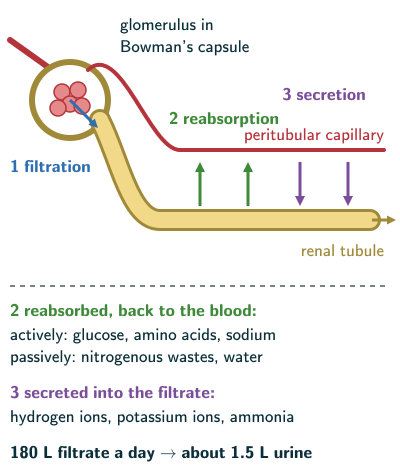
- The filtrate formed per day (180 litres) is far more than the urine released (1.5 litres), so nearly 99 per cent of the filtrate has to be reabsorbed by the renal tubules (NCERT page 209): (180 − 1.5) ÷ 180 ≈ 0.99.
- The tubular epithelial cells do this by active or passive mechanisms (page 209; see active and passive transport):
- actively: glucose, amino acids, Na and similar substances;
- passively: the nitrogenous wastes, such as urea. Only part of the urea is taken back: an adult still excretes 25–30 g of urea a day (NCERT Section 16.6, page 213);
- water moves passively by osmosis wherever the epithelium is water-permeable; this includes ADH-regulated collecting ducts, not only the initial segments.
Tubular secretion
- During urine formation, the tubular cells secrete substances such as H, K and ammonia into the filtrate (NCERT page 209).
- Tubular secretion is also an important step, because it helps maintain the ionic and acid–base balance of the body fluids (page 209).
Solved examples
Example 1: GFR (NCERT Exercise 1)
Define glomerular filtration rate (GFR).
Answer: the amount of filtrate formed by the kidneys per minute; in a healthy person it is about 125 mL a minute, or 180 litres a day (NCERT page 209).
Example 2: Keeping GFR steady (NCERT Exercises 2 and 10)
Explain the autoregulatory mechanism of GFR. What is the significance of the juxtaglomerular apparatus (JGA)?
Answer: NCERT: the JGA lies where the DCT and the afferent arteriole touch; a fall in GFR can activate its JG cells to release renin, which can stimulate the glomerular blood flow and thereby bring the GFR back to normal (page 209). Renin activates the angiotensin pathway, which raises the glomerular blood pressure and GFR and makes the adrenal cortex release aldosterone, which causes reabsorption of Na and water from the distal parts of the tubule and so also raises blood pressure and GFR (page 212); give these in an NCERT-based answer. Beyond the NCERT text: this does not always increase renal blood flow, and intrinsic autoregulation also uses arteriolar muscle responses and macula-densa feedback (Carlström and colleagues, 2015).
Example 3: True or false? (NCERT Exercise 3c, e)
(c) Protein-free fluid is filtered from blood plasma into the Bowman’s capsule. (e) Glucose is actively reabsorbed in the proximal convoluted tubule.
Answer: (c) true in NCERT’s simplified description: the filtrate contains very little protein compared with plasma; most plasma proteins are retained (NCERT page 208). (e) True: glucose is reabsorbed actively (page 209), and the PCT reabsorbs nearly all the essential nutrients (page 209).
Example 4: From filtrate to urine
GFR is 125 mL a minute and the urine released is 1.5 litres a day. How much filtrate is made in a day, and what fraction is reabsorbed?
Answer: 125 mL × 60 × 24 = 180 000 mL = 180 litres a day. Reabsorbed: (180 − 1.5) ÷ 180 = 178.5 ÷ 180 ≈ 0.99, nearly 99 per cent, as NCERT says (page 209).
Example 5: Blood filtered against filtrate formed
NCERT says about 1200 mL of blood is filtered each minute to form 125 mL of filtrate (pages 214–215). What fraction of that blood becomes filtrate?
Answer: 125 ÷ 1200 ≈ 0.10, about a tenth. The rest leaves via the efferent arteriole (page 207). This ratio uses whole blood; the physiological filtration fraction uses plasma flow and is about 20 per cent.
Example 6: A solute balance
A hypothetical solute is filtered at 100 mg/min, reabsorbed at 80 mg/min and secreted at 10 mg/min. How much is excreted?
Answer: 100 − 80 + 10 = 30 mg/min. Reabsorption removes solute from tubular fluid; secretion adds it. These processes can occur along overlapping portions of the tubule, rather than as three completely separate time steps.
Common mistakes to avoid
Common mistake
Letting proteins into the filtrate
NCERT describes a protein-free filtrate (page 208). In physiology, most plasma proteins are retained; small filtered proteins are largely reclaimed. Substantial urinary protein is not explained by freely filtering all plasma proteins.
Common mistake
Calling 1200 mL a minute the GFR
1100–1200 mL is the blood filtered by the kidneys each minute; the filtrate formed, the GFR, is about 125 mL a minute (NCERT pages 208–209 and 214–215).
Common mistake
Making all reabsorption active
Glucose, amino acids and Na are reabsorbed actively, but the nitrogenous wastes are taken up passively, and water passively in the initial segments (NCERT page 209).
Quick revision summary
- Urine forms by glomerular filtration, reabsorption and secretion.
- Glomerular capillary blood pressure filters blood through endothelium, basement membrane and the podocyte epithelium of Bowman’s capsule; water and small solutes pass while cells and most plasma proteins remain: ultrafiltration.
- GFR is about 125 mL a minute, or 180 litres a day. The JGA participates in filtration control and renin release when perfusion or NaCl delivery falls.
- Nearly 99 per cent of the filtrate is reabsorbed: glucose, amino acids and Na actively; part of the nitrogenous wastes, and water, passively.
- The tubules secrete H, K and ammonia, keeping the ionic and acid–base balance.
Formula sheet
- excreted amount = filtered amount − reabsorbed amount + secreted amount
- GFR ≈ 125 mL a minute ≈ 180 L a day
- reabsorbed ≈ (180 − 1.5) ÷ 180 ≈ 99 per cent
- filter: endothelium + basement membrane + podocyte epithelium
- secreted: H, K, ammonia
Questions students ask
What is the difference between tubular reabsorption and tubular secretion?
Tubular reabsorption and tubular secretion move substances in opposite directions: reabsorption takes substances out of the filtrate and back into the body, while secretion adds substances from the tubular cells into the filtrate (NCERT page 209). Reabsorption returns nearly 99 per cent of the filtrate, by active or passive mechanisms, while secretion helps keep the ionic and acid–base balance of the body fluids (page 209). Both are done by the tubule, after the glomerulus has carried out the first step, filtration (page 208).
Why is glomerular filtration called non-selective?
Glomerular filtration is non-selective, as NCERT’s Summary calls it (page 214), because the glomerulus sorts the plasma by size, not by usefulness: glucose and amino acids enter Bowman’s capsule as freely as urea does, while cells and most proteins are held back (NCERT page 208). The selecting is done afterwards by the tubules, which reabsorb what the body needs and leave most of the waste in the filtrate (page 209). Beyond the NCERT text, NIDDK describes the same filter: its thin walls let smaller molecules, wastes and fluid, mostly water, pass into the tubule, while larger molecules such as proteins, and the blood cells, stay in the blood (NIDDK, Your Kidneys & How They Work).
What is the difference between the juxtaglomerular apparatus and a juxtamedullary nephron?
The juxtaglomerular apparatus (JGA) is a small sensitive region of a nephron, while a juxtamedullary nephron is a whole nephron of one type: the JGA is formed by cellular modifications in the DCT and the afferent arteriole where they touch, and it helps keep GFR steady through renin (NCERT page 209), whereas juxtamedullary nephrons are those whose loop of Henle is very long and runs deep into the medulla (page 208). Beyond the NCERT text, the afferent arterioles of juxtamedullary nephrons arise near the boundary between cortex and medulla (O’Connor, Physiological Reports, 2019).
Which cells make up the juxtaglomerular apparatus?
The juxtaglomerular apparatus is made up of the juxtaglomerular (JG) cells, the macula densa of the DCT, the extraglomerular mesangial (lacis) cells and the granular peripolar cells, a list from beyond the NCERT text (MeSH, “Juxtaglomerular Apparatus”); NCERT names only the JG cells, which release renin when GFR falls (page 209). The JG cells are modified smooth muscle cells in the wall of the afferent arteriole, and the lacis cells lie in the angle between the afferent and efferent arterioles (same source). So NCERT’s “cellular modifications in the distal convoluted tubule and the afferent arteriole” are the macula densa and the JG cells.
Is the eGFR on a kidney test the same as NCERT’s GFR of 125 mL a minute?
No, the eGFR on a kidney test is a person’s own estimated GFR, not NCERT’s typical value: NCERT gives a GFR of approximately 125 mL a minute for a healthy individual (page 209), while, beyond the NCERT text, the eGFR is calculated from blood markers, creatinine, cystatin C or both, together with demographic variables, and reported in mL/min/1.73 m (NIDDK, Glomerular Filtration Rate Equations). Interpretation also uses age, trends and urine albumin. An eGFR ≥60 does not exclude kidney disease when other markers of damage are present; persistent eGFR <60 or kidney-damage markers for more than three months support chronic kidney disease (NIDDK, “Identify & Evaluate Patients with Chronic Kidney Disease”). A single estimate is not a diagnosis.
Practice questions
Try each question first, then open the answer to check your working.
-
Q1. What are the minute spaces between podocytes called?
Show answerHide answer
Filtration slits, or slit pores (NCERT page 208).
-
Q2. Why is glomerular filtration called ultrafiltration?
Show answerHide answer
Because blood is filtered so finely that almost all the constituents of plasma except the proteins pass into the lumen of Bowman’s capsule (NCERT page 208).
-
Q3. Name three substances secreted by the tubular cells into the filtrate.
Show answerHide answer
H, K and ammonia (NCERT page 209).