Disorders of the excretory system
NCERT Class 11 Biology Chapter 16 Section 16.8
Quick answer
Malfunctioning kidneys can let urea accumulate in the blood (uraemia), which is highly harmful and may lead to kidney failure; urea can be removed by haemodialysis, which exchanges solutes and removes excess water. NCERT calls kidney transplantation the ultimate method in the correction of acute renal failures. Kidney stones and glomerular inflammation are distinct disorders, and NCERT’s historical dialysis model differs from current practice.
With your textbook
NCERT Biology (Class 11), Chapter 16 “Excretory Products and their Elimination”, Section 16.8 “Disorders of the Excretory System”, pages 213–214.
Open the official NCERT chapter (PDF, 1.8 MB, ncert.nic.in) (opens in a new tab)
Checked against the 2026-27 reprint on .
Disorders of the excretory system
Uraemia
When the kidneys fail to clear urea, it builds up in the blood. NCERT names the condition:
Malfunctioning of kidneys can lead to accumulation of urea in blood, a condition called uremia, which is highly harmful and may lead to kidney failure.
NCERT Biology (Class 11), Section 16.8, page 213
In plain words: if the kidneys stop clearing the blood, urea piles up. A machine can then do the kidneys’ cleaning from outside the body, letting wastes leak out of the blood through a thin membrane into a clean fluid; or a working kidney can be given by a donor. Stones and inflammation are two other things that go wrong in the kidney.
Uraemia and kidney failure
- Malfunctioning kidneys let urea accumulate in the blood: uraemia (NCERT spells it “uremia”), which is highly harmful and may lead to kidney failure (NCERT page 213). Give this in an NCERT-based answer.
- Beyond the NCERT text: in medical usage, a rise in blood urea and creatinine is azotaemia, and uraemia is the illness caused by the retained wastes; it is usually the result of kidney failure (NLM MeSH, “Uremia” and “Azotemia”, public domain).
- In such patients, urea can be removed by haemodialysis (page 213).
Haemodialysis and the artificial kidney
NCERT describes the process (pages 213–214):
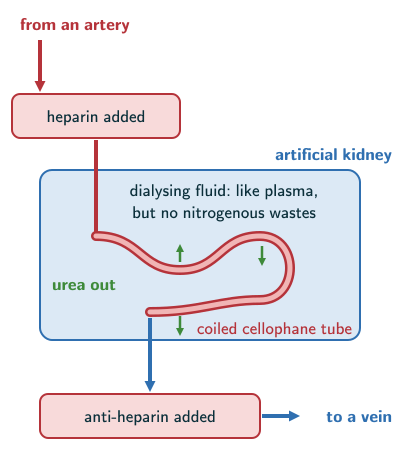
- Blood is drained from a convenient artery, and an anticoagulant such as heparin is added (see coagulation).
- It is pumped into a dialysing unit called the artificial kidney, which contains a coiled cellophane tube surrounded by dialysing fluid.
- The dialysing fluid has the same composition as plasma, except that it has no nitrogenous wastes.
- The porous cellophane membrane lets molecules pass according to their concentration gradient. Since the dialysing fluid has no nitrogenous wastes, these move freely out of the blood, clearing it.
- The cleared blood is pumped back into the body through a vein, after anti-heparin is added.
NCERT calls the method a boon for thousands of uraemic patients all over the world (page 214). Beyond the NCERT text, the US National Institute of Diabetes and Digestive and Kidney Diseases describes haemodialysis as “a treatment to filter wastes and water from your blood, as your kidneys did when they were healthy”. Today the blood leaves and returns through a vascular access, which may be an arteriovenous (AV) fistula, an AV graft or a catheter, and in the filter the dialysis solution flows the opposite way to the blood, on the other side of thin hollow fibres, taking up the wastes (NIDDK, Hemodialysis; public domain). The diagram below shows NCERT’s textbook model.
Kidney transplantation
- A functioning kidney from a donor, preferably a close relative, is transplanted, to minimise the chance of rejection by the immune system of the host. Modern clinical procedures have increased the success rate of this complicated technique (NCERT page 214). Beyond the NCERT text: a relative’s kidney is more likely to be a good tissue match, but the donor can also be a spouse, a friend or someone who has recently died; the team tests the donor’s blood against the patient’s (cross-matching), and the patient takes medicines every day so that the immune system does not reject the new kidney (NIDDK, Kidney Transplant; public domain).
- NCERT calls transplantation “the ultimate method in the correction of acute renal failures (kidney failure)” (page 214); use NCERT’s words in NCERT-based answers. Beyond the NCERT text: NIDDK notes that some children with acute kidney injury need dialysis “for a short time while their kidneys recover” (NIDDK, Kidney Disease in Children). NIDDK describes a kidney transplant as “a treatment for kidney failure; it’s not a cure”, and notes that end-stage renal disease is “kidney failure that is treated by dialysis or kidney transplant” (NIDDK, Kidney Transplant; What Is Kidney Failure?).
Renal calculi and glomerulonephritis
- Renal calculi: a stone, or insoluble mass of crystallised salts (oxalates and others), formed within the kidney (NCERT page 214).
- Glomerulonephritis: inflammation of the glomeruli of the kidney (page 214).
Solved examples
Example 1: Dialysing fluid (NCERT Exercise 12c)
Dialysis fluid contains all the constituents as in plasma except ___.
Answer: the nitrogenous wastes (NCERT pages 213–214).
Example 2: Why do wastes leave the blood?
In haemodialysis, why do urea and other nitrogenous wastes move out of the blood while the other constituents of plasma largely stay?
Answer: the porous cellophane membrane lets molecules pass according to their concentration gradient. As the nitrogenous wastes are absent from the dialysing fluid, which otherwise has the same composition as plasma, they move freely out of the blood (NCERT pages 213–214); in this model the other constituents, at the same concentration on both sides, have no gradient to drive them out (reasoned from NCERT pages 213–214). Beyond the NCERT text: NIDDK adds that haemodialysis also helps balance minerals such as potassium, sodium and calcium in the blood (NIDDK, Hemodialysis; public domain).
Example 3: Heparin and anti-heparin
Why is heparin added to the blood before dialysis, and anti-heparin before it returns?
Answer: heparin is an anticoagulant (NCERT page 213), so it keeps the blood from clotting in the dialysing unit; anti-heparin is added before the cleared blood is pumped back into a vein (page 214), so that the blood returned to the body can clot normally again (our reasoning).
Example 4: Name the disorder
Name: (a) urea accumulated in the blood; (b) a stone of crystallised salts in the kidney; (c) inflammation of the glomeruli.
Answer: (a) uraemia; (b) renal calculi; (c) glomerulonephritis (NCERT pages 213–214).
Common mistakes to avoid
Common mistake
Swapping NCERT’s artery and vein
NCERT drains the blood from a convenient artery and returns the cleared blood through a vein (NCERT pages 213–214); keep that order in an NCERT-based answer. Beyond the NCERT text: in practice the access may be an AV fistula, an artery joined to a vein so that the vein widens to take the needles, an AV graft, or a venous catheter, a tube placed in a vein (NIDDK, Hemodialysis; public domain).
Common mistake
Putting nitrogenous wastes in the dialysing fluid
The dialysing fluid is like plasma but without the nitrogenous wastes; that absence is what draws them out of the blood (NCERT pages 213–214).
Common mistake
Calling glomerulonephritis a kidney stone
Glomerulonephritis is inflammation of the glomeruli; a kidney stone is a renal calculus (NCERT page 214).
Quick revision summary
- Uraemia: urea accumulates in the blood when the kidneys malfunction; it is harmful and may lead to kidney failure (NCERT). Beyond the NCERT text: in medical usage uraemia is the illness of retained wastes, usually the result of kidney failure, and azotaemia the raised blood urea and creatinine (NLM MeSH).
- Haemodialysis: blood from an artery, with heparin, passes through a cellophane tube in dialysing fluid (plasma without nitrogenous wastes); wastes diffuse out down their gradient; anti-heparin is added and the blood returns through a vein (NCERT).
- Kidney transplantation: a functioning kidney from a donor, preferably a close relative, to minimise rejection; NCERT calls it the ultimate method for acute renal failures (NCERT). Beyond the NCERT text: it is a treatment for kidney failure, not a cure, and anti-rejection medicines are taken every day (NIDDK).
- Renal calculi are stones of crystallised salts such as oxalates; glomerulonephritis is inflammation of the glomeruli.
Formula sheet
- uraemia: urea accumulates in blood
- haemodialysis: artery → heparin → cellophane tube in dialysing fluid → anti-heparin → vein
- dialysing fluid = plasma − nitrogenous wastes
- renal calculi: crystallised salts (oxalates); glomerulonephritis: inflamed glomeruli
Questions students ask
What is the difference between haemodialysis and peritoneal dialysis?
Haemodialysis cleans the blood outside the body, in an artificial kidney, while peritoneal dialysis, which NCERT does not describe, cleans it inside the body, using the lining of the abdomen as the filter (NIDDK, Peritoneal Dialysis). In NCERT’s haemodialysis, the blood is pumped through a coiled cellophane tube surrounded by dialysing fluid in a dialysing unit (NCERT pages 213–214). In peritoneal dialysis, beyond the NCERT text, a solution of water, salt and other additives flows through a catheter into the belly, stays a few hours while wastes pass into it from the blood, and is then drained (NIDDK, Peritoneal Dialysis).
How is an artificial kidney different from a natural kidney?
A dialyser does only part of a natural kidney’s work: beyond the NCERT text, NIDDK says that haemodialysis removes wastes along with extra salt and water but “can replace part, but not all, of your kidney function” (NIDDK, Hemodialysis; public domain). A natural kidney also reabsorbs and secretes: its tubular secretion of H, K and ammonia keeps the ionic and acid–base balance of body fluids, and its juxtaglomerular cells release renin (NCERT page 209) and the hormone erythropoietin (NCERT Chapter 19, page 247). NCERT’s artificial kidney, by contrast, works only by letting molecules cross a porous cellophane membrane down their concentration gradient (pages 213–214).
Is nephritis in the NEET syllabus the same as NCERT’s glomerulonephritis?
Nephritis, the term in the NEET (UG) 2026 syllabus, is wider than NCERT’s glomerulonephritis: beyond the NCERT text, nephritis is inflammation of any part of the kidney (MeSH, “Nephritis”), while glomerulonephritis, the one kind NCERT names, is inflammation of the glomeruli of the kidney (NCERT page 214). The syllabus lists “Disorders; Uraemia, Renal failure, Renal calculi, Nephritis; Dialysis and artificial kidney.” in Unit 5, so learn NCERT’s glomerulonephritis line for it. Beyond the NCERT text, glomerulonephritis usually leads to blood and protein in the urine, high blood pressure and failing kidney function (MeSH, “Glomerulonephritis”).
Why do kidney stones form?
Kidney stones, which NCERT calls renal calculi, form when certain minerals reach high levels in the urine: beyond the NCERT text, NIDDK says they are caused by high levels of calcium, oxalate and phosphorus in the urine, minerals that are normally found in urine and do no harm at low levels (NIDDK, Kidney Stones). NCERT describes the result as a stone of crystallised salts formed within the kidney (page 214), and NIDDK adds that calcium oxalate stones are more common than calcium phosphate stones (NIDDK, Kidney Stones).
What is the difference between uraemia and azotaemia?
Uraemia, as NCERT defines it, is the accumulation of urea in the blood when the kidneys malfunction (page 213); azotaemia, a term from beyond the NCERT text, is a raised level of blood urea nitrogen and creatinine, a biochemical finding that is called uraemia once it comes with a set of clinical signs (MeSH, “Azotemia”). The same MeSH note adds that azotaemia can be caused by kidney diseases or by disorders outside the kidney, so a raised blood urea does not by itself show kidney failure (our reading). For NEET, give NCERT’s definition; azotaemia is in neither the NCERT text nor the NEET (UG) 2026 syllabus.
Practice questions
Try each question first, then open the answer to check your working.
-
Q1. What is the dialysing unit used in haemodialysis called?
Show answerHide answer
The artificial kidney (NCERT page 213).
-
Q2. Why is a donor kidney preferably taken from a close relative?
Show answerHide answer
To minimise its chances of rejection by the immune system of the host (NCERT page 214).
-
Q3. What are renal calculi made of?
Show answerHide answer
Insoluble masses of crystallised salts, such as oxalates, formed within the kidney (NCERT page 214).