Counter current mechanism and urine concentration
NCERT Class 11 Biology Chapter 16 Section 16.4
Quick answer
Opposite flows in Henle’s loop and the vasa recta help build and preserve a medullary gradient, mainly from NaCl and urea. With ADH increasing collecting-duct water permeability, water returns to the body and urine becomes concentrated. NCERT illustrates a gradient from about 300 to 1200 mOsmol/L.
With your textbook
NCERT Biology (Class 11), Chapter 16 “Excretory Products and their Elimination”, Section 16.4 “Mechanism of Concentration of the Filtrate”, pages 210–212.
Open the official NCERT chapter (PDF, 1.8 MB, ncert.nic.in) (opens in a new tab)
Checked against the 2026-27 reprint on .
Counter current mechanism
Counter current mechanism
NCERT opens the section with what the mechanism achieves:
Mammals have the ability to produce a concentrated urine.
NCERT Biology (Class 11), Section 16.4, page 210
Henle’s loop and the vasa recta play a significant role in this. The transport of substances made possible by their special arrangement is called the counter current mechanism (pages 210–211).
In plain words: the loop and the blood vessel beside it run down into the medulla and back up, side by side, with flows in opposite directions. Salt leaves the rising limb on the way up, actively or passively (NCERT page 209), and keeps the deep part of the kidney very salty. When ADH makes the collecting duct water-permeable, water moves into the concentrated interstitium and is returned to the circulation, so urine becomes more concentrated.
Henle’s loop and vasa recta
- The filtrate in the two limbs of Henle’s loop flows in opposite directions, and so forms a counter current (NCERT page 210).
- The two limbs differ. The descending limb is permeable to water but almost impermeable to electrolytes, so the filtrate is concentrated as it moves down; the ascending limb is impermeable to water but passes electrolytes, so the filtrate is diluted as it moves up (NCERT page 209). The NCERT Summary puts it in one line: the filtrate “gets concentrated as it moves down the descending limb but is diluted by the ascending limb” (page 215).
- The blood in the two limbs of the vasa recta also flows in a counter current pattern (pages 210–211).
- The closeness of Henle’s loop and the vasa recta, and the counter currents in them, help maintain an increasing osmolarity towards the inner medullary interstitium (page 211).
- The vasa recta is the U-shaped vessel that runs parallel to Henle’s loop; it is absent or highly reduced in cortical nephrons (page 208). NCERT credits this ability to concentrate urine to mammals (page 210).
Medullary osmolarity gradient
- NCERT’s concentrating-kidney model has an interstitial osmolarity rising from 300 mOsmol L in the cortex to about 1200 mOsmol L in the inner medulla (NCERT page 211).
- With sufficient ADH-dependent water permeability, the gradient helps water pass out of the collecting tubule, which concentrates the filtrate (urine) (page 212).
- Human kidneys can produce urine nearly four times as concentrated as the initial filtrate (page 212): 1200 ÷ 300 = 4.
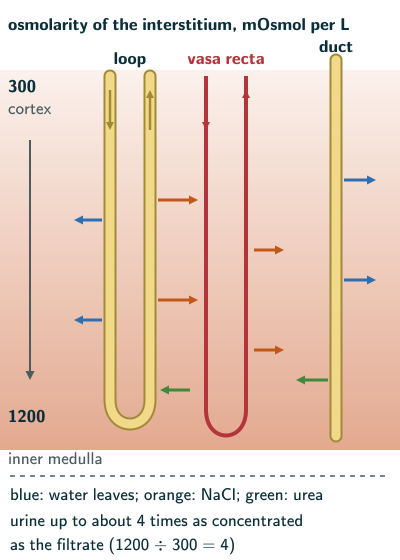
NaCl and urea in the interstitium
The gradient is mainly caused by NaCl and urea (NCERT page 211):
- NaCl is transported out by the ascending limb of Henle’s loop and is exchanged with the descending limb of the vasa recta.
- The ascending portion of the vasa recta returns the NaCl to the interstitium.
- Similarly, small amounts of urea enter the thin segment of the ascending limb of Henle’s loop, and the urea is transported back to the interstitium by the collecting tubule. (The collecting duct allows small amounts of urea into the medullary interstitium to keep up its osmolarity, page 210.)
Exchange occurs through the interstitial fluid, not through a direct opening between tubule and blood-vessel lumens. As blood descends in the vasa recta it tends to gain solutes and lose water; as it ascends it tends to lose solutes and gain water. The vessels carry reabsorbed water away while limiting loss of the medullary solute gradient.
These movements, made possible by the special arrangement of Henle’s loop and the vasa recta, are the counter current mechanism, and they keep up the concentration gradient in the medullary interstitium (pages 211–212).
Solved examples
Example 1: The counter current mechanism (NCERT Exercise 4)
Give a brief account of the counter current mechanism.
Answer: the filtrate flows in opposite directions in the two limbs of Henle’s loop, and blood flows in opposite directions in the two limbs of the vasa recta. With the two lying close together, they keep the osmolarity of the medullary interstitium rising from 300 mOsmol L in the cortex to about 1200 mOsmol L in the inner medulla. The gradient is caused mainly by NaCl, which leaves the ascending limb of Henle’s loop, is exchanged with the descending limb of the vasa recta and is returned to the interstitium by its ascending limb, and by urea, which enters the thin ascending limb and is returned to the interstitium by the collecting tubule. With adequate ADH, the gradient lets water pass out of the collecting tubule, so the urine is concentrated, up to about four times the filtrate (NCERT pages 210–212).
Example 2: How many times as concentrated?
The filtrate starts at the osmolarity of the cortex, and the inner medulla reaches about 1200 mOsmol L. How many times as concentrated can the urine become?
Answer: 1200 ÷ 300 = 4, matching NCERT’s “nearly four times” (page 212).
Example 3: Which vessel?
Which part of the vasa recta takes up NaCl from the interstitium, and which part returns it?
Answer: the descending limb of the vasa recta takes up the NaCl that leaves the ascending limb of Henle’s loop; the ascending portion of the vasa recta returns it to the interstitium (NCERT page 211).
Common mistakes to avoid
Common mistake
Making the gradient fall with depth
The osmolarity rises from the cortex (300 mOsmol L) to the inner medulla (about 1200 mOsmol L) (NCERT page 211).
Common mistake
Naming only NaCl
The gradient is caused mainly by NaCl and urea (NCERT page 211).
Common mistake
Forgetting the vasa recta
The counter current works in both Henle’s loop and the vasa recta; the two lie close together, with opposite flows in each pair of limbs (NCERT pages 210–211).
Quick revision summary
- Henle’s loop and the vasa recta each carry fluid down and back up in opposite directions: counter currents.
- Their closeness keeps the osmolarity of the medullary interstitium rising from 300 mOsmol L (cortex) to about 1200 mOsmol L (inner medulla).
- NaCl leaves the ascending limb, passes into the descending vasa recta and is returned by the ascending vasa recta; urea enters the thin ascending limb and is returned by the collecting tubule.
- With ADH making the duct water-permeable, the gradient draws water out of the collecting tubule, making urine up to about four times as concentrated as the filtrate.
Formula sheet
- counter current: opposite flows in the two limbs of Henle’s loop and of the vasa recta
- medullary gradient: 300 → about 1200 mOsmol L
- concentration factor: 1200 ÷ 300 = 4
- gradient made mainly by NaCl and urea
Questions students ask
What is the difference between a countercurrent multiplier and a countercurrent exchanger?
In the textbook model, beyond the NCERT text, Henle’s loop is the countercurrent multiplier and the vasa recta the countercurrent exchanger: the loop builds the medullary gradient, and the vasa recta keeps the blood flow from washing it away. The multiplier rests on active transport of salt out of the ascending limb, so salt builds up towards the bend; the exchanger is a passive swap of solutes between the descending and ascending vasa recta (Kriz, Kaissling and Le Hir, Pflügers Archiv, 2026). That 2026 paper proposes an alternative account based on salt transport and exchange; it should be identified as a research proposal, not a replacement consensus. For school work, learn the conventional loop-building/vasa-recta-preserving distinction alongside NCERT’s account (page 211).
Why is the counter current mechanism important?
The counter current mechanism is important because it lets the kidney conserve water by producing a concentrated urine: NCERT’s Summary calls the concentrating of the filtrate “an excellent mechanism of conservation of water” (page 215). The mechanism maintains a concentration gradient in the medullary interstitium, and that gradient allows an easy passage of water out of the collecting tubule, so the water returns to the body instead of leaving in the urine (NCERT pages 211–212). NCERT credits this ability to produce a concentrated urine to mammals (page 210).
Can the kidney make concentrated urine without ADH?
The kidney cannot make a fully concentrated urine without ADH, because ADH facilitates water reabsorption from the latter parts of the tubule (NCERT page 212), where the medullary gradient draws water out of the collecting tubule (pages 211–212). Beyond the NCERT text, vasopressin (ADH) acts on the collecting ducts by moving aquaporin 2, a water-channel protein, into the cell membrane facing the filtrate (MeSH, “Aquaporin 2”). So the counter current mechanism builds the gradient and ADH decides how much water is drawn across it; too little ADH causes diabetes insipidus.
Is the counter current mechanism in the NEET (UG) 2026 syllabus?
Yes, the counter current mechanism is in the NEET (UG) 2026 syllabus, though not by name: Unit 5, Human Physiology, lists “Urine formation, Osmoregulation” under “Excretory products and their elimination”, and NCERT teaches how the filtrate is concentrated in Section 16.4, “Mechanism of Concentration of the Filtrate” (pages 210–212). NCERT’s own Exercise 4 asks for a brief account of the counter current mechanism (page 215), so learn the opposite flows, the 300 to 1200 mOsmol L gradient and the roles of NaCl and urea.
Practice questions
Try each question first, then open the answer to check your working.
-
Q1. What is the osmolarity of the interstitium in the cortex, and in the inner medulla?
Show answerHide answer
300 mOsmol L in the cortex and about 1200 mOsmol L in the inner medulla (NCERT page 211).
-
Q2. Which two substances mainly cause the medullary gradient?
Show answerHide answer
NaCl and urea (NCERT page 211).
-
Q3. Which tube loses water because of the gradient, making the urine concentrated?
Show answerHide answer
The collecting tubule (collecting duct), into which the DCTs of many nephrons open (NCERT pages 208 and 212).