Micturition and the composition of urine
NCERT Class 11 Biology Chapter 16 Section 16.6
Quick answer
Micturition is bladder emptying through a coordinated reflex, normally modulated voluntarily after toilet training. Bladder muscle contracts as the outlet relaxes. NCERT gives typical daily urine of 1–1.5 litres and pH near 6; composition varies, and glucose or ketones alone do not diagnose diabetes.
With your textbook
NCERT Biology (Class 11), Chapter 16 “Excretory Products and their Elimination”, Section 16.6 “Micturition”, pages 212–213.
Open the official NCERT chapter (PDF, 1.8 MB, ncert.nic.in) (opens in a new tab)
Checked against the 2026-27 reprint on .
Micturition
Micturition
Urine made by the nephrons is carried to the urinary bladder and stored there under reflex and, in a healthy toilet-trained person, voluntary control; the central nervous system (CNS) coordinates emptying (NCERT Section 16.6, page 212). NCERT defines the release:
The process of release of urine is called micturition and the neural mechanisms causing it is called the micturition reflex.
NCERT Biology (Class 11), Section 16.6, page 213
In plain words: the bladder is a stretchy storage bag. As it fills, its walls stretch and sensors tell the brain and spinal cord; when the time is right, they order the bladder wall to squeeze and the ring of muscle at its outlet to open.
Micturition reflex
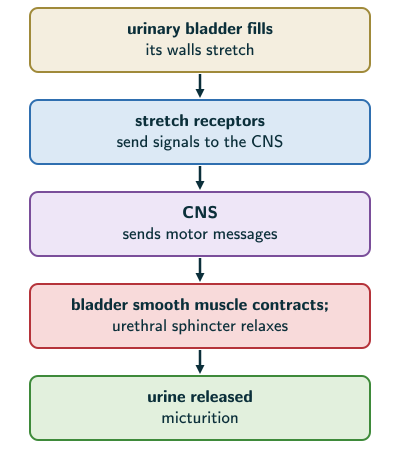
NCERT describes the reflex step by step (pages 212–213):
- The signal is started by the stretching of the urinary bladder as it fills with urine.
- Stretch receptors on the bladder walls send signals to the CNS.
- The CNS passes on motor messages that start the contraction of the smooth muscles of the bladder and, at the same time, the relaxation of the urethral sphincter.
- The urine is released.
The reflex is modulated by higher brain centres. The external urethral sphincter is skeletal muscle under somatic control; coordinated emptying also depends on autonomic activity and relaxation of the outlet. Infants and people with some neurological injuries can empty reflexly without normal voluntary control (Fowler and colleagues, “The neural control of micturition”, 2008).
The bladder wall’s smooth muscle is the visceral muscle found in the walls of hollow organs.
Composition of urine
- An adult human excretes, on average, 1 to 1.5 litres of urine a day (NCERT page 213).
- Urine is a light yellow, watery fluid that is slightly acidic (pH 6.0) and has a characteristic odour (page 213).
- On average, 25–30 g of urea is excreted a day (page 213).
- Various conditions can change the characteristics of urine, and urine analysis helps in the clinical diagnosis of many metabolic disorders and of kidney malfunction (page 213).
Glycosuria and ketonuria
- Glycosuria: the presence of glucose in urine (NCERT page 213).
- Ketonuria: the presence of ketone bodies in urine (page 213).
- NCERT associates these findings with diabetes mellitus (page 213), but they are clues, not a diagnosis. Glycosuria can also follow altered renal glucose transport; ketonuria can occur during fasting or carbohydrate restriction. Diabetes is assessed with blood-based criteria and clinical context (MedlinePlus, “Glucose in Urine Test” and “Ketones in Urine”).
Solved examples
Example 1: Micturition (NCERT Exercise 6)
Explain micturition.
Answer: urine is stored in the urinary bladder until the CNS gives a voluntary signal. As the bladder fills, it stretches; stretch receptors on its walls signal the CNS, which sends motor messages that contract the smooth muscles of the bladder and relax the urethral sphincter at the same time, so the urine is released. This release is micturition, and the neural mechanism behind it is the micturition reflex (NCERT pages 212–213).
Example 2: True or false? (NCERT Exercise 3a)
Micturition is carried out by a reflex.
Answer: true: the neural mechanisms causing micturition are called the micturition reflex (NCERT page 213).
Example 3: Urea a day (NCERT Exercise 12d)
A healthy adult human excretes, on average, ___ g of urea a day.
Answer: 25–30 g (NCERT page 213).
Example 4: Urea per litre
Using NCERT’s averages, 25–30 g of urea in 1 to 1.5 litres of urine a day, what is the range of urea per litre?
Answer: the lowest value is 25 ÷ 1.5 ≈ 16.7 g per litre (least urea, most urine); the highest is 30 ÷ 1 = 30 g per litre (most urea, least urine) (from NCERT page 213). This is an illustrative calculation from the stated averages, not a laboratory reference interval.
Example 5: Reading a report
A urine test shows glucose and ketone bodies. What are these findings called, and what do they suggest?
Answer: glycosuria and ketonuria. They can suggest diabetes mellitus in the appropriate context, as NCERT states (page 213), but other causes exist and a urine finding alone does not diagnose diabetes.
Common mistakes to avoid
Common mistake
Saying micturition is purely automatic
In a healthy toilet-trained person, voluntary control modulates the reflex. Micturition is neither purely voluntary in every person nor merely automatic in all circumstances (NCERT pages 212–213; Fowler and colleagues, 2008).
Common mistake
Contracting the sphincter
In micturition the bladder’s smooth muscles contract while the urethral sphincter relaxes (NCERT page 213).
Common mistake
Calling urine alkaline
Normal urine is slightly acidic, about pH 6.0 (NCERT page 213).
Quick revision summary
- Urine is stored in the bladder; the CNS coordinates a reflex that is normally under voluntary modulation after toilet training.
- Micturition reflex: bladder stretches → stretch receptors signal the CNS → motor messages contract the bladder’s smooth muscles and relax the urethral sphincter → urine released.
- An adult passes 1 to 1.5 litres of urine a day: light yellow, watery, slightly acidic (pH 6.0), with 25–30 g of urea a day.
- Glycosuria and ketonuria can accompany diabetes mellitus, but are not specific diagnostic tests.
Formula sheet
- reflex: stretch → stretch receptors → CNS → bladder contracts + sphincter relaxes
- urine: 1 to 1.5 L a day, pH about 6.0
- urea: 25–30 g a day
- glycosuria and ketonuria: possible diabetes clues, not specific diagnoses
Questions students ask
Why does glucose appear in the urine in diabetes mellitus?
Glucose appears in the urine in diabetes mellitus when the filtered glucose load exceeds tubular reabsorptive capacity. Diabetes mellitus is characterised by persistent hyperglycaemia and can be associated with urinary glucose loss (NCERT Chapter 19, page 246), although filtered glucose is normally reabsorbed actively (NCERT page 209). Beyond the NCERT text, MedlinePlus names too much glucose in the blood as a cause of glucose in urine (MedlinePlus, Glucose in Urine Test). Glycosuria can also occur with normal blood glucose, from an inherited defect of glucose reabsorption by the proximal tubules (MeSH, “Glycosuria, Renal”).
What is the difference between micturition and diuresis?
Micturition is the release of urine from the urinary bladder, while diuresis is the loss of water through urine, that is, the making of more urine by the kidneys: NCERT defines micturition as the process of release of urine (Section 16.6, page 213), and says ADH reduces the loss of water through urine (diuresis) (Chapter 19, page 242). For example, an increase in body fluid volume suppresses ADH release, so more urine is made (Chapter 16, page 212); while micturition is the act of passing whatever urine has collected in the bladder, set off when the stretched bladder signals the CNS (pages 212–213). Urination is simply the everyday word for micturition (MeSH, “Urination”).
Why is normal urine slightly acidic?
Urine is slightly acidic because the kidney uses it to remove acid from the body: to keep the pH of the body fluids and blood steady, the tubules secrete H and ammonia into the filtrate and reabsorb HCO from it (NCERT pages 209–210; see functions of the tubules). The hydrogen ions moved out of the blood end up in the urine, so the urine turns a little acidic while the blood’s pH is held steady. This is reasoned from NCERT’s two sections; NCERT itself states only that urine is slightly acidic (page 213).
Does normal urine contain protein?
In NCERT’s account, the filtrate is nearly free of protein: blood is filtered so finely that almost all the constituents of the plasma except the proteins pass into Bowman’s capsule (NCERT page 208). Beyond the NCERT text, normal urine contains very little protein, and a large amount may mean a kidney problem, though levels can also be high for a short time after strenuous exercise, with dehydration or stress, or in pregnancy (MedlinePlus, Protein in Urine test). So NCERT’s simplification describes the filtrate, not what a urine test finds (our reading).
Practice questions
Try each question first, then open the answer to check your working.
-
Q1. What starts the signal for micturition?
Show answerHide answer
The stretching of the urinary bladder as it fills with urine (NCERT page 212).
-
Q2. What is the pH of normal human urine, according to NCERT?
Show answerHide answer
About 6.0; urine is slightly acidic (NCERT page 213).
-
Q3. What is ketonuria?
Show answerHide answer
The presence of ketone bodies in urine (NCERT page 213).