Human endocrine system: glands and hormones
NCERT Class 11 Biology Chapter 19 Section 19.2
Quick answer
The endocrine system includes glands and dispersed hormone-producing cells that regulate growth, metabolism, reproduction and fluid balance. The hypothalamus and pituitary coordinate several glands, while other glands respond directly to changes such as blood glucose or calcium.
With your textbook
NCERT Biology (Class 11), Chapter 19 “Chemical Coordination and Integration”, Section 19.2 “Human Endocrine System”, pages 240–247.
Open the official NCERT chapter (PDF, 2.1 MB, ncert.nic.in) (opens in a new tab)
Checked against the 2026-27 reprint on .
Human endocrine system
Endocrine system
NCERT defines the system as a whole:
The endocrine glands and hormone producing diffused tissues/cells located in different parts of our body constitute the endocrine system.
NCERT Biology (Class 11), Section 19.2, page 240
In plain words: the endocrine system is a set of small chemical factories spread through the body. A control centre at the base of the brain directs a master gland just below it, and that gland in turn directs several others. Not every gland is under pituitary control: blood calcium and glucose directly influence parathyroid and pancreatic secretion. Each gland’s hormones adjust something specific, such as growth, blood sugar, calcium, salt and water, or the response to danger.
The glands
- The organised endocrine bodies are the pituitary, pineal, thyroid, adrenal, pancreas, parathyroid, thymus and gonads (testis in males, ovary in females) (NCERT page 240).
- Some other organs, the gastrointestinal tract, liver, kidney and heart, also produce hormones (page 240; see hormones of the heart, kidney and gut).
- NCERT describes the major glands together with the hypothalamus (page 240).
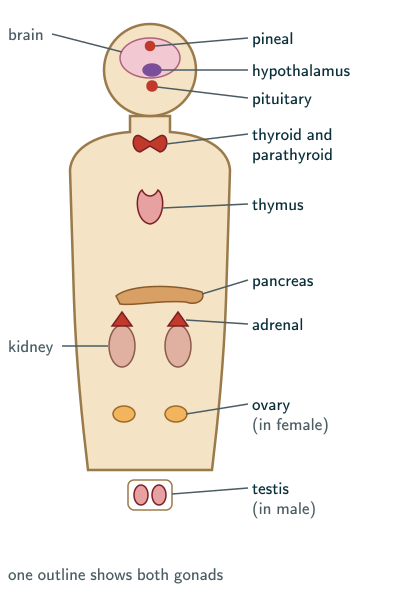
The hypothalamus
NCERT Section 19.2.1 (page 240):
- The hypothalamus is the basal part of the diencephalon of the forebrain and regulates a wide spectrum of body functions.
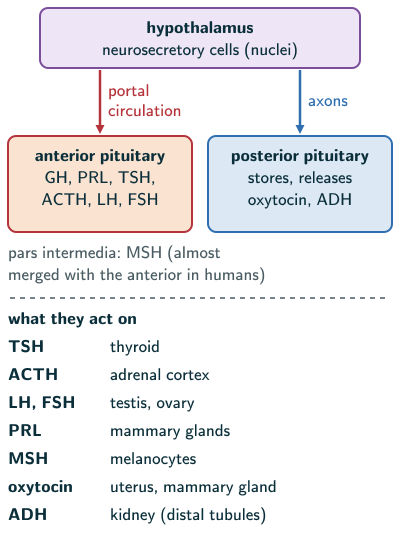
- It has groups of neurosecretory cells, called nuclei, that make hormones regulating the synthesis and secretion of pituitary hormones.
- Its hormones regulating the anterior pituitary are of two types: releasing hormones, which stimulate pituitary secretion, and inhibiting hormones, which inhibit it. For example, GnRH (gonadotrophin releasing hormone) stimulates the release of gonadotrophins, while somatostatin inhibits the release of growth hormone.
- These hormones pass down the axons of hypothalamic neurons and reach the pituitary through a portal circulatory system, regulating the anterior pituitary. The posterior pituitary is under the direct neural regulation of the hypothalamus.
The pituitary gland
NCERT Section 19.2.2 (pages 241–242):
- It sits in a bony cavity, the sella turcica, and is attached to the hypothalamus by a stalk. NCERT prints “sella tursica” (page 241); the standard spelling is sella turcica (Wikipedia, “Sella turcica”).
- It has an adenohypophysis (pars distalis and pars intermedia) and a neurohypophysis (pars nervosa).
- The pars distalis (anterior pituitary) makes GH, PRL, TSH, ACTH, LH and FSH.
- The pars intermedia secretes only MSH; in humans it is almost merged with the pars distalis.
- The neurohypophysis (posterior pituitary) stores and releases oxytocin and vasopressin, which are made in the hypothalamus and carried down axons to it.
What each hormone does (pages 241–242):
- GH: NCERT describes it through its disorders, below (page 241); beyond the NCERT text, NIDDK notes that GH controls the physical growth of the body (NIDDK, Acromegaly).
- Prolactin: growth of the mammary glands and formation of milk in them.
- TSH: synthesis and secretion of thyroid hormones.
- ACTH: synthesis and secretion of glucocorticoids from the adrenal cortex.
- LH and FSH (gonadotrophins): in males, LH stimulates androgen secretion from the testis, and FSH with androgens regulates spermatogenesis. In females, LH induces ovulation of mature (Graafian) follicles and maintains the corpus luteum, and FSH stimulates the growth of ovarian follicles.
- MSH: acts on melanocytes and regulates skin pigmentation.
- Oxytocin: contraction of smooth muscles; in females, vigorous uterine contraction at childbirth and milk ejection.
- Vasopressin (ADH): acts mainly at the kidney and increases water reabsorption in the late distal nephron and collecting ducts, so less water is lost in urine; hence its other name, anti-diuretic hormone (page 242). NCERT’s sentence here says “water and electrolytes”, but its Chapter 16 says ADH facilitates water reabsorption from the latter parts of the tubule (page 212), and NIDDK describes vasopressin as signalling the kidneys to conserve fluid (NIDDK, Diabetes Insipidus). Learn ADH as the water-conserving hormone (see regulation of kidney function).
Dwarfism, gigantism and acromegaly
- Over-secretion of GH causes abnormal growth of the body: gigantism (NCERT page 241). Beyond the NCERT text, NIDDK notes that excess GH causes gigantism rather than acromegaly when it begins in childhood, before the growth plates of the bones close at the end of puberty (NIDDK, Acromegaly).
- Low secretion of GH results in stunted growth, pituitary dwarfism (page 241). Beyond the NCERT text, the NCI SEER Training Modules (“Pituitary & Pineal Glands”, public domain) say a child with too little growth hormone may become a pituitary dwarf of normal proportions but small stature.
- Excess GH in adults, especially in middle age, causes severe disfigurement, especially of the face: acromegaly. It can lead to serious complications and premature death if unchecked, and is hard to diagnose early, often going undetected for many years (page 241).
Diabetes insipidus
- An impairment in the synthesis or release of ADH reduces water conservation, producing large volumes of dilute urine: central diabetes insipidus (the form described by NCERT, page 242). Dehydration can occur if drinking does not replace the lost water. In nephrogenic diabetes insipidus, the kidneys respond poorly despite sufficient ADH (NIDDK).
- Beyond the NCERT text, MedlinePlus notes that diabetes insipidus causes frequent urination and great thirst, and that it is different from diabetes mellitus, which involves insulin and high blood sugar (MedlinePlus, Diabetes Insipidus).
The pineal gland
- On the dorsal side of the forebrain; it secretes melatonin (NCERT Section 19.2.3, page 242).
- Melatonin regulates the 24-hour (diurnal) rhythm, such as the sleep-wake cycle and body temperature, and also influences metabolism, pigmentation, the menstrual cycle and our defence capability (page 242).
Thyroid gland
NCERT Section 19.2.4 (pages 242–243):
- Two lobes, one on either side of the trachea, joined by a thin flap of connective tissue, the isthmus.
- Made of follicles and stromal tissue. The follicular cells make thyroxine (T, tetraiodothyronine) and triiodothyronine (T). Iodine is essential for their normal rate of synthesis.
- Thyroid hormones regulate the basal metabolic rate, support red blood cell formation, control the metabolism of carbohydrates, proteins and fats, and influence water and electrolyte balance.
- The thyroid also secretes a protein hormone, thyrocalcitonin (TCT), which regulates blood calcium. NCERT’s Summary adds that it does so by decreasing it (page 250).
Goitre, cretinism and exophthalmic goitre
- Goitre means enlargement of the thyroid gland. Deficiency of iodine in the diet results in hypothyroidism and goitre (NCERT page 242); an enlarged thyroid can also come with excess hormone, as in exophthalmic goitre, a form of hyperthyroidism (page 243).
- Hypothyroidism during pregnancy causes defective development and maturation of the growing baby, leading to stunted growth (cretinism), “mental retardation” (NCERT’s term; now called intellectual disability), low intelligence quotient, abnormal skin, deaf-mutism and so on. In adult women, hypothyroidism may make the menstrual cycle irregular (NCERT pages 242–243). Beyond the NCERT text, MedlinePlus Genetics (“Congenital hypothyroidism”, US National Library of Medicine) lists cretinism as another name for congenital hypothyroidism, and says that untreated it can lead to intellectual disability and slow growth, while infants whose treatment begins in the first two weeks after birth usually develop normally.
- Hyperthyroidism means excess synthesis and secretion of thyroid hormones. NCERT names cancer of the thyroid gland and the development of thyroid nodules as causes (page 243). Beyond the NCERT text, MedlinePlus lists Graves’ disease (an autoimmune disorder) as the most common cause, with thyroid nodules, which may become overactive, among the others; it does not list thyroid cancer (MedlinePlus, Hyperthyroidism). In an NCERT-based answer, give NCERT’s causes: cancer of the thyroid gland and thyroid nodules (page 243).
- Exophthalmic goitre is a form of hyperthyroidism, with an enlarged thyroid, protruding eyeballs, an increased basal metabolic rate and weight loss; it is also called Graves’ disease (page 243). NCERT prints “Exopthalmic”; write “exophthalmic”. Beyond the NCERT text: the signs vary from person to person; more than one in three people with Graves’ disease develop an eye disease, Graves’ ophthalmopathy, whose signs can include bulging eyes (NIDDK, Graves’ Disease, public domain).
Parathyroid gland
NCERT Section 19.2.5 (page 243):
- In humans, four parathyroid glands lie on the back of the thyroid, one pair in each of its two lobes (page 243). They secrete a peptide hormone, parathyroid hormone (PTH), whose secretion is regulated by circulating calcium levels.
- PTH raises blood Ca: it stimulates bone resorption (dissolution, demineralisation), increases Ca reabsorption by the renal tubules and increases Ca absorption from digested food (page 243). So PTH is a hypercalcemic hormone.
- Along with TCT, PTH plays a significant role in calcium balance in the body (page 243); NCERT’s Summary adds that TCT lowers blood calcium (page 250). Low calcium in the body fluid is linked to tetany (NCERT Chapter 17, page 227).
Thymus
NCERT Section 19.2.6 (page 243):
- A lobular gland between the lungs, behind the sternum, on the ventral side of the aorta; it has a major role in developing the immune system.
- It secretes peptide hormones, thymosins, which play a major role in the differentiation of T-lymphocytes, which provide cell-mediated immunity; thymosins also promote the production of antibodies to provide humoral immunity (page 243).
- The thymus degenerates in old individuals, so less thymosin is produced, and as a result the immune responses of old persons become weak (page 243). Beyond the NCERT text, Wikipedia’s article “Thymus” says the gland grows until puberty and then begins to shrink and become less active, a process called thymic involution (facts in our words).
Adrenal gland
NCERT Section 19.2.7 (pages 244–245): one pair, one above each kidney, each with a central adrenal medulla and an outer adrenal cortex.
- Adrenal medulla: adrenaline (epinephrine) and noradrenaline (norepinephrine), together the catecholamines. They are secreted rapidly under stress and in emergencies, so they are the emergency hormones or hormones of fight or flight. They increase alertness, pupillary dilation, piloerection and sweating, raise the heart rate, the strength of heart contraction and the rate of respiration (see adrenal medullary hormones), and stimulate fuel mobilisation, including glycogen breakdown (raising blood glucose) and lipolysis. This is NCERT’s combined fight-or-flight account: effects depend on receptor and tissue; sweating is chiefly driven by sympathetic cholinergic nerves rather than circulating catecholamines alone.
- Adrenal cortex: three layers, zona reticularis (inner), zona fasciculata (middle) and zona glomerulosa (outer). It secretes the corticoids:
- Glucocorticoids, chiefly cortisol, act on carbohydrate metabolism. They stimulate gluconeogenesis, lipolysis and proteolysis, inhibit cellular uptake and use of amino acids, help maintain the cardiovascular system and kidney functions, produce anti-inflammatory reactions and suppress the immune response; cortisol also stimulates RBC production.
- Mineralocorticoids, chiefly aldosterone, regulate water and electrolytes. Aldosterone promotes Na reabsorption and K secretion in the distal nephron, and also promotes H secretion. Sodium retention supports water retention, while water permeability also depends on ADH. NCERT includes phosphate in its sentence (page 245); the principal physiological pairing is sodium retention with potassium and hydrogen-ion excretion (Endotext, Hyperaldosteronism).
- Small amounts of androgenic steroids, which play a role in the growth of axillary (armpit), pubic and facial hair at puberty.
Addison’s disease
- Addison’s disease is primary adrenal insufficiency: damage to the adrenal cortex causes insufficient cortisol and sometimes aldosterone. Weakness and fatigue are among its effects (NCERT page 244; NIDDK). Secondary adrenal insufficiency has a different cause and is not termed Addison’s disease.
- Beyond the NCERT text, MedlinePlus says that a problem with the immune system usually causes Addison disease, and that its symptoms include weight loss, muscle weakness, fatigue, low blood pressure and patchy or dark skin (MedlinePlus, Addison Disease).
Pancreas
NCERT Section 19.2.8 (pages 245–246):
- A composite gland, both exocrine and endocrine. The endocrine part is the islets of Langerhans: about 1 to 2 million islets, only 1 to 2 per cent of the pancreatic tissue.
- α-cells secrete glucagon; β-cells secrete insulin. Both are peptide hormones.
- Glucagon acts mainly on liver cells (hepatocytes). It stimulates glycogenolysis and gluconeogenesis and increases hepatic glucose output, so it raises blood sugar: a hyperglycemic hormone.
- Insulin acts on liver, skeletal muscle and adipose tissue to lower blood glucose. It increases glucose uptake through GLUT4 in muscle and adipose cells, promotes glycogenesis, and suppresses hepatic glucose production. Liver-cell glucose entry through GLUT2 is not insulin-dependent; NCERT’s statement about uptake by hepatocytes is a simplification (NCBI Bookshelf, endocrine pancreas).
- “Hypoglycemic” here means that insulin lowers blood glucose. NCERT writes “(hypoglycemia)” for this normal effect (page 246), but beyond the NCERT text, MedlinePlus defines hypoglycemia as blood glucose that drops below what is healthy, for example as a side effect of insulin medicines (MedlinePlus, Hypoglycemia). In health, insulin and glucagon together keep glucose in its normal range (page 246).
- Glucose homeostasis is kept jointly by insulin and glucagon (page 246).
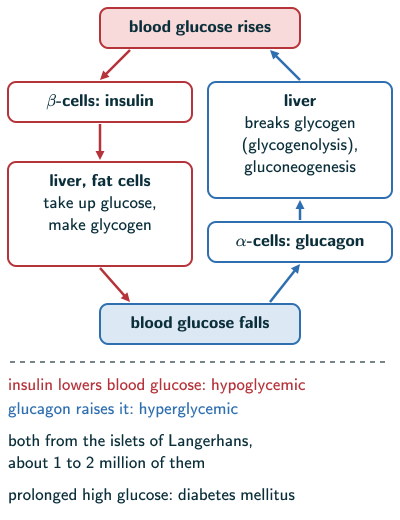
Diabetes mellitus
- Diabetes mellitus is characterised by persistent hyperglycemia caused by insufficient insulin secretion, impaired insulin action, or both. High blood glucose is a defining result of the disorder, not its sole cause. Glucose in urine may occur; excessive ketone production is a possible complication, not a feature of every case.
- NCERT’s Summary correctly gives insulin deficiency and/or insulin resistance (page 250). Type 1 diabetes requires insulin; type 2 management varies and does not always require insulin (NIDDK).
Testis
NCERT Section 19.2.9 (page 246):
- A pair, in the scrotal sac outside the abdomen; both a primary sex organ and an endocrine gland. It has seminiferous tubules and stromal (interstitial) tissue.
- The Leydig (interstitial) cells, in the spaces between the tubules, make the androgens, mainly testosterone.
- Androgens regulate the development, maturation and functions of the male accessory sex organs; stimulate muscular growth, facial and axillary hair and a lower-pitched voice; play a major role in spermatogenesis; influence libido through the CNS; behaviour also depends on social and other biological factors; and have anabolic effects on protein and carbohydrate metabolism.
Ovary
NCERT Section 19.2.10 (pages 246–247):
- A pair, located in the abdomen (page 246); the primary female sex organs. The ovary produces one ovum during each menstrual cycle (page 246): one in all, not one from each ovary, since NCERT Class 12 Biology says only one ovum is released per menstrual cycle (Chapter 2, page 39). The ovaries also produce two groups of steroid hormones, estrogens and progesterone (page 246).
- Estrogen is made mainly by the growing ovarian follicles. After ovulation, the ruptured follicle becomes the corpus luteum, which secretes mainly progesterone.
- Estrogens stimulate the growth and activities of the female secondary sex organs and the development of growing follicles, contribute to female secondary sex characters and mammary gland development, and regulate female sexual behaviour (page 247).
- Progesterone supports pregnancy. It also acts on the mammary glands and stimulates the formation of alveoli (sac-like structures which store milk) and milk secretion (page 247). Beyond the NCERT text, the US Office on Women’s Health says “The alveoli make milk in response to the hormone prolactin”, and that oxytocin makes small muscles in the breast contract and move the milk through the milk ducts (“Your Guide to Breastfeeding”, public domain).
Solved examples
Example 1: Hormones of each gland (NCERT Exercise 3a–i)
List the hormones secreted by (a) hypothalamus, (b) pituitary, (c) thyroid, (d) parathyroid, (e) adrenal, (f) pancreas, (g) testis, (h) ovary, (i) thymus.
Answer: (a) releasing and inhibiting hormones, such as GnRH and somatostatin; the hypothalamus also makes oxytocin and vasopressin, which the posterior pituitary stores and releases; (b) GH, PRL, TSH, ACTH, LH, FSH (pars distalis), MSH (pars intermedia), and oxytocin and vasopressin, stored and released by the pars nervosa; (c) T, T and thyrocalcitonin; (d) PTH; (e) adrenaline and noradrenaline (medulla), and glucocorticoids such as cortisol, mineralocorticoids such as aldosterone, and small amounts of androgens (cortex); (f) glucagon and insulin; (g) androgens, mainly testosterone; (h) estrogen and progesterone; (i) thymosins (NCERT pages 240–247).
Example 2: Target glands (NCERT Exercise 4)
Give the target of (a) hypothalamic hormones, (b) TSH, (c) ACTH, (d) LH and FSH, (e) MSH.
Answer: (a) the anterior pituitary for the releasing/inhibiting hormones in this exercise; oxytocin and ADH have other targets; (b) the thyroid; (c) the adrenal cortex; (d) the gonads, testis and ovary; (e) the melanocytes of the skin, which are cells rather than a gland (NCERT pages 240–242).
Example 3: PTH and thyroid hormones (NCERT Exercise 5a, b)
Write short notes on the functions of (a) parathyroid hormone, (b) thyroid hormones.
Answer: (a) PTH raises blood Ca: it stimulates bone resorption, Ca reabsorption by the renal tubules and Ca absorption from digested food, so it is hypercalcemic, and along with TCT it plays a significant role in calcium balance (NCERT page 243). (b) Thyroid hormones regulate the basal metabolic rate, support red blood cell formation, control carbohydrate, protein and fat metabolism and influence water and electrolyte balance (page 243); NCERT’s Summary adds the development and maturation of the central neural system and the menstrual cycle (page 250), which is why hypothyroidism during pregnancy causes cretinism (pages 242–243). Thyrocalcitonin regulates blood calcium (page 243).
Example 4: Thymosins, androgens, estrogens (NCERT Exercise 5c–e)
Write short notes on the functions of (c) thymosins, (d) androgens, (e) estrogens.
Answer: (c) Thymosins play a major role in T-lymphocyte differentiation for cell-mediated immunity and also promote antibody production for humoral immunity (NCERT page 243). (d) Androgens regulate the male accessory sex organs, muscular growth, facial and axillary hair, a lower-pitched voice, spermatogenesis, libido and anabolic metabolism (page 246); NCERT’s Summary adds erythropoiesis (page 250). (e) Estrogens stimulate the female secondary sex organs, growing follicles, female secondary sex characters and mammary gland development, and regulate female sexual behaviour (pages 246–247).
Example 5: Insulin and glucagon (NCERT Exercises 5f and 6a)
Write a short note on insulin and glucagon, and name a hyperglycemic and a hypoglycemic hormone.
Answer: both are peptide hormones of the islets of Langerhans. Glucagon (α-cells) acts on hepatocytes, stimulating glycogenolysis and gluconeogenesis, and raises blood sugar: it is hyperglycemic. Insulin (β-cells) promotes glucose uptake in skeletal muscle and adipose tissue, supports hepatic glycogen storage and suppresses hepatic glucose production, and lowers blood glucose: it is hypoglycemic. Together they keep glucose homeostasis (NCERT pages 245–246).
Example 6: Give examples (NCERT Exercise 6b–d, f)
Name (b) a hypercalcemic hormone, (c) the gonadotrophic hormones, (d) a progestational hormone, (f) an androgen and an estrogen.
Answer: (b) PTH (NCERT page 243); (c) LH and FSH (page 241); (d) progesterone (page 247); (f) androgen: testosterone (page 246); estrogen: estradiol, which NCERT lists among the steroid hormones (page 248).
Example 7: Which deficiency? (NCERT Exercise 7)
Which hormonal deficiency causes (a) diabetes mellitus, (b) goitre, (c) cretinism?
Answer: (a) insulin (deficiency and/or resistance; NCERT pages 246 and 250); (b) thyroid hormones, through hypothyroidism from iodine deficiency (page 242); (c) thyroid hormones, from hypothyroidism during pregnancy (pages 242–243). Beyond the NCERT text, infants with congenital hypothyroidism whose treatment begins in the first two weeks after birth usually develop normally (MedlinePlus Genetics, “Congenital hypothyroidism”).
Example 8: Match the following (NCERT Exercise 9)
Match (a) T, (b) PTH, (c) GnRH, (d) LH with (i) hypothalamus, (ii) thyroid, (iii) pituitary, (iv) parathyroid.
Answer: (a)–(ii), (b)–(iv), (c)–(i), (d)–(iii) (NCERT pages 240–243).
Common mistakes to avoid
Common mistake
Saying the posterior pituitary makes oxytocin and vasopressin
It stores and releases them; they are made in the hypothalamus and carried down axons (NCERT page 241). NCERT’s Summary says the pars nervosa “secretes two hormones” (page 250): read that as releases.
Common mistake
Mixing up diabetes insipidus and diabetes mellitus
Diabetes insipidus involves inadequate ADH action and loss of dilute urine; diabetes mellitus involves deficient insulin secretion and/or action and persistent hyperglycemia. Glucose in urine is not required in every case (NCERT pages 242, 246 and 250).
Common mistake
Letting PTH lower blood calcium
PTH raises blood Ca (hypercalcemic); thyrocalcitonin is the one that lowers it (NCERT pages 243 and 250).
Common mistake
Treating every goitre as too little thyroid hormone
Simple goitre from iodine deficiency comes with hypothyroidism (NCERT page 242); exophthalmic goitre (Graves’ disease) is a form of hyperthyroidism (page 243). Goitre means enlargement of the thyroid gland (NCERT page 242).
Common mistake
Putting cortisol in the adrenal medulla
The medulla secretes adrenaline and noradrenaline; cortisol and aldosterone come from the cortex (NCERT pages 244–245).
Quick revision summary
- Glands: hypothalamus, pituitary, pineal, thyroid, parathyroid, thymus, adrenal, pancreas, testis, ovary; the gut, liver, kidney and heart also make hormones.
- Hypothalamus: releasing and inhibiting hormones by portal circulation to the anterior pituitary; direct neural control of the posterior pituitary.
- Pituitary: pars distalis GH, PRL, TSH, ACTH, LH, FSH; pars intermedia MSH; pars nervosa stores oxytocin and vasopressin. GH excess gives gigantism or acromegaly, low GH secretion pituitary dwarfism; deficient ADH action causes diabetes insipidus.
- Pineal: melatonin, diurnal rhythms. Thyroid: T, T (metabolic rate), TCT (calcium); goitre, cretinism, exophthalmic goitre. Parathyroid: PTH raises calcium. Thymus: thymosins, T-lymphocytes.
- Adrenal medulla: catecholamines, fight or flight. Cortex: cortisol, aldosterone, androgens; Addison’s disease.
- Pancreas: glucagon raises and insulin lowers blood glucose; diabetes mellitus. Testis: androgens. Ovary: estrogen and progesterone.
Formula sheet
- anterior pituitary: GH, PRL, TSH, ACTH, LH, FSH; intermediate: MSH; posterior stores oxytocin, ADH
- GH: excess → gigantism (child), acromegaly (adult); low secretion → pituitary dwarfism
- calcium: PTH raises, TCT lowers
- glucose: glucagon raises (α-cells), insulin lowers (β-cells)
- adrenal: medulla → adrenaline, noradrenaline; cortex → cortisol, aldosterone
Questions students ask
Why is the pituitary gland called the master gland?
The pituitary gland is called the master gland because its hormones control several other endocrine glands as well as body growth: NCERT’s Summary says the pituitary hormones regulate the growth and development of somatic tissues and the activities of peripheral endocrine glands (page 250). Beyond the NCERT text, MedlinePlus calls it the master control gland and says its hormones influence growth and the work of other glands (MedlinePlus, Pituitary Disorders). It is not the top of the chain, though: hypothalamic releasing and inhibiting hormones regulate the synthesis and secretion of the pituitary’s own hormones (NCERT page 240).
Why does the posterior pituitary not make its own hormones?
The posterior pituitary does not make its own hormones because it is a store, not a factory: NCERT says the neurohypophysis stores and releases oxytocin and vasopressin, which are actually synthesised by the hypothalamus and transported axonally to it (page 241). Beyond the NCERT text, it is neural tissue, the far ends of axons whose cell bodies in hypothalamic nuclei make the two hormones, whereas the anterior pituitary is a glandular lobe that makes its own hormones (MeSH, “Pituitary Gland, Posterior” and “Pituitary Gland, Anterior”). So the anterior lobe answers to hypothalamic hormones arriving by a portal circulation, the posterior to direct neural regulation (NCERT page 240).
Why does iodine deficiency make the thyroid gland enlarge?
Iodine deficiency enlarges the thyroid because, beyond the NCERT text, the gland is driven to make hormones it cannot complete: with too little thyroid hormone the anterior pituitary secretes more TSH, which makes the thyroid grow as it tries, and fails, to make more hormone without iodine (NCI SEER Training Modules, Thyroid and Parathyroid Glands). NCERT gives the two ends of this chain: iodine is essential for the normal rate of thyroid hormone synthesis, so a diet short of iodine causes hypothyroidism and goitre (NCERT page 242). TSH is the pituitary hormone that “stimulates the synthesis and secretion of thyroid hormones from the thyroid gland” (page 241).
What is the difference between pituitary dwarfism and cretinism?
NCERT’s terms refer to different hormone deficiencies: pituitary dwarfism to low secretion of growth hormone (GH) by the pituitary, which stunts growth (page 241), and cretinism to hypothyroidism during pregnancy (pages 242–243). The thyroid deficiency harms more than growth: NCERT also lists effects on the growing baby’s intelligence, skin, hearing and speech (pages 242–243). Beyond the NCERT text, a child with too little GH may grow up small but normally proportioned (NCI SEER Training Modules, Pituitary and Pineal Glands).
What is the difference between glucose, glycogen and glucagon?
Glucose, glycogen and glucagon are a sugar, its store and a hormone: glucose is the sugar carried in the blood, glycogen is the polysaccharide of glucose that animals store (polysaccharides, NCERT Chapter 9, page 110), and glucagon is a peptide hormone secreted by the α-cells of the islets of Langerhans (NCERT Chapter 19, page 245). The three meet in the liver: glucagon acts mainly on liver cells and stimulates glycogenolysis, the breakdown of glycogen, which raises blood sugar (page 245), while insulin stimulates glycogenesis, the conversion of glucose to glycogen (page 246).
Which human hormone is called the stress hormone?
Cortisol, the main glucocorticoid of the adrenal cortex (NCERT page 245), is the human hormone sometimes called the stress hormone, a name from beyond the NCERT text: MedlinePlus says it helps the body respond to stress (MedlinePlus, Cortisol Test). NCERT links stress with the adrenal medulla too: its hormones, the catecholamines, are rapidly secreted in response to stress of any kind (page 244). In NCERT itself, the name stress hormone belongs to a plant growth regulator, abscisic acid, which increases the tolerance of plants to various kinds of stresses (NCERT Chapter 13, page 177).
How many endocrine glands are there in the human body?
There is no single useful total: some glands are paired, the parathyroids are four (NCERT page 243), and hormone-secreting cells also occur in other organs. NCERT lists eight organised gland categories—pituitary, pineal, thyroid, adrenal, pancreas, parathyroid, thymus and gonads—and describes the hypothalamus with them (page 240). Learn each source and hormone instead of adding these categories into a fixed gland count.
Practice questions
Try each question first, then open the answer to check your working.
-
Q1. Which hormone from the hypothalamus inhibits the release of growth hormone?
Show answerHide answer
Somatostatin (NCERT page 240).
-
Q2. Which cells of the testis make androgens?
Show answerHide answer
The Leydig (interstitial) cells, in the spaces between the seminiferous tubules (NCERT page 246).
-
Q3. What is the outermost layer of the adrenal cortex?
Show answerHide answer
The zona glomerulosa (NCERT page 245).