Gametogenesis
NCERT Class 12 Biology Chapter 2 Section 2.3
Quick answer
Gametogenesis forms haploid gametes. A primary spermatocyte normally gives four spermatids, whereas a primary oocyte retains most cytoplasm in one functional egg and produces polar bodies. Oogenesis begins before birth; the ovulated secondary oocyte is arrested in metaphase II and normally completes meiosis after fertilisation activates it.
With your textbook
NCERT Biology (Class 12), Chapter 2 “Human Reproduction”, Section 2.3 “Gametogenesis”, pages 31–33.
Open the official NCERT chapter (PDF, 64.5 MB, ncert.nic.in) (opens in a new tab)
Checked against the 2026-27 reprint on .
What is gametogenesis?
Gametogenesis
The primary sex organs – the testis in the males and the ovaries in the females–produce gametes, i.e, sperms and ovum, respectively, by the process called gametogenesis.
NCERT Biology (Class 12), Section 2.3, page 31
- Spermatogenesis: sperms form from the immature male germ cells (spermatogonia) in the testis, beginning at puberty (page 31).
- Oogenesis: the process of formation of a mature female gamete; it is markedly different from spermatogenesis and starts before birth (page 32).
In plain words: both processes use meiosis to halve the chromosome number from 46 to 23, but a primary spermatocyte gives four similar-sized haploid sperm products, which need not be genetically identical, while a primary oocyte gives one large egg and small polar bodies, after a pause that lasts from before birth to puberty or later.
Spermatogenesis
In the testis, the spermatogonia on the inside wall of the seminiferous tubules multiply by mitotic division (page 31).
- Each spermatogonium is diploid and contains 46 chromosomes (page 31).
- Some spermatogonia differentiate into primary spermatocytes (2n, 46), which periodically undergo meiosis (page 31; NCERT Figure 2.8 (a), page 33). NCERT’s sentence “Some of the spermatogonia called primary spermatocytes periodically undergo meiosis” reads as if they were the same cells: in an exam, write that spermatogonia divide by mitosis and primary spermatocytes by meiosis.
- A primary spermatocyte completes the first meiotic division (reduction division), which gives two equal, haploid secondary spermatocytes, with only 23 chromosomes each (page 31).
- The secondary spermatocytes undergo the second meiotic division, giving four equal, haploid spermatids (page 31). NCERT asks how many chromosomes a spermatid has: 23, the same as the secondary spermatocyte, because meiosis II separates sister chromatids without halving the number again (reasoned from NCERT page 31 and meiosis).
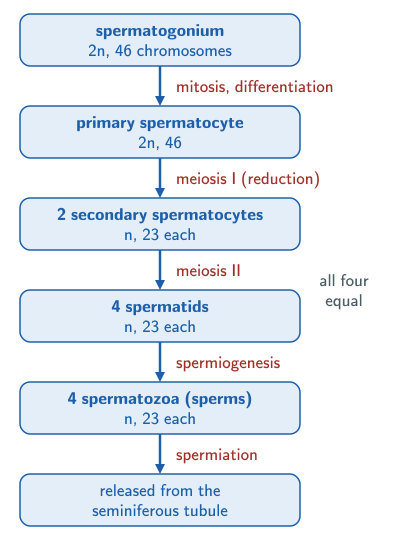
Chromosomes versus DNA: after premeiotic replication, a primary spermatocyte has 46 chromosomes but 92 chromatids (2n, 4C). A secondary spermatocyte has 23 chromosomes, each still duplicated (n, 2C); a spermatid has 23 unduplicated chromosomes (n, 1C). Here C denotes one haploid set’s DNA amount.
Spermiogenesis and spermiation
The spermatids are transformed into spermatozoa (sperms) by the process called spermiogenesis.
NCERT Biology (Class 12), Section 2.3, page 31
After spermiogenesis, the sperm heads become embedded in the Sertoli cells, and the sperms are finally released from the seminiferous tubules by the process called spermiation (page 31). Beyond the NCERT text: spermiation releases the sperms from the Sertoli cells into the lumen of the seminiferous tubule, from which they leave the testis (NCI SEER Training Modules, Testes); it is not ejaculation out of the body.
Hormonal control of spermatogenesis
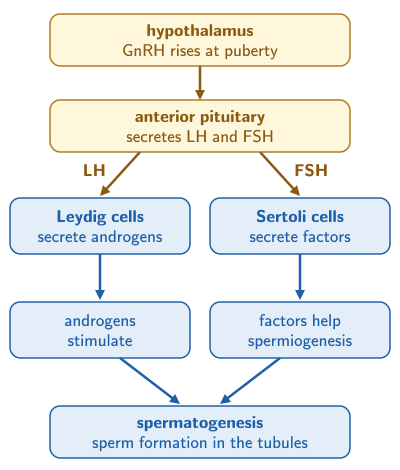
Spermatogenesis starts at puberty because of a significant increase in the secretion of gonadotropin releasing hormone (GnRH), a hypothalamic hormone (page 31):
- GnRH acts on the anterior pituitary and stimulates the secretion of two gonadotropins, luteinising hormone (LH) and follicle stimulating hormone (FSH) (page 31).
- LH acts on the Leydig cells and stimulates the synthesis and secretion of androgens; androgens, in turn, stimulate spermatogenesis (page 31).
- FSH acts on the Sertoli cells and stimulates the secretion of some factors that help in spermiogenesis (pages 31–32).
Structure of a sperm
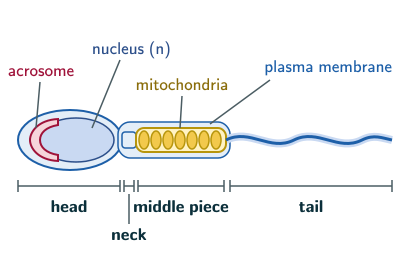
A sperm is a microscopic structure made of a head, neck, middle piece and tail; a plasma membrane envelops the whole body (page 32).
- Head: an elongated haploid nucleus, whose anterior part is covered by a cap-like acrosome. The acrosome is filled with enzymes that help fertilisation of the ovum (page 32).
- Middle piece: numerous mitochondria, which produce energy for the movement of the tail; sperm motility supports natural fertilisation (page 32).
- NCERT’s figures are 200–300 million sperms per ejaculate, at least 60 per cent with normal shape/size and at least 40 per cent with vigorous motility (page 32). These are textbook statements, not current diagnostic cutoffs for fertility. Modern semen assessment uses standardised methods and reference distributions; a value above or below a reference limit alone does not establish fertility or infertility (WHO semen manual, sixth edition; European Association of Urology, Male Infertility guideline).
- The sperms released from the seminiferous tubules are carried by the accessory ducts; the secretions of the epididymis, vas deferens, seminal vesicle and prostate are essential for their maturation and motility. The seminal plasma with the sperms is the semen, and the androgens maintain the functions of the accessory ducts and glands (page 32).
Oogenesis
Oogenesis begins during embryonic development (page 32):
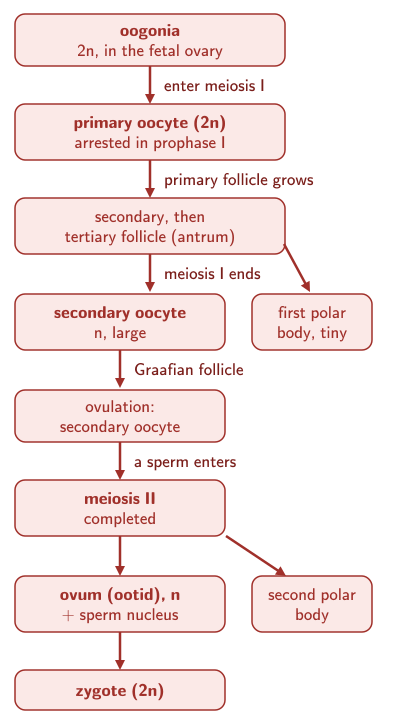
- A couple of million gamete mother cells, the oogonia, form within each fetal ovary; no more oogonia are formed or added after birth.
- These cells start dividing, enter prophase I of meiosis and are temporarily arrested at that stage; they are now primary oocytes.
- NCERT calls a primary oocyte with one layer of granulosa cells a primary follicle. Modern histology additionally distinguishes the earlier primordial follicle, with flattened surrounding cells, from the growing primary follicle with cuboidal granulosa cells.
- A large number of follicles degenerate between birth and puberty, so at puberty only 60 000–80 000 primary follicles are left in each ovary.
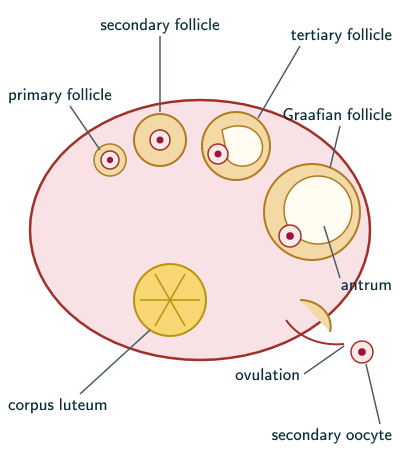
Primary, secondary, tertiary and Graafian follicles
- Primary follicle: a primary oocyte in a layer of granulosa cells (page 32).
- Secondary follicle: the primary follicle surrounded by more layers of granulosa cells and a new theca (page 32).
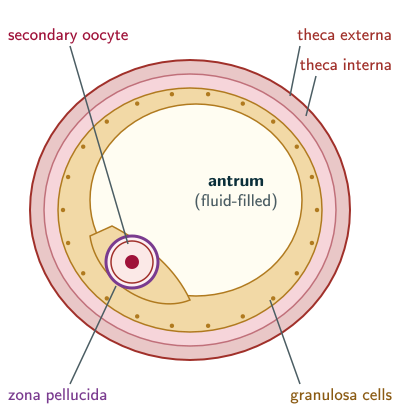
- Tertiary follicle: has a fluid-filled cavity, the antrum; the theca is organised into an inner theca interna and an outer theca externa (page 32).
- At the tertiary stage, NCERT says, the primary oocyte grows in size and completes its first meiotic division (page 32). Beyond the NCERT text: this happens in the follicle that is going to ovulate, shortly before ovulation, because the mid-cycle LH surge triggers the resumption of meiosis (Arroyo, Kim and Yeh, Reproductive Sciences, 2020; CC BY 4.0). Not every antral follicle does this: one primary oocyte outgrows the others and resumes meiosis I (NCI SEER Training Modules, Ovaries). The division is unequal: it gives a large haploid secondary oocyte and a tiny first polar body. The secondary oocyte keeps the bulk of the nutrient-rich cytoplasm of the primary oocyte (pages 32–33).
- Graafian (mature) follicle: the tertiary follicle changes into it; the oocyte is surrounded by a zona pellucida, a glycoprotein coat already developing at earlier stages (see the qualification below; NCERT page 33).
- NCERT slip (page 33): NCERT has the zona pellucida first forming at the Graafian stage. Beyond the NCERT text, a CC BY review says “ZP formation begins early in folliculogenesis, when proteins secreted by the oocyte assemble into a fibrillar matrix that thickens as the oocyte matures” (de la Fuente and others, International Journal of Molecular Sciences, 2025; CC BY 4.0). So the zona pellucida starts to form round the growing primary oocyte, long before the Graafian stage. Recognise the textbook wording when a question explicitly asks for it, while keeping the biological timing clear; do not infer a universal exam key.
NCERT asks two questions here (page 33). What is the advantage of the secondary oocyte keeping most of the cytoplasm? Our reasoning: retaining cytoplasm preserves organelles, RNAs, proteins and other resources for early development, so one large oocyte is made rather than four equal cells. Does the first polar body divide further or degenerate? NCERT states uncertainty about its fate (page 33). For this lesson the reliable outcome is one functional ovum; polar bodies ultimately degenerate, and their number should not be used to infer extra functional eggs (NCBI Bookshelf, Eggs).
Ovulation
The Graafian follicle ruptures to release the secondary oocyte (ovum) from the ovary; this is ovulation (page 33). The LH surge at mid-cycle induces it (NCERT Section 2.4, page 35). The entry of a sperm induces the completion of the secondary oocyte’s meiotic division (NCERT Section 2.5, page 36). Beyond the NCERT text: until then the secondary oocyte waits with its second meiotic division stopped in metaphase II (NCI SEER Training Modules, Ovaries).
Spermatogenesis and oogenesis compared
NCERT asks you to identify the major differences (page 33). From the text of pages 26 and 31–36:
- How long: sperm formation continues even in old men, but formation of ova ceases in women around the age of fifty (NCERT page 26); the menstrual cycles cease at menopause, at about 50 years of age (NCERT Section 2.4, page 35).
- When it starts: spermatogenesis begins at puberty; oogenesis begins in the fetal ovary, and no oogonia are added after birth.
- Where: in the seminiferous tubules of the testis; in the follicles of the ovary.
- Products of one meiosis: a primary spermatocyte gives four equal, haploid spermatids; a primary oocyte gives one large ovum and small polar bodies, because both meiotic divisions are unequal.
- Pauses: meiosis in a spermatocyte runs through; a primary oocyte waits in prophase I until meiotic resumption before ovulation, and the secondary oocyte finishes meiosis II only at fertilisation.
- Final step: spermatids change shape into sperms (spermiogenesis); the secondary oocyte is released at ovulation and completes meiosis II only if a sperm enters.
Solved examples
Example 1: Spermatogenesis (NCERT Exercises 6 and 8)
What is spermatogenesis? Briefly describe it, and define spermiogenesis and spermiation.
Answer: spermatogenesis is the production of sperms from spermatogonia in the testis, starting at puberty. Spermatogonia (2n, 46) multiply by mitosis; primary spermatocytes undergo meiosis I to give two secondary spermatocytes (n, 23), and meiosis II gives four equal haploid spermatids. Spermiogenesis transforms the spermatids into spermatozoa; spermiation releases the sperms, whose heads were embedded in the Sertoli cells, from the seminiferous tubules (NCERT page 31).
Example 2: Counting gametes
(a) What is the theoretical sperm yield from 30 primary spermatocytes if all products survive? (b) If 30 primary oocytes all complete meiosis, how many ova result and how many chromosomes does each have?
Answer: (a) each primary spermatocyte gives four spermatids, each becoming a sperm: 30 × 4 = 120 sperms. (b) each primary oocyte gives one ovum (the other products are polar bodies): 30 ova, each haploid with 23 chromosomes (NCERT pages 31–33 and 36).
Example 3: Applying NCERT’s percentages
An ejaculate has 250 million sperms. Using the percentages stated in NCERT, calculate the numbers with normal shape/size and vigorous motility. Do these results diagnose fertility?
Answer: at least 60 per cent of 250 million = 150 million with normal shape and size, and at least 40 per cent = 100 million with vigorous motility (NCERT page 32). This checks arithmetic only; these textbook percentages do not diagnose fertility, and the two groups may overlap.
Example 4: Hormones (NCERT Exercise 7)
Name the hormones involved in the regulation of spermatogenesis.
Answer: GnRH from the hypothalamus; LH and FSH from the anterior pituitary; and androgens from the Leydig cells. LH stimulates androgen secretion, androgens stimulate spermatogenesis, and FSH acts on the Sertoli cells to help spermiogenesis (NCERT pages 31–32).
Common mistakes to avoid
Common mistake
Saying the ovary releases a mature ovum
At ovulation the Graafian follicle releases the secondary oocyte; meiosis II is completed only when a sperm enters (NCERT pages 33 and 36).
Common mistake
Giving LH’s target as the Sertoli cells
LH acts on the Leydig cells (androgens); FSH acts on the Sertoli cells (factors for spermiogenesis) (NCERT page 31).
Common mistake
Mixing up spermiogenesis and spermiation
Spermiogenesis changes spermatids into sperms; spermiation releases the sperms from the seminiferous tubules (NCERT page 31).
Common mistake
Thinking new oogonia form throughout life
All oogonia form in the fetal ovary; none are added after birth (NCERT page 32).
Quick revision summary
- Gametogenesis: spermatogenesis in the testis from puberty; oogenesis in the ovary, starting before birth.
- Spermatogonium (2n, 46) → primary spermatocyte → meiosis I → 2 secondary spermatocytes (n, 23) → meiosis II → 4 spermatids → spermiogenesis → sperms → spermiation.
- GnRH → anterior pituitary → LH (Leydig cells, androgens, spermatogenesis) and FSH (Sertoli cells, factors for spermiogenesis).
- Sperm: head (haploid nucleus, acrosome), neck, middle piece (mitochondria), tail; NCERT’s semen percentages are textbook figures, not modern fertility cutoffs.
- Oogonia form only before birth; primary oocytes arrest in prophase I in primary follicles; 60 000–80 000 left per ovary at puberty.
- Follicles: primary, secondary, tertiary (antrum; meiosis I gives secondary oocyte and first polar body), Graafian (zona pellucida already present); ovulation releases the secondary oocyte.
Formula sheet
- primary spermatocyte (2n, 46) → 2 secondary spermatocytes (n, 23) → 4 spermatids (n, 23) → 4 sperms
- primary oocyte (2n) → 1 ovum (n) + polar bodies
- GnRH → LH → Leydig cells → androgens → spermatogenesis
- GnRH → FSH → Sertoli cells → spermiogenesis
- sperm: head (acrosome), neck, middle piece (mitochondria), tail
- follicle stages: primary, secondary, tertiary (antrum), Graafian
Questions students ask
How long does spermatogenesis take?
Beyond the NCERT text, human spermatogenesis takes about 64 to 74 days from a spermatogonium to a sperm: a 2022 review gives its duration as “classically determined to be 64 days but modern methods show to be closer to 74 days” (Ruthig and Lamb, Frontiers in Endocrinology, CC BY). That is about two to two and a half months. NCERT gives no duration; it says only that spermatogenesis begins at puberty (NCERT page 31).
Is gametogenesis the same as meiosis?
No, gametogenesis is not the same as meiosis: meiosis is the division that halves the chromosome number, while gametogenesis is the whole making of gametes, with meiosis as one stage. In human spermatogenesis, spermatogonia first multiply by mitosis, the spermatocytes go through the two meiotic divisions, and the spermatids become sperms by spermiogenesis (NCERT page 31), which, beyond the NCERT text, involves no division: each spermatid reshapes into one sperm (MeSH, Spermatids). In plants the two are further apart, because meiosis makes spores rather than gametes: see meiosis in plants.
Why is oogenesis called a discontinuous process?
Oogenesis is called discontinuous because its meiosis stops and restarts: primary oocytes formed in the fetal ovary are temporarily arrested in prophase I (NCERT page 32), those later ovulated finish the first meiotic division only after puberty, and the secondary oocyte released at ovulation completes the second division only if a sperm enters it (page 36). As ovulation goes on until menopause around 50 years of age, an oocyte released late in life has waited in prophase I for about fifty years (page 35). Spermatogenesis has no such pause: it starts at puberty, and its two meiotic divisions follow each other (page 31).
How many polar bodies are formed in oogenesis?
Oogenesis forms two polar bodies for each ovum in NCERT’s account: the first when the primary oocyte completes the first meiotic division, and the second when the secondary oocyte completes the second meiotic division after a sperm has entered it (NCERT pages 32 and 36). A third is possible but not certain: NCERT asks whether the first polar body divides further or degenerates and answers “At present we are not very certain about this” (page 33). So 12 primary oocytes that go all the way to fertilisation give 12 ova and 24 polar bodies, or 36 if every first polar body divided.
What is the difference between oogenesis and folliculogenesis?
Oogenesis is the development of the egg cell itself, while folliculogenesis, a term from beyond the NCERT text, is the development of the follicle around it; the two go on together in the ovary. NCERT defines only the first: “The process of formation of a mature female gamete is called oogenesis” (NCERT page 32). A 2025 review sums up the second as “During the folliculogenesis stage, the follicles grow, and the cells inside also change” (Orozco-Galindo and others, Current Issues in Molecular Biology, CC BY 4.0); in NCERT that growth runs from the primary through the secondary and tertiary to the Graafian follicles.
Is a tertiary follicle the same as a Graafian follicle?
No, the tertiary follicle and the Graafian follicle are two successive stages of the same follicle: NCERT says the tertiary follicle, marked by a fluid-filled antrum and a theca organised into theca interna and theca externa, “further changes into the mature follicle or Graafian follicle” (NCERT pages 32–33). The Graafian follicle is thus the mature, final stage, the one that ruptures to release the secondary oocyte (page 33). Beyond the NCERT text, MeSH keeps them apart too, counting tertiary and Graafian as two of the five stages it gives for a follicle (MeSH, Ovarian Follicle).
Practice questions
Try each question first, then open the answer to check your working.
-
Q1. What fills the acrosome, and what is its role?
Show answerHide answer
Enzymes that help the sperm fertilise the ovum (NCERT page 32).
-
Q2. At which stage does the primary oocyte complete its first meiotic division, and what does it give?
Show answerHide answer
In the tertiary follicle (NCERT page 32); beyond the NCERT text, it follows the mid-cycle LH surge, in the follicle that is going to ovulate (Arroyo, Kim and Yeh, 2020). The unequal division gives a large haploid secondary oocyte and a tiny first polar body (NCERT page 32).
-
Q3. How many primary follicles are left in each ovary at puberty?
Show answerHide answer
Only 60 000–80 000 (NCERT page 32).