Significance of meiosis
NCERT Class 11 Biology Chapter 10 Section 10.5
Quick answer
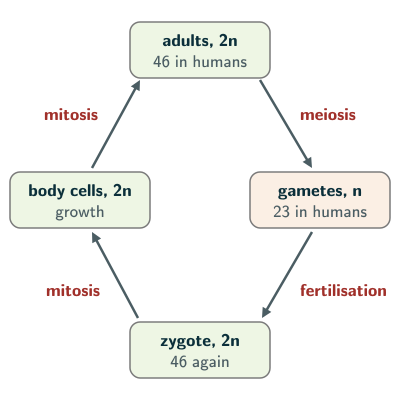
Meiosis establishes a haploid phase and fertilisation restores the diploid phase, normally conserving chromosome number across sexual generations. Crossing over and independent assortment reshuffle inherited alleles, producing genetic variation on which evolution can act; mutation is a distinct source of new alleles.
With your textbook
NCERT Biology (Class 11), Chapter 10 “Cell Cycle and Cell Division”, Section 10.5 “Significance of Meiosis”, page 128.
Open the official NCERT chapter (PDF, 2.5 MB, ncert.nic.in) (opens in a new tab)
Checked against the 2026-27 reprint on .
Significance of meiosis
Why meiosis matters
Meiosis is the mechanism by which conservation of specific chromosome number of each species is achieved across generations in sexually reproducing organisms, even though the process, per se, paradoxically, results in reduction of chromosome number by half.
NCERT Biology (Class 11), Section 10.5, page 128
- Meiosis also increases the genetic variability in the population from one generation to the next; variations are very important for the process of evolution (page 128).
In plain words: the paradox is that halving the chromosome number is exactly what keeps it constant. Each gamete carries half, and fertilisation adds two halves together, so the child has the same number as the parents, and a new mix of their genes.
Constant chromosome number across generations
- Meiosis produces the haploid phase: it contributes directly to animal gametogenesis, whereas land-plant spores grow into gametophytes that form gametes by mitosis. Sexual reproduction fuses two haploid gametes (page 125).
- Fertilisation restores the diploid phase (page 125), so the species’ chromosome number stays the same from generation to generation.
- A typical diploid human body-cell nucleus has 46 chromosomes, 23 pairs (NCERT Chapter 8, page 101): human gametes carry 23, and the zygote 46.
Genetic variability
- Meiosis involves pairing of homologous chromosomes and recombination between their non-sister chromatids (page 125); crossing over in pachytene exchanges genetic material between homologous chromosomes (page 126).
- Beyond the NCERT Class 11 text: in metaphase I each bivalent lines up independently of the others (NCERT Class 12 Biology, Section 4.3.2, page 66: chromosome pairs “can align at the metaphase plate independently of each other”; that sentence opens “During Anaphase of meiosis I”, but the lining up happens in metaphase I), so the maternal and paternal chromosomes of different pairs are shuffled into the gametes in many combinations. With 23 pairs, a human can make 2 = 8 388 608 kinds of gametes from this shuffling alone, before crossing over adds more.
Solved examples
Example 1: The significance of meiosis (NCERT Exercise 12)
What is the significance of meiosis?
Answer: it conserves the specific chromosome number of each species across generations, even though it produces the haploid phase, because fertilisation restores it; and it increases genetic variability from one generation to the next, which is important for evolution (NCERT page 128).
Example 2: Without the halving
If human gametes were made by mitosis and kept all 46 chromosomes, how many would the children and grandchildren have?
Answer: 46 + 46 = 92 in the children and 92 + 92 = 184 in the grandchildren: the number would double every generation. Meiosis prevents this (idea from NCERT page 128).
Example 3: Counting combinations
How many kinds of gametes can independent assortment alone give with 2 pairs of chromosomes, and with 3 pairs?
Answer: each pair can go either way, so 2 = 4 with two pairs and 2 = 8 with three pairs (beyond the NCERT Class 11 text; NCERT Class 12 Biology, Section 4.3.2, page 66). Without crossing over, a single meiosis gives only two of these kinds; the full set is possible across many meioses, assuming the pairs segregate independently.
Common mistakes to avoid
Common mistake
Thinking meiosis lowers the species’ chromosome number
It produces a haploid phase; fertilisation restores it, so the species’ number is conserved (NCERT page 128).
Common mistake
Thinking meiosis is the only source of genetic variation
Meiosis reshuffles inherited alleles through recombination and assortment (NCERT pages 125 and 128). Mutations can also arise in mitotically dividing cells; chromosome preservation in normal mitosis does not mean genetic change is impossible.
Quick revision summary
- Meiosis conserves each species’ chromosome number across generations, although it creates haploid products; fertilisation restores it.
- It increases genetic variability through recombination; variation is important for evolution.
- Typical human diploid nuclei: 46 chromosomes; 23 in gametes.
Formula sheet
- gametes: n; zygote: 2n
- humans: 2n = 46, n = 23
- meiosis: constant chromosome number, genetic variability
Questions students ask
What is the difference between crossing over and independent assortment?
Crossing over and independent assortment are the two ways meiosis shuffles genes: crossing over exchanges segments between non-sister chromatids of a homologous pair in pachytene, making new combinations within one chromosome, while independent assortment, beyond the NCERT Class 11 text, sends the maternal and paternal chromosomes of different pairs to the poles in any combination. It happens because each pair can align at the metaphase plate of meiosis I independently of the others (NCERT Class 12 Biology, Section 4.3.2, page 66). So crossing over recombines genes on the same chromosome, and independent assortment genes on different chromosomes.
Why is meiosis II needed if meiosis I already halves the chromosome number?
Meiosis II is needed because, although meiosis I has already halved the chromosome number, every chromosome still has two sister chromatids, and meiosis II separates them, turning the two cells of meiosis I into four haploid cells with one chromatid per chromosome (NCERT pages 127–128). It halves the DNA content again, from 2C to C per cell, with no DNA replication before it. Because crossing over has made the two sister chromatids of a recombined chromosome different, meiosis II also sends them to different cells, so after crossing over the four cells of one meiosis can all differ (beyond the NCERT text).
Why is genetic variation important for evolution?
Genetic variation is important for evolution because natural selection can act only on heritable differences: NCERT Class 12 Biology describes natural selection as “a process in which heritable variations enabling better survival are enabled to reproduce and leave greater number of progeny” (Section 6.7, page 121). Mutation can create new alleles, recombination reshuffles existing ones, gene flow moves alleles between populations and genetic drift changes their frequencies by chance. These processes have distinct roles; drift does not create new alleles. The NCERT Class 11 text says that variations are very important for the process of evolution (page 128).
What is the importance of meiosis in plants?
In land plants meiosis has the same two roles as in animals, keeping the chromosome number constant and increasing variation, but it makes haploid spores rather than gametes: in bryophytes, for example, some cells of the sporophyte undergo meiosis to produce haploid spores, which grow into the gametophyte (NCERT Chapter 3, page 29). In flowering plants a pollen mother cell gives a tetrad of four microspores by meiosis, and the megaspore mother cell four megaspores (NCERT Class 12 Biology, Section 1.2, pages 6 and 10). The gametophytes then make the gametes by mitosis, as when the generative cell divides into two male gametes (page 7), and fertilisation restores the diploid phase.
Practice questions
Try each question first, then open the answer to check your working.
-
Q1. What restores the diploid phase after meiosis?
Show answerHide answer
Fertilisation (NCERT page 125).
-
Q2. Why does NCERT call the role of meiosis in keeping the chromosome number constant a paradox?
Show answerHide answer
Because meiosis itself reduces the chromosome number by half, yet it is the mechanism that conserves the number across generations (NCERT page 128).