Cell cycle
NCERT Class 11 Biology Chapter 10 Section 10.1
Quick answer
The cell cycle coordinates genome replication and division into two daughter cells, with interphase (G1, S and G2) followed by M phase. In a typical diploid cell, S phase doubles nuclear DNA from 2C to 4C while chromosome number stays 2n; NCERT’s cultured human-cell example takes about 24 hours. Cells outside the cycle remain metabolically active, but their ability to re-enter depends on cell type.
With your textbook
NCERT Biology (Class 11), Chapter 10 “Cell Cycle and Cell Division”, Section 10.1 “Cell Cycle”, pages 120–122.
Open the official NCERT chapter (PDF, 2.5 MB, ncert.nic.in) (opens in a new tab)
Checked against the 2026-27 reprint on .
The cell cycle
Cell cycle
The sequence of events by which a cell duplicates its genome, synthesises the other constituents of the cell and eventually divides into two daughter cells is termed cell cycle.
NCERT Biology (Class 11), Section 10.1, page 120
- Cell division, DNA replication and cell growth must take place in a coordinated way, so that the daughter cells receive intact genomes (page 120).
- Cell growth, as an increase in cytoplasm, is continuous, but replication of the nuclear genome occurs in one specific stage of the cycle; the events are under genetic control (page 120).
In plain words: a regularly dividing cell spends much of its cycle growing and preparing for division; many mature cells instead remain outside the cycle. It grows, copies its DNA once, prepares for division, and only then splits into two. Repeating this cycle lets a single cell, such as a fertilised egg, build a body of millions of cells (page 120).
Phases of the cell cycle
- A typical eukaryotic cell cycle is illustrated by human cells in culture, which divide about once every 24 hours. The duration varies between organisms and cell types: yeast can go through the cycle in only about 90 minutes (page 121).
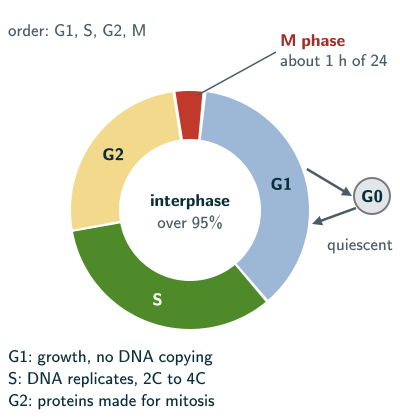
- The cycle has two basic phases: interphase and M phase (mitosis phase). M phase is the actual cell division; interphase is the period between two successive M phases (page 121).
- In the 24-hour human cell cycle, cell division proper lasts only about an hour, and interphase more than 95 per cent of the cycle (page 121).
- M phase starts with nuclear division, the separation of daughter chromosomes (karyokinesis), and usually ends with division of the cytoplasm (cytokinesis) (page 121).
Interphase: G1, S and G2
Interphase was historically called the resting phase, but in it the cell prepares for division by growing and replicating its DNA in an orderly way. It has three phases (page 121):
- G1 phase (Gap 1): the interval between mitosis and the start of DNA replication. The cell is metabolically active and grows continuously, but does not replicate its DNA. NCERT’s chapter Summary adds that most of the organelle duplication also occurs in this phase (page 129).
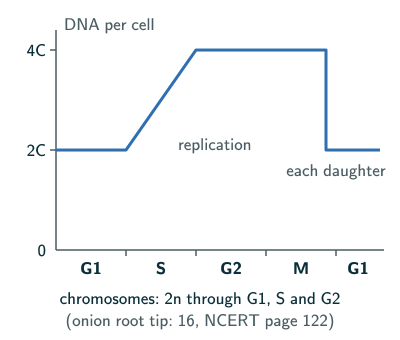
- S phase (Synthesis): The nuclear genome is replicated; for a typical diploid cell the nuclear DNA content doubles from 2C to 4C. Here C is the DNA amount in one unreplicated haploid genome; a haploid mitotic cell instead goes from C to 2C. The chromosome number does not increase: a cell with 2n chromosomes in G1 still has 2n after S phase. In animal cells, DNA replication begins in the nucleus and the centriole duplicates in the cytoplasm. NCERT’s Summary calls S “the phase of DNA replication and chromosome duplication” (page 129): each chromosome now has two chromatids joined at the centromere (page 122), but it still counts as one chromosome.
- G2 phase (Gap 2): proteins are synthesised in preparation for mitosis, while cell growth continues; the Summary calls G2 “the period of cytoplasmic growth” (page 129).
Quiescent stage (G0) and who divides
- Some cells in adult animals do not appear to divide (for example, heart cells), and many others divide only occasionally, to replace cells lost through injury or cell death (page 122).
- Cells that do not divide further exit G1 and enter an inactive stage, the quiescent stage (G0). They stay metabolically active while not proliferating (page 122). Some quiescent cells can return to the cycle after stimulation; do not assume every terminally differentiated cell can do so. Alberts and colleagues’ Molecular Biology of the Cell distinguishes reversible withdrawal from terminal differentiation.
- In animals, mitotic division is seen only in the diploid somatic cells, with a few exceptions where haploid cells divide by mitosis, for example in male honey bees. Plants can show mitotic divisions in both haploid and diploid cells (page 122), as in the haploid gametophytes of plants with alternation of generations.
Plants keep growing all their lives because their meristems keep dividing: the apical meristems at the root and shoot tips and, in dicots and gymnosperms, the lateral meristems, the vascular cambium and cork cambium (NCERT Chapter 13, pages 167–168; NCERT asks about them on page 121). Animals have no meristems, but some of their cells, such as those of the epidermis, the gut lining and blood, keep being replaced by mitosis (NCERT page 125).
Solved examples
Example 1: The onion root tip (NCERT page 122)
An onion root-tip cell has 16 chromosomes. How many chromosomes does it have at G1, after S and after M? If the DNA content after M is 2C, what is it at G1, after S and at G2?
Answer: chromosomes: 16 at G1, 16 after S, 16 in each daughter after completed M phase, because S phase doubles the DNA but not the chromosome number. DNA: 2C at G1, 4C after S, 4C at G2 (NCERT page 121).
Example 2: How long is interphase?
In a 24-hour human cell cycle with about 1 hour of cell division, what fraction of the cycle is interphase?
Answer: 23 ÷ 24 ≈ 0.958, about 96 per cent, which matches NCERT’s “more than 95%” (page 121).
Example 3: Yeast against human cells
How many yeast cell cycles fit into one 24-hour human cell cycle?
Answer: 24 hours = 1440 minutes; 1440 ÷ 90 = 16, so about 16 cycles (durations from NCERT page 121).
Example 4: What is G0? (NCERT Exercise 4)
What is G0 (quiescent phase) of the cell cycle?
Answer: the quiescent stage, an inactive stage entered by cells that do not divide further: they exit G1 and stop proliferating but stay metabolically active, and some can re-enter the cycle when stimulated, as occurs during replacement of lost cells (NCERT page 122). This is not a promise that every specialised non-dividing cell resumes division.
Example 5: Mitosis without S phase? (NCERT Exercise 14)
Can there be mitosis without DNA replication in S phase?
Answer: no, not a normal mitosis. Mitosis gives each daughter cell one chromatid of every chromosome (NCERT page 123), so every chromosome must first be copied into two sister chromatids, and that copying is the DNA replication of S phase (NCERT page 121). Without it, the daughters could not each receive a complete, identical set. Meiosis II, which is similar to mitosis, has no S phase before it, but its chromosomes still carry the two chromatids copied before meiosis I: meiosis has only a single cycle of DNA replication (NCERT pages 125 and 129).
Example 6: DNA replication without cell division? (NCERT Exercise 15)
Can there be DNA replication without cell division?
Answer: yes. Replication (S phase) and division (M phase) are separate steps of the cycle. In some organisms karyokinesis is not followed by cytokinesis, so the cell becomes multinucleate, a syncytium, as in the liquid endosperm of coconut (NCERT page 124): the DNA is replicated for every nuclear division, but the cell itself does not divide. Beyond the NCERT text: some cells copy their DNA again and again with no division at all, which builds the giant polytene chromosomes of insect salivary glands.
Example 7: Chromosomes and DNA through the cycle (NCERT Exercise 16)
How do (i) the number of chromosomes (N) per cell and (ii) the DNA content (C) per cell change through the cycle? Take the onion root tip, 2n = 16.
Answer:
| Stage | N per cell | C per cell |
|---|---|---|
| G1 | 2n (16) | 2C |
| S | 2n (16) | 2C rising to 4C |
| G2 | 2n (16) | 4C |
| Prophase, metaphase | 2n (16) | 4C |
| Anaphase | 32 daughter chromosomes in one undivided cell; 16 moving to each pole | 4C |
| Telophase | 32 total, in two diploid nuclei of 16 each | 4C total; 2C per nucleus |
| Each daughter after cytokinesis | 2n (16) | 2C |
S phase doubles C but not N (NCERT page 121). N doubles only at anaphase, when the sister chromatids separate and become daughter chromosomes (NCERT page 123); cytokinesis then halves both N and C per cell (NCERT page 124). The temporary total of 32 chromosomes across two separating sets is not the creation of a stable tetraploid nucleus.
Common mistakes to avoid
Common mistake
Doubling the chromosome number in S phase
S phase doubles the DNA (2C to 4C), not the chromosome number, which stays 2n (NCERT page 121).
Common mistake
Calling interphase a time of rest
Interphase was historically called the resting phase, but the cell is growing and replicating its DNA (NCERT page 121).
Common mistake
Saying animal haploid cells never divide by mitosis
Male honey bees are an exception: their haploid cells divide by mitosis (NCERT page 122).
Quick revision summary
- Cell cycle: the cell duplicates its genome, makes its other parts and divides into two; growth is continuous, DNA synthesis happens in one stage.
- Human cells in culture: about 24 hours per cycle, M phase about 1 hour, interphase over 95 per cent; yeast: about 90 minutes.
- Interphase: G1 (growth), S (DNA 2C to 4C, chromosomes stay 2n, centriole duplicates in animal cells), G2 (proteins for mitosis).
- M phase: karyokinesis, then cytokinesis.
- G0: metabolically active cells outside the proliferative cycle; re-entry depends on cell type; mitosis in diploid somatic cells of animals, in haploid and diploid cells of plants.
Formula sheet
- cell cycle: interphase (G1, S, G2) + M phase
- human cells in culture: about 24 h; M phase about 1 h
- interphase: more than 95% of the cycle
- yeast: about 90 minutes
- diploid S phase: nuclear DNA 2C to 4C; chromosomes stay 2n
Questions students ask
What is the difference between interphase and mitosis?
Interphase and M phase are the two basic phases of the cell cycle: interphase is the period between two successive M phases, in which the cell grows and replicates its DNA, while M phase is the actual cell division, karyokinesis usually followed by cytokinesis (NCERT page 121). Interphase is far longer: in the 24-hour cycle of human cells in culture, cell division proper lasts only about an hour. The DNA content per cell doubles from 2C to 4C in the S phase of interphase, and M phase shares it out so that each daughter cell is back to 2C.
Why is interphase called the resting phase when the cell is so active?
Interphase is called the resting phase because the cell shows no visible sign of division in it: its chromosomes are generally less condensed and are not resolved as the distinct bodies seen during mitosis; chromosomes still exist during interphase (Chapter 8, page 101). In fact it is “the time during which the cell is preparing for division by undergoing both cell growth and DNA replication in an orderly manner” (NCERT page 121): growth in G1, DNA replication in S, and synthesis of proteins for mitosis in G2. It is also by far the longest phase, more than 95 per cent of the cycle in human cells in culture (NCERT page 121).
What is the difference between G1 and G2 phase?
G1 and G2 are the two gap phases of interphase: G1 is the interval between mitosis and the start of DNA replication, in which the cell is metabolically active and grows, while G2 follows S phase, and in it proteins are synthesised in preparation for mitosis as cell growth continues (NCERT page 121). In the typical diploid example, a G1 cell has 2C nuclear DNA and a G2 cell 4C, though both have the same 2n chromosomes; in G2 each chromosome is made of two sister chromatids. NCERT’s Summary adds that most organelle duplication occurs in G1, and calls G2 the period of cytoplasmic growth (page 129).
What is the difference between G0 and G1 phase?
G1 is the first gap phase of a dividing cell, which grows in it and then moves on to DNA replication in S phase, while G0, the quiescent stage, is the inactive stage entered by cells that do not divide further, such as heart cells: they exit G1 instead of going on to S (NCERT pages 121–122). Like G1 cells, cells in G0 remain metabolically active, but they no longer proliferate “unless called on to do so depending on the requirement of the organism” (NCERT page 122). Because a cell leaves for G0 before S phase, a typical diploid cell leaving G1 for G0 retains 2C nuclear DNA and 2n chromosomes; this is not a universal description of every specialised cell.
What is the difference between interphase and interkinesis?
Interphase is the long period between two successive M phases of the cell cycle, made up of G1, S and G2, in which the DNA is replicated in S phase, while interkinesis is the stage between meiosis I and meiosis II, which is generally short-lived and has no replication of DNA (NCERT pages 121 and 127). Interphase takes up more than 95 per cent of a human cell cycle in culture. The chromosomes differ too: after telophase I they may disperse a little but do not reach the extremely extended state of the interphase nucleus, so prophase II usually begins before they have fully elongated (NCERT page 127).
Is cell cycle and cell division in the NEET 2026 syllabus?
Cell cycle and cell division is in the NEET (UG) 2026 Biology syllabus: Unit 3, Cell Structure and Function, lists “Cell division: Cell cycle, mitosis, meiosis and their significance.” It matches NCERT Class 11 Biology Chapter 10, Cell Cycle and Cell Division, whose Sections 10.1 to 10.5 this page and the four after it cover one by one: the cell cycle, mitosis, the significance of mitosis, meiosis and the significance of meiosis.
Practice questions
Try each question first, then open the answer to check your working.
-
Q1. In which phase does the centriole duplicate in animal cells?
Show answerHide answer
S phase (NCERT page 121).
-
Q2. What is the stage between mitosis and the start of DNA replication called?
Show answerHide answer
G1 phase (NCERT page 121).
-
Q3. Name one kind of adult animal cell that does not appear to divide.
Show answerHide answer
Heart cells (NCERT page 122).