Meiosis
NCERT Class 11 Biology Chapter 10 Section 10.4
Quick answer
Meiosis halves chromosome number through one DNA replication followed by two divisions, producing haploid products. In NCERT’s prophase I account, homologues pair in zygotene, cross over in pachytene and remain linked at chiasmata in diplotene; meiosis I separates homologues and meiosis II separates sister chromatids. Products contribute to animal gamete formation or become spores in land plants; not all become functional gametes.
With your textbook
NCERT Biology (Class 11), Chapter 10 “Cell Cycle and Cell Division”, Section 10.4 “Meiosis”, pages 125–128.
Open the official NCERT chapter (PDF, 2.5 MB, ncert.nic.in) (opens in a new tab)
Checked against the 2026-27 reprint on .
Meiosis
Meiosis
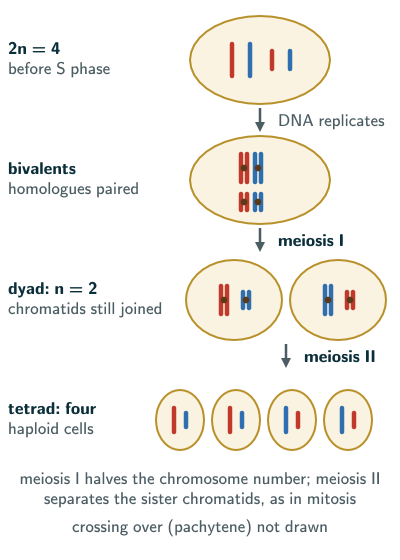
A specialised diploid cell undergoes a kind of division that reduces chromosome number by half, producing haploid products: this is meiosis, also called the reduction division (NCERT pages 125 and 129).
Meiosis ensures the production of haploid phase in the life cycle of sexually reproducing organisms whereas fertilisation restores the diploid phase.
NCERT Biology (Class 11), Section 10.4, page 125
In plain words: meiosis halves the chromosome number so that, when two gametes fuse, the offspring has the same number as its parents. On the way, matching chromosomes from the mother and the father pair up and swap pieces, which can produce new combinations of inherited alleles; not every product must be genetically unique.
Key features
NCERT lists the key features of meiosis (page 125):
- Two sequential cycles of nuclear and cell division, meiosis I and meiosis II, but only a single cycle of DNA replication.
- Meiosis I begins after the parental chromosomes have replicated, at the S phase, to give identical sister chromatids.
- It involves pairing of homologous chromosomes and recombination between non-sister chromatids of homologous chromosomes.
- The textbook model yields four haploid products after meiosis II. They need not all become functional gametes: animal oogenesis allocates most cytoplasm to one ovum and produces polar bodies.
NCERT says we come across meiosis during gametogenesis in plants and animals (page 125). In animals meiosis contributes directly to gamete formation; spermatids still differentiate into sperm, and oogenesis produces an ovum plus polar bodies. In land plants it gives spores, which grow into the haploid gametophyte (alternation of generations; NCERT Section 3.2, page 29); the gametophyte then makes the gametes by mitosis (NCERT Class 12 Biology, Section 1.2, page 7). Its phases are prophase I, metaphase I, anaphase I and telophase I in meiosis I, and prophase II, metaphase II, anaphase II and telophase II in meiosis II.
Meiosis I and the five stages of prophase I
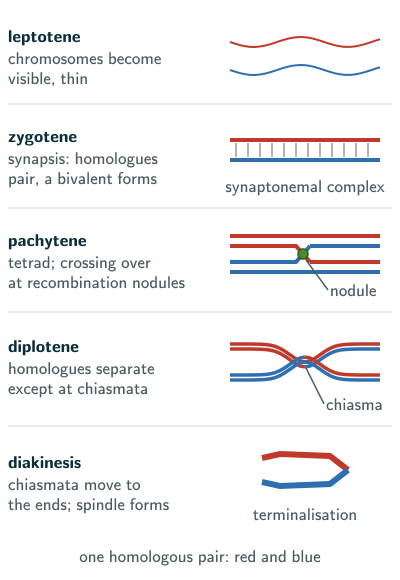
Prophase I is typically longer and more complex than the prophase of mitosis. By chromosomal behaviour it has five stages (page 126):
- Leptotene: the chromosomes become gradually visible under the light microscope; compaction continues.
- Zygotene: chromosomes start pairing, a process called synapsis; the paired chromosomes are homologous chromosomes. Electron micrographs show that synapsis is accompanied by a complex structure, the synaptonemal complex. A pair of synapsed homologous chromosomes is a bivalent (two chromosomes) or a tetrad (four chromatids).
- Pachytene: longer than leptotene and zygotene, which are relatively short-lived (page 126). The four chromatids of each bivalent become distinct and appear clearly as tetrads. Recombination nodules appear, the sites of crossing over between non-sister chromatids of homologous chromosomes. Crossing over, the exchange of genetic material between two homologous chromosomes, is enzyme-mediated; the enzyme is recombinase. Recombination is complete by the end of pachytene, leaving the chromosomes linked at the sites of crossing over.
- Diplotene: the synaptonemal complex dissolves, and the recombined homologues of each bivalent tend to separate, except at the sites of crossovers; these X-shaped structures are chiasmata. In oocytes of some vertebrates, diplotene can last for months or years.
- Diakinesis: marked by terminalisation of chiasmata. The chromosomes are fully condensed and the meiotic spindle is assembled; by its end the nucleolus disappears and the nuclear envelope breaks down. Diakinesis is the transition to metaphase.
NCERT writes that the chromosomes paired at zygotene “are called homologous chromosomes” (page 126). They are homologous whether or not they are paired: chromosomes occur in pairs, with the two alleles of a gene “on homologous sites on homologous chromosomes” (NCERT Class 12 Biology, Section 4.3.2, page 65); zygotene is simply when the homologues, one from each parent, come together.
The rest of meiosis I (pages 126–127):
- Metaphase I: the bivalents align on the equatorial plate; microtubules from opposite poles attach to the kinetochores of the homologous chromosomes.
- Anaphase I: the homologous chromosomes separate, while the sister chromatids stay together at their centromeres.
- Telophase I: the nuclear membrane and nucleolus reappear and cytokinesis follows, giving a dyad of cells. The chromosomes may disperse a little, but not to the extended state of an interphase nucleus.
- Interkinesis: the short stage between the two divisions; there is no DNA replication in it. It is followed by prophase II.
Meiosis II
Meiosis II resembles a normal mitosis (page 127):
- Prophase II: begins immediately after cytokinesis, usually before the chromosomes have fully elongated; the nuclear membrane disappears by its end and the chromosomes become compact again.
- Metaphase II: the chromosomes align at the equator; microtubules from opposite poles attach to the kinetochores of the sister chromatids.
- Anaphase II: the centromere of each chromosome splits, and the sister chromatids move to opposite poles as the microtubules attached to the kinetochores shorten.
- Telophase II: the two groups of chromosomes are again enclosed by nuclear envelopes, and cytokinesis gives a tetrad of cells, four haploid daughter cells (page 128).
Mitosis and meiosis compared
| Feature | Mitosis | Meiosis |
|---|---|---|
| Also called | equational division | reduction division |
| Divisions | one | two (I and II) |
| Daughter cells | two, same chromosome number as the parent | four, haploid |
| Homologues | do not pair | pair, cross over |
| Anaphase | centromeres split | I: homologues separate; II: centromeres split |
| Chromosome number | kept the same | halved |
| Where | somatic cells; haploid cells too in plants and male honey bees | diploid cells that form gametes (animals) or spores (plants) |
(NCERT pages 122–128; Summary, page 129.)
Solved examples
Example 1: Name the stage (NCERT Exercise 6, parts iii and iv)
At which stage (iii) do homologous chromosomes pair, and (iv) does crossing over take place?
Answer: (iii) zygotene; (iv) pachytene (NCERT page 126).
Example 2: Synapsis, bivalent, chiasmata (NCERT Exercise 7)
Describe synapsis, a bivalent and chiasmata.
Answer: synapsis is the pairing of homologous chromosomes in zygotene, accompanied by a synaptonemal complex. A bivalent (tetrad) is a pair of synapsed homologous chromosomes. Chiasmata are the X-shaped points where the homologues stay joined in diplotene, at the sites of crossing over (NCERT page 126). Draw them as in the prophase I figure above.
Example 3: Two anaphases (NCERT Exercise 10)
Distinguish anaphase of mitosis from anaphase I of meiosis.
Answer: in mitotic anaphase, centromeres split and sister chromatids move to opposite poles (NCERT pages 123–124). In anaphase I, homologous chromosomes separate, while the sister chromatids stay together at their centromeres (NCERT page 127); the centromeres split only in anaphase II.
Example 4: Counting chromosomes and DNA
A cell with 2n = 8 and 2C DNA in G1 undergoes meiosis. Give the chromosome number and DNA content per cell after S phase, after meiosis I and after meiosis II.
Answer: after S: 8 chromosomes, 4C. After meiosis I: 4 chromosomes (each still of two chromatids), 2C. After meiosis II: 4 chromosomes, C. Four haploid cells form (NCERT pages 121 and 125–128).
Example 5: Equal and unequal daughter cells (NCERT Exercise 9)
Find examples where the four daughter cells of meiosis are equal in size, and where they are unequal.
Answer: beyond the NCERT Class 11 text, from NCERT Class 12 Biology. Equal: in sperm formation the two meiotic divisions of a primary spermatocyte give “four equal, haploid spermatids” (Section 2.3, page 31); in pollen formation a pollen mother cell gives a microspore tetrad, a cluster of four microspores (Section 1.2, page 6). Unequal: in egg formation both meiotic divisions are unequal, so one large haploid ovum gets most of the cytoplasm and the others are small polar bodies (Section 2.3, page 32; Section 2.5, page 36).
Common mistakes to avoid
Common mistake
Saying chromatids separate in anaphase I
In anaphase I the homologous chromosomes separate; sister chromatids separate in anaphase II (NCERT page 127).
Common mistake
Adding a DNA replication before meiosis II
There is no DNA replication in interkinesis; meiosis has a single cycle of DNA replication (NCERT pages 125 and 127).
Common mistake
Mixing up chiasmata and crossing over
Crossing over happens in pachytene, at recombination nodules; chiasmata are the X-shaped links seen in diplotene where it happened (NCERT page 126).
Quick revision summary
- Meiosis halves chromosome number to make haploid products: gamete precursors in animals, spores in land plants; fertilisation restores the diploid number.
- Two divisions, one DNA replication; homologues pair and recombine; four haploid cells.
- Prophase I: leptotene, zygotene (synapsis, synaptonemal complex, bivalent), pachytene (crossing over, recombination nodules, recombinase), diplotene (chiasmata), diakinesis (terminalisation).
- Metaphase I bivalents on the plate; anaphase I homologues separate; telophase I dyad; interkinesis without DNA replication.
- Meiosis II is like mitosis: sister chromatids separate in anaphase II; telophase II gives a tetrad of four haploid cells.
Formula sheet
- meiosis: one DNA replication, two divisions
- prophase I: leptotene, zygotene, pachytene, diplotene, diakinesis
- zygotene: synapsis; pachytene: crossing over; diplotene: chiasmata
- anaphase I: homologues separate; anaphase II: sister chromatids separate
- textbook result: four haploid products, not necessarily four functional gametes
Questions students ask
What is the difference between meiosis I and meiosis II?
Meiosis I separates the homologous chromosomes of each pair, after they have paired and crossed over in prophase I, so each pole receives half the chromosome number of the parent cell, while meiosis II, which resembles a normal mitosis, separates the sister chromatids and leaves the chromosome number unchanged (NCERT pages 126–129). Meiosis I thus gives two haploid cells whose chromosomes still have two chromatids each, and meiosis II four haploid cells. That is why NCERT Class 12 Biology calls the first meiotic division the reduction division (Section 2.3, page 31), a name the Class 11 text gives to meiosis as a whole (page 129).
How is prophase I different from prophase II and from mitotic prophase?
Prophase I is longer and more complex than both: in its five stages the homologous chromosomes pair (synapsis), form a synaptonemal complex, cross over and stay linked at chiasmata, this characteristic sequence does not occur in prophase II or normal mitotic prophase (NCERT page 126). Prophase II, which NCERT calls a much simpler prophase, begins immediately after cytokinesis, usually before the chromosomes have fully elongated; they become compact again, and the nuclear membrane disappears by its end (NCERT page 127). Mitotic prophase, like prophase II, condenses chromosomes of two chromatids each without any pairing, but a prophase II cell has only half the chromosome number of the cell that entered meiosis.
What is the difference between the synaptonemal complex and chiasmata?
The synaptonemal complex is the complex structure that forms along paired homologous chromosomes during synapsis in zygotene, while chiasmata are the X-shaped points where the recombined homologues stay joined, at the sites of crossing over, after that complex dissolves at the beginning of diplotene (NCERT page 126). The complex is therefore present through pachytene, while crossing over takes place, and is gone by the time chiasmata appear. NCERT describes the complex from electron micrographs; chiasmata, beyond the NCERT text, are large enough to be seen with an ordinary light microscope.
What is the difference between crossing over and recombination?
Crossing over is the exchange of genetic material between non-sister chromatids of two homologous chromosomes, at recombination nodules in pachytene, while recombination is its outcome: in NCERT’s words, “Crossing over leads to recombination of genetic material on the two chromosomes” (page 126). Crossing over is an enzyme-mediated process, and the enzyme involved is recombinase. In genetics, NCERT Class 12 Biology uses recombination, Morgan’s term, for “the generation of non-parental gene combinations” (Section 4.3.3, page 67); for two linked genes, such combinations arise by crossing over between them.
How is metaphase I different from the metaphase of mitosis?
In metaphase I of meiosis the bivalents, pairs of homologous chromosomes, align on the equatorial plate, with microtubules from opposite poles attached to the kinetochores of the two homologous chromosomes, while in mitotic metaphase single chromosomes align on the metaphase plate, with the kinetochores of the two sister chromatids of each attached to spindle fibres from opposite poles (NCERT pages 123 and 126). Metaphase II is like mitotic metaphase: the chromosomes align at the equator, and microtubules from opposite poles attach to the kinetochores of sister chromatids (NCERT page 127).
How many bivalents are formed in prophase I of a human cell?
A typical human primary oocyte forms 23 bivalents in prophase I, because its 46 chromosomes make 23 homologous pairs (NCERT Chapter 8, page 101) and a bivalent, or tetrad, is one pair of synapsed homologous chromosomes (NCERT page 126). Each bivalent has four chromatids, so the cell holds 92 chromatids at pachytene. After meiosis I each product has 23 chromosomes of two chromatids each, and after meiosis II each haploid nuclear product has 23 chromosomes of one chromatid. In a typical primary spermatocyte, 22 autosomal pairs accompany an XY pair; beyond NCERT, the NLM MeSH definition of pseudoautosomal regions explains that X and Y pair through limited shared regions, not along their whole lengths.
Practice questions
Try each question first, then open the answer to check your working.
-
Q1. Which enzyme mediates crossing over?
Show answerHide answer
Recombinase (NCERT page 126).
-
Q2. Which stage of prophase I can last for months or years in the oocytes of some vertebrates?
Show answerHide answer
Diplotene (NCERT page 126).
-
Q3. What is formed at the end of telophase I?
Show answerHide answer
A dyad of cells (NCERT page 127).