Pre-fertilisation: structures and events
NCERT Class 12 Biology Chapter 1 Section 1.2
Quick answer
Before fertilisation, pollen grains and embryo sacs develop, pollination transfers pollen to a stigma, and compatible pollen tubes grow towards ovules. NCERT’s typical embryo sac is 7-celled and 8-nucleate at maturity (page 11).
With your textbook
NCERT Biology (Class 12), Chapter 1 “Sexual Reproduction in Flowering Plants”, Section 1.2 “Pre-fertilisation: Structures and Events”, pages 4–17.
Open the official NCERT chapter (PDF, 36.8 MB, ncert.nic.in) (opens in a new tab)
Checked against the 2026-27 reprint on .
What happens before fertilisation?
Pre-fertilisation: structures and events
Much before the actual flower is seen on a plant, the decision that the plant is going to flower has taken place.
NCERT Biology (Class 12), Section 1.2, page 4
- Hormonal and structural changes lead to the differentiation and development of the floral primordium; inflorescences bear the floral buds and then the flowers (page 4).
- In the flower, the male and female reproductive structures, the androecium and the gynoecium, differentiate and develop (page 4).
- The events before fertilisation are: the male gametophyte (pollen grain) forms in the anther, the female gametophyte (embryo sac) forms in the ovule, pollination brings pollen to the stigma, and pollen–pistil interaction takes a compatible pollen tube to the egg apparatus (pages 5–17).
In plain words: before a flowering plant can fertilise an egg, it has to make pollen in the anthers and an embryo sac in each ovule, and then get the right pollen onto the stigma. Each of these steps has its own structures and its own vocabulary, and the NEET (UG) 2026 syllabus lists them in Unit 6, so learn NCERT’s terms.
The stamen and the anther
- A typical stamen has two parts: the long, slender stalk, the filament, and the terminal, generally bilobed anther. The proximal end of the filament is attached to the thalamus or the petal of the flower (page 5).
- The number and length of stamens vary in flowers of different species (page 5).
- A typical angiosperm anther is bilobed and dithecous: each lobe is one theca, so the anther has two thecae, and each theca holds two microsporangia. A longitudinal groove often runs lengthwise along the anther (page 5).
- NCERT slip (page 5): the book prints “each lobe having two theca, i.e., they are dithecous”. Di- means two, and the same page and the Summary call the anther bilobed, dithecous and tetrasporangiate, with four microsporangia, “two in each lobe” (pages 5 and 23); NCERT Class 11 Biology says each lobe “has two chambers, the pollen-sacs” (Chapter 5, page 64). So what each lobe has two of is microsporangia (pollen sacs), not thecae (reasoned from NCERT). In an exam: a typical anther has 2 lobes = 2 thecae and 4 microsporangia.
- In transverse section the anther is a four-sided (tetragonal) structure with four microsporangia at the corners, two in each lobe. The microsporangia develop further into pollen sacs, which run the length of the anther and are packed with pollen grains (page 5).
So a typical anther is bilobed, dithecous and tetrasporangiate (NCERT Summary, page 23).
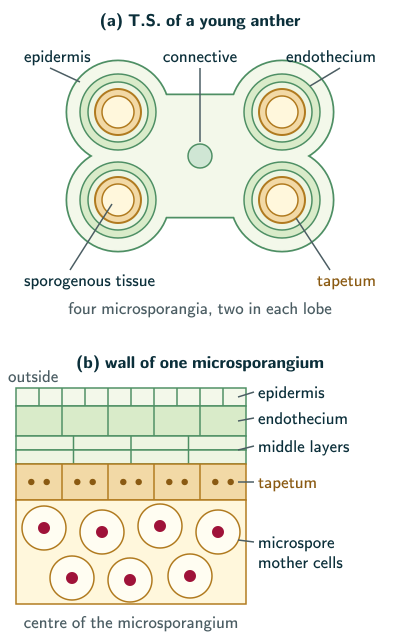
Structure of the microsporangium
In transverse section a typical microsporangium is near circular. It is generally surrounded by four wall layers, from outside in: the epidermis, endothecium, middle layers and tapetum (page 5). NCERT’s “middle layers” is plural, so the four are kinds of wall layer, and the middle band can be more than one cell thick (reasoned from NCERT page 5).
- The outer three layers protect the microsporangium and help in the dehiscence of the anther, to release the pollen (page 5).
- The tapetum is different:
The innermost wall layer is the tapetum. It nourishes the developing pollen grains.
NCERT Biology (Class 12), Section 1.2.1, page 5
- Tapetal cells have dense cytoplasm and generally have more than one nucleus (page 5). NCERT asks how they could become bi-nucleate. Our reasoning: the nucleus divides, but the cell does not, so two nuclei share one cytoplasm (as in the free-nuclear divisions you will meet in the embryo sac).
- In a young anther, a group of compactly arranged, homogeneous cells, the sporogenous tissue, occupies the centre of each microsporangium (page 5).
Microsporogenesis
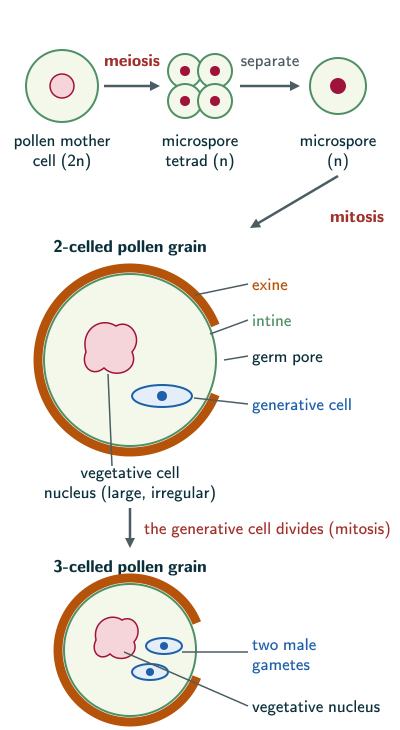
As the anther develops, the cells of the sporogenous tissue undergo meiosis to form microspore tetrads. Each sporogenous cell can give a tetrad, so each is a potential pollen mother cell (PMC), or microspore mother cell (pages 5–6).
The process of formation of microspores from a pollen mother cell (PMC) through meiosis is called microsporogenesis.
NCERT Biology (Class 12), Section 1.2.1, page 6
- The microspores, as they form, are arranged in a cluster of four cells, the microspore tetrad (page 6).
- As the anthers mature and dehydrate, the microspores separate from each other and develop into pollen grains (page 6).
- Each microsporangium forms several thousands of pollen grains, released when the anther dehisces (page 6).
- NCERT asks for the ploidy of the cells of the tetrad: meiosis halves the chromosome number, so a diploid PMC (2n) gives four haploid (n) microspores.
The pollen grain
The pollen grains represent the male gametophytes.
NCERT Biology (Class 12), Section 1.2.1, page 6
- Pollen grains are generally spherical, about 25–50 micrometres in diameter (page 7).
- Exine: the hard outer layer, made of sporopollenin, one of the most resistant organic materials known. It withstands high temperatures and strong acids and alkali, and NCERT states that no degrading enzyme is known. Pollen grains are well preserved as fossils because of it. The exine has prominent apertures, the germ pores, where sporopollenin is absent, and shows a fascinating array of patterns (page 7).
- NCERT asks why the exine should be hard and what the germ pore is for (page 7). Our reasoning: the hard sporopollenin exine protects the cells inside from heat, acids, alkali and decay while the pollen travels to a stigma; the germ pores, where sporopollenin is absent, are where the pollen tube comes out when the grain germinates on the stigma (page 16).
- Intine: the inner wall, thin and continuous, made of cellulose and pectin. A plasma membrane surrounds the cytoplasm (page 7).
- A mature pollen grain has two cells (page 7):
- the vegetative cell: bigger, with abundant food reserve and a large, irregularly shaped nucleus;
- the generative cell: small, spindle-shaped, with dense cytoplasm and a nucleus; it floats in the cytoplasm of the vegetative cell.
- In over 60 per cent of angiosperms, pollen grains are shed at this 2-celled stage. In the rest, the generative cell divides mitotically into the two male gametes before shedding: the 3-celled stage (page 7).
No enzyme that degrades sporopollenin is so far known.
NCERT Biology (Class 12), Section 1.2.1, page 7
How the tapetum helps build the pollen wall. NCERT says the tapetum nourishes the developing pollen grains (page 5) and that the exine is made of sporopollenin (page 7); NCERT Exercise 17 asks you to connect the two. Beyond the NCERT text, a review by Yao, Hu and Yang (Seed Biology, 2022; CC BY 4.0) lists what the tapetum supplies: it “provides enzymes to dissolve pectin and callose to release microspores from tetrads” and “synthesizes precursors for pollen wall formation”. So much of the sporopollenin exine is built from materials made by the tapetum, outside the pollen grain itself.
Pollen and people (pages 7–8):
- Pollen of many species causes severe allergies and bronchial afflictions in some people, often leading to chronic respiratory disorders such as asthma and bronchitis (page 7). Beyond the NCERT text, the US National Institute of Environmental Health Sciences (NIEHS, “Pollen”) says pollen in the air can trigger sneezing, congestion and watery eyes: the seasonal allergy also known as allergic rhinitis or hay fever. Parthenium, or carrot grass, came into India as a contaminant with imported wheat; it is now ubiquitous and causes pollen allergy (NCERT page 7).
- Pollen grains are rich in nutrients. Pollen tablets and syrups are sold as food supplements in western countries, and pollen consumption “has been claimed” to increase the performance of athletes and race horses; NCERT reports it only as a claim.
Pollen viability and pollen banks
Once shed, pollen must land on a stigma before it loses viability if it is to bring about fertilisation (page 8).
- The period of viability is highly variable and depends to some extent on the prevailing temperature and humidity (page 8).
- In some cereals such as rice and wheat, pollen loses viability within 30 minutes of release; in some members of Rosaceae, Leguminosae and Solanaceae, it stays viable for months (page 8).
- Pollen of a large number of species can be stored for years in liquid nitrogen at −196 °C. Such stored pollen can be used as pollen banks, like seed banks, in crop breeding programmes (page 8).
NCERT slip (page 8): the book prints the family name as “Leguminoseae”. The family is Leguminosae, also called Fabaceae (the family Leguminosae; beyond the NCERT text, Wikipedia’s article “Fabaceae” gives the same two names). In an exam, write Leguminosae or Fabaceae.
The pistil
The gynoecium is the female reproductive part of the flower (page 8).
- It may be a single pistil (monocarpellary) or more than one (multicarpellary). Several pistils may be fused (syncarpous, as in Papaver) or free (apocarpous, as in Michelia) (NCERT pages 8–9, Figure 1.7).
- The terms count carpels: NCERT Class 11 Biology says the gynoecium “is made up of one or more carpels” and calls fused carpels syncarpous (Chapter 5, page 65), and NCERT Figure 1.7 (b) calls the fused gynoecium of Papaver a “multicarpellary, syncarpous pistil” (page 9). So fused carpels form one compound pistil, and one pistil does not always mean one carpel (reasoned from NCERT). In an exam, keep NCERT’s terms from page 8: monocarpellary, multicarpellary, syncarpous (Papaver) and apocarpous (Michelia).
- Each pistil has three parts: the stigma, a landing platform for pollen grains; the style, the elongated slender part beneath the stigma; and the ovary, the basal bulged part (page 8).
- Inside the ovary is the ovarian cavity (locule), with the placenta in it; the placentation types are Class 11 work. Arising from the placenta are the megasporangia, commonly called ovules (pages 8–9).
- The number of ovules in an ovary may be one (wheat, paddy, mango) or many (papaya, water melon, orchids) (page 9).
Structure of the ovule
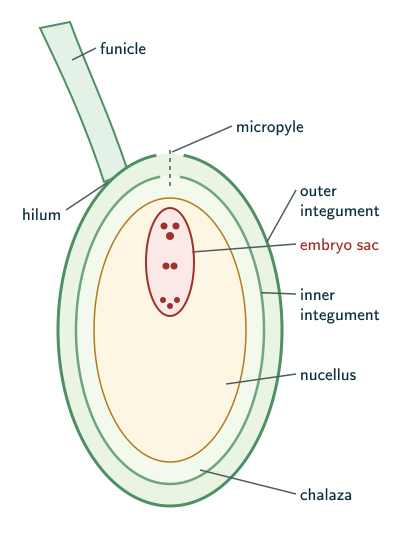
An ovule is a small structure attached to the placenta by a stalk, the funicle. The body of the ovule fuses with the funicle at the hilum (page 9).
Thus, hilum represents the junction between ovule and funicle.
NCERT Biology (Class 12), Section 1.2.2, page 9
- Integuments: each ovule has one or two protective envelopes. They encircle the nucellus except at the tip, where a small opening, the micropyle, is organised (page 9).
- Chalaza: opposite the micropylar end; it represents the basal part of the ovule (page 9).
- Nucellus: the mass of cells enclosed within the integuments; its cells have abundant reserve food (page 9).
- Embryo sac: the female gametophyte, located in the nucellus. An ovule generally has a single embryo sac, formed from a megaspore (page 9).
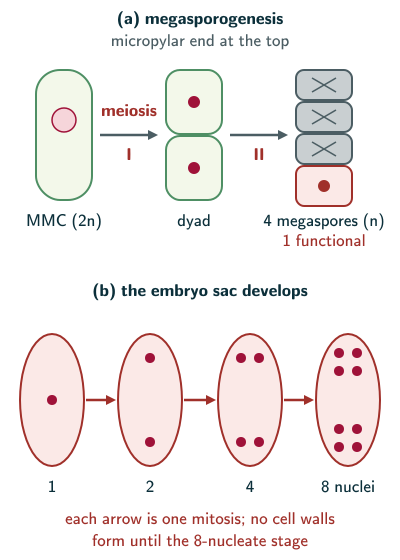
Megasporogenesis
The process of formation of megaspores from the megaspore mother cell is called megasporogenesis.
NCERT Biology (Class 12), Section 1.2.2, page 9
- Ovules generally differentiate a single megaspore mother cell (MMC) in the micropylar region of the nucellus. It is a large cell with dense cytoplasm and a prominent nucleus (pages 9–10).
- The MMC undergoes meiosis, which gives four megaspores (page 10).
- NCERT asks why the MMC must undergo meiosis. Our reasoning: meiosis makes the megaspores, and so the embryo sac and its egg, haploid; fertilisation then restores the diploid number in the zygote, so the chromosome number stays the same from one generation to the next.
The two processes side by side (NCERT pages 5–10):
- Microsporogenesis: in the anther, inside each microsporangium; many pollen mother cells; meiosis; microspore tetrads, which become pollen grains.
- Megasporogenesis: in the ovule, inside the nucellus; usually a single megaspore mother cell; meiosis; four megaspores, of which one forms the embryo sac.
The female gametophyte: the embryo sac
In a majority of flowering plants, one megaspore is functional and the other three degenerate. Only the functional megaspore develops into the female gametophyte, the embryo sac (page 10).
This method of embryo sac formation from a single megaspore is termed monosporic development.
NCERT Biology (Class 12), Section 1.2.2, page 10
Ploidy (NCERT asks this on page 10): the nucellus is diploid (2n) like the rest of the ovule; the MMC is 2n; the functional megaspore is n; the female gametophyte is n. Its egg, synergid and antipodal nuclei and the two polar nuclei of the central cell are all haploid (reasoned from NCERT pages 10–11, and NCERT Section 1.3, page 18, where triple fusion joins three haploid nuclei).
How the embryo sac forms (page 11):
- The nucleus of the functional megaspore divides mitotically into two nuclei, which move to opposite poles: the 2-nucleate embryo sac.
- Two more sequential mitotic nuclear divisions give the 4-nucleate and then the 8-nucleate stages.
- These divisions are strictly free nuclear: nuclear division is not followed immediately by cell wall formation. Only after the 8-nucleate stage are cell walls laid down.
- NCERT describes one mitotic division and then “two more”: three in all, one round after another. If you count every nucleus that divides, the three rounds make 1 + 2 + 4 = 7 nuclear divisions (reasoned from NCERT page 11). In an NCERT-based answer, say the embryo sac forms by three free-nuclear mitotic divisions.
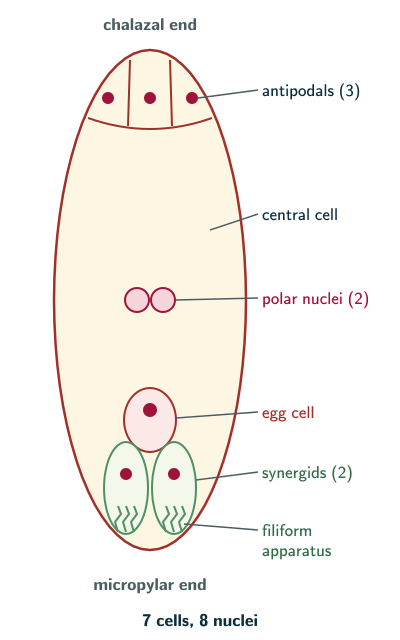
The mature embryo sac (page 11): six of the eight nuclei are surrounded by cell walls and organised into cells; the remaining two, the polar nuclei, lie below the egg apparatus in the large central cell.
- Micropylar end: three cells form the egg apparatus: two synergids and one egg cell. The synergids have special cellular thickenings at the micropylar tip, the filiform apparatus, which guide the pollen tube into the synergid.
- Chalazal end: three cells, the antipodals.
- Centre: the large central cell with two polar nuclei.
Thus, a typical angiosperm embryo sac, at maturity, though 8-nucleate is 7-celled.
NCERT Biology (Class 12), Section 1.2.2, page 11
| Part | Cells | Nuclei |
|---|---|---|
| Antipodals | 3 | 3 |
| Synergids | 2 | 2 |
| Egg cell | 1 | 1 |
| Central cell | 1 | 2 (polar nuclei) |
| Total | 7 | 8 |
Pollination
The male and female gametes are made in the pollen grain and the embryo sac. Both are non-motile, so they have to be brought together for fertilisation (page 11).
Transfer of pollen grains (shed from the anther) to the stigma of a pistil is termed pollination.
NCERT Biology (Class 12), Section 1.2.3, page 11
Flowering plants have evolved an amazing array of adaptations for pollination, and they make use of external agents to achieve it (page 11). Self-pollination can also happen without an agent: cleistogamous flowers are invariably autogamous and produce assured seed-set even in the absence of pollinators (NCERT page 12).
Autogamy, geitonogamy and xenogamy
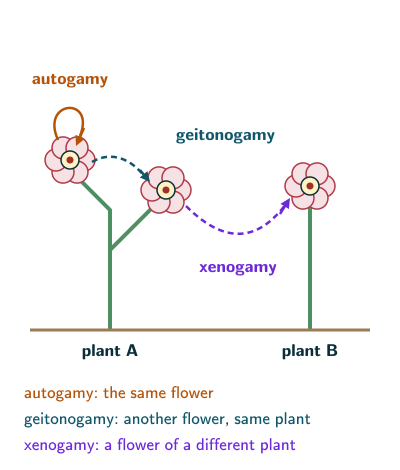
By the source of the pollen, pollination is of three kinds (pages 11–12):
- Autogamy: pollen from the anther to the stigma of the same flower. In a normal flower that opens and exposes its anthers and stigma, complete autogamy is rather rare: it needs pollen release and stigma receptivity in synchrony, and anthers and stigma lying close together.
- Geitonogamy: pollen from the anther to the stigma of another flower of the same plant. It is functionally cross-pollination, since it needs a pollinating agent, but genetically it is similar to autogamy, because the pollen comes from the same plant.
- Xenogamy: pollen from the anther to the stigma of a different plant.
This is the only type of pollination which during pollination brings genetically different types of pollen grains to the stigma.
NCERT Biology (Class 12), Section 1.2.3, page 12
NCERT’s “genetically different” compares plants: only in xenogamy does the pollen come from another plant, with that plant’s genes. A plant’s own pollen grains need not all be alike either: NCERT Chapter 4 notes that a heterozygous parent produces two kinds of gametes (Section 4.2.2, page 59). In an exam, keep NCERT’s line: xenogamy is the only type of pollination that brings genetically different pollen to the stigma (reasoned from NCERT pages 12 and 59).
Chasmogamous and cleistogamous flowers
Some plants, such as Viola (common pansy), Oxalis and Commelina, produce two types of flowers (page 12):
- Chasmogamous flowers, like the flowers of other species, with exposed anthers and stigma.
- Cleistogamous flowers, which do not open at all. Their anthers and stigma lie close together; when the anthers dehisce in the bud, pollen reaches the stigma. They are therefore invariably autogamous, with no chance of cross-pollen landing on the stigma, and they give assured seed-set even without pollinators.
NCERT asks whether cleistogamy is an advantage or a disadvantage to the plant (page 12). Our reasoning: it is an advantage in that seed-set is assured; it is a disadvantage in that the seeds come only from self-pollination, which brings in no pollen, and so no genes, from another plant, and continued self-pollination results in inbreeding depression (page 15).
Agents of pollination
Plants use two abiotic agents (wind and water) and one biotic agent (animals). A majority of plants use biotic agents; only a small proportion use abiotic ones (page 12). With wind and water, pollen reaching a stigma is a matter of chance, so such flowers make an enormous amount of pollen compared with the number of ovules (page 12).
Wind (more common of the two abiotic agents; page 13):
- pollen grains are light and non-sticky, so wind currents carry them;
- stamens are well exposed, and stigmas are large and often feathery, to trap airborne pollen;
- flowers often have a single ovule in each ovary, and numerous flowers are packed into an inflorescence;
- NCERT’s familiar example is the corn cob: “the ears you see are nothing but the stigma and style which wave in the wind to trap pollen grains” (page 13).
- NCERT slip (page 13): the threads that wave in the wind are not the ears; they are the long styles, the silks. Beyond the NCERT text, a CC BY paper says “The styles of maize/corn are called silks”: they emerge from the tips of the cobs, each silk leads to one ovule that can become one grain, and the pollen is shed by the tassel, the male inflorescence (Thompson and Raizada, Microorganisms, 2024; CC BY 4.0). In an exam, the silks of a corn cob are its styles and stigmas; the tassel is male.
- Wind-pollination is quite common in grasses (page 13).
Water (quite rare: limited to about 30 genera, mostly monocotyledons; page 13):
- Examples: Vallisneria and Hydrilla in fresh water, and several marine sea-grasses such as Zostera.
- In Vallisneria, the female flower reaches the water surface on a long stalk; male flowers or pollen are released onto the surface and carried passively by currents; some reach the female flowers and the stigma.
- In sea-grasses, the female flowers stay submerged and the pollen is released inside the water; the pollen of many such species is long and ribbon-like.
- In most water-pollinated species, a mucilaginous covering protects the pollen from wetting.
- Not all aquatic plants use water: in a majority, such as water hyacinth and water lily, the flowers emerge above the water and are pollinated by insects or wind.
- Wind- and water-pollinated flowers are not very colourful and make no nectar (page 13). NCERT asks why; our reasoning: they need not attract animals.
Animals (pages 14–15):
- The common pollinators are bees, butterflies, flies, beetles, wasps, ants, moths, birds (sunbirds and humming birds) and bats; insects, particularly bees, are the dominant biotic agents. Lemurs, arboreal rodents and reptiles (gecko lizard and garden lizard) are reported as pollinators in some species.
- Flowers are often specifically adapted to a particular species of animal.
- Most insect-pollinated flowers are large, colourful, fragrant and rich in nectar; small flowers are clustered into an inflorescence to be conspicuous. Flowers pollinated by flies and beetles secrete foul odours.
- Rewards: nectar and pollen are the usual rewards. While collecting them, the animal touches the anthers and the stigma; its body gets a coat of pollen, which is generally sticky in animal-pollinated flowers, and pollination happens when it touches a stigma.
- Safe places to lay eggs: in some species this is the reward; an example is the tallest flower of Amorphophallus, about 6 feet in height (page 14). The moth and the plant Yucca cannot complete their life cycles without each other: the moth lays its eggs in the locule of the ovary, the flower is pollinated by the moth, and the larvae come out as the seeds start developing (pages 14–15).
- Pollen/nectar robbers: insects that consume pollen or nectar without bringing about pollination (page 15).
NCERT slip (page 14): NCERT calls the 6-foot structure of Amorphophallus a flower; botanically it is an inflorescence. Beyond the NCERT text, the US Botanic Garden (“Titan arum”, public domain) describes a spathe round a central spadix, with the female flowers lowest on the stalk and the male flowers above them, and gives the average recorded inflorescence as about 5 feet. In an exam, answer Amorphophallus for NCERT’s “tallest flower” and use NCERT’s 6 feet.
Outbreeding devices
A majority of flowering plants have hermaphrodite (bisexual) flowers, so their pollen is likely to reach the stigma of the same flower (page 15).
Continued self-pollination result in inbreeding depression.
NCERT Biology (Class 12), Section 1.2.3, page 15
Beyond the NCERT text, Wikipedia’s article “Inbreeding depression” gives the usual reason: the offspring of very closely related parents are more likely to carry harmful genes in the homozygous state, which can make them less fit. Self-pollination is the closest kind of inbreeding, since both gametes come from one plant (reasoned from NCERT pages 12 and 15).
Flowering plants have evolved several devices that discourage self-pollination and encourage cross-pollination (page 15):
- Pollen release and stigma receptivity are not synchronised: pollen is released before the stigma is receptive, or the stigma becomes receptive well before the pollen is released.
- Anther and stigma at different positions, so the pollen cannot touch the stigma of the same flower.
- Self-incompatibility: a genetic mechanism that stops self-pollen (from the same flower or other flowers of the same plant) from fertilising the ovules, by inhibiting pollen germination or pollen tube growth in the pistil.
- Unisexual flowers: if male and female flowers are on the same plant (monoecious, as castor and maize), autogamy is prevented but not geitonogamy; if they are on different plants (dioecy, as papaya), both autogamy and geitonogamy are prevented.
| Device | Prevents |
|---|---|
| Timing or position (1, 2) | autogamy |
| Self-incompatibility (3) | fertilisation by pollen of the same flower or of other flowers of the same plant |
| Monoecy | autogamy, not geitonogamy |
| Dioecy | autogamy and geitonogamy |
(NCERT page 15.)
Pollen–pistil interaction
Pollination does not guarantee that the right type of pollen arrives (compatible pollen of the same species as the stigma). Pollen of other species, or self-pollen in a self-incompatible plant, also lands on the stigma (page 15).
- The pistil recognises the pollen. Compatible pollen is accepted and post-pollination events leading to fertilisation follow; incompatible pollen is rejected, either by preventing pollen germination on the stigma or by stopping pollen tube growth in the style (pages 15–16).
- This recognition is the result of a continuous dialogue between pollen and pistil, mediated by chemical components of the pollen interacting with those of the pistil (page 16).
After compatible pollination (pages 16–17):
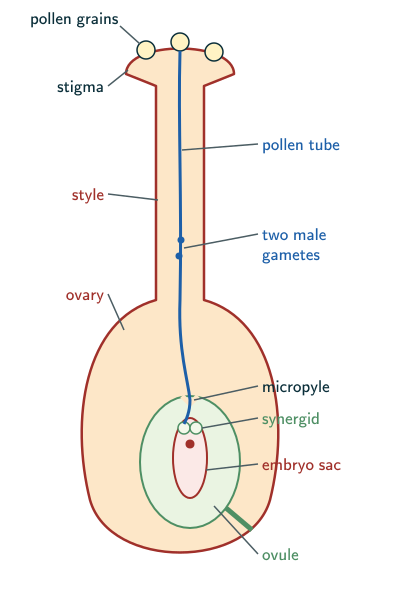
- The pollen grain germinates on the stigma and puts out a pollen tube through one of its germ pores; its contents move into the tube.
- The tube grows through the tissues of the stigma and style to the ovary.
- If the pollen was shed at the 2-celled stage, the generative cell divides into the two male gametes while the tube grows in the stigma; if it was shed at the 3-celled stage, the tube carries the two male gametes from the start.
- In the ovary, the tube enters the ovule through the micropyle, then enters one of the synergids through the filiform apparatus, which guides it.
All these events–from pollen deposition on the stigma until pollen tubes enter the ovule–are together referred to as pollen-pistil interaction.
NCERT Biology (Class 12), Section 1.2.3, page 17
- NCERT’s Summary words the end point differently: “until the pollen tube enters the embryo sac” (page 24). Both describe the same path, since the tube enters the ovule through the micropyle and then the embryo sac through a synergid; for a definition, use the main text’s “until pollen tubes enter the ovule” (page 17).
- Knowing these interactions helps a plant breeder manipulate pollen–pistil interaction, even in incompatible pollinations, to get desired hybrids (page 17).
- Try it (page 17): dust pollen of pea, chickpea, Crotalaria, balsam or Vinca on a drop of about 10 per cent sugar solution on a slide; after about 15–30 minutes, pollen tubes are likely to be seen under the low-power lens.
Artificial hybridisation: emasculation and bagging
A breeder crosses different species, and often genera, to combine desirable characters into commercially ‘superior’ varieties. Artificial hybridisation is one of the major approaches of crop improvement; it works only if just the desired pollen is used and the stigma is protected from unwanted pollen (page 17).
Female parent with bisexual flowers (page 17):
- Emasculation: remove the anthers from the flower bud before the anthers dehisce, using a pair of forceps.
- Bagging: cover the emasculated flower with a bag of suitable size, generally of butter paper, so no unwanted pollen reaches its stigma.
- When the stigma becomes receptive, dust it with mature pollen collected from the anthers of the male parent.
- Rebag the flower and let the fruits develop.
Female parent with unisexual flowers: no emasculation is needed. Bag the female flower buds before they open, pollinate with the desired pollen when the stigma becomes receptive, and rebag (page 17).
Solved examples
Example 1: Microsporogenesis and megasporogenesis (NCERT Exercise 2)
Differentiate between microsporogenesis and megasporogenesis. Which type of cell division occurs during these events? Name the structures formed at the end.
Answer: microsporogenesis is the formation of microspores from a pollen mother cell in the anther; megasporogenesis is the formation of megaspores from the megaspore mother cell in the nucellus of the ovule. Both use meiosis. Microsporogenesis ends with microspore tetrads, which become pollen grains; megasporogenesis ends with four megaspores, one of which forms the embryo sac (NCERT pages 6, 9 and 10).
Example 2: The developmental sequence (NCERT Exercise 3)
Arrange in the correct developmental sequence: pollen grain, sporogenous tissue, microspore tetrad, pollen mother cell, male gametes.
Answer: sporogenous tissue → pollen mother cell → microspore tetrad → pollen grain → male gametes (NCERT pages 5–7).
Example 3: Seven cells, eight nuclei (NCERT Exercises 5 and 6)
What is monosporic development? How many mitotic divisions make the embryo sac, and why is it 7-celled but 8-nucleate?
Answer: monosporic development is the formation of the embryo sac from a single functional megaspore (NCERT page 10). Its nucleus divides mitotically, and two more sequential free-nuclear divisions follow, three in all: 1 → 2 → 4 → 8 nuclei, that is 2 = 8. Walls then form round six nuclei (three antipodals, two synergids, one egg), and the remaining two polar nuclei share the central cell: 6 + 1 = 7 cells and 6 + 2 = 8 nuclei (NCERT page 11).
Example 4: Counting meiotic divisions for seeds
What is the theoretical minimum number of meiotic divisions needed for 80 sexually produced seeds, assuming typical monosporic embryo sacs and every required pollen grain succeeds?
Answer: each seed comes from one ovule, whose embryo sac comes from one megaspore mother cell: 80 meioses. Each ovule is fertilised by one pollen tube, which brings both male gametes (one for syngamy, one for triple fusion; NCERT page 18), so 80 pollen grains are needed. One pollen mother cell gives a tetrad of 4 pollen grains, so 80 ÷ 4 = 20 meioses. Total: 80 + 20 = 100 meiotic divisions. This is an ideal minimum; a real plant makes far more pollen than that, since each microsporangium forms several thousands of pollen grains (NCERT page 6).
Example 5: Outbreeding devices and self-incompatibility (NCERT Exercises 8 and 9)
Name two strategies that prevent self-pollination. What is self-incompatibility, and why does self-pollination not lead to seed formation in a self-incompatible species?
Answer: any two of: pollen release and stigma receptivity not synchronised; anther and stigma at different positions; unisexual flowers (NCERT page 15). Self-incompatibility does not stop self-pollen from landing on the stigma; NCERT calls it a device “to prevent inbreeding”. It is a genetic mechanism that stops self-pollen from fertilising the ovules: the pistil inhibits its germination on the stigma or the growth of its pollen tube in the pistil. With no pollen tube reaching the ovule, no male gametes reach the egg, so no seed forms (NCERT pages 15–16).
Example 6: Bagging and emasculation (NCERT Exercises 10 and 15)
What are emasculation and bagging, and when does a breeder use them?
Answer: emasculation is removing the anthers from a bud of a bisexual flower before they dehisce; bagging is covering the flower with a bag, generally of butter paper, so no unwanted pollen reaches the stigma. A breeder uses them in artificial hybridisation, so that only pollen from the chosen male parent pollinates the female parent. A female parent with unisexual flowers needs bagging but no emasculation (NCERT page 17).
Common mistakes to avoid
Common mistake
Calling the tapetum a protective layer
The outer three wall layers (epidermis, endothecium, middle layers) protect and help dehiscence; the innermost layer, the tapetum, nourishes the developing pollen grains (NCERT page 5).
Common mistake
Swapping exine and intine
The exine is the hard outer layer of sporopollenin, with germ pores; the intine is the thin inner layer of cellulose and pectin (NCERT page 7).
Common mistake
Calling the embryo sac 8-celled
It has 8 nuclei but 7 cells: the two polar nuclei share one central cell (NCERT page 11).
Common mistake
Putting the filiform apparatus on the egg
The filiform apparatus is on the synergids, at their micropylar tips, and it guides the pollen tube into a synergid (NCERT page 11).
Common mistake
Treating geitonogamy as genetic cross-pollination
Geitonogamy needs a pollinator, but the pollen comes from the same plant, so genetically it is like autogamy; only xenogamy brings genetically different pollen (NCERT page 12).
Common mistake
Saying monoecy prevents geitonogamy
Male and female flowers on the same plant (castor, maize) prevent autogamy only; dioecy (papaya) prevents both (NCERT page 15).
Quick revision summary
- A typical anther is bilobed, dithecous and tetrasporangiate; the microsporangium wall has four layers: epidermis, endothecium, middle layers and the nourishing tapetum.
- Microsporogenesis: a pollen mother cell (2n) divides by meiosis into a tetrad of haploid microspores, which become pollen grains, the male gametophytes.
- Pollen wall: exine of sporopollenin with germ pores; intine of cellulose and pectin. Pollen is shed 2-celled (vegetative and generative cell; over 60 per cent of angiosperms) or 3-celled (vegetative cell and two male gametes).
- Pollen viability varies (lost within 30 minutes in rice and wheat, months in some families); pollen can be stored for years in liquid nitrogen at −196 °C in pollen banks.
- Ovule: funicle, hilum, integuments, micropyle, chalaza, nucellus and embryo sac.
- Megasporogenesis: the MMC divides by meiosis into four megaspores; one is functional (monosporic development) and, by three free-nuclear mitoses, gives the 7-celled, 8-nucleate embryo sac.
- Pollination: autogamy, geitonogamy, xenogamy; cleistogamous flowers are invariably autogamous. Agents: wind, water (about 30 genera), animals.
- Outbreeding devices: timing, position, self-incompatibility, unisexual flowers (monoecy stops autogamy only; dioecy stops both).
- Pollen–pistil interaction runs from pollen landing on the stigma until the pollen tube enters the ovule; breeders use emasculation and bagging in artificial hybridisation.
Formula sheet
- anther: bilobed, dithecous (2 thecae), 4 microsporangia
- wall: epidermis, endothecium, middle layers, tapetum (nourishes)
- PMC (2n) undergoes meiosis → microspore tetrad (n) → pollen grains
- exine: sporopollenin, germ pores; intine: cellulose and pectin
- MMC (2n) → meiosis → 4 megaspores; 1 functional
- embryo sac: 3 free-nuclear mitoses, 1 → 2 → 4 → 8 nuclei
- embryo sac: 7 cells, 8 nuclei
- xenogamy: pollen from a different plant, the only genetically different pollen
- monoecy stops autogamy; dioecy stops autogamy and geitonogamy
Questions students ask
What is the difference between pollination and fertilisation?
Pollination is, in NCERT’s words, the “transfer of pollen grains (shed from the anther) to the stigma of a pistil” (page 11), while fertilisation is the fusion of gametes in the embryo sac: one male gamete fuses with the egg, giving the zygote, and the other with the two polar nuclei (page 18). Pollination comes first; fertilisation follows only after a compatible pollen tube has grown through the style, entered an ovule through the micropyle and released its two male gametes into a synergid (pages 17–18). So pollination does not guarantee fertilisation: the pistil rejects incompatible pollen by preventing its germination on the stigma or its tube’s growth in the style (pages 15–16).
What is the difference between an ovule and an embryo sac?
The ovule is the megasporangium, the whole structure joined to the placenta by its funicle, with one or two integuments wrapped round a mass of cells, the nucellus, while the embryo sac is the female gametophyte that develops inside that nucellus, in most flowering plants from a single functional megaspore (NCERT pages 9–10). So the embryo sac, not the ovule, is the female counterpart of the pollen grain; by NCERT’s names, the ovule as a whole matches a microsporangium, and it is the ovule that becomes the seed (pages 5, 9 and 20). Nor is the embryo sac an embryo: the embryo develops later, from the zygote formed at fertilisation, at the micropylar end of the embryo sac (page 19).
Why is the pollen grain called the male gametophyte?
The pollen grain is called the male gametophyte because it is the haploid generation that produces the male gametes: it develops from a microspore, one of the four cells a pollen mother cell gives by meiosis, and its generative cell divides by mitosis into two male gametes (NCERT pages 6–7). NCERT’s Summary calls pollen grains “the male gametophytic generation” (page 23). In over 60 per cent of angiosperms that division waits until the pollen tube is growing in the stigma, while in the rest it happens before the pollen is shed (pages 7 and 17).
Is a microsporangium the same as a pollen sac?
A pollen sac is a microsporangium at a later stage: NCERT says the four microsporangia of a typical anther, two in each lobe, “develop further and become pollen sacs”, which run the length of the anther and are “packed with pollen grains” (page 5). So “microsporangium” (plural microsporangia) names the young sporangium, with its wall layers round the sporogenous tissue, and “pollen sac” the same chamber once it is full of pollen, while the anther is the whole bilobed head of the stamen that carries all four (page 5).
What is a floral primordium?
A floral primordium is the young structure from which a flower develops (our reading of NCERT): NCERT says that, long before any flower is visible, hormonal and structural changes lead to “the differentiation and further development of the floral primordium”, after which the inflorescence, its buds and finally the flowers appear (NCERT Class 12, page 4). NCERT Class 11 gives the change behind it: in a flower “the shoot apical meristem changes to floral meristem”, so the shoot tip forms floral parts, node after node, where it would otherwise form leaves (Chapter 5, page 61; see the flower as a modified shoot).
Practice questions
Try each question first, then open the answer to check your working.
-
Q1. Which wall layer of the microsporangium nourishes the developing pollen grains, and what is unusual about its cells?
Show answerHide answer
The tapetum, the innermost layer. Its cells have dense cytoplasm and generally more than one nucleus (NCERT page 5).
-
Q2. What is the ploidy of the nucellus, the megaspore mother cell, the functional megaspore and the female gametophyte?
Show answerHide answer
2n, 2n, n and n (reasoned from NCERT pages 9–10). The large central cell has two polar nuclei, each haploid (NCERT pages 11 and 18).
-
Q3. What are chasmogamous flowers? Can cross-pollination occur in cleistogamous flowers? (NCERT Exercise 7)
Show answerHide answer
Chasmogamous flowers open and expose their anthers and stigma, like the flowers of other species. Cross-pollination cannot occur in cleistogamous flowers: they do not open at all, and their anthers shed pollen onto the stigma in the bud, so there is no chance of cross-pollen landing on the stigma (NCERT page 12).
-
Q4. Name two water-pollinated plants of fresh water and one marine example.
Show answerHide answer
Vallisneria and Hydrilla in fresh water; sea-grasses such as Zostera in the sea (NCERT page 13).