Inflorescence
NCERT Class 11 Biology Chapter 5 Section 5.4
Quick answer
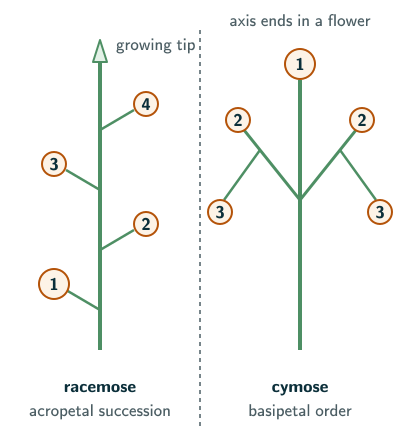
Inflorescence is the arrangement of flowers on the floral axis, and a flower is itself a modified shoot whose apical meristem becomes a floral meristem. In a racemose inflorescence the main axis keeps growing and flowers are borne laterally in acropetal succession, oldest at the base. In a cymose inflorescence the axis ends in a flower, so its growth is limited, and flowers are borne in basipetal order, oldest at the top.
With your textbook
NCERT Biology (Class 11), Chapter 5 “Morphology of Flowering Plants”, Section 5.4 “The Inflorescence”, page 61.
Open the official NCERT chapter (PDF, 3.4 MB, ncert.nic.in) (opens in a new tab)
Checked against the 2026-27 reprint on .
What is an inflorescence?
Inflorescence
The arrangement of flowers on the floral axis is termed as inflorescence.
NCERT Biology (Class 11), Section 5.4, page 61
- Inflorescences are of two major types: racemose, where the apex of the main axis continues to grow, and cymose, where it develops into a flower (page 61).
- A flower is itself a modified shoot.
In plain words: flowers are arranged on the flowering axis in definite patterns. If the tip of the flowering axis keeps growing and new flowers keep appearing near it, the pattern is racemose. If the tip itself turns into a flower and stops, new flowers can only appear lower down, and the pattern is cymose. Flowers are what make angiosperms the flowering plants.
The flower as a modified shoot
A flower is a modified shoot wherein the shoot apical meristem changes to floral meristem.
NCERT Biology (Class 11), Section 5.4, page 61
In a flower the internodes do not elongate, so the axis gets condensed, and the apex produces different kinds of floral appendages laterally at successive nodes instead of leaves (page 61). These floral appendages are the four whorls, calyx, corolla, androecium and gynoecium, on the thalamus (NCERT Section 5.5, page 62). Beyond the NCERT text: they stand in place of leaves and are regarded as modified leaves.
NCERT adds: “When a shoot tip transforms into a flower, it is always solitary” (page 61). That is too broad: in a cymose inflorescence the main axis also ends in a flower, yet more flowers arise below it (NCERT Figure 5.8, page 62). Read NCERT’s line as being about a single flower at the end of a shoot.
Racemose inflorescence
In racemose inflorescences the main axis continues to grow, and the flowers are borne laterally in an acropetal succession (page 61).
Cymose inflorescence
In cymose inflorescences the main axis terminates in a flower, so its growth is limited, and the flowers are borne in a basipetal order (page 61).
Beyond the NCERT text: “acropetal” means towards the apex and “basipetal” towards the base, describing the direction in which younger flowers appear: the oldest racemose flowers are at the base, the oldest cymose flower at the tip.
Solved examples
Example 1: Racemose and cymose (NCERT Exercise Q4)
Differentiate between racemose and cymose inflorescence.
Answer:
| Feature | Racemose | Cymose |
|---|---|---|
| Main axis | continues to grow | terminates in a flower |
| Growth of the axis | not ended by a flower | limited |
| Flowers | borne laterally | the first ends the main axis |
| Order | acropetal succession | basipetal order |
(NCERT page 61.) Beyond the NCERT text: in acropetal succession the oldest flowers are at the base, and in basipetal order the oldest flower is at the tip. Mustard is a common example of a racemose inflorescence and jasmine of a cymose one.
Example 2: The basis of the types (NCERT Exercise Q9)
Define inflorescence and explain the basis for its different types.
Answer: inflorescence is the arrangement of flowers on the floral axis. The two major types are defined by what happens at the apex of the axis: if it continues to grow, the inflorescence is racemose; if it develops into a flower, it is cymose (NCERT page 61). So racemose flowers are lateral, in acropetal succession, and cymose flowers are in basipetal order.
Example 3: What makes a flower a shoot
Give two ways in which a flower shows that it is a modified shoot.
Answer: its shoot apical meristem has changed to a floral meristem, and its internodes do not elongate, so the axis is condensed, with floral appendages at successive nodes in place of leaves (NCERT page 61).
Example 4: Solitary flower or cyme?
A shoot tip has become a flower. Does that alone make the flower solitary?
Answer: no. NCERT says that when a shoot tip transforms into a flower, it is always solitary (page 61), but in a cymose inflorescence the main axis also terminates in a flower, and younger flowers arise below it (NCERT Figure 5.8, page 62). Look below the flower: if more flowers follow there, it is a cyme.
Example 5: Reading a diagram
An axis carries buds near its tip and open flowers lower down, and the tip is still growing. Name the inflorescence and the order of its flowers.
Answer: racemose, with flowers in acropetal succession (NCERT page 61).
Common mistakes to avoid
Common mistake
Swapping acropetal and basipetal
Racemose flowers appear in acropetal succession (oldest at the base); cymose flowers in basipetal order (oldest at the top).
Common mistake
Saying the racemose axis ends in a flower
In racemose inflorescences the main axis continues to grow; it is the cymose axis that terminates in a flower.
Common mistake
Forgetting that a flower is a shoot
NCERT calls the flower a modified shoot: its apical meristem becomes a floral meristem and its internodes stay short.
Quick revision summary
- Inflorescence: the arrangement of flowers on the floral axis.
- A flower is a modified shoot: the shoot apical meristem becomes a floral meristem, internodes do not elongate, and floral appendages arise at successive nodes.
- Racemose: the main axis keeps growing; flowers lateral, in acropetal succession.
- Cymose: the main axis ends in a flower; growth limited; flowers in basipetal order.
Formula sheet
- inflorescence: arrangement of flowers on the floral axis
- racemose: axis keeps growing; acropetal (oldest at the base)
- cymose: axis ends in a flower; basipetal (oldest at the top)
- flower: modified shoot; apical meristem → floral meristem
Questions students ask
What are the types of racemose inflorescence?
Racemose (indeterminate) inflorescences, whose main axis keeps growing, are grouped by the shape of that axis; the raceme is just one type. A long axis bears stalked flowers in a raceme (mustard), stalkless ones in a spike (Achyranthes), unisexual ones on a drooping axis in a catkin (mulberry), and crowded ones on a fleshy axis wrapped in a large bract in a spadix (Colocasia); a short axis gives a corymb, its flowers brought to one level by longer lower stalks (candytuft), or an umbel, equal stalks from one point (onion). A flattened axis bears a capitulum (sunflower). These subtypes are beyond the NCERT text.
What are the types of cymose inflorescence?
Cymose (determinate) inflorescences are classed by how many lateral branches arise below each terminal flower: one in a monochasial cyme, two in a dichasial cyme, as in Dianthus, and more than two in a polychasial cyme, as in Calotropis (beyond the NCERT text). A monochasial cyme is called helicoid when the successive branches all arise on the same side and scorpioid when they arise on alternate sides. In every type the main axis ends in a flower and the flowers are borne in basipetal order (NCERT page 61).
What are special types of inflorescence?
Special types of inflorescence are ones that fit neither the simple racemose nor the simple cymose plan, the best known being the cyathium, the verticillaster and the hypanthodium (beyond the NCERT text). A cyathium, as in Euphorbia, is a cup of bracts holding one female flower and several male flowers, each male flower reduced to a single stamen; a verticillaster, as in tulsi (Ocimum), is a pair of small cymes in the axils of opposite leaves that looks like a whorl of flowers; and a hypanthodium, as in the fig (Ficus), is a hollow, fleshy receptacle with tiny flowers lining its inside. The NEET (UG) 2026 syllabus names only ‘inflorescence - cymose and recemose’.
Practice questions
Try each question first, then open the answer to check your working.
-
Q1. Why is the growth of the main axis limited in a cymose inflorescence?
Show answerHide answer
Because the main axis terminates in a flower (NCERT page 61).
-
Q2. Assertion: in a cymose inflorescence the oldest flower is at the top. Reason: the main axis terminates in a flower. Are both true, and does the reason explain the assertion?
Show answerHide answer
Both are true, and the reason explains the assertion: the main axis ends in the first flower, and later ones arise below it, in basipetal order (NCERT page 61).
-
Q3. NCERT uses “acropetal” for leaves as well as for flowers. Where?
Show answerHide answer
Leaves originate from shoot apical meristems and are arranged in an acropetal order (NCERT page 59); in racemose inflorescences the flowers are borne laterally in an acropetal succession (page 61). In both, the youngest are nearest the growing tip.
-
Q4. On a flat axis such as the sunflower head, where are the oldest flowers when the succession is acropetal?
Show answerHide answer
At the rim: on a flattened axis, acropetal succession appears as centripetal order, the oldest flowers outermost and the youngest at the centre (beyond the NCERT text).