Semi-technical description
NCERT Class 11 Biology Chapter 5 Section 5.8
Quick answer
A semi-technical description describes a flowering plant briefly, in simple scientific terms and a fixed order: habit, vegetative characters, floral characters, then a floral diagram and a floral formula. In the formula K, C, A and G stand for calyx, corolla, androecium and gynoecium, brackets show fusion, and a line under or over G marks a superior or inferior ovary. Mustard’s formula is ⊕ ⚥ K2+2 C4 A2+4 G(2), with the G underlined for a superior ovary.
With your textbook
NCERT Biology (Class 11), Chapter 5 “Morphology of Flowering Plants”, Section 5.8 “Semi-technical Description of a Typical Flowering Plant”, pages 67–68.
Open the official NCERT chapter (PDF, 3.4 MB, ncert.nic.in) (opens in a new tab)
Checked against the 2026-27 reprint on .
What is a semi-technical description?
Semi-technical description
Various morphological features are used to describe a flowering plant.
NCERT Biology (Class 11), Section 5.8, page 67
- After the parts of the plant are described, a floral diagram and a floral formula are presented (page 67).
In plain words: botanists describe every flowering plant in the same order and with the same terms, like filling in a standard form, so that any two descriptions can be compared at a glance. NCERT’s chapter Summary gives the reason: floral characteristics form the basis of classification and identification of flowering plants (pages 69–70).
The order of description
The description has to be brief, in a simple and scientific language and presented in a proper sequence.
NCERT Biology (Class 11), Section 5.8, page 67
NCERT gives the sequence (page 67):
- Habit of the plant.
- Vegetative characters: roots, stem and leaves.
- Floral characters: inflorescence and flower parts.
- A floral diagram and a floral formula.
The floral formula and its symbols
The floral formula sums up a flower in symbols (pages 67–68):
| Symbol | Stands for |
|---|---|
| Br | bracteate |
| K | calyx |
| C | corolla |
| P | perianth |
| A | androecium |
| G | gynoecium |
| G with a line below | superior ovary |
| G with a line above | inferior ovary |
| ♂ | male |
| ♀ | female |
| ⚥ | bisexual |
| ⊕ | actinomorphic |
| % | zygomorphic |
- NCERT’s formulas (pages 67 and 69) put symmetry and sex first, then K and C (or P for both), A and G.
- The numbers count members; in mustard A2+4 records two outer and four inner stamens. A plus sign can also separate groups within a whorl: pea A(9)+1 means nine fused filaments and one free, not two stamen whorls.
- Fusion is shown by putting the number in brackets: G(2) means two fused carpels. Fusion of members of the same whorl is called cohesion.
- Adhesion, one whorl joined to another, is shown by a line drawn above the symbols of the floral parts (page 68).
- The floral formula also shows cohesion and adhesion within the parts of a whorl and between whorls (page 68).
For mustard, NCERT’s Figure 5.16 (page 67) gives ⊕ ⚥ K2+2 C4 A2+4 G(2), with the G underlined; Example 1 below reads it.
The floral diagram
A floral diagram gives the number of parts of a flower, their arrangement and their relation to one another (page 68).
- A dot at the top of the diagram shows the position of the mother axis, the axis (stem or inflorescence axis) that bears the flower (page 68).
Calyx, corolla, androecium and gynoecium are drawn in successive whorls, calyx being the outermost and the gynoecium being in the centre.
NCERT Biology (Class 11), Section 5.8, page 68
NCERT’s floral diagram and formula (Figure 5.16) are those of the mustard plant, family Brassicaceae (page 68). The line across the ovary in the figure is a false septum: NCERT explains that in parietal placentation the ovary is one-chambered but becomes two-chambered when a false septum forms, as in mustard (page 65).
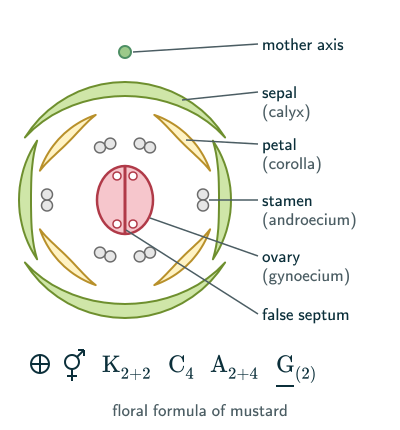
NCERT notes that the filaments in a mustard flower vary in length (page 64). Beyond the NCERT text: the two outer stamens are short and the four inner ones long, an arrangement called tetradynamous. The family’s older name is Cruciferae, from its four petals arranged like a cross; the NEET (UG) 2026 syllabus lists it under that name.
Solved examples
Example 1: Reading a formula
What does ⊕ ⚥ K2+2 C4 A2+4 G(2), with the G underlined, tell you?
Answer: the flower is actinomorphic and bisexual, with four sepals in two whorls of two, four free petals, six free stamens in two whorls of two and four, and two fused carpels in a superior ovary. NCERT gives this formula for mustard (pages 67–68).
Example 2: Writing a formula
A flower is zygomorphic and bisexual, with 5 free sepals, 5 free petals, 10 free stamens and 1 carpel in a superior ovary. Write its floral formula.
Answer: % ⚥ K5 C5 A10 G1, with the G underlined. Free parts take no brackets (symbols as on NCERT pages 67–68).
Example 3: Fusion and adhesion
How does a floral formula show that the petals are united, and that the stamens are attached to the petals?
Answer: united petals: the number goes in brackets, as C(5). Stamens attached to petals: a line is drawn above the symbols C and A, joining them (NCERT page 68).
Example 4: The order of description
In what order does a semi-technical description describe a plant?
Answer: its habit, then its vegetative characters (roots, stem and leaves), then its floral characters (inflorescence and flower parts), followed by a floral diagram and a floral formula (NCERT page 67).
Example 5: The dot in a floral diagram
What does the dot at the top of a floral diagram stand for?
Answer: the position of the mother axis with respect to the flower (NCERT page 68).
Example 6: Reading adhesion
NCERT’s Solanaceae formula (page 69) is ⊕ ⚥ K(5) C(5) A5 G(2), with a curved line over C and A and the G underlined. What do the line and the underline show?
Answer: the line shows adhesion, stamens attached to petals (epipetalous); the underline shows a superior ovary (NCERT pages 68–69).
Common mistakes to avoid
Common mistake
Swapping the lines on G
A line below G means a superior ovary (the ovary sits above the other parts); a line above G means an inferior ovary.
Common mistake
Confusing fusion with adhesion
Fusion of members of one whorl goes in brackets; adhesion of one whorl to another is a line drawn above their symbols.
Common mistake
Drawing whorls in the wrong order
In a floral diagram the calyx is outermost and the gynoecium in the centre, with the mother axis as a dot at the top.
Common mistake
Writing ⊕ for a zygomorphic flower
⊕ is actinomorphic; a zygomorphic flower takes %.
Quick revision summary
- A semi-technical description is brief, simple and scientific, in a fixed order: habit, vegetative characters (roots, stem, leaves), floral characters (inflorescence, flower parts), then a floral diagram and a floral formula.
- Floral formula symbols: Br bracteate; K calyx; C corolla; P perianth; A androecium; G gynoecium (line below: superior ovary; line above: inferior); ♂ male, ♀ female, ⚥ bisexual; ⊕ actinomorphic, % zygomorphic.
- Brackets show fusion; a line above the symbols shows adhesion.
- A floral diagram shows the number, arrangement and relations of the parts: mother axis as a dot at the top, calyx outermost, gynoecium in the centre.
- Mustard (Brassicaceae): ⊕ ⚥ K2+2 C4 A2+4 G(2), G underlined.
Formula sheet
- order: habit, vegetative characters, floral characters, floral diagram and formula
- K calyx, C corolla, P perianth, A androecium, G gynoecium, Br bracteate
- G with a line below: superior ovary; with a line above: inferior ovary
- ⊕ actinomorphic, % zygomorphic; ♂ male, ♀ female, ⚥ bisexual
- brackets: fusion; line above the symbols: adhesion
- mustard: ⊕ ⚥ K2+2 C4 A2+4 G(2), G underlined
Questions students ask
What is the difference between a floral formula and a floral diagram?
A floral formula sums up a flower in one line of symbols, while a floral diagram is a drawing of the flower’s whorls as concentric rings, as if the bud were cut across. The formula shows the position of the ovary, by a line under or over G, which a floral diagram cannot show; the diagram shows what the formula cannot: the aestivation of the sepals and petals, the placentation, and the position of each part relative to the others and to the mother axis. Both give the number of parts and show fusion and adhesion, and NCERT presents the two together, as for mustard in Figure 5.16.
How do you write a floral formula?
A floral formula is written in a fixed order: Br if the flower is bracteate, the symmetry (⊕ or %) and the sex (⚥, ♂ or ♀), then K, C, A and G (P in place of K and C when they are not distinct), each with the number of its members. Brackets round a number show fusion within a whorl, a line above two symbols shows one whorl joined to another, and a line under or over G marks a superior or inferior ovary. Two signs outside NCERT’s list are also used: ∞ for a large, indefinite number, as in A(∞) for the many united stamens of china rose, and 0 for a missing whorl, as in A0 for a female ray floret of marigold.
How do you draw a floral diagram?
To draw a floral diagram, mark the mother axis as a dot at the top and, for a bracteate flower, the bract at the bottom, opposite it; then draw the whorls as rings from the outside in, ending with a cross-section of the ovary showing its chambers, placentae and ovules. Draw the sepals and petals with their margins overlapping or just touching as in the bud, which records the aestivation, and place each whorl alternate with or opposite the one outside it, as in the flower. Join fused members of a whorl, and link each epipetalous stamen to its petal with a short line.
Is the floral formula in the NEET syllabus?
The floral formula is not named in the NEET (UG) 2026 Biology syllabus, but its Unit 2 lists ‘Family (malvaceae, Cruciferae, leguminoceae, compositae, graminae)’, and each family’s floral features are summed up in its floral formula and floral diagram. The 2026–27 NCERT Class 11 book prints only two floral formulae, mustard’s (Cruciferae) in Figure 5.16 and that of Solanaceae, which the NEET list does not name; those of the other four NEET families are beyond the NCERT book and are given on their Malvaceae and the other family pages.
Practice questions
Try each question first, then open the answer to check your working.
-
Q1. What does P stand for in a floral formula, and when is it used?
Show answerHide answer
Perianth: used when the calyx and corolla are not distinct, as in lily (NCERT pages 62 and 67).
-
Q2. In a floral diagram, which whorl is drawn in the centre?
Show answerHide answer
The gynoecium (NCERT page 68).
-
Q3. What does A2+4 in mustard’s formula tell you?
Show answerHide answer
Six stamens in two whorls: two in the outer whorl and four in the inner (NCERT Figure 5.16, page 67, gives the formula).
-
Q4. Which symbol stands for bracteate?
Show answerHide answer
Br (NCERT page 67).