Family Malvaceae
Beyond NCERT In the NEET syllabus; the Class 11 book has no section for it.
Quick answer
The traditional cotton–hibiscus group of Malvaceae has typically stipulate leaves, twisted petals and many monadelphous stamens with monothecous anthers. China rose has an epicalyx, a superior five-carpelled ovary and axile placentation; its formula is ⊕ ⚥ K(5) C5 A(∞) G(5), with C–A adhesion and G underlined. Modern Malvaceae is broader, so these characters are not universal across the entire family.
The family Malvaceae
Malvaceae
Malvaceae is the cotton, or mallow, family of dicotyledons. Its familiar members are cotton (Gossypium), lady’s finger or okra (Abelmoschus esculentus) and china rose (Hibiscus rosa-sinensis).
- Flowers usually have an epicalyx and twisted petals.
- Stamens are many, monadelphous, with one-lobed (monothecous) anthers.
- The ovary is superior, with axile placentation.
The 2026–27 NCERT book describes only the family Solanaceae, while the NEET (UG) 2026 syllabus lists Malvaceae in Unit 2. NCERT does use china rose, lady’s finger and cotton as examples in Sections 5.3 and 5.5 (pages 61–65), and those lines are cited below. Everything else on this page is beyond the 2026–27 NCERT text.
This description follows the traditional cotton–hibiscus group used in school morphology. The broader modern Malvaceae includes additional groups with different stamen and anther characters: NSW Flora describes both one- and two-locular anthers. Treat the china-rose combination as a diagnostic example, not an exceptionless description of every modern member.
Vegetative characters
- Habit: herbs, shrubs and trees; young parts often bear star-shaped (stellate) hairs, and many members have mucilage.
- Leaves: alternate, simple, stipulate, often palmately lobed, with reticulate venation. NCERT gives china rose as an example of alternate phyllotaxy (page 61).
Epicalyx and twisted aestivation
- Inflorescence: often a solitary axillary flower, as in china rose, or a cyme.
- Flower: bisexual, actinomorphic, pentamerous and hypogynous. NCERT gives china rose as a hypogynous flower with a superior ovary (page 63).
- Epicalyx: a whorl of bracteoles just outside the calyx, which looks like a second calyx. It is absent in a few genera, such as Abutilon.
- Calyx: five sepals, united, valvate.
- Corolla: five free petals (polypetalous; they only look united because their bases are joined to the staminal tube), in twisted aestivation.
If one margin of the appendage overlaps that of the next one and so on as in china rose, lady’s finger and cotton, it is called twisted.
NCERT Biology (Class 11), Section 5.5.1, page 64
Monadelphous stamens and monothecous anthers
- Stamens: many, their filaments united into one bundle, the staminal tube, which surrounds the style. NCERT gives china rose as its example of stamens united into one bundle, monadelphous (page 64).
- Anthers: one-lobed (monothecous) and kidney-shaped. Most flowers have bilobed anthers (NCERT page 64), each lobe with two pollen-sacs; a one-lobed anther has only two pollen-sacs (bisporangiate) instead of four. So one-lobed, kidney-shaped anthers are a mark of Malvaceae.
Gynoecium, placentation and fruit
- Gynoecium: usually five fused carpels (pentacarpellary, syncarpous) in china rose; the ovary is superior and five-chambered, with axile placentation. NCERT gives china rose as an example of axile placentation (page 65).
- The style passes up through the staminal tube and ends in as many stigmas as there are carpels.
- Fruit: usually a capsule, as in cotton and lady’s finger.
- Seeds: in cotton, the seed coat bears long hairs; these are the cotton fibres.
Floral formula
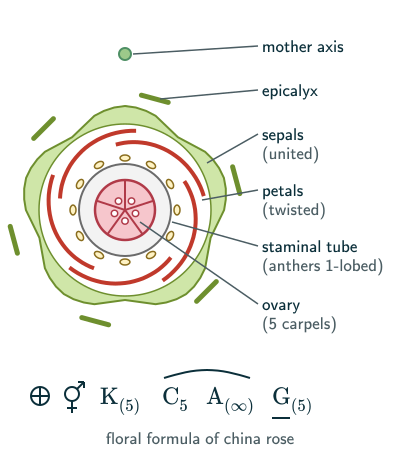
Beyond the NCERT text, which gives floral formulas only for mustard and Solanaceae: for china rose, ⊕ ⚥ K(5) C5 A(∞) G(5), with a line over C and A and the G underlined.
- ⊕ ⚥: actinomorphic and bisexual.
- K(5): five united sepals. C5: five free petals.
- A(∞): many stamens, united (monadelphous). The line over C and A shows the petals joined at the base to the staminal tube.
- G(5), underlined: five fused carpels in a superior ovary.
- Some books add the epicalyx before K, as Epi5–8 for china rose.
Economic importance
| Plant | Use |
|---|---|
| Cotton (Gossypium) | fibre, from the hairs on its seeds |
| Lady’s finger, okra (Abelmoschus esculentus) | vegetable |
| China rose (Hibiscus rosa-sinensis) | ornamental |
Solved examples
Example 1: Spot the family
A flower has an epicalyx, twisted petals, many stamens united into a tube round the style, and one-lobed anthers. Name the family.
Answer: Malvaceae, as in china rose.
Example 2: Epicalyx
What is an epicalyx, and in which of these is it found: china rose, mustard, pea?
Answer: a whorl of bracteoles just outside the calyx, found in china rose (Malvaceae). Mustard and pea have none.
Example 3: Monadelphous or diadelphous
Compare the stamens of china rose and pea.
Answer: china rose: many stamens united into one bundle (monadelphous), with one-lobed anthers. Pea: stamens in two bundles (diadelphous), with two-lobed anthers. NCERT gives both bundle types (page 64).
Example 4: Reading the formula
In ⊕ ⚥ K(5) C5 A(∞) G(5), with a line over C and A and the G underlined, what do A(∞) and the line tell you?
Answer: A(∞): many stamens, fused (monadelphous). The line over C and A: the petals are joined to the stamens (adhesion), here at the base of the staminal tube (symbols as on NCERT pages 67–68).
Example 5: Cotton fibre
Which part of the cotton plant gives cotton fibre?
Answer: the long hairs on the seed coat of its seeds.
Common mistakes to avoid
Common mistake
Calling the china-rose anther bilobed
The china-rose anther is monothecous. This is the traditional cotton–hibiscus character; modern broadly circumscribed Malvaceae also includes members with different anthers.
Common mistake
Mistaking the epicalyx for the calyx
The epicalyx is a separate whorl of bracteoles outside the calyx; the calyx itself has five united sepals.
Common mistake
Giving Malvaceae valvate petals
The calyx is valvate, but the petals are twisted, as NCERT says for china rose, lady’s finger and cotton.
Quick revision summary
- Malvaceae (cotton family): herbs, shrubs and trees, often with stellate hairs and mucilage; leaves alternate, simple, stipulate.
- Typical cotton–hibiscus flower: bisexual, actinomorphic, pentamerous, hypogynous; epicalyx often present, absent in genera such as Abutilon.
- Calyx 5 united, valvate; corolla 5 free, twisted, joined at the base to the staminal tube.
- Stamens many, monadelphous, in a staminal tube round the style; anthers one-lobed (monothecous).
- Ovary superior, five fused carpels in china rose, axile placentation; fruit a capsule.
- Uses: cotton (fibre), okra (vegetable), china rose (ornamental).
Formula sheet
- Malvaceae: cotton family; epicalyx usually present
- calyx 5 united (valvate); corolla 5 free (twisted)
- stamens many, monadelphous; anthers monothecous
- cotton–hibiscus examples: ovary superior, axile; fruit commonly capsule
- china rose: ⊕ ⚥ K(5) C5 A(∞) G(5), line over C and A, G underlined
- uses: cotton fibre, okra vegetable, china rose ornamental
Questions students ask
What is the difference between Malvaceae and Solanaceae?
Malvaceae and Solanaceae differ most in the flower: a Malvaceae flower such as china rose usually has an epicalyx, five free petals in twisted aestivation and many stamens united into a staminal tube (monadelphous) with one-lobed anthers, while a Solanaceae flower has no epicalyx, five united petals in valvate aestivation and five epipetalous stamens. Both have a superior ovary with axile placentation, but china rose has five fused carpels, while Solanaceae has two, obliquely placed, with swollen placentae. Their leaves differ as well: stipulate in Malvaceae, exstipulate in Solanaceae.
Why is Malvaceae called the mallow family?
Malvaceae is called the mallow family because it is named after its genus Malva, whose species are the mallows. It is also called the cotton family, after its best-known crop, cotton (Gossypium); lady’s finger (Abelmoschus esculentus) and china rose (Hibiscus rosa-sinensis) belong to it too.
Is Malvaceae a dicot or a monocot family?
Malvaceae is a family of dicotyledons: its leaves have reticulate venation and are often palmately lobed, and its flowers are pentamerous, with five sepals and five petals. Most monocots, by contrast, have parallel venation and floral parts in threes; the two classes are compared on the angiosperms page.
Is Malvaceae in the NCERT Class 11 book?
Malvaceae is not described in the NCERT Class 11 book: the 2026–27 edition describes only Solanaceae, and the editions before NCERT’s rationalisation described Fabaceae, Solanaceae and Liliaceae, not Malvaceae. It is in the NEET (UG) 2026 syllabus, whose Unit 2 lists ‘Family (malvaceae, Cruciferae, leguminoceae, compositae, graminae)’, so its characters come from standard botany texts. NCERT’s Chapter 5 does use china rose, cotton and lady’s finger as examples of twisted aestivation, and china rose as an example of monadelphous stamens and axile placentation.
Practice questions
Try each question first, then open the answer to check your working.
-
Q1. Which of these does NCERT give as examples of twisted aestivation: china rose, pea, cotton, Calotropis, lady’s finger?
Show answerHide answer
China rose, cotton and lady’s finger (NCERT page 64).
-
Q2. What surrounds the style in a china rose flower?
Show answerHide answer
The staminal tube, formed by the united filaments of its many stamens.
-
Q3. What kind of fruit do cotton and lady’s finger have?
Show answerHide answer
A capsule.
-
Q4. Are the leaves of Malvaceae stipulate or exstipulate?
Show answerHide answer
Stipulate; contrast Solanaceae, whose leaves are exstipulate (NCERT page 68).