Family Cruciferae (Brassicaceae)
Beyond NCERT In the NEET syllabus; the Class 11 book has no section for it.
Quick answer
Cruciferae (Brassicaceae), the mustard family, has herbs with alternate, exstipulate leaves and racemes of actinomorphic, tetramerous, hypogynous flowers. The four petals form a cross (cruciform), the six stamens are tetradynamous (2 short, 4 long), and the superior ovary has parietal placentation with a false septum and becomes a siliqua. Mustard’s formula is ⊕ ⚥ K2+2 C4 A2+4 G(2), with the G underlined.
The family Cruciferae
Cruciferae (Brassicaceae)
Cruciferae, also called Brassicaceae, is the mustard family of dicotyledons. Its name means “cross-bearing”, from its four petals arranged like a cross.
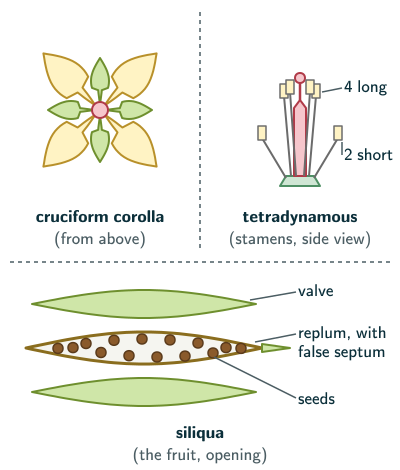
- The corolla is cruciform and the stamens are tetradynamous: 2 short and 4 long.
- The ovary has two fused carpels, made two-chambered by a false septum, with parietal placentation.
- The characteristic fruit is a siliqua or its short form, a silicula; other modifications occur.
The 2026–27 NCERT book has no section on this family, but the NEET (UG) 2026 syllabus lists it in Unit 2. NCERT does use mustard as an example many times in Chapter 5, and its Figure 5.16 (page 67) is the floral diagram and floral formula of the mustard plant, which NCERT names with its family, Brassicaceae, on page 68. Those lines are cited below; everything else is beyond the 2026–27 NCERT text.
Vegetative characters
- Habit: chiefly herbs, including annuals, biennials and perennials; many smell pungent when crushed. NSW Flora also records rare small shrubs. Cultivated radishes include annual and biennial forms.
- Root: a tap root; NCERT gives mustard as its example of a tap root system (page 58, Figure 5.2a). Beyond the NCERT text: radish and turnip are traditional storage-root examples, with fusiform and napiform forms respectively. The swollen organ can include hypocotyl, especially in turnip; these are representative shapes, not the shape of every cultivar.
- Leaves: alternate, simple, exstipulate; the lower leaves are often deeply lobed. NCERT gives mustard as an example of alternate phyllotaxy (page 61).
Cruciform corolla and tetradynamous stamens
- Inflorescence: a raceme.
- Flower: ebracteate, bisexual, actinomorphic, tetramerous and hypogynous. NCERT gives mustard as actinomorphic (page 62) and hypogynous, with a superior ovary (page 63).
- Calyx: four free sepals, in two whorls of two.
- Corolla: four free, clawed petals arranged like a cross, alternating with the sepals: a cruciform corolla.
- Androecium: six free stamens, two short ones in an outer whorl and four long ones in an inner whorl: tetradynamous.
There may be a variation in the length of filaments within a flower, as in Salvia and mustard.
NCERT Biology (Class 11), Section 5.5.1, page 64
Parietal placentation and the siliqua
- Gynoecium: two fused carpels (bicarpellary, syncarpous); the ovary is superior. NCERT gives mustard as syncarpous (page 65).
- Placentation: parietal. The ovary is one-chambered but becomes two-chambered when a false septum forms; NCERT’s examples are mustard and Argemone (page 65); only mustard’s ovary has the false septum.
- Fruit: a siliqua, a long, dry fruit that splits from below upwards into two valves, leaving the seeds attached to the replum, the persistent rim that holds the false septum. A short, broad version is a silicula.
- Seeds: commonly described as non-endospermic, with reserves mainly in the embryo. Do not infer literal absence of every endosperm cell throughout the family: a primary Plant Physiology study, Distinct Cell Wall Architectures in Seed Endosperms (2012), documents a retained thin layer in Arabidopsis and Lepidium.
Many books loosely call the false septum itself the replum. Strictly, the replum is the persistent rim formed by the two placentae, and the false septum is the thin wall stretched across it.
Floral formula
NCERT gives mustard’s formula in Figure 5.16 (page 67): ⊕ ⚥ K2+2 C4 A2+4 G(2), with the G underlined.
- ⊕ ⚥: actinomorphic and bisexual.
- K2+2: four free sepals in two whorls of two.
- C4: four free petals.
- A2+4: six free stamens, 2 in the outer whorl and 4 in the inner.
- G(2), underlined: two fused carpels in a superior ovary.
The floral diagram of mustard is drawn on the page on the semi-technical description of a flowering plant.
Economic importance
| Plant | Use |
|---|---|
| Mustard (Brassica) | oil from the seeds; leaves as a vegetable |
| Radish (Raphanus sativus) | swollen tap root, eaten as a vegetable |
| Cabbage (Brassica oleracea) | a large terminal bud of crowded leaves, eaten as a vegetable |
Turnip (swollen hypocotyl/root storage organ) and cauliflower (a compact immature inflorescence) are in the same family.
Solved examples
Example 1: Spot the family
A flower has four petals in a cross, six stamens (two short and four long) and a two-chambered ovary with a false septum. Name the family and the stamen type.
Answer: Cruciferae (Brassicaceae); the stamens are tetradynamous.
Example 2: Reading the mustard formula
What does A2+4 in mustard’s floral formula show?
Answer: six free stamens in two whorls, two in the outer and four in the inner (formula from NCERT Figure 5.16, page 67). The outer two are short and the inner four long, which is why the androecium is called tetradynamous.
Example 3: Why “false”?
Why is mustard’s septum called a false septum?
Answer: it is not formed by the carpel walls, as the septa of an axile ovary are. It grows across from the two parietal placentae and joins them, making the ovary two-chambered (NCERT page 65 gives the two chambers; the origin is beyond the NCERT text).
Example 4: Siliqua
What is a siliqua, and how does it open?
Answer: the long, dry fruit of the mustard family. It splits from below upwards into two valves, which fall away and leave the seeds on the replum, the persistent rim that holds the false septum.
Example 5: Cabbage and cauliflower
Both are forms of one species, Brassica oleracea. Which part of each do we eat?
Answer: cabbage: its large terminal bud of crowded leaves; cauliflower: its dense inflorescence.
Common mistakes to avoid
Common mistake
Writing the mustard stamens as six equal
They are tetradynamous: 2 short (outer) and 4 long (inner), written A2+4.
Common mistake
Calling mustard seeds endospermic
The usual textbook classification is non-endospermic, with reserves mainly in the embryo. A thin residual endosperm persists in some crucifers, so avoid the universal claim that no member has endosperm cells.
Common mistake
Calling the siliqua a legume
A legume (pea family) comes from one carpel and splits along both sutures, with its seeds in two rows on the ventral suture (marginal placentation, NCERT page 65). A siliqua comes from two fused carpels and opens from below upwards into two valves, leaving the seeds on the replum.
Quick revision summary
- Cruciferae (Brassicaceae), the mustard family: mostly annual herbs with pungent juice; tap roots, swollen in radish and turnip; leaves alternate, simple, exstipulate.
- Flower: raceme; ebracteate, bisexual, actinomorphic, tetramerous, hypogynous.
- Calyx 4 (2 + 2), free; corolla 4, free, cruciform; stamens 6, tetradynamous (2 short + 4 long).
- Ovary superior, two fused carpels, parietal placentation, two-chambered by a false septum; fruit a siliqua; seeds non-endospermic.
- Formula (NCERT Figure 5.16): ⊕ ⚥ K2+2 C4 A2+4 G(2), G underlined.
- Uses: mustard (oil), radish (root), cabbage (bud).
Formula sheet
- Cruciferae: mustard family (Brassicaceae)
- corolla cruciform; stamens tetradynamous (2 short + 4 long)
- ovary superior, parietal; false septum stretched across the replum
- fruit usually siliqua or silicula; seeds commonly classified non-endospermic
- mustard: ⊕ ⚥ K2+2 C4 A2+4 G(2), G underlined
- uses: mustard oil, radish root, cabbage bud
Questions students ask
Are Cruciferae and Brassicaceae the same family?
Yes, Cruciferae and Brassicaceae are two names for the same family, the mustard family. Cruciferae, ‘cross-bearing’, is an old descriptive name that the botanical code still allows because of its long use, and Brassicaceae is the regular name, formed from the genus Brassica. NCERT calls the mustard family Brassicaceae (page 68), while the NEET (UG) 2026 syllabus lists it as Cruciferae, so a question may use either name.
What is the difference between Brassicaceae and Solanaceae?
Brassicaceae and Solanaceae differ in nearly every whorl of the flower: a mustard flower is tetramerous, with four free petals arranged in a cross and six free, tetradynamous stamens, while a Solanaceae flower is pentamerous, with five united petals and five epipetalous stamens. Both have a superior ovary of two fused carpels, but in Brassicaceae the placentation is parietal, with a false septum, and the fruit a siliqua, while in Solanaceae it is axile, on swollen placentae, and the fruit a berry or capsule. The leaves of both families are alternate and exstipulate, so the flower and fruit are what tell them apart.
What are cruciferous vegetables?
Cruciferous vegetables are the vegetables of the mustard family, Cruciferae (Brassicaceae), the family named after the cross-shaped corolla of its flowers. They include cabbage, cauliflower, broccoli and knol-khol, which are all forms of one species, Brassica oleracea, as well as radish, turnip and the leaves of mustard, cooked as sarson ka saag.
Which Brassicaceae examples does NCERT give?
NCERT’s Chapter 5 names only one plant of the Brassicaceae, mustard, and uses it as an example of a tap root system, alternate phyllotaxy, an actinomorphic flower, a hypogynous flower with a superior ovary, filaments of different lengths in one flower, a syncarpous gynoecium and parietal placentation with a false septum. It also gives mustard’s floral diagram and floral formula in NCERT Figure 5.16 (page 67), one of only two floral formulae in the chapter; the other is that of Solanaceae.
Practice questions
Try each question first, then open the answer to check your working.
-
Q1. What does “cruciform” mean for a corolla?
Show answerHide answer
Four free petals arranged like a cross.
-
Q2. Name the shape of the storage root of radish and of turnip.
Show answerHide answer
Radish: fusiform (spindle-shaped); turnip: napiform (top-shaped).
-
Q3. Is the mustard ovary superior or inferior?
Show answerHide answer
Superior: NCERT gives mustard as a hypogynous flower (page 63), and its formula has the G underlined (Figure 5.16, page 67).
-
Q4. A crucifer fruit is about as long as it is broad. Is it a siliqua or a silicula?
Show answerHide answer
A silicula. A siliqua is at least three times as long as it is broad; a silicula is less, as in shepherd’s purse (Capsella).