Modifications of leaf
Beyond NCERT In the NEET syllabus; the Class 11 book has no section for it.
Quick answer
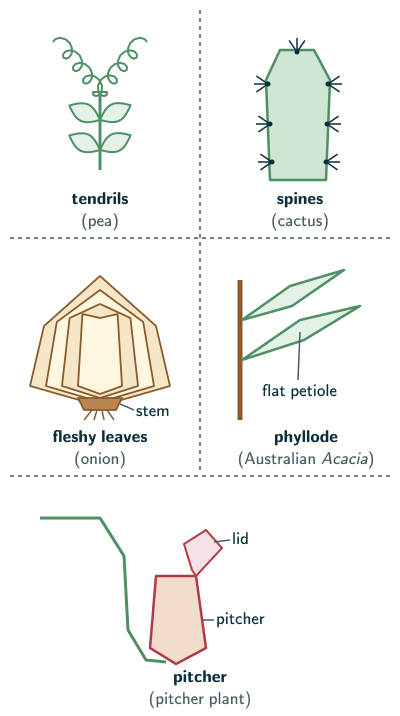
Leaves, the main organs of photosynthesis, are sometimes modified for other jobs. In pea some leaflets become tendrils for climbing, in cacti leaves are reduced to protective spines, and onion and garlic store food in fleshy leaves. In Australian acacia the green, flattened petiole (phyllode) makes food, and insectivorous plants such as the pitcher plant and Venus fly trap have leaves modified to catch insects.
How leaves are modified
Modifications of leaf
The leaf is a lateral, generally flattened structure borne on the stem.
NCERT Biology (Class 11), Section 5.3, page 59
NCERT calls leaves the most important vegetative organs for photosynthesis (page 59), but leaves are often modified for jobs other than photosynthesis. Standard examples (beyond the 2026–27 NCERT text):
- Climbing: leaf tendrils, as in pea.
- Defence: spines, as in cacti.
- Storage: fleshy leaves, as in onion and garlic.
- Food-making by the petiole: phyllodes, as in Australian Acacia.
- Catching insects: the pitchers of the pitcher plant and the traps of the Venus fly trap.
The 2026–27 NCERT chapter describes the normal leaf but not its modifications, while the NEET (UG) 2026 syllabus lists “Morphology and modifications” in Unit 2. Apart from the cited NCERT lines, everything on this page is beyond the 2026–27 NCERT text.
In plain words: a modified leaf may not look like a leaf at all, but it arises where a leaf arises, at a node, and a bud in its axil can give it away (NCERT page 59). A modified leaflet, such as a pea tendril, has no bud of its own; the bud sits in the axil of the whole compound leaf (NCERT page 60). The plant has given that leaf, or part of it, a new job.
Leaf tendrils and spines
- Leaf tendrils: in pea, the upper leaflets of the pinnately compound leaf are converted into tendrils that coil round supports and help the plant climb.
- Spines: in cacti, leaves are reduced to spines that protect the plant and, with almost no leaf surface, lose less water by transpiration; the green stem then takes over photosynthesis.
Both are beyond the 2026–27 NCERT text. Compare the stem tendrils of gourds and the thorns of Bougainvillea, which come from axillary buds rather than from leaves. NCERT Class 12 Biology (Evolution, page 115) calls the thorn and tendrils of Bougainvillea and Cucurbita homologous.
Fleshy storage leaves
In onion and garlic, fleshy leaves store food; an onion bulb is made of these fleshy leaves on a very short, disc-like stem, so the bulb as a whole counts as a modified underground stem (beyond the 2026–27 NCERT text).
Phyllodes
In many Australian Acacia species, adult foliage consists of phyllodes: photosynthetic, leaf-like petioles and/or rachises with the normal blade reduced or absent. The Australian National Botanic Gardens describes this broader origin. The usual textbook example is a flattened green petiole; not all Australian acacias lose their compound leaf blades (beyond the 2026–27 NCERT text).
Leaves of insectivorous plants
NCERT names insectivorous plants among the members of Plantae that are partially heterotrophic:
A few members are partially heterotrophic such as the insectivorous plants or parasites.
NCERT Biology (Class 11), Section 2.4, page 19
NCERT gives bladderwort and Venus fly trap as examples (page 19; see partial heterotrophs). In such plants the leaves are modified to catch insects: in the pitcher plant (Nepenthes) a specialised distal part of the leaf develops into a pitcher with a lid, connected to the expanded photosynthetic part by a tendril; in the Venus fly trap (Dionaea) the two halves of the leaf blade snap shut on an insect; in bladderwort (Utricularia) parts of the finely divided leaves form small bladders that trap tiny water animals (beyond the 2026–27 NCERT text).
Solved examples
Example 1: Name the modification
Name the leaf modification and its job: (a) pea; (b) cactus; (c) onion; (d) Australian Acacia; (e) pitcher plant.
Answer: (a) leaf tendrils, for climbing; (b) spines, for defence; (c) fleshy leaves, for storage; (d) phyllodes, for making food; (e) pitchers, for catching insects (beyond the 2026–27 NCERT text).
Example 2: Leaf tendril or stem tendril?
Pea and cucumber both climb with tendrils. How do their tendrils differ in origin?
Answer: the pea’s tendrils are modified leaflets; the cucumber’s are modified stems that come from axillary buds (beyond the 2026–27 NCERT text).
Example 3: Spine or thorn?
Cacti have spines and Bougainvillea has thorns. Which is a modified leaf and which a modified stem?
Answer: the cactus spine is a modified leaf; the Bougainvillea thorn is a modified stem, from an axillary bud (beyond the 2026–27 NCERT text).
Example 4: Who makes the food?
In an Australian Acacia with phyllodes, which leaf structure takes over the blade’s photosynthetic role?
Answer: the petiole, which expands, turns green and synthesises food; it is called a phyllode (beyond the 2026–27 NCERT text).
Example 5: Why trap insects?
Why does NCERT call insectivorous plants partially heterotrophic?
Answer: they remain photosynthetic and use captured animals to supplement nitrogen and other mineral nutrients where availability is low; NCERT calls this nutritional supplement partial heterotrophy (NCERT page 19 names them; the explanation is beyond the NCERT text).
Example 6: An onion is not a root
Is an onion bulb a root, a stem or a set of leaves?
Answer: a bulb is a modified underground stem: a very short, disc-like stem bearing fleshy scale leaves, with roots below. The food is stored in the fleshy leaves, which is why onion is listed among leaf modifications. It is not a root (beyond the 2026–27 NCERT text).
Common mistakes to avoid
Common mistake
Calling a cactus spine a thorn
Cactus spines are modified leaves; thorns, as in Citrus and Bougainvillea, are modified stems. NCERT Class 12 Biology (Organisms and Populations, page 198) loosely calls the defences of Acacia and cactus “thorns”; in morphology keep the terms apart.
Common mistake
Confusing a phyllode with a phylloclade
A phyllode is a flattened green petiole, part of a leaf (Australian Acacia); a phylloclade is a flattened or fleshy green stem (Opuntia, Euphorbia).
Common mistake
Treating all tendrils alike
Pea tendrils are modified leaflets; gourd and grapevine tendrils are modified stems.
Quick revision summary
- Leaves are the main photosynthetic organs (NCERT page 59), but some are modified for other jobs.
- Tendrils: pea (leaflets, for climbing). Spines: cacti (defence, less water loss).
- Fleshy storage leaves: onion, garlic.
- Phyllode: Australian Acacia, a green, flattened petiole that makes food.
- Insectivorous plants (NCERT page 19: bladderwort, Venus fly trap): leaves modified as pitchers, snap traps and bladders.
Formula sheet
- leaf tendril: modified leaflets, for climbing (pea)
- spine: modified leaf, for defence (cacti)
- fleshy leaves: storage (onion, garlic)
- phyllode: green flattened petiole (Australian acacia)
- insectivorous leaves: pitchers, snap traps, bladders
Questions students ask
Is modification of leaf deleted for NEET 2026?
No, modification of leaf is not deleted for NEET (UG) 2026: Unit 2 of its Biology syllabus lists ‘Morphology and modifications’, so leaf tendrils, spines, fleshy storage leaves, phyllodes and insect-catching leaves can still be asked. What changed is the NCERT book: the 2026–27 Class 11 text describes the normal leaf but no longer its modifications, so their standard examples come from older editions and botany textbooks.
What are the types of leaf tendrils?
Leaf tendrils are classed by the part of the leaf that becomes the tendril. The standard examples are leaflet tendrils in pea, where the upper leaflets of the compound leaf become tendrils; a whole-leaf tendril in Lathyrus aphaca, the yellow vetchling, whose large, leafy stipules take over photosynthesis; and a leaf-tip tendril in Gloriosa, where the tip of the leaf blade is drawn out into a coil. Some books add petiole tendrils (Clematis) and stipule tendrils (Smilax); all of these are beyond the 2026–27 NCERT text.
What is the difference between a leaf tendril and a leaf spine?
A leaf tendril and a leaf spine are both modified leaves or parts of leaves, but a tendril is slender and coils round a support to help the plant climb, as in pea, while a spine is hard and pointed and protects the plant, as in cacti (beyond the 2026–27 NCERT text). Because they share one origin, the leaf, but do different jobs, the two are homologous organs, like the thorn and tendrils of Bougainvillea and Cucurbita, which NCERT Class 12 Biology says ‘represent homology’ (Evolution, page 115).
Practice questions
Try each question first, then open the answer to check your working.
-
Q1. Which plants does NCERT give as examples of insectivorous plants?
Show answerHide answer
Bladderwort and Venus fly trap (NCERT page 19).
-
Q2. In which plant are leaflets modified into tendrils?
Show answerHide answer
Pea (beyond the 2026–27 NCERT text).
-
Q3. What is a phyllode?
Show answerHide answer
A flattened, green petiole that synthesises food when the leaves are small and short-lived, as in Australian Acacia (beyond the 2026–27 NCERT text).
-
Q4. Name two plants with fleshy food-storing leaves.
Show answerHide answer
Onion and garlic (beyond the 2026–27 NCERT text).