The stem
NCERT Class 11 Biology Chapter 5 Section 5.2
Quick answer
The seedling’s main shoot develops from the plumule, and stems bear nodes, internodes, leaves and buds. Stems support leaves, flowers and fruits and conduct water, minerals and photosynthates; some also store food or aid propagation. Nodes and buds identify underground stems as well as aerial ones; multicellular hairs and positive phototropism are usual features, not universal tests.
With your textbook
NCERT Biology (Class 11), Chapter 5 “Morphology of Flowering Plants”, Section 5.2 “The Stem”, page 59.
Open the official NCERT chapter (PDF, 3.4 MB, ncert.nic.in) (opens in a new tab)
Checked against the 2026-27 reprint on .
What is the stem?
The stem
It develops from the plumule of the embryo of a germinating seed.
NCERT Biology (Class 11), Section 5.2, page 59
- The stem is the ascending part of the axis, bearing branches, leaves, flowers and fruits (page 59).
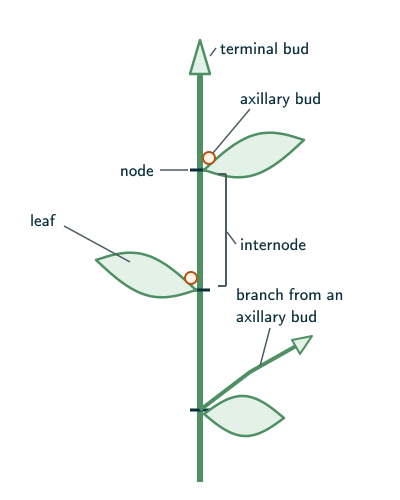
- It bears nodes, where leaves are borne, and internodes, the portions between two nodes.
- It bears buds, which may be terminal or axillary.
In plain words: the primary shoot develops from the seed’s plumule, while the primary root develops from the radicle. Most young aerial stems grow upwards, but stems can also creep or grow underground. It holds leaves, flowers and fruits where they are useful, and it carries water, minerals and food between the roots and the leaves. You can tell a stem from a root by its nodes and internodes.
Nodes, internodes and buds
NCERT describes the stem’s parts on page 59:
- Nodes: the regions of the stem where leaves are borne. NCERT prints “where leaves are born”; the correct word is borne (carried).
- Internodes: the portions between two nodes.
- Buds: a terminal bud at the tip of the stem; axillary buds in the axils of leaves. A leaf develops at a node and bears a bud in its axil, and the axillary bud later develops into a branch (NCERT Section 5.3, page 59). The axil is the upper angle between a leaf and the stem (beyond the NCERT text).
The stem is generally green when young and often becomes woody and dark brown later (page 59).
Functions of the stem
The main function of the stem is spreading out branches that bear leaves, flowers and fruits (page 59).
It conducts water, minerals and photosynthates.
NCERT Biology (Class 11), Section 5.2, page 59
Some stems also store food, give support or protection, or help in vegetative propagation (page 59). Stems that do these jobs often look very different (beyond the 2026–27 NCERT text); they are described on the page on modifications of the stem.
Beyond the NCERT Biology text: a branch held out sideways under the weight of its leaves and fruits is a beam fixed at one end, and, as for the supported beam in physics, a thicker branch sags far less under the same load.
Telling a stem from a root
The morphological features of stems like the presence of nodes and internodes, multicellular hair and positively phototropic nature help to differentiate the stems from roots.
NCERT Biology (Class 11), Chapter 5, Summary, page 69
- Origin: the seedling’s main shoot develops from the plumule (page 59), the primary root from the radicle (page 57). Later branches arise from buds; adventitious roots need not arise from the radicle.
- Nodes and internodes: present on stems, with leaves and buds at the nodes; absent on roots.
- Hairs: hairs on stems are usually multicellular; root hairs are unicellular, each an elongation of one epidermal cell (NCERT page 59; NCERT Chapter 6, page 72).
- Apex: a stem ends in a terminal bud; a root apex is covered by a root cap (page 59).
- Response to light: young aerial shoots commonly show positive phototropism, growing towards light (NCERT’s general comparison, page 69). An underground storage stem need not show this response visibly; nodes and buds are more useful identification marks.
Solved examples
Example 1: From which part of the embryo?
From which parts of the embryo do the stem and the primary root develop?
Answer: the stem from the plumule (NCERT page 59); the primary root from the radicle (page 57).
Example 2: Node or internode?
What is the difference between a node and an internode?
Answer: a node is the region of the stem where leaves are borne; an internode is the portion between two nodes (NCERT page 59).
Example 3: Where branches come from
A branch grows out from the axil of a leaf. What did it develop from?
Answer: from an axillary bud, the bud a leaf bears in its axil (NCERT page 59).
Example 4: What the stem carries
Name the three things the stem conducts.
Answer: water, minerals and photosynthates (NCERT page 59).
Example 5: Stem or root?
An underground part bears nodes with small leaves and buds. Is it a stem or a root?
Answer: a stem: nodes and internodes, with leaves and buds at the nodes, mark a stem (NCERT Summary, page 69). The potato, which grows underground, is such a stem (NCERT page 68).
Example 6: Extra jobs of stems
Besides spreading out branches and conducting water, minerals and photosynthates, what other functions do some stems perform?
Answer: storage of food, support, protection and vegetative propagation (NCERT page 59).
Common mistakes to avoid
Common mistake
Calling every underground part a root
Underground stems still have nodes and buds; NCERT itself describes the potato as an underground stem (page 68).
Common mistake
Calling an internode a node
The node is where a leaf is borne; the internode is the length of stem between two nodes.
Common mistake
Putting axillary buds anywhere on the stem
An axillary bud sits in the axil of a leaf, at a node; the terminal bud is at the tip of the stem.
Quick revision summary
- The stem is the ascending part of the axis; it develops from the plumule and bears branches, leaves, flowers and fruits.
- Nodes bear leaves; internodes lie between nodes; buds are terminal or axillary, and axillary buds grow into branches.
- Young stems are generally green; older stems often become woody and dark brown.
- Functions: spreading out branches with leaves, flowers and fruits; conducting water, minerals and photosynthates; in some stems storage, support, protection and vegetative propagation.
- Stems differ from roots in their nodes and internodes, multicellular hairs and positive phototropism.
Formula sheet
- seedling main shoot: from plumule; primary root: from radicle
- node: where leaves are borne; internode: between two nodes
- buds: terminal (tip), axillary (leaf axil) → branch
- stem conducts water, minerals, photosynthates
- stem marks: nodes and internodes; hairs usually multicellular; young aerial shoots commonly phototropic
Questions students ask
What is the difference between a terminal bud and an axillary bud?
A terminal bud is the bud at the tip of a stem, while an axillary bud sits in the axil of a leaf and later develops into a branch (NCERT page 59). The terminal (apical) bud also controls the axillary buds: NCERT says that in most higher plants ‘the growing apical bud inhibits the growth of the lateral (axillary) buds, a phenomenon called apical dominance’ (Section 13.4.3.1, page 175). That is why removing the shoot tip, as in tea plantations and hedge-making, usually makes the axillary buds grow out into branches.
What is the difference between a stem and a shoot?
The shoot system comprises stems with their leaves, flowers and fruits, while the stem is its supporting axis (NCERT pages 57, 59 and 69). Most shoots are above ground, but underground modified stems such as potato belong to the shoot system too. So the stem is one part of the shoot system, which also includes the leaves, flowers and fruits the stem carries. A branch is itself a stem, a lateral one that grows from an axillary bud (NCERT page 59).
What is the difference between an axillary bud and a stipule?
An axillary bud is a bud in the axil of a leaf, at the node, and it later develops into a branch, while stipules are two small, lateral, leaf-like structures that the leaf base may bear (NCERT pages 59–60). The bud is a young shoot of the stem, but the stipules are parts of the leaf itself and never grow into shoots. A leaf develops at a node and bears a bud in its axil, but not every leaf has stipules: leaves without them are exstipulate, as NCERT describes the leaves of Solanaceae (page 68).
Practice questions
Try each question first, then open the answer to check your working.
-
Q1. What is the main function of the stem?
Show answerHide answer
Spreading out branches bearing leaves, flowers and fruits (NCERT page 59).
-
Q2. What colour is a young stem, and how does an older stem often change?
Show answerHide answer
It is generally green when young, and later often becomes woody and dark brown (NCERT page 59).
-
Q3. Name the two kinds of buds a stem bears.
Show answerHide answer
Terminal and axillary buds (NCERT page 59).
-
Q4. What does “positively phototropic” mean for a stem?
Show answerHide answer
It grows towards light, one of the features that tell stems from roots (NCERT Summary, page 69).