Applications of elastic behaviour
NCERT Class 11 Physics Chapter 8 Section 8.6
Quick answer
Elasticity helps size crane ropes, design beams and pillars, and estimate a mountain-height scale of order 10 km. In NCERT’s model, a 10-tonne crane with a load safety factor of ten needs steel of solid-equivalent radius about 3 cm. A slender, simply supported rectangular beam of span l, breadth b and depth d carrying a central load W sags by δ = Wl/(4bdY), where Y is Young’s modulus; increasing depth greatly reduces sag.
With your textbook
NCERT Physics Part II (Class 11), Chapter 8 “Mechanical Properties of Solids”, Section 8.6 “Applications of elastic behaviour of materials”, pages 174–176.
Open the official NCERT chapter (PDF, 1.2 MB, ncert.nic.in) (opens in a new tab)
Checked against the 2026-27 reprint on .
Where is elastic behaviour used?
Applications of elastic behaviour
Engineers use the elastic properties of materials to make structures that neither deform permanently nor break under their loads. NCERT Section 8.6 (pages 174–176) gives four examples:
- the thickness of a crane’s rope, from the yield strength of steel;
- the bending of a beam, and why beams have an I-shaped cross-section;
- the shape of pillars;
- the greatest possible height of a mountain, from the strength of rock.
In plain words: the ideas of this chapter (stress, strain, yield strength and Young’s modulus) are the working tools of structural engineering. They answer questions such as how thick a rope must be, why a railway rail or a bridge girder has an I-shaped section, and how a simple strength model gives a mountain-height scale of roughly 10 km.
How thick should a crane’s rope be?
A crane is to lift up to 10 tonnes (10 kg). Its steel rope must not be stretched beyond its elastic limit, so the stress Mg/A must stay below the yield strength σy:
Least cross-section of a rope
With σy = 300 × 10 N m for mild steel, as NCERT takes it, A ≥ 10 × 9.8/(300 × 10), about 3.3 × 10 m, a radius of about 1 cm (Example 1).
Generally a large margin of safety (of about a factor of ten in the load) is provided.
NCERT Physics Part II (Class 11), Section 8.6, page 175
In this textbook estimate, A is the total load-bearing metal area; a stranded rope’s outer area also contains gaps and depends on its construction (reasoned). NCERT gives the factor of ten as the general practice for such ropes; actual design factors vary (reasoned).
Ten times the area means √10 ≈ 3.2 times the radius, giving a solid-equivalent radius of about 3 cm in NCERT’s estimate. A single steel wire that thick would be practically a rigid rod:
So the ropes are always made of a number of thin wires braided together, like in pigtails, for ease in manufacture, flexibility and strength.
NCERT Physics Part II (Class 11), Section 8.6, page 175
A note on NCERT’s number. NCERT says it takes the 300 × 10 N m from Table 8.1, but Table 8.1 (page 170) lists no mild steel; for steel it gives a yield strength of 250 × 10 N m. With 250 × 10 the least radius is about 1.1 cm and, with the factor of ten, about 3.5 cm. The conclusion, a rope a few centimetres thick made of many thin wires, is the same.
Bending of a beam, and the I-section
A bar of breadth b and depth d, resting on two supports a distance l apart (the span) and loaded midway between them by a weight W, sags at the centre by (for a slender rectangular beam, simply supported at both ends, with small linear elastic deflection, ignoring self-weight and shear deflection)
Sag of a centrally loaded beam
(NCERT Section 8.6, page 175, Eq. 8.16.) Each support pushes up with W/2, as the equilibrium of a rigid body requires. The formula shows how to reduce the sag:
- use a material with a large Young’s modulus Y;
- keep the span l short, since δ grows as l;
- increase the depth d rather than the breadth b: δ falls as 1/d but only as 1/b.
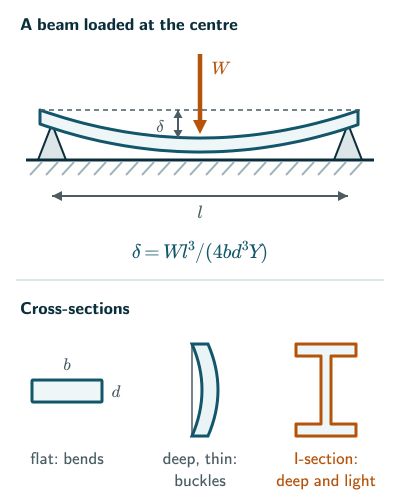
A very deep, thin bar has its own problem: it can become unstable and bend sideways, often with twisting, depending on its span, loading and lateral restraint. This is called buckling. The common compromise is the I-shaped section, with a broad flange at the top and bottom joined by a thin web. It gives a large load-bearing surface and enough depth to resist bending:
This shape reduces the weight of the beam without sacrificing the strength and hence reduces the cost.
NCERT Physics Part II (Class 11), Section 8.6, page 175
Steel girders, and railway rails (whose section is close to an I), use this shape for the same reason.
Pillars
Pillars and columns are common in buildings and bridges. A pillar with rounded ends supports less load than one with a distributed shape at the ends (NCERT, pages 175–176). Beyond the NCERT text: the end conditions have a large effect on a slender column’s buckling load, and ends fixed against rotation carry more than pinned ones (Wikipedia, “Buckling”); broader contact spreads bearing forces, but merely widening an end does not automatically make it fixed (reasoned). NCERT’s text refers to this figure as “Fig. 8.9(a)” and “Fig. 8.9(b)”; the pillars are in its Fig. 8.8, and Fig. 8.9 is the graph for NCERT Exercise 8.2. A real design must also allow for the conditions in which the structure works, its cost, and how reliable its materials will be over a long period.
Estimating a mountain-height scale
At the base of a mountain of height h, the weight of the rock above presses down with a force per unit area hρg, where ρ is the density of the rock. The sides of a mountain are free, so this is not a uniform (hydraulic) compression: the one-sided compression gives the rock at the base a shearing stress of the same order as hρg. NCERT takes it as approximately hρg itself; in an ideal uniaxial-stress model the largest shear, on planes at 45° to the vertical, is hρg/2, which does not change the order of the estimate. If this exceeds the critical stress at which rock starts to flow, the base gives way. So the greatest height is about
Greatest height of a mountain
NCERT uses this to explain why the maximum height of a mountain on the Earth is about 10 km (page 176). Strictly, it is an order-of-magnitude model, not an exact limit: mountain shape, rock strength, confinement, temperature, erosion and crustal support also matter (reasoned). NCERT takes the critical stress as the elastic limit of rock. With an elastic limit of 30 × 10 N m for typical rock and ρ = 3 × 10 kg m, h comes out at about 10 km, a little more than the height of Mount Everest (Example 3; NCERT, page 176).
Solved examples
Example 1: A crane’s rope
How thick must the steel rope of a crane with a 10-tonne capacity be, with and without a safety factor of ten in the load? Use NCERT’s σy = 300 × 10 N m and g = 9.8 m s.
Without a safety factor: A = Mg/σy = 10 × 9.8/(300 × 10), about 3.3 × 10 m. For a circular section, r = √(A/π), about 1.0 × 10 m.
With a factor of ten: the area is ten times larger and the radius √10 ≈ 3.2 times larger, about 3.2 cm.
Answer: solid-equivalent radii about 1 cm without a factor and 3.2 cm with the specified factor of ten; these are textbook tensile-area estimates.
Example 2: A plank flat and on edge
A wooden plank 2.0 m long, 20 cm wide and 5.0 cm thick rests on supports at its ends and carries 800 N at its centre. Find the sag when it lies flat and when it stands on its narrow edge. Take Y = 13 × 10 N m for wood (NCERT Table 8.1).
In both cases Wl = 800 × 2.0 = 6400 N m.
Flat (b = 0.20 m, d = 0.05 m): bd = 0.20 × 0.05 = 2.5 × 10 m, and 4bdY = 4 × 2.5 × 10 × 13 × 10 = 1.3 × 10 N m, so δ = 6400/(1.3 × 10), about 4.9 × 10 m.
On edge (b = 0.05 m, d = 0.20 m): bd = 0.05 × 0.20 = 4.0 × 10 m, so δ = 6400/(2.08 × 10), about 3.1 × 10 m.
Answer: about 4.9 mm flat and 0.31 mm on edge, one-sixteenth as much: turning the plank swaps b and d, so bd grows by (0.20/0.05) ÷ (0.20/0.05) = 16. Joists in floors are laid on edge for this reason.
Example 3: The tallest possible mountain
NCERT (page 176) takes the elastic limit of rock as 30 × 10 N m, its density as 3 × 10 kg m and g = 10 m s. Estimate the greatest height of a mountain.
h = (30 × 10)/(3 × 10 × 10) = 1 × 10 m.
Answer: about 10 km, which is more than the height of Mount Everest (NCERT page 176); Everest rises about 8.85 km above sea level. Strictly, this is an order-of-magnitude estimate, and height above sea level differs from height above a mountain’s supporting base (reasoned).
Common mistakes to avoid
Common mistake
Designing to the breaking strength
For the ductile-steel tension example, use the yield strength when permanent deformation is unacceptable, together with the stated factor. Actual limits also depend on buckling, fatigue, defects and the applicable design; brittle materials do not have the same yield criterion.
Common mistake
Thinking a wider beam is as good as a deeper one
The sag depends on 1/(bd). Doubling the depth cuts the sag eightfold; doubling the breadth only halves it.
Common mistake
Scaling the radius with the load
The cross-section, not the radius, is proportional to the load. Ten times the load needs ten times the area, but only √10 ≈ 3.2 times the radius.
Common mistake
Treating the base of a mountain as under hydraulic pressure
The rock at the base is pressed from above but free at the sides, so this is not a uniform (hydraulic) pressure. The one-sided compression has a shear component of the same order as hρg (NCERT: approximately hρg; hρg/2 for an ideal uniaxial stress state), and rock flows when this reaches its critical shearing stress.
Quick revision summary
- In the ideal static tensile model, A ≥ Mg/σy; NCERT’s illustrative factor of ten gives a solid-equivalent radius about 3.2 cm for its 10-tonne load and specified steel.
- A centrally loaded beam sags by δ = Wl/(4bdY): use a large Y, a short span and, above all, depth.
- Deep, thin bars buckle; the I-section gives depth and a large load-bearing surface with little material.
- A pillar with rounded ends supports less load than one with a distributed shape at the ends; the gain comes from restraining the ends against rotation, which broad contact alone does not guarantee.
- The shear strength of rock limits mountains on the Earth to about 10 km, an order-of-magnitude estimate.
- In short: least area = Mg/σy, and δ = Wl/(4bdY).
Formula sheet
- A ≥ Mg/σy (rope or rod)
- δ = Wl3/(4bd3Y) (beam loaded at the centre)
- h ≈ (elastic limit of rock)/(ρg) (greatest mountain height)
Questions students ask
Are the applications of elastic behaviour in the JEE Main and NEET syllabus?
The applications of elastic behaviour, NCERT Section 8.6, are not named in the official JEE Main 2027 or NEET (UG) 2026 syllabus, whose Unit 7 lists elastic behaviour, the stress-strain relationship, Hooke’s law, Young’s modulus, bulk modulus and modulus of rigidity. The section is still in the NCERT Class 11 book. Its rope and mountain estimates use only ideas in both syllabuses, such as stress = load/area and the yield strength, while its beam-sag formula is quoted without proof.
Why is a hollow tube stiffer than a solid rod of the same mass?
Within ordinary beam/torsion theory, redistributing a fixed cross-sectional area into a larger-diameter tube increases bending and torsional stiffness compared with a solid rod of the same material and length, because its material lies far from the centre line, where bending and twisting strain it most; material near the centre carries little of the load. For example, a tube of outer radius 2.0 cm and inner radius 1.73 cm has approximately the same area as a solid rod of radius 1.0 cm and about 7 times its bending stiffness. Thin-wall buckling and other failure modes must be checked before inferring a greater load capacity. An I-section works the same way for loads from one direction, as in floor beams and rails, while tubes and box sections resist bending in every direction and twisting too, which is why bicycle frames, shafts and many columns are hollow.
Why is concrete reinforced with steel bars?
Concrete is reinforced with steel bars because it is strong in compression but weak and brittle in tension, with a tensile strength only about a tenth of its compressive strength. In a beam resting on supports at its ends and loaded from above, the upper part is squeezed and the lower part stretched, so plain concrete would crack from below; steel bars set near the bottom carry the tension. Their broadly similar thermal expansion helps compatibility, while adhesion, friction and the mechanical interlock of ribbed bars transfer forces between them; matching expansion alone does not create the bond.
What are the applications of elasticity in daily life?
Everyday applications of elasticity include things that store energy and give it back, such as a bow, a catapult, a trampoline and a pole-vaulter’s pole; things that soften shocks, such as rubber mounts, shoe soles and tyres; and structures, such as bridges, cranes and buildings, designed so that their stresses stay within the elastic range. Engineers choose materials by their elastic properties: a large Young’s modulus for parts that must hardly deform, such as beams and rails, and a material that can take large elastic strains, such as rubber, for parts that must flex and recover.
Practice questions
Try each question first, then open the answer to check your working.
-
Q1. Why are crane ropes made of many thin wires braided together instead of one thick wire?
Show answerHide answer
A single wire of the needed thickness, about 3 cm in radius, would be practically a rigid rod, so ropes are made of a number of thin wires braided together, for ease in manufacture, flexibility and strength (NCERT page 175). Strictly, a braided rope’s strength depends on its total metal area, the wires’ strength and how they share the load, not on its outer diameter (reasoned).
-
Q2. If the span of a centrally loaded beam is doubled, other things staying the same, how does its sag change?
Show answerHide answer
δ ∝ l, so the sag becomes 2 = 8 times larger.
-
Q3. Why do railway rails and steel girders have an I-shaped cross-section?
Show answerHide answer
Depth reduces bending most (δ ∝ 1/d), but a deep thin bar buckles. The I-section puts material in broad flanges at the top and bottom, joined by a thin web, giving depth and a large load-bearing surface while saving weight and cost.